Two Areas of Contrast Over the Middle East, 2025 (PURSUE PR134 and PR142)
Two short sensor clips, one of a minute and thirty-nine seconds and one of fourteen seconds, filed by U.S. Central Command from somewhere in the Middle East in 2025 and published by the Department of War on 7 August 2026. There is no witness statement, no radar track, no paired intelligence report, and no stated day or month. The Department calls what the cameras tracked an "area of contrast" and takes care to say that its own description should not be read as any kind of judgment. Officially, both remain unresolved.
What did witnesses see at Middle East?
There are no witnesses in this case, and that is the first thing to say plainly. What exists is two short video files from military sensors, published by the U.S. Department of War with captions written by the government, and nothing else. No pilot statement, no aircrew narrative, no ground observer, no radar track, no paired intelligence report. This archive normally opens a case file with what people saw. Here the only observer on the record is a camera, and the only account of the event is a caption describing what that camera did.
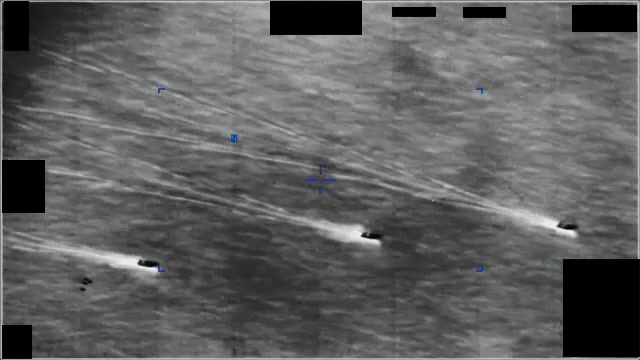
The first record is DOW-UAP-PR134. The Department's description reads in full: "The United States Central Command submitted a report of an unidentified anomalous phenomenon to the All-domain Anomaly Resolution Office (AARO) consisting of 1 minute and 39 seconds of video footage from an electro-optical and infrared sensor aboard a U.S. military platform in 2025." The timed description that follows is a single line covering the entire clip: "00:00-01:39: The sensor pans to track an area of contrast from left to right across the background, keeping it generally centered within the frame. The sensor adjusts collection mode and level of magnification several times." That is the whole of it. For ninety-nine seconds an operator holds something in frame, follows it left to right, and repeatedly changes how the sensor is collecting and how far it is zoomed in.
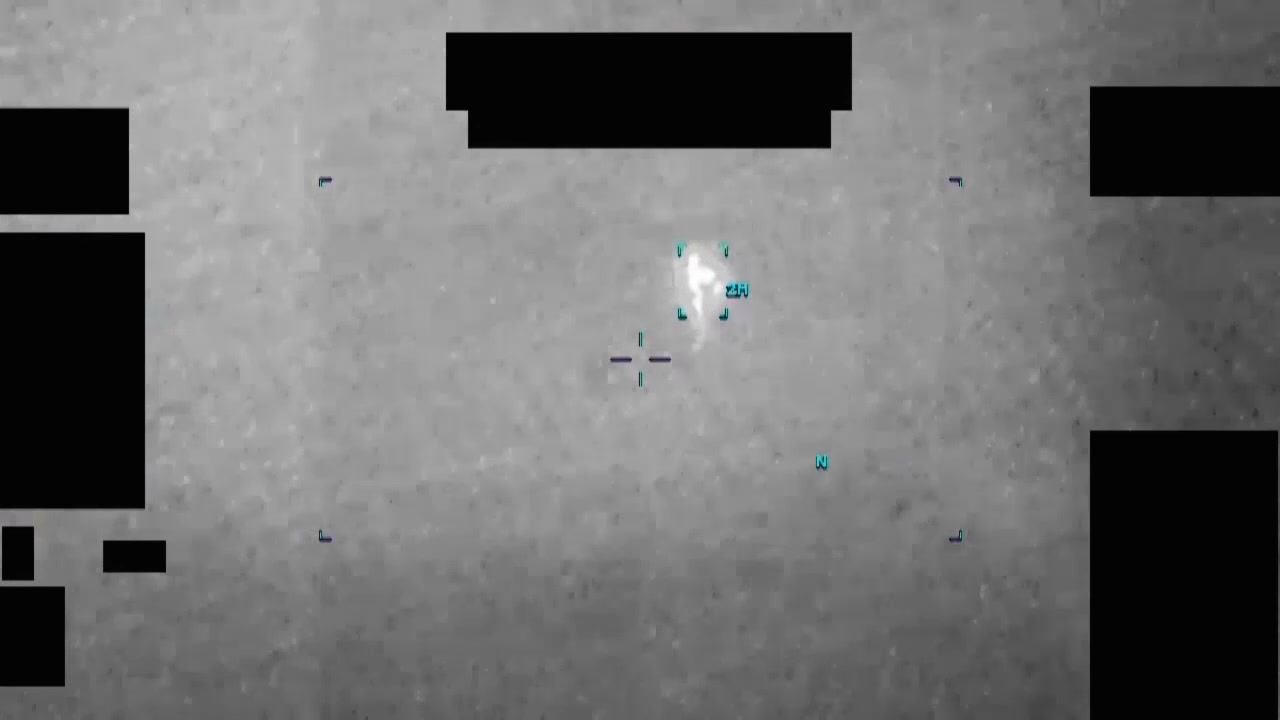
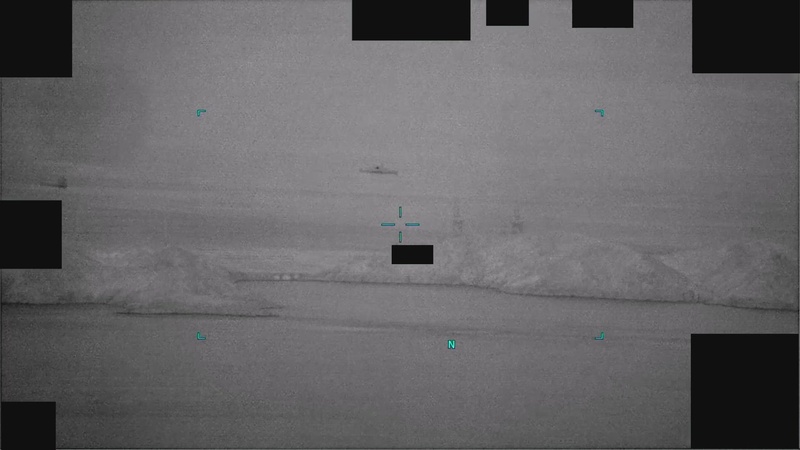
The second record is DOW-UAP-PR142, and it is far shorter. The Department describes "14 seconds of video footage from an infrared sensor aboard a U.S. military platform in 2025," broken into three blocks: "00:00-00:04: No content. 00:05-00:08: An area of contrast enters the sensor field-of-view from the left edge, transits from left to right, and exits the right edge of the frame. 00:09-00:14: No content." Roughly four seconds of usable material sits inside a fourteen second file. Note that the two clips do not even come from the same kind of sensor. PR134 is described as electro-optical and infrared, PR142 as infrared alone, so they were most likely shot by different platforms or at least in different collection modes.
The published imagery matches those descriptions. The frame DVIDS uses to front PR134 is a blue tinted overhead view of a dense, low-rise city, with streets, blocks and rooftops clearly resolved, green sensor symbology and range marks along the lower half of the frame, and a solid black rectangle covering part of the upper right corner where the sensor's own data readout would normally sit. The frame fronting PR142 is a greyscale infrared scene of a shoreline with terrain behind it, a centred crosshair reticle, and at least eight black rectangles blanked out around the edges of the image. Those black boxes are not compression damage. The Department's release manifest marks both records with a Redaction value of TRUE, so the burned-in metadata, and with it whatever the sensor was recording about heading, altitude, slant range and time, has been deliberately removed before publication.
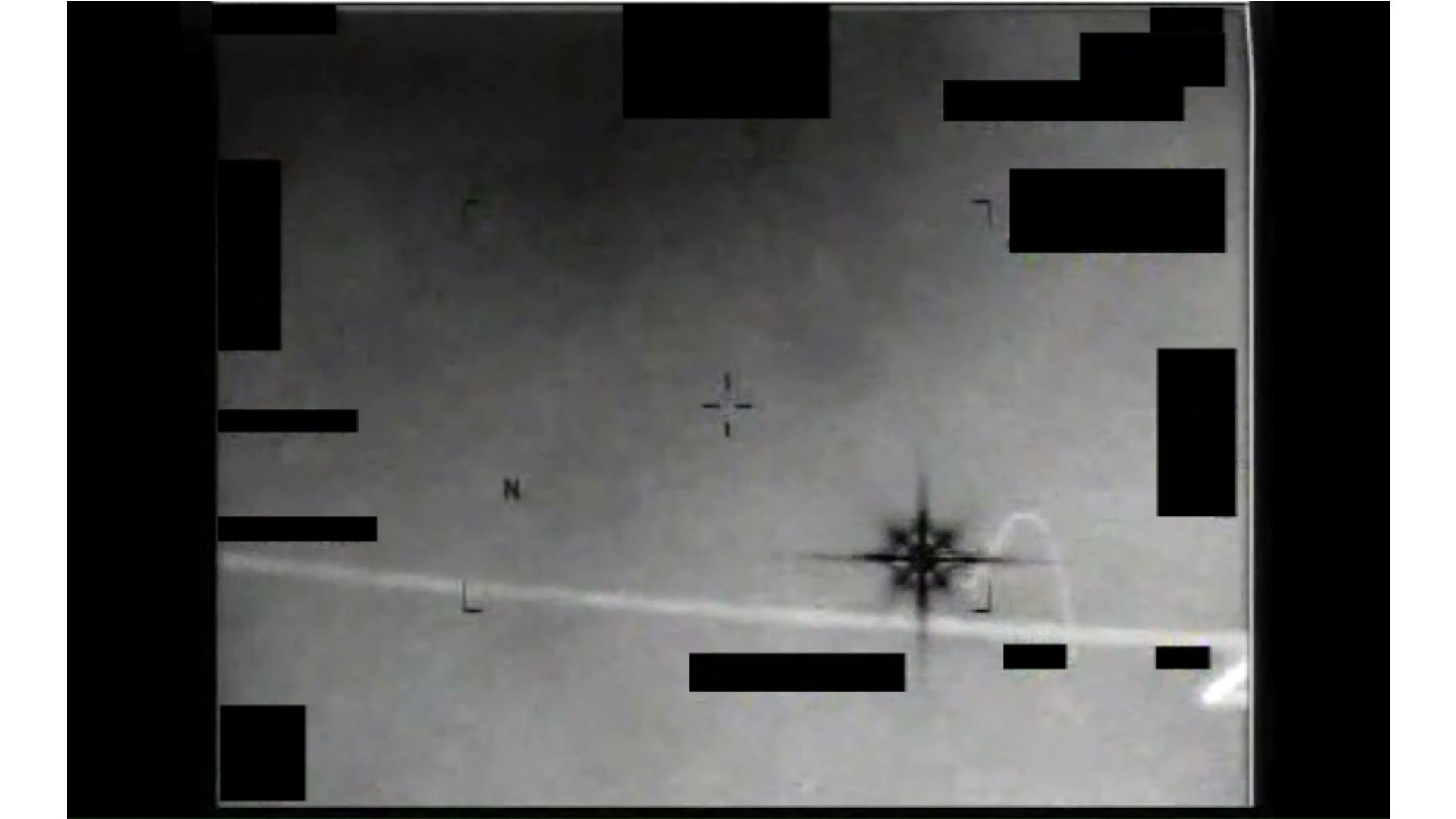
What neither frame shows is an identifiable object. In the PR134 still nothing in the sky is resolvable at all, and in the PR142 still there is only a small dark shape above the reticle that could be almost anything. That is the honest state of the visual evidence, and it is why the Department's phrasing matters so much. It never says object. It says "area of contrast," which is a description of the picture rather than a claim about the world.
More footage and images of this sighting
What is the official explanation?
The two clips arrived in PURSUE Release 05, the fifth tranche of declassified and historical Unidentified Anomalous Phenomena files published under the Presidential Unsealing and Reporting System for UAP Encounters. The Department of War put it online at war.gov/UFO on 7 August 2026 with a statement attributable to Assistant to the Secretary of War for Public Affairs and Chief Pentagon Spokesman Sean Parnell: "Today, the Department of War is publishing the fifth release of declassified and historical Unidentified Anomalous Phenomena (UAP) files as part of the Presidential Unsealing and Reporting System for UAP Encounters (PURSUE). The collection continues to be housed on WAR.GOV/UFO, and the Department will release additional files on a rolling basis." The release runs to 41 records drawn from the Department of War, the FBI, the CIA, the Department of State and the Executive Office of the President, and it followed tranches published on 8 May, 22 May, 12 June and 10 July 2026.
The Department publishes a machine readable manifest alongside the release, and it is the only official source of an incident location, because every DVIDS record in the corpus reads "(UNDISCLOSED LOCATION)." In that manifest both of these records carry Agency "Department of War," Type "VID," Incident Date "2025" and Incident Location "Middle East." So there are two official answers to the same question. The manifest says Middle East. The DVIDS pages, posted at 08.07.2026 07:15, say the location is undisclosed. This archive's standing practice is to report both rather than pick one, because the discrepancy between two government surfaces describing the same file is itself a finding about how carefully this material has been assembled.
The file metadata is worth setting out because it is all the hard identification there is. PR134 is DVIDS video 1017792, VIRIN 250101-D-D0360-7849, filename DOD_111887390, length 00:01:39, categorised as B-Roll, credited as a Courtesy Video to the All Domain Anomaly Resolution Office and released into the public domain. PR142 is DVIDS video 1017797, VIRIN 250101-D-D0360-3085, filename DOD_111887419. On PR142 the DVIDS Length field reads 00:00:11 while the Department's own description covers fourteen seconds and runs its timings out to 00:14, which is a second internal inconsistency in the same record. Both pages carry the tags UAPVIDEOS and AARO080726.
The dates are placeholders and should be treated as such. Both VIRINs begin 250101 and both DVIDS pages give a Date Taken of 01.01.2025. Across the PURSUE corpus that first-of-January or first-of-month stamp has been shown repeatedly to be a systematic filler rather than a real event date, and the Department's own manifest confirms it here by giving the incident date as the bare year 2025. Anyone who reports these clips as having been shot on 1 January 2025 is reading a file convention as a fact.
One structural detail separates these two records from everything else in the release. Release 05 contains two large, tightly linked video sets: six clips from a September 2021 encounter over the Gulf of Oman, numbered PR117 to PR122, every one of them cross-referenced to the other five and to an intelligence information report filed as DOW-UAP-D101, and five clips from a 2019 Pacific Ocean event, PR123 to PR127, likewise cross-referenced to each other. PR134 and PR142 have nothing in either pairing column. They are not linked to each other, they are not linked to any document, and they are not linked to any other video. There is no mission report to read behind them, no observer assessment, no narrative from the crew. The clip is the entire record. Two further Middle East videos in the same release, PR136 and PR149, are also unpaired, but both carry an incident date of 2023 and are separate events that this file does not cover.
Each DVIDS page closes with the Department's standard warning about its own words, and it deserves quoting in full: "This video description is provided for informational purposes only. Readers should not interpret any part of this description as reflecting an analytical judgment, investigative conclusion, or factual determination regarding the described event's validity, nature, or significance." That sentence is doing real work. The Department is publishing a description of a video while formally declining to say that the description means anything.
Press coverage on the day was thin and concentrated on the longer clip. Fox News published "Video shows US military tracking what appears to be mysterious object flying over Middle East in 2025" by Alex Nitzberg at 1:26pm EDT on 7 August 2026, quoting the Department's PR134 description and the Parnell statement verbatim and reproducing a still from the footage credited to the U.S. Department of War. CBS News covered the release the same day under Stefan Becket, counting the 41 records, dating the material from 1950 to 2026 and noting a 2025 Middle East video among the contents. Neither piece, and no coverage this archive could find, mentions PR142 at all. The fourteen second clip appears to have been published and simply passed over.
What did the witnesses think it was?
Because there is no witness account, the honest thing to do is describe exactly who is speaking in this record and who is not. The reporting entity is U.S. Central Command, the combatant command responsible for the Middle East, which submitted the material to the All-domain Anomaly Resolution Office. That is an institution, not a person. Somewhere behind PR134 there is a sensor operator who watched something for ninety-nine seconds, decided it was worth staying on, and changed collection mode and magnification several times to get a better look at it. That decision is the closest thing to human testimony the file contains, and it is worth taking seriously as far as it goes. Operators do not usually spend a minute and a half of a mission tracking something they have already decided is a bird. But it is inference from a caption, not a statement, and nobody has published what the operator thought.
What is missing is conspicuous when set against the rest of the same release. Release 05 contains FBI FD-302 interview reports in which named agents write down what a witness described, including a former military pilot's account of a silent triangular object roughly five hundred feet across over Bagram Airfield in Afghanistan in 2002. It contains an intelligence information report backing the Gulf of Oman video set. It contains diplomatic cables and digital renderings produced from witness descriptions. The Department clearly knows how to release a witness narrative alongside footage when one exists. For PR134 and PR142 it released neither, and it did not say why.
The redaction tells its own small story. Both records are flagged for redaction in the manifest, and the black boxes in the published frames sit precisely where sensor telemetry is normally burned into the image. Whoever prepared these files removed the platform's own instrumentation readout. That is standard operational security practice and there is no reason to read anything sinister into it, but the practical effect for anyone assessing the case is total: with the heading, altitude, slant range and time stripped out, a viewer cannot recover the geometry of the encounter, and without geometry an "area of contrast" has no size, no distance and no speed. The Department has published the picture and withheld every number that would let anyone measure what is in it.
The public and press response filled some of that vacuum with language the Department never used. Coverage of the release described a 2025 clip of an orb racing over a populated Middle East city. The Department says no such thing. It says an area of contrast tracked left to right. That said, the characterisation is not invented from nothing: the PR134 frame really does show a dense urban area from above, so the setting is right even if the words orb and racing are the writer's and not the government's. Readers of this file should hold that line clearly. The imagery supports a city. It does not support a shape, a speed, or an object.
It is also worth being clear about what the archive itself does not know. Nobody has published which platform carried the sensor, whether it was crewed or uncrewed, what mission it was flying, which country it was over, whether other sensors held the same target, or whether anybody on the ground looked up. The absence of all of that is not evidence of concealment. On this record it is simply the shape of a case that consists of two video files and a caption.
Is the Two Areas of Contrast Over the Middle East, 2025 (PURSUE PR134 and PR142) real? The two-pass assessment
PASS ONE: how this could be entirely ordinary. It could be, very easily, and the government's own published record is the strongest argument for it. AARO's Consolidated Annual Report for Fiscal Year 2025 states that the office received 319 reports of UAP-related events and resolved 114 of them, and that "all resolved cases are attributable to prosaic objects such as balloons, satellites, birds, aircraft, and unmanned aerial systems (UAS)," plus one commercial rocket launch and one manned jet pack. The same report notes "a collection bias favoring the continental United States, its littoral waters, and global U.S. military operational areas," and states plainly that "Locations with a higher density of U.S. military sensors and assets tend to submit more UAP reports." That is the first and most boring explanation for why the Middle East keeps appearing in this corpus. It is not that more strange things fly there. It is that more American cameras point at the sky there.
The more specific precedent is close enough to be uncomfortable. AARO has already published a resolved case of almost exactly this profile. In its "Middle East Red Balloon 2024" release it describes receiving one minute and thirty-six seconds of full-motion video from a camera aboard a U.S. military platform in the Middle East, which the reporting Service believed depicted a slow-moving spheroidal object. AARO assessed "with high confidence, that the object depicted in the video is almost certainly (greater than or equal to 95% likelihood) a consumer-grade reflective foil balloon," on the basis of its morphological consistency with other resolved balloon imagery and its behavioural correlation with recorded wind speed and direction. That clip is a minute and thirty-six seconds. PR134 is a minute and thirty-nine. Same theatre, same sensor type, same kind of tracking behaviour, and a party balloon at the end of it. Any assessment of PR134 that does not put a mylar balloon at the top of the list is not being serious.
After balloons come drones, and CENTCOM airspace in 2025 was as drone-saturated as any airspace on earth, with small uncrewed systems in routine use by American forces, partner forces and hostile actors alike. AARO's Fiscal Year 2024 report records that U.S. military assets deployed to the Middle East provided 57 reports in that period, of which AARO resolved 13 as balloons, unmanned aerial systems or satellites, and placed the remaining 42 into Active Archive "due to insufficient information to facilitate analysis." Then birds, which infrared sensors render as bright contrast blobs and which pass close to a lens far more often than anything else does. Then aircraft, which over a city in the Middle East is close to a certainty. Then the sensor itself: thermal artefacts, stuck or hot pixels, internal reflections and the narcissus effect all produce persistent bright or dark patches that a tracking system will happily hold in frame.
The geometry problem is the one that swallows all of these. Neither record includes range data, and the redaction has removed the telemetry that would have supplied it. An area of contrast with no range has no size and no speed. In PR142 the thing crosses the whole field of view in about four seconds, and that number sounds impressive until you remember it is equally consistent with a bird two hundred feet from the lens, a drone half a mile out, and an airliner ten miles away. Worse, a sensor on a moving platform generates apparent motion by itself: an object hanging perfectly still in the air will appear to transit the frame from one edge to the other purely because the aircraft carrying the camera is flying past it. That parallax has resolved a long list of famous UAP clips, and nothing in the released material rules it out here. The same applies to PR134's repeated changes of collection mode and magnification, which are the operator working the controls and not the target doing anything.
PASS TWO: what actually resists all of that. Very little, and the file should say so. The one fact that genuinely survives is this. The Department of War classifies these records as unresolved, meaning the government could not make a determination about what was observed, and it did so with resources no outside analyst has. AARO held the full resolution originals rather than a compressed public copy, held the burned-in telemetry that has been blacked out for the rest of us, knew the platform, the sensor, the date and the airspace, and could go back to the submitting command and ask. With all of that in hand it did not close either case, and it did not offer even a preliminary attribution of the kind it published without hesitation for the Red Balloon video. In the language of this corpus, an unresolved record is a record the office looked at and could not finish.
That is a real fact, but it is a weak one, and it is important not to inflate it. AARO's Fiscal Year 2025 report is explicit that "A lack of timely and actionable sensor data continues to constrain AARO's ability to resolve cases," and its Fiscal Year 2024 report shows the practical result: 42 of 57 Middle East reports parked in Active Archive for insufficient information rather than because anything about them was exotic. Unresolved in this system very often means unresolvable on the data available, not unexplainable in principle. Ninety-nine seconds of a tracked blob with the metadata removed is exactly the kind of material that produces that outcome no matter what the blob was.
The secondary point in favour of the records is the operator's own behaviour on PR134. Someone held the target for the length of the clip and worked the sensor to get a better look at it, which is not what a crew does with a bird they have already recognised. It is a genuine signal, but a faint one, and it is fully consistent with a crew looking hard at a balloon.
VERDICT. There is no official explanation and no counter-explanation with a shown method attached to these specific files, so there is nothing to dispute. There is also no witness, no document, no radar, no telemetry, no stated day, no agreed location and no measurable object. What there is amounts to two short clips that the United States government published and declined to explain, with a caveat attached warning that its own description of them carries no analytic weight. That is the definition of a thin case, and this file will not pretend otherwise. The tier is Unknown.
Sources
- www.dvidshub.net/video/1017792/dow-uap-pr134-unresolved-uap-report-middle-east-2025
- www.dvidshub.net/video/1017797/dow-uap-pr142-unresolved-uap-report-middle-east-2025
- www.war.gov/News/Releases/Release/Article/4565994/department-of-war-publishes-fifth-release-of-unidentified-anomalous-phenomena-f/
- www.war.gov/Portals/1/Interactive/2026/UFO/uap-data.csv?release=5
- www.foxnews.com/politics/video-shows-us-military-tracking-what-appears-mysterious-object-flying-over-middle-east-2025
- www.cbsnews.com/news/ufo-files-pentagon-5th-release-documents-videos/
- www.dvidshub.net/video/964843/middle-east-red-balloon-2024
- www.miragenews.com/war-dept-releases-fifth-ufo-files-on-wargov-1723837/
More cases from this region: UFO sightings in Undisclosed