The Five Pacific Videos the Navy's UAP Task Force Handed to AARO (DOW-UAP-PR123 to PR127, 2019)
Five short military videos, seven minutes and twenty six seconds in total, filmed in 2019 somewhere in the Pacific, held by the Navy's UAP Task Force, handed to AARO in 2022, published by the Department of War in August 2026 as unresolved, and carrying an admission that the media had been digitally altered before the government's own investigators ever received it.
What did witnesses see at Pacific Ocean (the Department of War publishes no ship?
On 7 August 2026 the United States Department of War published five video records inside PURSUE Release 05: DOW-UAP-PR123, PR124, PR125, PR126 and PR127, each titled "Unresolved UAP Report, Pacific Ocean, 2019". They run 1 minute 4 seconds, 53 seconds, 28 seconds, 2 minutes 32 seconds and 2 minutes 29 seconds, seven minutes and twenty six seconds of footage in all. The Department's own manifest cross pairs each of the five to the other four, which is the Department stating in machine readable form that this is one event, not five. Every one of the five carries the sentence "The footage contained within DOW-UAP-PR123 through DOW-UAP-PR127 was captured contemporaneously." All five share a VIRIN stem, 190101-D-D0360, with only the trailing serial changing: 2393, 4404, 5823, 9686 and 4342.
The five split into two distinct kinds of recording. PR123, PR124 and PR125 are described by the Department as "a secondary capture, recorded via a hand-held recording device, of an infrared sensor display aboard a U.S. military platform." In other words, somebody stood in front of a thermal imaging screen on a ship or an aircraft and filmed the screen with a separate camera. The Department is blunt about what that costs: "This footage does not represent native primary sensor data, and the secondary recording method introduces limitations in fidelity, resolution, and overall visual quality. Artifacts inherent to filming a screen, such as blurring or flickering, may be present."
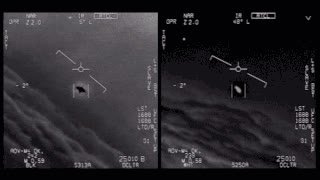
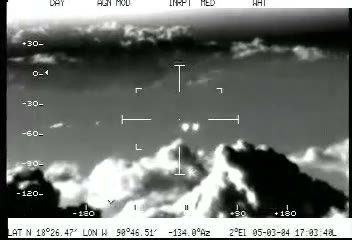
What those three clips show, in the Department's own frame by frame language, is an object that the infrared sensor is actively working to hold. On PR123: "00:00-00:03: An area of contrast is visible near the center of the frame." Then "00:04-00:07: The area of contrast loses distinctiveness against the background." Then it returns, and "The sensor pans and zooms in to focus on the area of contrast, keeping it generally within the center of the frame", and for the remaining thirty nine seconds "The area of contrast remains generally centered within the sensor field-of-view." PR124 is the same behaviour compressed: the object sits centred, "00:02-00:29: The sensor zooms in on the area of contrast", and then over the last twenty three seconds it again "loses distinctiveness against the background." PR125 adds motion. The object holds centre for five seconds, then "00:06-00:09: The area of contrast tracks left within the sensor field-of-view", fades out, and then a fresh contrast appears and "The sensor pans to track it, keeping it generally within the center of the frame." The published opening frame of PR123 shows exactly what the Department describes: a letterboxed thermal display filmed off a monitor, heavy screen grain, a crosshair reticle with a small numeral readout beneath it, and a faint pale patch left of centre.
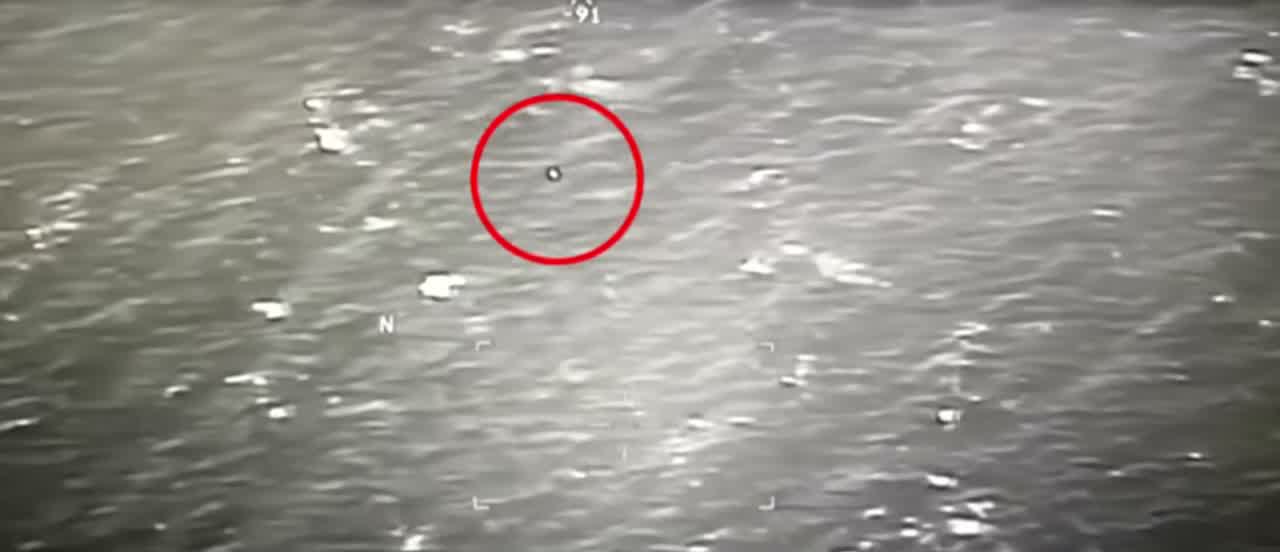
PR126 and PR127 are a different camera and a different problem. The Department describes them not as screen captures but as footage "captured via hand-held recording device by a U.S. military service member in 2019", adding that "Low-light conditions at the time of capture influence the overall visual quality of the footage." These two are not one object under a reticle, they are several. PR126 opens with the camera panning and "bringing two apparent light sources into frame from the top left corner", then for forty four seconds "As the camera pans, it repeatedly brings several apparent light sources into and out of the frame." At 00:54 the operator zooms in on "the light source in the lower left quarter of the frame", holds it for about thirty seconds, then zooms back out and carries on tracking. PR127 is two and a half minutes of the same activity, chopped into segments by an unusual annotation: the Department logs five stretches where "The camera pans to track an apparent light source" separated by four stretches marked simply "No content." The published opening frame of PR127's companion PR126 is close to pure low light noise, which is consistent with the Department's warning about the conditions.
What the Department does not publish is almost everything a reader would want. There is no ship name, no aircraft type, no unit, no month, no time of day, no coordinates, no bearing, no altitude, no range, no speed, no radar, no witness statement and no paired document. Unlike several other PURSUE video records, these five have no PDF pairing at all, so there is no mission report or FD-1057 sitting behind them. The only location the government publishes anywhere, in the manifest column or on the DVIDS page, is the words "Pacific Ocean".
What is the official explanation?
PURSUE stands for the Presidential Unsealing and Reporting System for UAP Encounters. The Department of War's own release page describes it as a government wide effort ordered after a presidential directive, run by the Department with support from the Office of the Director of National Intelligence, "to expeditiously find, review, identify, declassify and publicly release unresolved UAP-related records and historical documents in the federal government's possession." The page is explicit about the filter applied: "The materials archived here are unresolved cases, meaning the government is unable to make a definitive determination on the nature of the observed phenomena." Release 05 was published on 7 August 2026 and comprised 41 records, following tranches on 8 May, 22 May, 12 June and 10 July 2026. Secretary of War Pete Hegseth's statement on the page says the files "have long fueled justified speculation" and frames the programme as "unprecedented transparency".
The five Pacific records are the only ones in the entire published corpus attributed to the Navy's own UAP Task Force by name. Each of the five opens with the same sentence: "The United States Navy Unidentified Anomalous Phenomena Task Force (UAPTF) transferred this media to the All-domain Anomaly Resolution Office (AARO) in 2022." The UAPTF was approved on 4 August 2020 by Deputy Secretary of Defense David L. Norquist and announced on 14 August 2020. The Department of the Navy led it, under the Office of the Under Secretary of Defense for Intelligence and Security, and its mission was stated as being "to detect, analyze and catalog UAPs that could potentially pose a threat to U.S. national security." The task force was superseded during 2021 and 2022 and its work passed to the All-domain Anomaly Resolution Office, which stood up in July 2022 and which is credited on all five DVIDS records as the releasing organisation. So the chain the Department publishes is this: something was filmed in 2019, before any of those offices existed in that form; the Navy task force held it; in 2022 it moved to AARO; and in 2026 it was released still unresolved. Seven years passed between the recording and the publication.
The sentence that matters most is the last one in every description: "This media was digitally altered before being reported to AARO, and is presented as it was received." That is the United States government stating, on the record, that the file it has just published was modified by someone before its own investigators ever saw it, and that it is publishing the modified version rather than an original it does not appear to hold. It is worth being exact about what the Department does not say. It does not say who altered it. It does not say how. It does not say why. It does not say the alteration was concealment, and it does not say the underlying event is fabricated. It also does not claim AARO itself altered anything.
That wording is not unique to these five, and this archive checked rather than assumed. Reading the Department's full published manifest across all five releases, 375 records in total, the phrase "digitally altered" appears on 18 of them, spread across four separate tranches. In Release 02 nine records carry a slightly different formula, "This media was digitally altered prior to its upload to a classified network, and is presented as received." In Release 04 three records carry the same idea, two of them saying the media "was digitally altered before being reported to the UAPTF, and is presented as it was received by AARO." Most usefully, two records from the first tranche actually spell out what an alteration was. On DOW-UAP-PR020, from Kuwait in May 2022, the Department writes: "The original reporter digitally altered the imagery by adding a red line encircling an area of interest before submitting it to AARO." On DOW-UAP-PR040, from the Middle East in 2020: "The original reporter digitally altered the imagery by pausing the video playback and adding a white line encircling an area of interest at timestamp 00:10, annotated with the phrase 'U/I SMALL THERMAL SIGNATURE.' AARO did not edit the originally reported material, and this media is presented as received." Those are the only two cases in the whole corpus where the Department describes the alteration, and in both the alteration is a reporting annotation: somebody circled the thing they wanted the analysts to look at. That does not prove the Pacific five were annotated rather than something else, because the Department declines to say, but it does establish what the phrase has meant in the Department's own usage every time it has been willing to explain it.
Every one of the five also ends with the standard PURSUE disclaimer: "This video description is provided for informational purposes only. Readers should not interpret any part of this description as reflecting an analytical judgment, investigative conclusion, or factual determination regarding the described event's validity, nature, or significance." The Department describes pixels and refuses to interpret them.
One further piece of the official record is the silence around it. Release 05 was widely covered on the day. CBS News, under Stefan Becket on 7 August 2026, led on six videos of a September 2021 Gulf of Oman encounter involving an AC-130J gunship. Just The News, the same evening, reported the 41 record count and the Gulf of Oman material. The National Desk, under Maria Tedesco, listed a 1953 document, the Gulf of Oman orb, a 2023 pilot account and a 2025 sphere. Insider Paper led on a 2002 Bagram triangle. None of them mentioned the Pacific five at all. The Gulf of Oman records, PR117 to PR122, carry the same "secondary capture" language as PR123 to PR125 and took the headlines; the five Navy task force clips, the only records in the corpus with the UAPTF named on them, went unreported.
What did the witnesses think it was?
There is no named witness in this case and there is no witness statement in the public record. What there is instead is the physical evidence of witness behaviour, which is not nothing. On PR126 and PR127 the Department states plainly that the footage was "captured via hand-held recording device by a U.S. military service member in 2019". Somebody serving on a United States military platform, in the dark, in poor visual conditions, took out a camera and spent more than five minutes across two recordings following lights across the sky, zooming on one of them, losing it, finding it again. On PR123, PR124 and PR125 somebody, quite possibly the same person on the same night, stood in front of an infrared sensor display and filmed the screen with a hand held camera while the sensor operator panned and zoomed to hold an object in the centre of the field of view. Filming a screen is what people do when they believe the recording running inside the system will not be available to them and they want to keep a copy. It is a deliberate act, repeated five times, and it is the reason the material exists at all.
That behaviour has a documented parallel in the Pacific in 2019. Adam Kehoe and Marc Cecotti, working from ship deck logs obtained under the Freedom of Information Act, established a sustained series of encounters off Southern California in July 2019 involving the destroyers USS Kidd, USS Rafael Peralta, USS Russell, USS John Finn and USS Paul Hamilton. The logs record the USS Kidd sighting "Two UAVs" at about ten at night on 14 July 2019 and deploying its SNOOPIE team, the shipboard team whose job is to photograph an unidentified contact. The following night the Kidd logged "Multiple UAVs around ship". The USS Rafael Peralta logged a "White light hovering over ship's flight deck" while making sixteen knots in visibility under one nautical mile, and later took a radio call from the cruise ship Carnival Imagination reporting five or six drones manoeuvring nearby. Those encounters ran for well over an hour at a time and, on the record of the logs, none of the warships identified what was around them. That is the documented state of the eastern Pacific in 2019: crews under standing orders to photograph unidentified contacts, doing exactly that, and coming away without an answer.
Whether the five PURSUE clips are from that specific cluster is an open question and this archive will not pretend otherwise. The Department publishes only the words "Pacific Ocean" and the year, which spans an ocean covering a third of the planet and twelve months. The obvious comparison is against the 2019 Navy material that reached the public in 2021 through the filmmaker Jeremy Corbell, the infrared clip attributed to the USS Omaha and the night vision clip attributed to the USS Russell, both of which are 2019, both Pacific, both hand held recordings of the same two kinds. Two things cut against a simple identification. First, none of the five official descriptions mentions an object entering the water, which is the single most famous feature of the leaked Omaha clip and the detail the Department would have had to describe frame by frame if it were present. Second, PURSUE by the Department's own statement publishes only records the government could not resolve, and the leaked 2019 night vision material has been the subject of a specific and well known counter explanation since 2021. No analyst has yet published a frame level comparison between PR123 to PR127 and the 2021 leaks, and until somebody does, the honest position is that the five are consistent with the 2019 Pacific cluster in period, ocean, platform type and capture method, and are not demonstrated to be the same files. If a match were shown, this case would need rewriting.
The absence of a paired document is itself a witness fact. Many PURSUE video records come attached to a declassified mission report or an FBI interview form carrying the observer's own words, an assessment field and a named unit. These five have no PDF pairing at all. Whatever the crew wrote at the time, if they wrote anything, has not been released, and the observers remain anonymous.
Is the Five Pacific Videos the Navy's UAP Task Force Handed to AARO (DOW-UAP-PR123 to PR127, 2019) real? The two-pass assessment
Pass one, the ordinary explanations, and this material makes them easy to reach for.
Start with drones, because the Pacific in 2019 demonstrably had them. The deck log record established by Kehoe and Cecotti shows small unmanned aircraft operating around United States warships off Southern California over multiple nights in July 2019, in numbers, at night, keeping pace with ships under way. An infrared sensor holding a small warm object at range, zooming on it, and repeatedly watching it lose distinctiveness against the background is precisely what a small drone looks like through a thermal sensor when atmospheric conditions and the sensor's own automatic gain fight the contrast. Nothing in the Department's five descriptions is inconsistent with a drone. Nothing in them requires anything more than a drone.
Aircraft are the leading candidate for PR126 and PR127, and there is a named, method shown analysis of exactly this class of imagery. On 8 April 2021 Mick West, writing at Metabunk, examined night vision footage attributed to the USS Russell in July 2019 in which point lights appeared as triangles. He showed that the shape was bokeh, the out of focus rendering of a point light source, whose form is set by the shape of the lens aperture rather than by the object, and he demonstrated the effect on camera with a 50mm f/1.4 lens, pulling focus and watching the shapes appear and resolve. He also timed the flashing and found intervals of roughly one and a half seconds, which is the beat of ordinary aircraft anti collision beacons. PR126 and PR127 are described by the Department in exactly the vocabulary West's analysis addresses, "apparent light sources" brought into and out of frame by a panning hand held camera in low light, with the operator zooming to try to resolve one. That is what an aircraft's lights look like when someone films the night sky with a hand held camera that cannot focus on infinity.
Birds deserve a line rather than a dismissal, because on an infrared display a bird is a warm object against a cool sea with no scale reference and no range cue, and "an area of contrast" is exactly how it would be logged. So do sensor artifacts in their own right: blooming, thermal crossover, and the automatic gain behaviour that makes a genuine target fade and reappear without the target doing anything at all.
Then there is the compounding degradation, which is the honest core of the sceptical case here and which the Department itself states first. Three of these five are a camera pointed at a screen. That chain runs from the scene, through a thermal sensor with its own processing, onto a display, through a hand held camera's optics and sensor, into a file, then through whatever handling produced the version submitted, then through a release encode. The Department's warning is unusually candid: this "does not represent native primary sensor data", and "Artifacts inherent to filming a screen, such as blurring or flickering, may be present." Every measurement anyone would want in order to make a claim, angular size, angular rate, true contrast, flicker frequency, is either destroyed or made untrustworthy by that chain. Anybody who tells you they have measured an object's speed from these clips has measured a photograph of a monitor.
And then there is the alteration, which has to be taken seriously without being inflated. The government says the file was digitally altered before AARO received it and is published as received. That means the pixels are not a chain of custody. No forensic conclusion, in either direction, can rest on them. It does not follow that a hoax is indicated. It does follow that these five clips cannot serve as evidence of anything that depends on the integrity of the image.
Pass two, what survives if the ordinary explanations do not exhaust it.
Take the alteration first, since it is the load bearing worry. The Department has explained what it means by that phrase exactly twice in 375 published records, and both times the alteration was a reporting annotation, a red or white line drawn around the object so the analyst would know where to look, in one case with the typed label "U/I SMALL THERMAL SIGNATURE" beside it. That is the behaviour of someone submitting a report, not concealing one, and it is entirely compatible with the rest of the chain here: a crew member films a screen, marks the thing they want examined, and passes it up. Cropping, redaction of screen furniture, stabilisation and format conversion would all equally fall under the phrase. If the alteration on the Pacific five was of that benign kind, and the Department's own usage is the only guide available, then what is left is a real observation, poorly preserved.
What is left is not small. Five separate files, in two different capture modes, seven minutes and twenty six seconds, all recorded contemporaneously by people on a United States military platform who thought this was worth keeping. An infrared sensor operator working the object, panning and zooming to hold it centred across three of the clips, which is a trained crew treating it as a track rather than as a curiosity. A second camera outside, in the dark, following several light sources at once. The material was important enough that the Navy's own UAP Task Force, an office created specifically to catalogue things that might threaten national security, held it, and important enough that it survived the handover to AARO in 2022 and four more years of review to be published in 2026 under a programme that by its own statement only publishes cases where "the government is unable to make a definitive determination on the nature of the observed phenomena."
Weigh honestly against that: there is no radar, no ship, no month, no coordinates, no range, no altitude, no witness statement, no paired mission report, and an admitted alteration. The multiplicity of light sources on PR126 and PR127 is more consistent with a drone group or with ordinary aircraft than with anything exotic, and the July 2019 record shows a Pacific full of both. No independent analyst has published anything on these five files at all, and the mainstream coverage of Release 05 did not notice them.
So the tier is Unknown. There is no official narrative, because the Department explicitly declines to offer one and instructs readers not to read one into its own descriptions. There is no counter explanation aimed at these specific files by any named analyst, so there is nothing to dispute. The case stands on five degraded government videos, an unnamed service member's decision to film them, and a government admission that what it published is not the original. That is genuinely unresolved, and it should be recorded as unresolved rather than dressed up in either direction. The single piece of work that would move this case is a frame level comparison against the 2019 Navy footage that leaked in 2021, and against any other 2019 Pacific material, by somebody with the files in hand.
Sources
- www.dvidshub.net/video/1017805/dow-uap-pr123-unresolved-uap-report-pacific-ocean-2019
- www.dvidshub.net/video/1017806/dow-uap-pr124-unresolved-uap-report-pacific-ocean-2019
- www.dvidshub.net/video/1017788/dow-uap-pr125-unresolved-uap-report-pacific-ocean-2019
- www.dvidshub.net/video/1017790/dow-uap-pr126-unresolved-uap-report-pacific-ocean-2019
- www.dvidshub.net/video/1017791/dow-uap-pr127-unresolved-uap-report-pacific-ocean-2019
- web.archive.org/web/20260808030642if_/https://www.war.gov/Portals/1/Interactive/2026/UFO/uap-data.csv?release=5
- web.archive.org/web/20260808030642/https://www.war.gov/UFO/?releaseDate=Release+05
- www.war.gov/UFO/
- www.cbsnews.com/news/ufo-files-pentagon-5th-release-documents-videos/
- justthenews.com/government/security/pentagon-releases-fifth-batch-ufo-files-comprised-41-records
- thenationaldesk.com/news/americas-news-now/photos-pentagon-drops-fifth-batch-of-ufo-files-trump-administration-uap-government-agencies
- insiderpaper.com/pentagon-releases-new-ufo-files-5th/
- web.archive.org/web/20210908090947/https://www.defense.gov/Newsroom/Releases/Release/Article/2314065/establishment-of-unidentified-aerial-phenomena-task-force/
- www.navy.mil/Press-Office/Press-Releases/display-pressreleases/Article/2314280/establishment-of-unidentified-aerial-phenomena-task-force/
- www.twz.com/39913/multiple-destroyers-were-swarmed-by-mysterious-drones-off-california-over-numerous-nights
- www.metabunk.org/threads/pyramid-ufos-in-night-vision-footage-are-bokeh.11695/
More cases from this region: UFO sightings in United States (Department of War record; ocean location undisclosed)