The Gale Crater Ridgeline Object: Curiosity Sol 3924
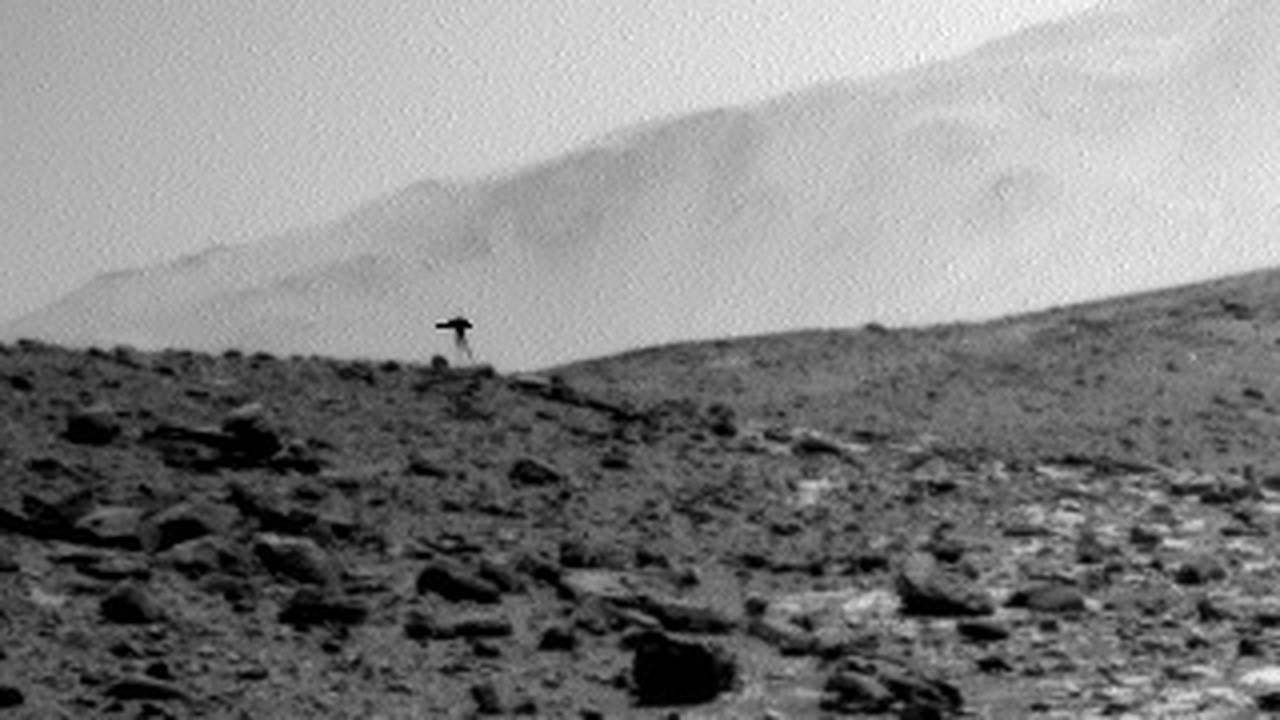
The witness in this case is a camera, and the testimony is a set of pixel values anyone can check. This case file covers what witnesses reported, the official narrative, and a two-pass assessment with its evidence tier.
What did witnesses see at Gale Crater?
The witness in this case is a camera, and the testimony is a set of pixel values anyone can check. The camera is aboard NASA's Curiosity rover, on the lower slopes of Mount Sharp in Gale Crater.
On sol 3924 of the Mars Science Laboratory mission, Curiosity was grinding up the lower slopes of Aeolis Mons, the layered mound at the centre of Gale Crater that the team calls Mount Sharp, and it was running a long Navigation Camera block. Ninety-six Navcam frames came down from that sol. Pulled from NASA's public raw-image archive and sorted by their onboard timestamps, they fall into an obvious pattern: groups of three exposures held at a fixed mast pointing, roughly thirteen seconds apart. That is the cadence Curiosity uses when the team wants to catch something that moves.
One of those groups carries the whole case. Three right Navcam frames, all tagged with the same site and sequence code S1031528NCAM00594M_. NRB_745839032EDR, exposed at 22:27:21.617 UTC: nothing at the site. NRB_745839044EDR, exposed at 22:27:33.827 UTC: nothing at the site. NRB_745839057EDR, exposed at 22:27:46.827 UTC: something at the site.
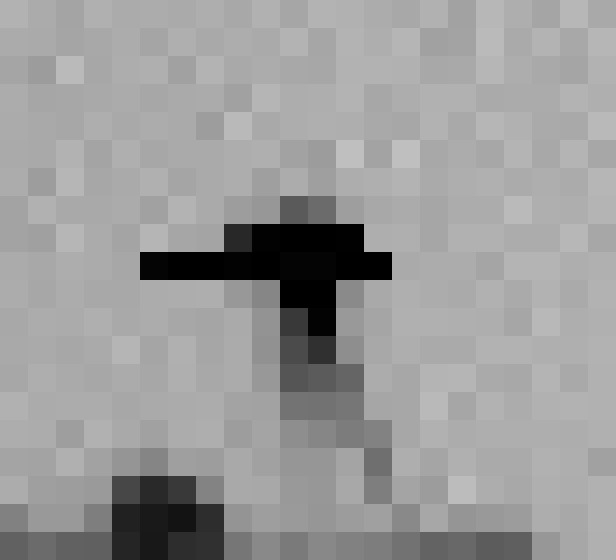
Differencing the three frames against one another gives an intra-group pixel noise floor of about 1.3 grey levels, so the images are very nearly identical and any genuine change is unmissable. In the first two frames, zero pixels at the location in question deviate by more than 40 grey levels. In the third, a compact dark cluster of 34 pixels sits centred on image coordinate x=133, y=380, reaching about 174 grey levels darker than the same pixels in the two frames that flank it. The object is present in exactly one frame of three and absent from the frames taken 25 seconds and 13 seconds earlier at identical pointing. That is what the tabloid coverage was reaching for with "vanished less than a minute later". The measurement pins it far tighter than that: a 13 second window, with numbers attached.
What the cluster looks like, at full contrast enhancement on the real pixels, is a broad roughly horizontal dark cap or crossbar sitting above a narrower vertical stalk that runs down to the ridge surface. It is silhouetted dark against bright sky, right on the skyline, which is why it reads as a standing thing rather than a mark on the ground. It is also about 7 pixels by 5 pixels in a 1024 by 512 frame. Essentially every apparent piece of structure in it is one pixel across. That is the honest description, and it is exactly why different people looking at the same 34 pixels have called it a jellyfish, a tripod, a scarecrow and a figure. The silhouette is suggestive and it sits at the absolute limit of what the sensor can resolve. Nothing beyond that broad cap over stalk shape can legitimately be claimed from this data, and this file will not claim it.
More footage and images of this sighting


NASA mission update for sols 3923 to 3925 by Deborah Padgett, OPGS Task Lead at JPL, posted 21 August 2023, giving the rover's position near the Gediz Vallis Ridge and the planned Navcam dust devil movies and 360 degree phase function sky survey. View source
What is the official explanation?
There is no official narrative about this frame, and that needs saying plainly rather than dressed up in either direction.
NASA and JPL published the image themselves. It sits in the Mars Science Laboratory public raw-image archive as entry 1250462, credited NASA/JPL-Caltech, with its metadata intact: sol 3924, instrument NAV_RIGHT_B, acquisition 2023-08-20 22:27:46 UTC, 1024 by 512 pixels, JPEG. The two frames that show nothing are equally public and still resolve today at the same archive path, all three returning HTTP 200 with identical dimensions. Nothing was withheld, cropped or quietly pulled. That matters, because the usual shape of a rover-anomaly story involves an allegedly scrubbed image, and this one does not.
The mission's own account of the sol is on the record too. Deborah Padgett, OPGS Task Lead at JPL, posted the sols 3923 to 3925 mission update on 21 August 2023 under the title "Approaching the Ridgetop, Bermuda Triangle Ahead". Curiosity was closing on the Gediz Vallis Ridge, a target the team had spent years being diverted away from, and Padgett wrote that the rover was "just a few meters away from being able to reach the arm out and get contact science on some of the ridge material". The plan for those sols included Navcam dust devil movies, a measurement of dust in the air across Gale Crater, imaging of clouds and their shadows, and a Navcam 360 degree phase function sky survey. NASA separately published a 31 frame cylindrical Navcam panorama from the same sol, drive 1598, site 103, taken around 1 PM local mean solar time with an azimuth centre of 217 degrees. The sequence that produced this frame belongs to a documented, routine navigation and atmospheric imaging campaign.
The instrument documentation is public as well. Each Navcam uses a 1024 by 2048 pixel CCD with 12 micron square pixels imaging over a 1024 by 1024 region, digitised at 12 bits, behind an f/12 lens of 14.67 mm focal length giving a 45 by 45 degree field and an angular resolution of 0.82 milliradians per pixel, through a red bandpass centred near 650 nm with a full width at half maximum around 140 nm. Crucially for this case, the flight software compresses downlinked images with either the ICER wavelet compressor, which is lossy, or LOCO, which is lossless. These raw-archive products are lossy compressed EDRs, not radiometrically corrected science-grade RDRs.
What does not exist is any NASA or JPL statement addressing this specific frame. Every outlet that ran the story in August 2026 said the same thing: no comment was issued. The International Business Times and NaturalNews both fell back on describing NASA's general habit of calling one-off shapes artifacts, corrupted pixels or compression errors, which is a characterisation of agency practice, not a finding about this image. No named JPL imaging scientist has published an analysis of NRB_745839057. There is no official position here to weigh, for or against. Treat the silence as silence.
What did the witnesses think it was?
There is no human witness here in the ordinary sense. Nobody stood on that ridge. The people whose testimony matters are the ones who read the pixels, and their claims deserve the same careful handling as any observer's.
The frame sat unremarked in NASA's public archive for almost three years. A search for any earlier enthusiast posting of this anomaly, in 2023, 2024 or 2025, turns up nothing traceable; the first public surfacing that can be documented is August 2026, when Kari Sivertzen, an enthusiast who routinely combs the public rover catalogues for anomalies, reposted it on X. Her own statement of method is modest, and it is worth quoting because it sets the evidential bar she was actually working to: "Sometimes I spot things that catch my eye, and I share them here. I believe there is life on other planets, and since NASA has found potential traces of life on Mars, it's the perfect place to look." That is a declaration of prior belief, not a claim of analysis. She found the frame. She did not measure it, and she has not claimed to.
The press followed between roughly 13 and 15 August 2026. The Daily Mail ran it as a jellyfish. The International Business Times UK, under Briane Nebria on 14 August 2026, ran the "jellyfish-shaped UFO" framing and the "vanished less than a minute later" line. Unexplained Mysteries, T.K. Randall, the same day, ran it as a tripod. NaturalNews, Edison Reed, on 15 August 2026, catalogued the whole spread of reader interpretations: a jellyfish-like being, a mechanical device, a camera artifact, a War of the Worlds walker, a tower, a scarecrow, corrupted pixels. That disagreement is itself data. Thirty-four pixels do not constrain a shape, and the descriptions diverge exactly as far as the observers' expectations do.
Two claims that travelled with the story need correcting outright. The first is that the object might be NASA's Ingenuity helicopter. It cannot be. Ingenuity flew in Jezero Crater on the Mars 2020 mission, and Jezero and Gale are separated by roughly 3,700 kilometres of Martian surface, a great circle figure of about 3,780 kilometres between crater centres. There is no version of August 2023 in which a Jezero rotorcraft is standing on a Gale Crater ridgeline. The claim is false on geography alone.
The second is the date. Some outlets gave 20 August 2023 and some gave 21 August. Both were reading real things. Sol 3924 straddles two Earth calendar days, and NASA's own cylindrical panorama product from that sol carries a 21 August 2023 date while the individual frame carries an onboard timestamp of 2023-08-20T22:27:46.827 UTC, which converts to about 6.27 pm US Eastern time. The frame's own clock is the authority. This archive dates the case 20 August 2023 on that basis, and on no repost caption.
Is the Gale Crater Ridgeline Object: Curiosity Sol 3924 real? The two-pass assessment
Pass one, how could this be entirely ordinary.
Start with cosmic rays. Energetic particles striking a CCD deposit charge along their path, and the published work on recognising cosmic-ray events in CMOS and CCD imagery describes the resulting traces as spots, tracks and worms, generally sharp and generally confined to one or a few pixels unless the particle arrived at a grazing angle. Mars has no global magnetosphere and about one percent of Earth's atmospheric column, so surface particle flux is high and single-frame hits are routine. Two things sit awkwardly. A charge deposit brightens pixels, and this cluster is dark. Thirty-four contiguous pixels with internal cap and stalk structure is also a great deal of area for one hit.
Then compression. These are lossy ICER wavelet products, and lossy wavelet compression is entirely capable of manufacturing dark blotches, particularly at a high contrast boundary, which is precisely what a ridgeline against bright sky is. Wavelet ringing near a sharp edge is the single most plausible ordinary mechanism available. It has the right polarity, the right location and the right one-frame behaviour, since each frame is compressed independently. Nobody has demonstrated it for this frame with a shown method, which is the difference between a strong candidate and a finding.
Bad pixels are testable and largely fail the test. A dead or intermittently bad detector site recurs at the same detector coordinate across many frames. This structure appears at x=133, y=380 in one frame of ninety-six from the same sol, and not in the two identically pointed frames bracketing it 13 and 25 seconds earlier. A permanent defect would show in all three.
Dust devils are real in Gale Crater and Curiosity images them deliberately. Guzewich, Mason, Lemmon, Newman and Lewis published the survey in the Journal of Geophysical Research: Planets in October 2023, covering 1,260 dedicated Navcam sequences over roughly 3.5 Mars years, with active dust lifting in 42.7 percent of sequences and 79 percent of events classified as dust devils. But dust devils in Navcam are bright, diffuse, columnar and usually visible across several frames of a movie as they translate. This feature is dark, compact, static and single frame. The morphology is wrong in every respect.
Windblown debris or a saltating grain near the lens fails on focus and motion. Anything close enough to the Navcam to subtend this angle would be far outside the depth of field of a fixed focus f/12 lens and would smear, not sit crisply on the skyline.
Finally the order of magnitude problem any physical reading must survive. At 0.82 milliradians per pixel, a 7 pixel width subtends about 5.7 milliradians. If the thing is genuinely on that ridgeline it is hundreds of metres away, putting it somewhere near 1.7 metres across at 300 metres and 5.7 metres at a kilometre. Something that size has to have arrived and departed inside 13 seconds, leaving no trace in the flanking exposures.
The strongest single piece of evidence for an ordinary reading is inside the same group of frames. In the 22:27:21 exposure, at x=488, y=158, high in open sky where nothing can physically stand, there is a genuine single pixel transient about 156 grey levels dark, present in that one frame only. That is a textbook detector or compression transient, and it proves this camera and this pipeline do produce isolated one-frame dark hits at high amplitude. The honest question is whether a 34 pixel structured cluster is the same class of event as a 1 pixel hit. It is thirty-four times the area and it has internal shape. That difference is real and it is not nothing, but the control case shows the mechanism exists a few hundred pixels away in the same sequence.
Pass two, if it is not an artifact. Then something with a broad horizontal cap over a narrow vertical support stood on a Martian ridgeline for under 13 seconds during a routine atmospheric imaging block and left before the next exposure. Nothing in the rest of the sol 3924 set corroborates it. No second camera caught it. There is no motion vector, no shadow, no follow up, no disturbed ground. There is also no official debunk to log here, because no agency has said anything about this frame at all.
That is why the tier is Unknown. An artifact, most likely a compression artifact at a high contrast edge, is the probable answer and this file says so without flinching. But probable is not demonstrated. No named analyst has published a method-shown demonstration that this particular 34 pixel cluster is an artifact, and this archive does not promote a strong prior into a verdict. The frame is real, the timestamps are real, the 174 grey level excursion is real, and the two flanking frames are real and empty. What made those 34 pixels dark has not been established by anyone.
ENRICHMENT, 16 August 2026: the pixel level claim, tested. In the days after this file was published, readers began arguing on r/UFOs that the object is not a silhouette at all but a detector or compression event, on the grounds that its core is a run of pure black pixels forming what one poster called a single pixel, one colour, solid black, double strike line. The archive went back to the NASA frame and measured it rather than arguing about it. The claim about the pixels is correct. Inside the cluster, nine pixels sit at exactly zero, digital black, arranged as two short horizontal runs: an upper run of three pixels at row 380 and a longer run of nine near black pixels spanning columns 129 to 137 at row 381, with a narrow grey stalk fading downward beneath them. Magnified, the shape reads as two crossing bars rather than a solid body.
But the archive also measured the thing the poster could not, and it cuts in two directions at once. First, clipped black is NOT anomalous in this product on its own: roughly 190 pixels in the upper two thirds of this frame sit at exactly zero, almost all of them in the shadowed terrain below the ridge, and that population is stable across the triplet at 192, 186 and 194 pixels. So black clipping by itself proves nothing. Second, and this is the part that matters, the zero pixels group by image row in near lockstep across all three frames in every band except one. Row band 380 carries nine zero pixels in the anomaly frame and NONE in either flanking frame. The object's black core is the only clipped black in the image that is not present 13 and 25 seconds earlier at identical pointing.
Third, the object sits above the local skyline, not on it. Reading down each column between x equals 130 and x equals 170, the terrain's first dark row falls at about 393 to 400, while at row 380 every column returns ordinary sky values between 156 and 180, except column 135, which returns zero. Fourth, the control transient cited earlier in this file does NOT clip: the isolated single pixel dark speck at x equals 488, y equals 158 reads 80 against a background near 236, so the one known artifact in this sequence is a partial darkening, while the ridgeline object goes to the floor.
What that does to the assessment: it strengthens the artifact reading without closing it. Two clean, clipped, roughly perpendicular runs are a very recognisable signature of a detector strike, and the case file should say so plainly, more plainly than it did on publication. What still has not happened is a named analyst publishing a method shown demonstration for this specific cluster, and the nearest thing to a matched artifact in the same sequence behaves differently from it. The tier stays Unknown, and the probable answer stays probable.
Sources
- mars.nasa.gov/raw_images/1250462/?site=msl
- mars.nasa.gov/msl-raw-images/proj/msl/redops/ods/surface/sol/03924/opgs/edr/ncam/NRB_745839057EDR_S1031528NCAM00594M_-br2.jpg
- mars.nasa.gov/msl-raw-images/proj/msl/redops/ods/surface/sol/03924/opgs/edr/ncam/NRB_745839032EDR_S1031528NCAM00594M_-br2.jpg
- mars.nasa.gov/msl-raw-images/proj/msl/redops/ods/surface/sol/03924/opgs/edr/ncam/NRB_745839044EDR_S1031528NCAM00594M_-br2.jpg
- mars.nasa.gov/raw_images/1250461/?site=msl
- science.nasa.gov/blog/sols-3923-3925-approaching-the-ridgetop-bermuda-triangle-ahead/
- science.nasa.gov/resource/sol-3924-right-navigation-camera-cylindrical-projection-2/
- an.rsl.wustl.edu/help/Content/About%20the%20mission/MSL/Instruments/MSL%20Navcam.htm
- ntrs.nasa.gov/citations/20230016244
- www.jpl.nasa.gov/images/pia21270-martian-dust-devil-action-in-gale-crater-sol-1597/
- www.ibtimes.co.uk/jellyfish-shaped-ufo-bizarre-figure-standing-mars-surface-vanished-less-minute-later-1814270
- www.unexplained-mysteries.com/news/400121/mystery-tripod-spotted-in-photograph-taken-by-mars-rover
- www.naturalnews.com/2026-08-15-nasa-mars-photo-unidentified-object-possible-explanations.html
- www.reddit.com/r/UFOs/comments/1vpat52/the_jellyfish_in_nasas_mars_rover_image_appears/
More cases from this region: UFO sightings in Mars