The Lon Yarbrough Car Stop: Old Frio City Road, San Antonio, Texas (5 November 1957)
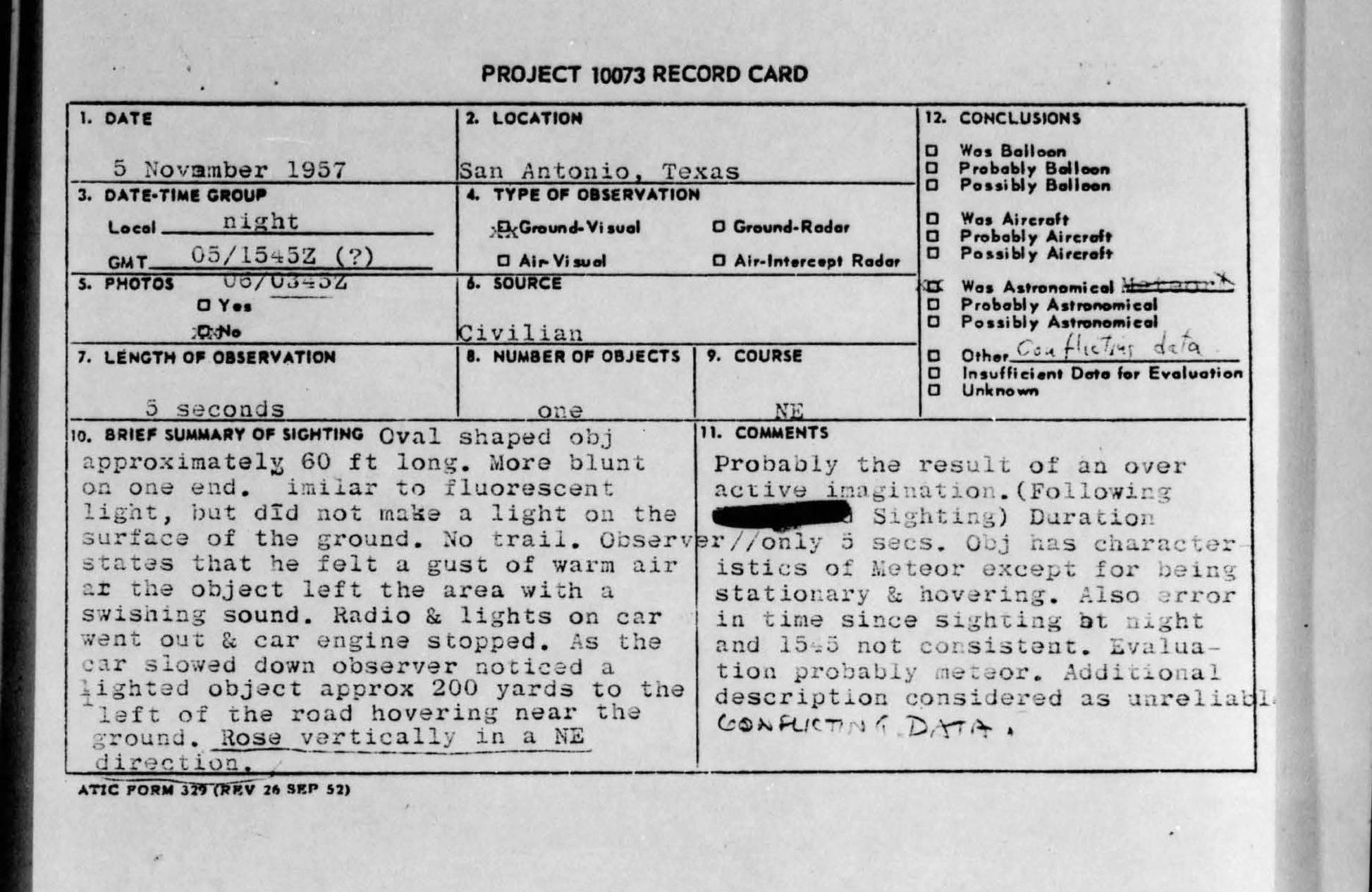
A 39 year old civilian cook at Lackland Air Force Base said his radio, then his headlights, then his engine died on the old Frio City Road outside San Antonio, while a 60 foot glowing egg hovered in a field 200 yards away. The Air Force's own record card confirms the details, then closes the file with five words: "probably the result of an over active imagination."
What did witnesses see at Old Frio City Road?
The contemporary account of this sighting is a story in the San Antonio Light of 6 November 1957, printed under the headline "S.A. MAN 'SEES' TEXNIK", a local joke word welding Texas onto Sputnik. The Light named the witness as Lon Yarbrough, aged 39, a civilian cook employed at Lackland Air Force Base, living at 838 Marquette in San Antonio. He came forward on Wednesday 6 November, the day after the event, and the paper framed him against the story then dominating every Texas front page: Yarbrough, it said, "claimed he'd seen outside San Antonio the unidentified flying object that has puzzled Americans from Levelland to the gulf."
Yarbrough put the encounter at about 9:30 in the evening on Tuesday 5 November 1957, in a field off the old Frio City Road, the road running southwest out of San Antonio toward the Medina County line. He was driving his 1957 car home. The failures came in a specific order, and the order is the most interesting single detail in the whole account. First the car radio quit playing. Then the headlights dimmed. Only after that did he look across the field to his left and see, about 200 yards away, what he called a glaring white light, "like a big neon". Then his engine stopped dead.
He said he stared at the white light for about ten seconds. He judged it roughly 60 feet long and egg shaped. It then shot up into the air, levelled off at about 60 feet, and crossed the road just ahead of his car, headed southeast. He said he could not estimate its speed. As it passed overhead it made a whistling noise, and at the same moment he felt a blast of hot air. It stayed visible only a few seconds after that and then was gone, and he said he did not know what had happened or where the light went. When it disappeared, his lights and radio came back on by themselves. He tried the starter, the engine caught, and he drove off fast. The Light closed on his own words: "I was scared. Fact is, I'm still scared today."
The Air Force's own paperwork describes the same event independently, and it adds detail the newspaper never printed. The Project Blue Book Project 10073 Record Card for 5 November 1957, San Antonio, Texas, records a ground visual observation by a civilian, one object, length of observation 53 seconds. Its typed summary reads: "Oval shaped object approximately 60 ft long. More blunt on one end, similar to fluorescent light, but did not make a light on the surface of the ground. No trail. Observer states that he felt a gust of warm air as the object left the area with a swishing sound. Radio and lights on car went out and car engine stopped. As the car slowed down observer noticed a lighted object approx 200 yards to the left of the road hovering near the ground. Rose vertically."
Two documents produced by unrelated parties within days of each other therefore agree on the hard particulars: an egg or oval shape, roughly 60 feet long, about 200 yards off the road, hovering near the ground, a neon or fluorescent quality of light, the radio and lights failing and then the engine, a rush of hot air on departure, and a whistle or swish as it went. The card adds one negative detail no witness would think to invent: for all its brightness, the object "did not make a light on the surface of the ground". That is the opposite of what the Levelland drivers three nights earlier described, where the object lit up the pavement and the cab of a truck.
One correction has to be made here, because it runs through most of the modern listings of this case. Secondary summaries in circulation describe Yarbrough as a civil service employee driving US Highway 81 from Devine to San Antonio, seeing the object settle into a ravine, watching it rest for several minutes, and then seeing it depart toward San Antonio. None of that appears in the two primary documents. The San Antonio Light places him on the old Frio City Road, not on US 81, and nowhere near Devine, which is about 35 miles southwest of the city. The Light says the object crossed the road ahead of him and headed southeast, which is away from San Antonio, not toward it. The Light describes a field, and the Blue Book card describes ground near the road, neither of them a ravine. The primary record also gives a much shorter event than the later summaries do: 53 seconds on the card, roughly ten seconds of staring plus a few seconds of departure in the newspaper, not "a few minutes". Where the documents and the summaries disagree, this archive follows the documents, and the Devine and Highway 81 details should be treated as an error introduced downstream. The name itself is also usually respelled: the 1957 newspaper prints Yarbrough, later listings print Yarborough.
The only real internal tension is duration. The Air Force card logs 53 seconds; the newspaper describes something closer to fifteen or twenty seconds of visible object. The Blue Book evaluator noticed the same thing and wrote a complaint about the timings on the card, which is dealt with in the official section below.
More footage and images of this sighting
Machine OCR text layer of the Blue Book microfilm scan containing the 5 November 1957 San Antonio record card, the source for every quotation from the card on this page. View source
Loren E. Gross, 'The Fifth Horseman of the Apocalypse, UFOs: A History, 1957: November 3rd to 5th', entry 169, which reproduces the San Antonio Light of 6 November 1957 under the headline 'S.A. MAN SEES TEXNIK'. Source note 170 in the same booklet cites the paper directly. View source

NOAA Global Historical Climatology Network daily record for San Antonio International Airport, station USW00012921. Rows for 19571105 show 0.3 mm precipitation with rain and fog flags set, and no thunder flag on any day from 1 to 12 November 1957. View source
What is the official explanation?
The official record for this case exists, it is reachable, and it is short. The Project Blue Book Project 10073 Record Card for 5 November 1957, San Antonio, Texas survives on the digitised Blue Book microfilm and is hosted openly at the Internet Archive under the item identifier 1957-11-7232487-SanAntonio-Texas. It is filmed as page one of a small run of San Antonio cards from that month, followed by cards for 7, 12 and 13 November 1957. Every San Antonio UFOB message filmed with those cards was sent by the commander of the 741st Aircraft Control and Warning Squadron at Lackland Air Force Base to the commander of the 33d Air Division, with information copies to Air Defense Command at Ent Air Force Base, to the Air Technical Intelligence Center at Wright-Patterson, and to the Director of Intelligence at Headquarters USAF. There is a small irony in that routing: the man who reported the object worked at Lackland, and the unit that forwarded the report to Washington was also at Lackland.
The card's fields are filled in as follows. Date, 5 November 1957. Location, San Antonio, Texas. Type of observation, ground visual. Source, civilian. Number of objects, one. Length of observation, 53 seconds. Photos, no. The brief summary is quoted in full in the section above. The evaluator's comments block is the operative Air Force finding, and its first sentence is legible without any interpretation at all: "Probably the result of an over active imagination." The rest of the block is degraded on the microfilm, but enough survives to reconstruct the reasoning: the evaluator noted the short duration, observed that the object had the characteristics of something conventional "except for being stationary and hovering", complained that the times given were inconsistent, and closed by ruling that the "additional description" was to be "considered as unrelia[ble]". Two honest caveats belong here. The tick box in field 12, which is where Blue Book recorded its formal category, cannot be read reliably from the scan, so this archive does not assert which box was marked. And the accompanying teletype pages filmed in the same file are in far worse condition than the cards; only fragments of the AFR 200-2 lettered items survive legibly, so the witness's occupation, the weather block and the preparing officer's comments as the Air Force recorded them cannot be quoted with confidence. Anyone who presents those items as archival fact is dressing up a guess.
What that leaves is an official disposition consisting of one adjective. No named investigator. No site visit on the record. No interview transcript. No measurement of anything. No engineering examination of the car, which was still in existence and, being a 1957 model, was less than a year old. The Air Force did not identify an aircraft, a balloon, a meteor, a star or a vehicle fault. It wrote that a man had an over active imagination, and closed the file.
That disposition has to be read against what Blue Book was doing in the same fortnight, because the context is documented from the inside. J. Allen Hynek, the Air Force's own astronomical consultant, later described in his own book how the Levelland reports of 2 and 3 November were handled. He wrote: "I am not proud today that I hastily concurred in Captain Gregory's evaluation as 'ball lightning' on the basis of information that an electrical storm had been in progress in the Levelland area at the time. That was shown not to be the case. Observers reported overcast and mist but no lightning. Besides, had I given it any thought whatever, I would soon have recognized the absence of any evidence that ball lightning can stop cars and put out headlights." Hynek also recorded what the Levelland field work actually consisted of: "I was told that the Blue Book investigation consisted of the appearance of one man in civilian clothes at the sheriff's office at about 11:45 A.M. on November 5; he made two auto excursions during the day and then told Sheriff Clem that he was finished." That single day of field work was 5 November 1957, the same day Yarbrough had his encounter 350 miles to the southeast. Hynek further quotes a Blue Book memorandum of 4 December 1957 in which Captain Gregory complained that "as a result of pressure from both the press and public, Assistant Secretary of Defense requested that ATIC immediately submit a preliminary analysis to the press, a most difficult requirement in view of the limited data."
Two later official and semi-official bodies looked back at this cluster and did not accept the Air Force's handling of it. In sworn testimony to the House Committee on Science and Astronautics on 29 July 1968, the atmospheric physicist James E. McDonald wrote of the Levelland ignition failures: "This series of incidents became national headline news until officially explained in terms of ball lightning and wet ignitions. However, on checking weather data, I found that there were no thunderstorms anywhere close to Levelland that night, and there was no rain capable of wetting ignitions." McDonald had interviewed Sheriff Weir Clem and a Levelland newspaperman directly, reported that both confirmed the absence of rain or lightning, and concluded flatly that "the incidents cannot be regarded as explained". He also pointed out the structural problem with the wet ignition line: in these cases the lights come back on by themselves and the engine restarts immediately once the object withdraws, and "the latter point in itself makes the 'wet ignition' explanation unreasonable, of course".
The Condon Committee, funded by the Air Force and generally hostile to the subject, nevertheless wrote in Section III, Chapter 4 of its 1968 report that "reports of temporary stalling of automobile motors by UFOs constitute one of the more puzzling aspects of UFO reports", noted that "the automobiles are invariably reported to operate normally after the UFO leaves the vicinity, and no permanent damage to the car's ignition or lighting system is indicated", and recorded that its own laboratory tests indicated a car with a steel-cased ignition coil "would continue to operate in magnetic fields less than 20 kg". Roy Craig then wrote the sentence that matters most for this page: "Magnetic mapping of the bodies of automobiles involved in particularly puzzling UFO reports of past years, such as the November 1957 incidents at Levelland, Texas, would have been most desirable, but the cars were no longer available for study." The government's own closing study called the November 1957 Texas car cases particularly puzzling and regretted that nobody had tested the vehicles while they still existed. Nobody tested Yarbrough's 1957 car either.
What did the witnesses think it was?
Lon Yarbrough is a thin figure in the record, and it is worth being honest about that rather than inflating him. What is documented is that he was 39, that he worked as a civilian cook at Lackland Air Force Base, that he lived at 838 Marquette in San Antonio, and that on the day after the event he told his story to the San Antonio Light. He is not on record anywhere else. He did not write a book, join a group, sell photographs, get hypnotised, appear at a convention, or resurface in any later wave. Everything that is known about what he believed comes from a single newspaper column and a single Air Force card.
What he believed, on that evidence, was simple and unglamorous. He did not say it was a spacecraft. He did not say he saw occupants, markings, portholes or a landing gear. He offered no theory at all. He described a light, gave dimensions, gave a direction, admitted he could not estimate the speed, and admitted he did not know where it went. The strongest thing he said was about his own state: "I was scared. Fact is, I'm still scared today." That is a man describing fright a full day later, not a man building a story. The Light's own language keeps its distance too, using "claimed" four separate times, so this was not a paper cheerleading a witness.
His employment cuts both ways and should not be oversold. Some later summaries upgrade him to a "civil service employee at Lackland Air Force Base", which sounds like technical staff. The 1957 newspaper says civilian cook. That does not make him unreliable, and a cook's eyes are as good as anyone's at 200 yards, but it does mean the case cannot lean on aviation expertise. What his employment does establish is that he was a man with a steady job on a military installation, in a town full of military installations, telling a story that could only make his life harder. In November 1957 the Air Force was publicly ridiculing exactly this class of report. A Lackland employee volunteering a saucer story to the city paper was choosing embarrassment.
There were no corroborating witnesses in the car and none has ever been produced from the roadside. This is a single witness case, and the archive says so plainly. The apparent "second San Antonio report" of 5 November that circulates in some catalogues, described as a car radio quitting, headlights dimming, engine stopping and an object hovering low over a field, is not a second event; it is this same event catalogued a second time from a different summary, and the matching details give it away.
What corroborates Yarbrough is not another person at his elbow but the shape of the week around him, and the internal agreement of two documents written by people who were not talking to each other. The San Antonio Light's reporter heard "whistling noise" and "blast of hot air". The Air Force clerk at Lackland, writing up a report that went to Wright-Patterson, recorded "a gust of warm air as the object left the area with a swishing sound". Neither of those is a stock saucer detail from 1957 pulp; both describe the same physical sensation. The Light heard "like a big neon"; three nights earlier a driver near Whitharral had told police, in a statement preserved in the Blue Book files and quoted by Hynek, that the object was "lit up like a large neon light". The Light heard 60 feet and egg shaped; the Levelland drivers described egg shaped and torpedo shaped objects that they put at 100 to 200 feet. The failure sequence Yarbrough gave, electrical systems dying on approach and restoring themselves on departure with no lasting damage, is precisely the sequence that the Condon Committee would later call one of the more puzzling aspects of the subject.
The obvious counter to all of that is that Yarbrough had read the Levelland coverage. He almost certainly had; the Light itself put him in that frame in its opening sentence. That is a real argument and it is given its full weight in the assessment. It is worth noting, though, that the one detail on the Air Force card that a copycat would be least likely to supply is the one that contradicts the famous case: Yarbrough's object, for all its brightness, "did not make a light on the surface of the ground", while the entire Levelland set piece was an object flooding the pavement with light.
The dispute
The dispute has two distinct parts and they should not be blurred together, because one is an official assertion and the other is a real physical argument.
The first part is the Air Force's own disposition. The Project Blue Book Project 10073 Record Card for 5 November 1957, San Antonio, Texas carries the typed evaluator's comment "Probably the result of an over active imagination", followed by a partly illegible passage noting the short duration, observing that the object had conventional characteristics "except for being stationary and hovering", complaining that the reported times were inconsistent, and ruling the "additional description" to be "considered as unrelia[ble]". That is the entire counter-explanation offered by the United States Air Force. It was advanced by an unnamed evaluator in the Blue Book office at the Air Technical Intelligence Center, Wright-Patterson, working from a teletype filed by the 741st Aircraft Control and Warning Squadron at Lackland. No investigator is named, no site visit is recorded, no witness interview survives, no candidate object is identified, and the car was never examined. The formal tick box in field 12 of the card cannot be read reliably on the microfilm scan, so this archive does not claim to know which category Blue Book formally assigned. An assertion of imagination, with no mechanism and no method shown, does not close a case; it only records that the file was closed.
The second part is the honest physical argument, and it is much better than the first. The strongest ordinary explanation for a 1957 car dying at night is a damp ignition system, and unlike at Levelland, the weather here supports it. The NOAA Global Historical Climatology Network daily record for San Antonio International Airport, station USW00012921, logs 0.3 mm of precipitation on 5 November 1957 with both the rain flag and the fog flag set. James McDonald's celebrated demolition of the Air Force's "ball lightning and wet ignitions" line for Levelland, delivered under oath to the House Committee on Science and Astronautics on 29 July 1968, rested on there being no thunderstorms and no wetting rain at Levelland that night. Half of that defence is unavailable in San Antonio: there was measurable moisture. The other half holds, and holds hard. The same NOAA record shows no thunder flag at San Antonio on any day between 1 and 12 November 1957, against 45 thunder days at that station across 1957 as a whole, so ball lightning has no generator to come from, and Hynek himself conceded there is "absence of any evidence that ball lightning can stop cars and put out headlights".
What the damp ignition argument does not cover is decisive. Headlights on a 1957 car draw from the battery and generator and are not on the ignition circuit; a wet distributor cap does not dim them. It does not silence a car radio. It does not repair itself unaided within seconds and let the engine catch on the first attempt, a point McDonald made directly when he said that the immediate restart "in itself makes the 'wet ignition' explanation unreasonable, of course". And it does not put a 60 foot luminous egg shaped object 200 yards away in a field, hovering near the ground, which then rises, levels off at 60 feet, crosses the road ahead of the car with a whistle and a blast of hot air, and departs southeast. To close the case on damp ignition you have to treat the object as a separate coincidence, and no analyst has ever shown a method for identifying it.
The third strand of the dispute is flap contagion, and it is the most powerful thing anyone can say against this report. The Levelland car stops of 2 and 3 November 1957 were national headline news within hours, arriving on the same front pages as Sputnik 2. Loren E. Gross's documented history quotes the period coverage directly, including Levelland callers demanding to know "was it Sputnik?" Yarbrough came forward on 6 November, into a saturated news environment, describing an egg shaped object of about 60 feet that glowed "like a big neon", all of which had already appeared in print. That is a genuine reason for caution and it is why this case sits in a disputed tier at all. It is not, however, a demonstrated explanation. Contagion predicts that a copycat will reproduce the famous details, and Yarbrough's most distinctive detail contradicts them: the Air Force card records that his object, for all its brightness, "did not make a light on the surface of the ground", while the entire Levelland account turns on objects flooding the pavement with light. The case is diminished by these arguments. It is not closed by them.
Is the Lon Yarbrough Car Stop: Old Frio City Road, San Antonio, Texas (5 November 1957) real? The two-pass assessment
Pass one. How could this be entirely ordinary, with no exotic component at all?
The strongest ordinary candidate is the one the case's own physical evidence half supports: a damp ignition system on a night with rain and fog. Yarbrough's car was a 1957 model with a conventional coil, distributor cap and breaker points, a system notoriously prone to misfire and stall when moisture bridges the cap or the plug leads. The National Oceanic and Atmospheric Administration's Global Historical Climatology Network daily record for San Antonio International Airport, station USW00012921, is unambiguous for that date. On 5 November 1957 the station logged 0.3 mm of precipitation, roughly one hundredth of an inch, and set both the rain flag and the fog flag. Rain and fog flags run across most of that first fortnight of November. So the "there was no rain" argument that James McDonald successfully deployed against the Levelland ball lightning story does not transfer to San Antonio on 5 November. There was moisture in the air that day, and a damp ignition stall is a completely mundane thing for a car to do in it.
What damp ignition does not do is explain the rest of the report, and this is where the ordinary case runs out of road. A wet distributor does not dim headlights, which are fed straight from the battery and generator and have nothing to do with the ignition circuit. It does not silence a radio. It does not restore itself, unaided, within seconds, and then let the engine catch on the first turn of the key. And it does not produce a 60 foot glowing egg sitting 200 yards away in a field. To run the ordinary explanation cleanly you have to stack three separate coincidences on one minute of one man's evening: an unrelated ignition fault, an unrelated electrical fault, and an unrelated light source that then flew over him.
Ball lightning, the Air Force's public line for the Levelland cluster, is worse here than it was at Levelland. The same NOAA record shows no thunder flag at San Antonio on any day from 1 to 12 November 1957. Thunder was flagged at that station on 45 separate days across 1957, so this is a real absence and not a hole in the record. No thunderstorm means no plausible ball lightning generator, and in any case, as Hynek himself conceded, there is no evidence that ball lightning stops cars or extinguishes headlights. Saint Elmo's fire fails on the same ground and additionally fails on size, shape, distance and motion.
An aircraft landing light is a serious candidate on paper. San Antonio in 1957 was ringed by Lackland, Kelly, Randolph and Brooks, and the Blue Book file for the neighbouring 7 November San Antonio report shows the evaluator reaching for exactly this class of answer. It fails on the specifics, though. A landing light does not sit still 200 yards away at ground level in a field, then rise vertically, then level off at 60 feet and cross a road ahead of a car. A bolide fails harder: meteors do not hover, and the Blue Book evaluator himself appears to have noted that the object had conventional characteristics "except for being stationary and hovering", which is the whole problem.
That leaves the two arguments that genuinely bite. The first is flap contagion, and it is strong. On 2 and 3 November a dozen drivers around Levelland reported near identical car stops, the story went national, Sputnik 2 had gone up on 3 November, and Loren Gross's documented history records that on the Sunday morning "news of the big, dog-carrying, Sputnik II was headlined in early editions of every newspaper across America" while callers from New York, Los Angeles and Detroit jammed the Levelland police switchboard demanding to know "was it Sputnik?" By Tuesday 5 November, every driver in Texas had a template in his head for what a stalled car at night meant. Yarbrough reported the following day, into that atmosphere, using imagery ("like a big neon", egg shaped, roughly 60 feet) that had been in print for 72 hours. The second argument is simply that this is one man, alone, at night, with no photograph, no physical trace, no second observer, and no examination of the vehicle.
Pass two. If it was not ordinary, what does the record actually support?
Not much beyond the report itself, and this archive will not pretend otherwise. There is no radar, no trace, no instrumentation. What survives is a coherent, specific, unembellished account that a working man volunteered against his own interest, recorded twice within a day by parties who were not coordinating, and agreeing across those two records on details a fabricator would not bother with: the failure order (radio, then lights, then engine), the absence of ground illumination beneath a very bright object, the gust of hot air, and the whistle or swish on departure. The pattern it belongs to is the most evidentially interesting class in the entire Blue Book corpus, because those reports are independent of each other, they describe a mechanism rather than a shape, and they were made by ordinary drivers with nothing to gain. The Condon Committee, working for the Air Force with a mandate that pointed the other way, still wrote that these cases "constitute one of the more puzzling aspects of UFO reports" and still regretted that the Levelland cars had not been magnetically mapped while they existed.
The official debunk is logged here as what it is: evidence that the case needed closing, not evidence that the case was empty. "Probably the result of an over active imagination" is not a finding, it is a mood. It names no mechanism, no object, no witness error and no test. It was written into a file by an evaluator who never met Yarbrough, in the same fortnight that the head of Blue Book was complaining in writing that the Assistant Secretary of Defense wanted a press analysis immediately "in view of the limited data", and in the same fortnight that Blue Book's own scientific consultant signed off on a ball lightning explanation he would later publicly disown. When the closing apparatus is that rushed and that thin, its verdict tells you about the apparatus.
Tier: Barely Disputed. There is a specific official finding, and there is a genuinely serious ordinary candidate in damp ignition supported by a real, primary weather record. But the official finding is an assertion with no method shown behind it, and the ordinary candidate covers the engine and nothing else, not the headlights, not the radio, not the instant self-restoration, and not the 60 foot luminous object in the field. Nothing in the record rises anywhere near the Strongly Disputed bar: there is no confession, no recantation, no recovered prop, and no positive identification of any specific real-world object. The case stands, damaged but standing, and it deserves to be read next to Levelland rather than folded into it.
Sources
- archive.org/details/1957-11-7232487-SanAntonio-Texas
- archive.org/download/1957-11-7232487-SanAntonio-Texas/1957-11-7232487-SanAntonio-Texas_djvu.txt
- sohp.us/collections/ufos-a-history/pdf/GROSS-1957-Nov-3-5.pdf
- sohp.us/collections/ufos-a-history/doc/1957-Nov-3-5.php
- files.ncas.org/ufosymposium/mcdonald.html
- files.ncas.org/condon/text/s3chap04.htm
- archive.org/details/the-ufo-experience-j.-allen-hynek
- noaa-ghcn-pds.s3.amazonaws.com/csv/by_station/USW00012921.csv
- archive.org/details/1957-11-6781581-Levelland-Texas
- documents2.theblackvault.com/documents/projectbluebook/projectbluebook-levellandufocase-november2-3-1957.pdf
More cases from this region: UFO sightings in United States