The USS John F. Kennedy Glowing Sphere
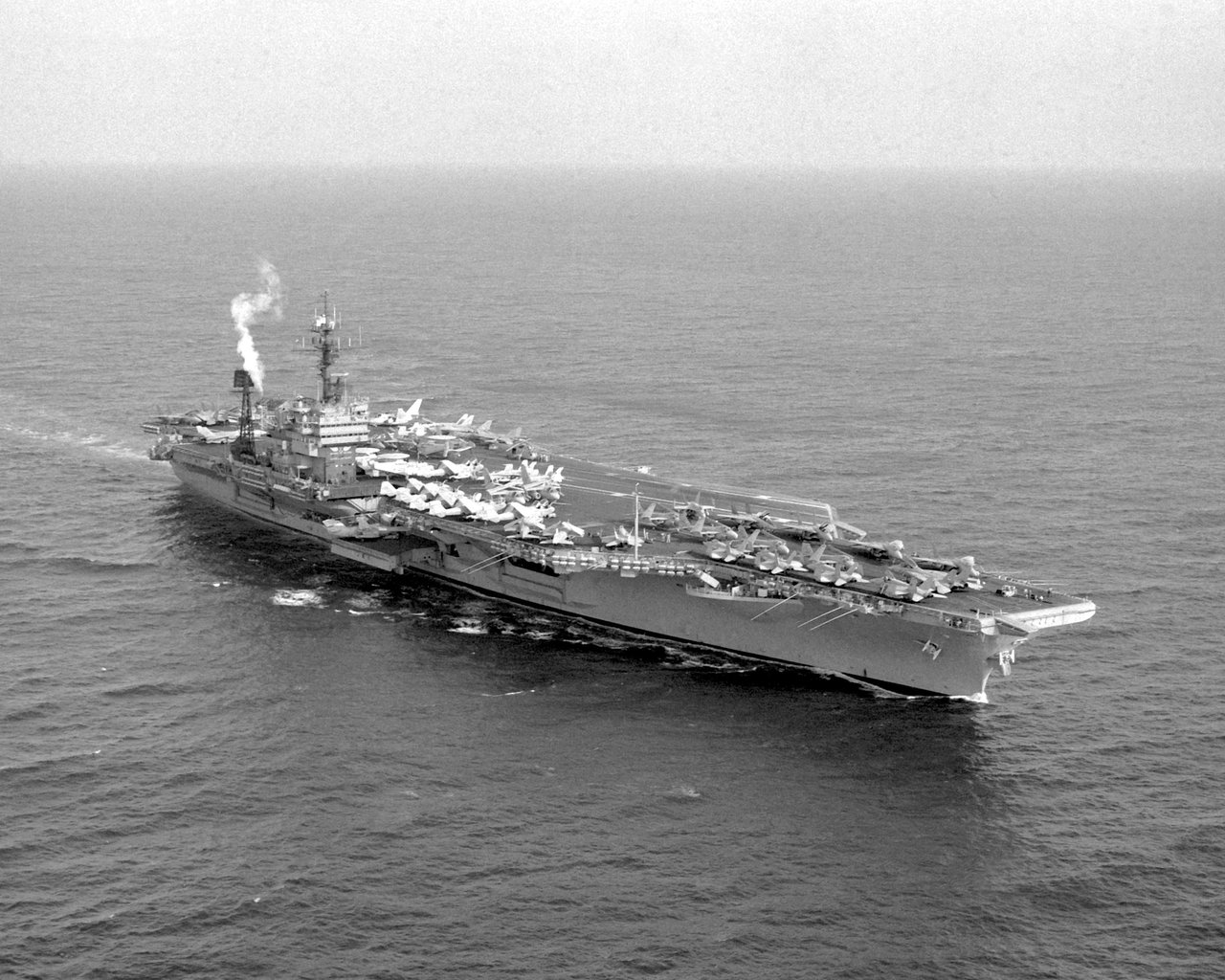
The witness is Jim Kopf, who in 1971 served in the communications department of the supercarrier USS John F. Kennedy, hull number CVA-67. This case file covers what witnesses reported, the official narrative, and a two-pass assessment with its evidence tier.
What did witnesses see at Atlantic Ocean?
The witness is Jim Kopf, who in 1971 served in the communications department of the supercarrier USS John F. Kennedy, hull number CVA-67. In the account he filed with NUFORC in 2000, he places the carrier in the Atlantic southeast of Florida, in the stretch of water people call the Bermuda Triangle. By his telling the ship was steaming back toward Norfolk, Virginia after a two-week operational readiness exercise in the Caribbean, and the crew was looking forward to a thirty-day stand-down before a six-month Mediterranean deployment.
Kopf says it was evening, "about 20:30 (8:30 PM)," and the Kennedy had just wrapped an eighteen-hour stretch of flight operations. He was on watch in the communications center, monitoring eight teletypes that printed the Fleet Broadcasts. He had pulled a message off one of the broadcasts and turned to file it. When he turned back, the primary teletypes were "typing garbage." The alternates were doing the same. He went to the intercom and called Facilities Control, and a voice told him all communications were out across the ship.
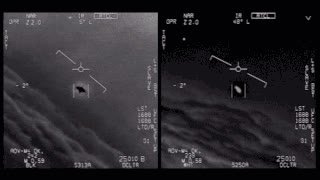
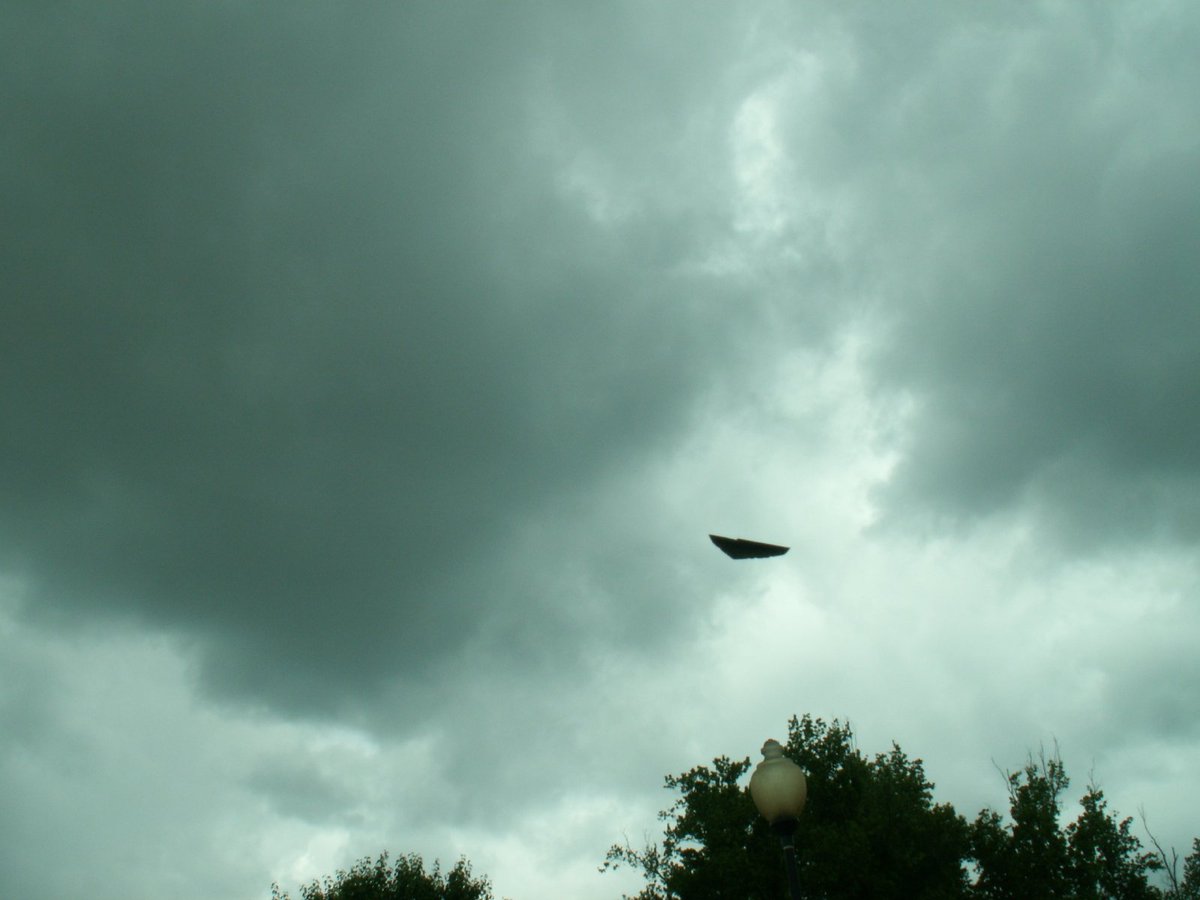
Over an intercom line to the signal bridge, Kopf says the men in the comm center heard someone yelling "IT IS GOD! IT'S THE END OF THE WORLD!" and then a second voice: "There is something hovering over the ship!" They looked up and saw, in his words, "a large, glowing sphere." He stresses there was no point of reference for size, so he could not judge it: if it hung a hundred feet up it might be two to three hundred feet across; higher up it would be larger still. At arm's length he compared it to a beach ball. It made no sound he could hear, the light it threw was about half the brightness of the sun, and it "pulsated from yellow to orange slowly." They watched it for only about twenty seconds before General Quarters sounded and the communications officer chased them back inside to their battle station.
Kopf describes the aftermath in specifics. The teletypes started printing normally again after roughly twenty minutes. A friend in the Combat Information Center, a radar operator, told him every radar screen had simply glowed solid during the event. He reports the navigation bridge compasses were not working, the two ready Combat Air Patrol F-4 Phantoms on deck would not start, and the medics had to sedate a boatswain's mate who had been a lookout. He also relays a rumor that three or four "men in trenchcoats" landed aboard and interviewed personnel, and that the captain came on the closed-circuit television to remind the crew that "certain events that take place aboard a Naval Combatant Ship, are classified and are not to be discussed."
What is the official explanation?
There is no official narrative for this event, because there is no official record of it at all. Project Blue Book, the Air Force UFO program, had been shut down on 17 December 1969, more than a year before the claimed date, so there was no federal body collecting and adjudicating UFO reports in mid-1971. The case never produced a deck log entry, a message traffic reference, a casualty report, or any naval document that has surfaced. Everything known about it traces to Kopf's own first-person submission to a civilian clearinghouse, the National UFO Reporting Center, logged as report 13385 and dated 11 July 2000.
The only thing resembling an official touchstone is the documented operational history of the ship itself, and that history is where the account runs into trouble. The Naval History and Heritage Command, the U.S. Carriers reference, and seaforces.org all record that the Kennedy's Mediterranean cruise of September 1970 to March 1971 ended on 1 March 1971, and that her next deployment did not begin until 1 December 1971, when she sailed for the North Atlantic and the Mediterranean through October 1972. A July 1971 date falls in the gap between those two deployments. Kopf's framing, a ship just back from a Caribbean readiness exercise and about to deploy to the Med for six months, actually describes the run-up to the December 1971 cruise, not early July. So the witness's own setup and the witness's own date do not line up with the verifiable schedule.
The captain's reported on-camera reminder that shipboard events are "classified and are not to be discussed" is, in the framing this archive uses, a witness claim and not an official admission. No transcript, no Plan of the Day, and no message confirms it. It cannot be treated as the Navy closing a real case, because there is no surviving Navy paper trail at all to close.
What did the witnesses think it was?
Jim Kopf, communications department, USS John F. Kennedy (CVA-67), single named witness who filed the account with NUFORC on 11 July 2000.
The dispute
The dispute is not that anyone has caught Jim Kopf in a hoax. It is that the case has no independent footing and that his own dating does not survive contact with the ship's record. The single load-bearing document is his NUFORC report, filed 11 July 2000 about an event he places on or around 2 July 1971. That is a gap of roughly twenty-nine years between the experience and the first written account, with no contemporaneous note, log, photograph, or named second witness anywhere in between. A vivid, detailed memory recorded three decades later is not corroboration, it is one person's recollection, and recollection of a dramatic night drifts and consolidates over that long.
The harder problem is the calendar. The Naval History and Heritage Command's ship history, the U.S. Carriers deployment table, and seaforces.org all agree that the Kennedy's 1970 to 1971 Mediterranean cruise ended on 1 March 1971 and that her next deployment did not begin until 1 December 1971. Early July 1971 sits squarely in the stand-down between them. Yet Kopf describes the ship as just back from a Caribbean readiness exercise and about to deploy to the Mediterranean for six months, which is the profile of the workup to the December 1971 cruise, not a July evening months earlier. Either the date is wrong, or the operational framing is wrong, and both came from the same source. When the only witness's own setup contradicts the only objective record available, the account's reliability takes a real hit. It is worth noting that one widely reposted retelling (Stronghold Nation) shifts the event to May 1971 and recolors the object green, which shows how loosely the details have traveled.
What pushes this toward dispute, then, is the absence of anything outside Kopf, combined with an internal date conflict. What holds it back from being strongly disputed is just as important. No one has produced a confession, a recantation, recovered props, or a positive identification of a specific real-world cause. There is no traced rocket launch, no named balloon, no identified aircraft or ship's light, no demonstrated fabrication. Skeptics can reasonably suspect a misremembered date, an embellished sea story, or a genuine electrical casualty later dressed up as a UFO, but suspicion of that kind is not the same as showing the method. Under this archive's rules a plausible-but-unproven mundane reconstruction and an unverifiable single witness keep a case in "Barely Disputed," not "Strongly Disputed." The honest verdict is that the story stands or falls on Jim Kopf alone, and his own timeline does not match his own ship.
Is the USS John F. Kennedy Glowing Sphere real? The two-pass assessment
Pass one, the ordinary readings. The most economical explanation is that the dramatic version assembled over thirty years around a real but mundane core. Total simultaneous loss of communications, radar screens "glowing," dead compasses and two jets that will not start are also the signature of a serious electrical or grounding fault, a power transient, or strong atmospheric and electromagnetic interference aboard a ship saturated with high-power emitters, exactly the sort of casualty that would prompt a captain to remind the crew that shipboard events are not for outside discussion. A glowing yellow-to-orange sphere with no fixed reference for size, seen for about twenty seconds at night over open ocean, is consistent with a number of prosaic things: ball lightning or a plasma effect, a flare or pyrotechnic, a misjudged celestial or aircraft light, even St. Elmo's fire on the masts during a charged atmosphere. The "men in trenchcoats" detail is explicitly secondhand rumor, the kind of motif that attaches to sea stories. And the recordkeeping problem cuts the same way: the witness's date does not fit the Kennedy's documented schedule, his framing fits a different deployment entirely, and a competing retelling moves the event to a different month and a different color. A hoax is not required to explain any of this. Honest memory drift plus a genuine electrical incident accounts for most of it.
Pass two, if it happened as described. Then a structured, self-luminous object roughly the apparent size described hovered silently over a nuclear-capable supercarrier and, for about twenty minutes, suppressed essentially every electronic and electrical system on board, communications, radar, magnetic compasses and aircraft ignition, before releasing them all at once. That is a coordinated, area-wide electromagnetic effect on hardened military equipment, with multiple crew across separated spaces, comms, CIC, the bridge, the signal bridge and the flight deck, reacting at the same moment. If real, it belongs to the recurring and unexplained pattern of naval close encounters with apparent power over electronics, and the official reminder to keep quiet would read as the Navy treating it as real enough to contain.
Weighing the two passes: the case is entirely uncorroborated. One witness, named but alone, no document, no photograph, no second named observer, first recorded twenty-nine years later, and carrying an internal date conflict against the ship's own deployment history. That is enough to dispute it. But nobody has shown a confession, a recantation, recovered props, or a specific identified object or cause, so it does not meet the bar for strongly disputed. The object remains unidentified and the night remains unverified. The tier is Barely Disputed.
Sources
- nuforc.org/sighting/?id=13385
- www.nicap.org/jfk.htm
- www.ufoevidence.org/cases/case1075.htm
- www.uscarriers.net/cv67deploy.htm
- www.seaforces.org/usnships/cv/CV-67-USS-John-F-Kennedy.htm
- www.history.navy.mil/research/histories/ship-histories/danfs/j/john-f-kennedy-cva-67.html
- web.archive.org/web/20220520142450/https://www.ufocasebook.com/2011/1971johnfkennedy.html
- www.stronghold-nation.com/history/myth/the-uss-kennedy-incident
More cases from this region: UFO sightings in United States