The New Mexico Green Fireballs
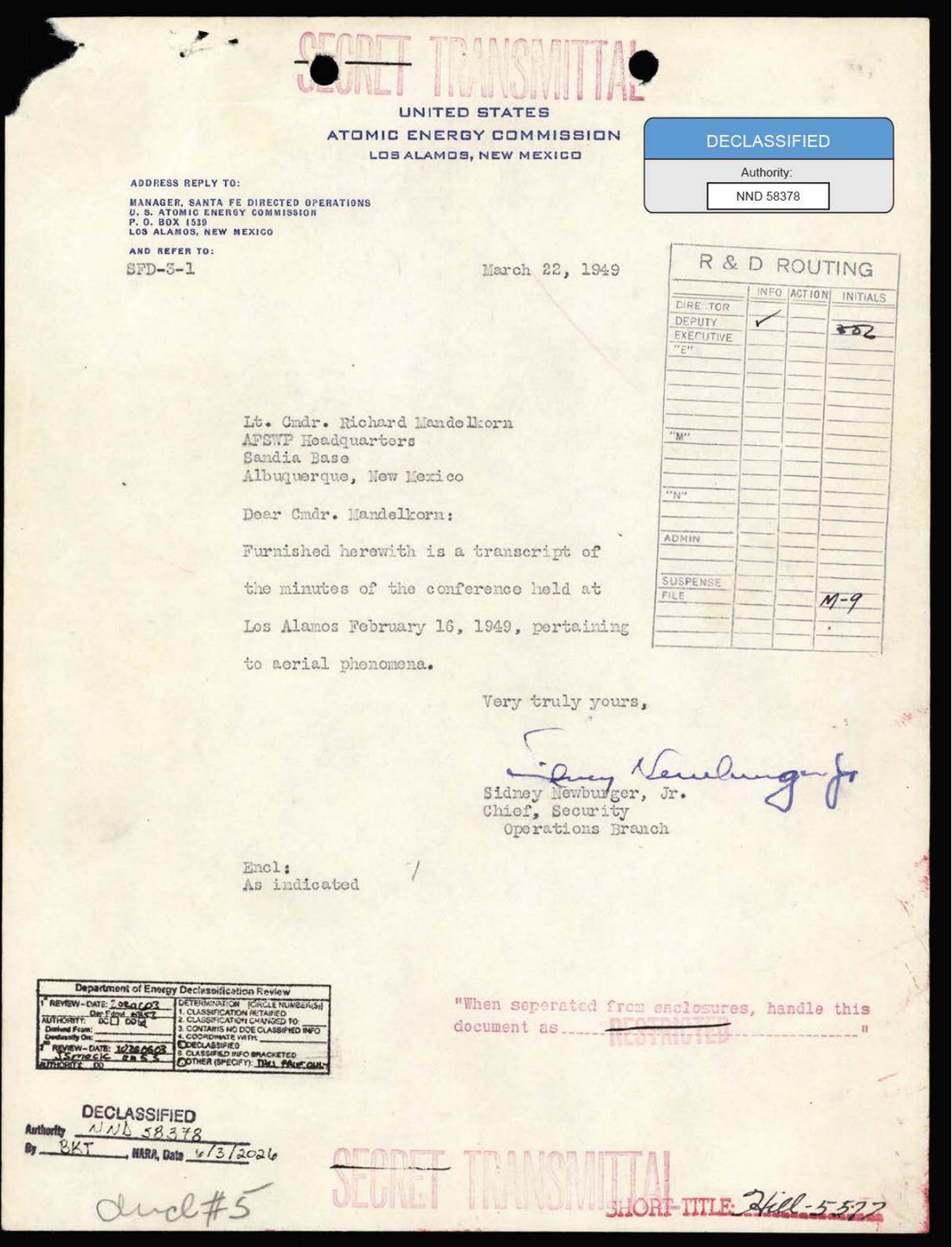
For roughly three years beginning in the last weeks of 1948, brilliant green fireballs streaked almost horizontally across the New Mexico sky, again and again over the most sensitive nuclear installations in the United States. They were not shy phenomena seen by one nervous witness. They were tracked by pilots, weather observers, security officers, and by Dr. Lincoln LaPaz, the country's foremost authority on meteorites, who saw one himself and concluded it was no ordinary meteor. The alarm ran high enough that in February 1949 the Atomic Energy Commission and the Air Force convened a secret conference at Los Alamos, chaired by physicists who had built the atomic bomb, to decide what was falling on their weapons laboratories. They reached no agreement. On July 10, 2026, the U.S. Department of War released the full transcript of that conference in the fourth PURSUE tranche at war.gov/UFO, and the seventy-seven-year-old mystery of the green fireballs, contested by the very meteor expert brought in to explain it, is once again an open file.
What did witnesses see at New Mexico (Los Alamos?
The wave began quietly in November 1948, when residents around Albuquerque started reporting mysterious green flares in the night sky. Officials first assumed they were discharged military flares, but the reports grew in frequency and detail through early December until it was clear they were nothing so mundane. On December 5, 1948, the crew of a USAF C-47 flying at 18,000 feet near Las Vegas, New Mexico, watched a bright green ball of fire that, in their words, did not arch downward the way meteors usually do. That same night a second aircraft crew reported a similar object. On December 8, two Air Force intelligence officers described something like a burning green flare but much more intense and considerably larger than any normal flare. The sightings piled up across the following weeks, with fresh reports logged on December 6, 7, 11, 13, 14, 20, and 28.
The defining features were consistent and strange. The objects burned a vivid, almost fluorescent green, later measured spectroscopically at a wavelength near 5,218 angstroms, a color LaPaz distinguished sharply from the pale yellowish green of an ordinary copper-bearing meteor. They flew nearly flat, hugging a low altitude of only eight to ten miles and holding a nearly constant velocity over long horizontal distances, rather than plunging in the steep, decelerating arc of a falling stone. On December 20, 1948, one was seen to descend at about a forty-five degree angle and then abruptly level off into level flight. Above all they were silent. A meteor bright enough to be seen for hundreds of miles should produce explosive noise and set off animal alarm across the countryside, and none of that ever happened. And they left no train: unlike the persistent glowing dust wake of a real fireball, the green fireballs left little or nothing behind.
What made the pattern impossible to dismiss was where they appeared. The green fireballs clustered with uncomfortable precision over the nation's nuclear infrastructure: the Los Alamos weapons laboratory, Sandia Base and Kirtland Air Force Base at Albuquerque, the Killeen Base storage site, White Sands, Holloman, and the Atomic Energy Commission facilities in between. Tabulations of the 1949 reports counted roughly twenty-six sightings in the Los Alamos area, about seventeen around Sandia Base concentrated in the latter half of the year, and around a dozen near White Sands, Alamogordo, and Holloman. The odds of a natural celestial phenomenon selecting the very map coordinates of America's atomic secrets were, to the officers filing the reports, hard to accept.
One of the most striking single events came on January 30, 1949, when a green fireball was tracked by more than a hundred observers strung across New Mexico and West Texas, from southwest of Amarillo down toward Lubbock. Reports continued to accumulate through 1949 and into 1950, sometimes as single brilliant objects and sometimes as formations. On August 20, 1949, near Las Cruces, the astronomer Clyde Tombaugh, discoverer of Pluto, watched with his family an array of rectangular lights crossing the sky that he judged too fast for aircraft and too slow for a meteor, a sighting from an unimpeachable professional observer that deepened the sense that something genuinely unexplained was operating over New Mexico.
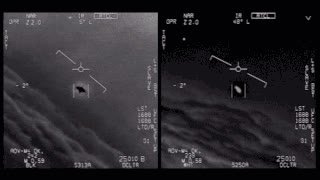
More footage and images of this sighting
What is the official explanation?
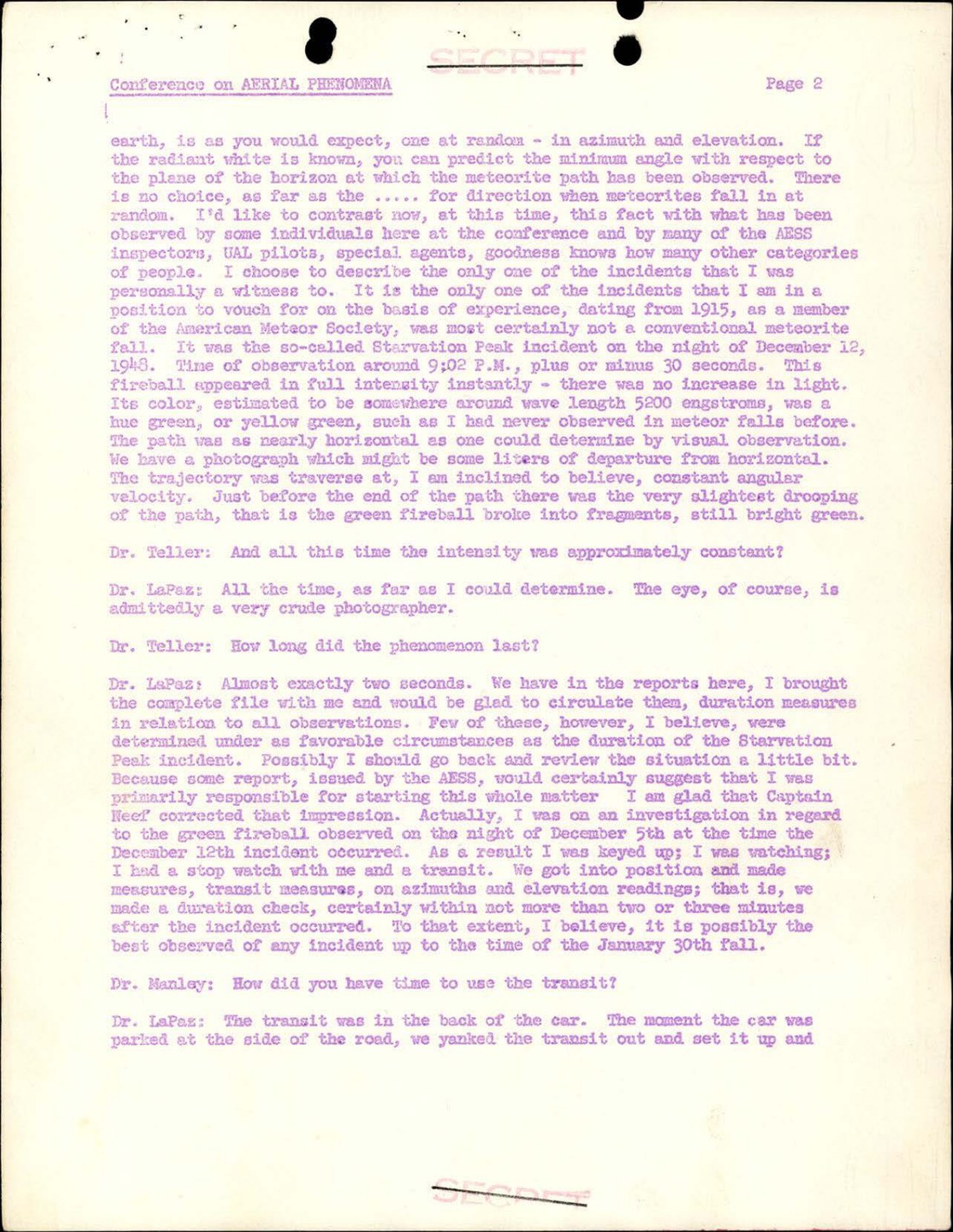
The nuclear context turned curiosity into a security emergency. Because the fireballs favored the weapons laboratories, the Air Force Office of Special Investigations and the Atomic Energy Commission needed to know quickly whether they were natural, a Soviet reconnaissance device, or a secret American test. They turned to Dr. Lincoln LaPaz, director of the Institute of Meteoritics at the University of New Mexico and the leading meteor scientist in the country. LaPaz organized triangulation crews who interviewed witnesses, reconstructed flight paths, and computed where any surviving fragment should have landed. After what one account calls many sleepless hours of plotting, his teams searched the predicted impact zones and found nothing: no fragments, no craters, no scorching, no meteoritic dust. For a man whose life's work was recovering fallen meteorites, the total absence of physical residue was itself an anomaly. LaPaz laid out three ways the fireballs broke the rules of ordinary meteors: the color was too vivid a green, the trajectories were too flat, and there was no sound. He witnessed one himself on December 12, 1948, near Starvation Peak east of Santa Fe, an object that in his description appeared in full intensity instantly, moved almost horizontally with a yellow-green hue, lasted about two seconds, and broke into bright green fragments. He judged it, in his own words, most certainly not a conventional meteorite fall.
With LaPaz unable to certify the objects as natural, and with reports still coming in over the weapons plants, the authorities convened a closed conference at the Los Alamos Scientific Laboratory on February 16, 1949. The transcript newly released in 2026, filed as DOE-UAP-D004 and titled the Conference on Aerial Phenomena, was transmitted under an Atomic Energy Commission SECRET cover letter of March 22, 1949. It was organized around Edward Teller, the Hungarian-American theoretical physicist, Manhattan Project veteran, and future father of the hydrogen bomb, and it brought together an extraordinary roster including Los Alamos director Norris Bradbury, LaPaz, the atmospheric physicist Joseph Kaplan, and representatives of the Army, the FBI, the Atomic Energy Commission, and the Armed Forces Special Weapons Project. Teller worked the problem at the blackboard, testing whether the objects could be understood as some shallow, grazing meteor entry. According to the released transcript the group did not reach consensus. The shallow-meteor idea was considered but never settled, and the horizontal paths and the silence remained unexplained. The conference recommended that formal study be handed to the Cambridge Research Laboratory.
That handoff produced Project Twinkle, the official green-fireball observation program established in 1950. It set up patrol and observation posts in New Mexico, in the corridor around Holloman and the town of Vaughn, equipped with cinetheodolite cameras intended to photograph the fireballs from two stations at once so their altitude, size, and speed could be triangulated and their spectra captured. The project logged some genuine results. On April 27, 1950, cameras achieved a triangulation; on May 24 a crew filmed multiple fast-moving objects; and on August 31, 1950, project cameras caught objects during a V-2 rocket launch while an F-86 interceptor failed to close on them. Yet Twinkle was chronically underfunded, the two-station instrumentation was never fully manned or synchronized, and the fireball rate itself fell off sharply after the cameras were installed. The final report, written by Dr. Louis Elterman in November 1951, dismissed the whole effort as a dismal failure that had gained no information, a verdict the physicist and researcher Bruce Maccabee later challenged as misleading given the successful observations that were on record. The program was wound down inconclusively as attention shifted to the Korean War.
The February 1949 transcript stayed classified for the better part of a lifetime. It surfaced on July 10, 2026, when the Department of War published its fourth tranche of declassified Unidentified Anomalous Phenomena records under the PURSUE transparency initiative, a batch of roughly forty files, including fourteen documents, nineteen videos, and several audio recordings drawn from the Pentagon, NASA, the CIA, the FBI, and the Energy Department. In the transcript the investigators walked through green-fireball paths in detail, each low and nearly level and holding constant speed, and LaPaz singled out the silence as the most implausible feature of all. The same July 2026 release also contained a 1948 Top Secret intelligence study built around photographs of the German Horten flying wing, a tailless aircraft whose disc-like planform fed the era's official anxiety that the objects might be a foreign craft; a Horten prototype was said to have reached about 14,200 feet in 1938. But the flying wing was a machine that could be measured. The green fireballs were not.
What did the witnesses think it was?
The witness record is what lifts this case above rumor. The observers were overwhelmingly trained and sober: air crews, weather men, radar operators, intelligence officers, and scientists working at the weapons laboratories, people who watched the sky for a living and had security reasons not to invent things. Their descriptions converged. Air Force intelligence officers who saw the December 8, 1948, object stressed that it was far more intense and much larger than any flare in the inventory. On December 13, 1948, LaPaz worked alongside a USAF captain and a Civil Air Patrol officer to triangulate one object's path, and professional astronomers such as Clyde Tombaugh added their own sightings to the file.
LaPaz himself is the pivotal witness, precisely because he was the man hired to debunk the phenomenon and could not. He advised the military and the Atomic Energy Commission that the fireballs were most likely either a secret American defense device or a Soviet spy device, the two explanations a cautious scientist reaches for when a thing behaves like technology rather than nature. Pressed on whether they might simply be a natural phenomenon, he said he hoped they were, but did not believe it, and suggested the truth would only be settled if one of the objects finally struck the ground and left something to examine. None ever did. The scientists at Los Alamos and Sandia, for their part, were unsettled enough that when Project Blue Book director Edward Ruppelt visited Los Alamos in early 1952 he found staff physicists openly speculating that the fireballs might be projected into the atmosphere from a spacecraft hovering hundreds of miles overhead, an idea remarkable less for its content than for who was entertaining it: the people who had built the bomb.
Is the New Mexico Green Fireballs real? The two-pass assessment
The honest natural case is real and deserves a fair hearing. Green is exactly the color a meteor rich in copper, magnesium, or ionized oxygen can burn, and the human eye is most sensitive to that part of the spectrum, so a bright meteor can look startlingly green. Grazing or Earth-skimming meteors do exist, entering at shallow angles and traveling long, nearly horizontal paths before burning out, which is the mechanism Edward Teller probed at the blackboard in 1949. A cluster of unusually vivid grazing meteors, combined with an atmospheric or upper-air luminous phenomenon not well understood at the time, could account for much of what was seen. It is also true that this was the height of the early Cold War over the most secret sites in America, and both a classified U.S. program and a Soviet probe were live hypotheses, exactly as LaPaz told his handlers. The sharp fall in sightings after Project Twinkle's cameras went up, and the program's own inconclusive final report, are sometimes read as a phenomenon that faded because it was mundane all along.
But the residue that survives that explanation is stubborn, and it was the professionals closest to the evidence who refused to let it go. The trajectories were too flat and the speeds too constant for objects supposedly decelerating in the atmosphere. The color was consistent and anomalous, measured near 5,218 angstroms rather than varying as tumbling meteoric material should. No fragment, crater, or dust train was ever recovered despite LaPaz's teams searching the computed impact zones, which for the nation's top meteoriticist was the deepest problem of all. LaPaz called the silence the most implausible feature: bodies bright enough to be seen across four hundred miles should thunder, and these never made a sound. And the geography would not go away, with the fireballs favoring Los Alamos, Sandia, Kirtland, and the atomic corridor rather than distributing themselves at random across the sky.
The decisive point is procedural. When a government convenes Edward Teller, Norris Bradbury, Lincoln LaPaz, Joseph Kaplan, and their peers in a secure room at Los Alamos and asks them to explain lights over the bomb plant, and that assembly of Manhattan Project intellect studies the data and reaches no consensus, the phenomenon has been examined by the best minds available and defeated them. The meteor explanation was not imposed on skeptics from outside; it was contested from inside by the very meteor expert brought in to confirm it. Project Twinkle ended not with an answer but with a shrug and a budget cut. Seventy-seven years later the transcript of that failure is finally public, and the New Mexico green fireballs remain what they were in 1949: extensively investigated, seriously taken, and never satisfactorily explained.
Sources
- www.abovethenormnews.com/wp-content/uploads/2026/07/DOE-UAP-D004_Los-Alamos-Conference-on-Aerial-Phenomena_1949.pdf
- www.history.com/articles/ufos-green-fireballs-nuclear-facilities-new-mexico
- www.nicap.org/nmexico/newmexicosightings.htm
- avi-loeb.medium.com/highlights-from-the-fourth-uap-data-release-by-the-u-s-government-105a9b2561c7
- www.newsweek.com/ufo-files-1949-los-alamos-green-fireball-mystery-declassified-department-of-war-12181696
More cases from this region: UFO sightings in United States