The New York Cylindrical Object Airliner Near-Miss

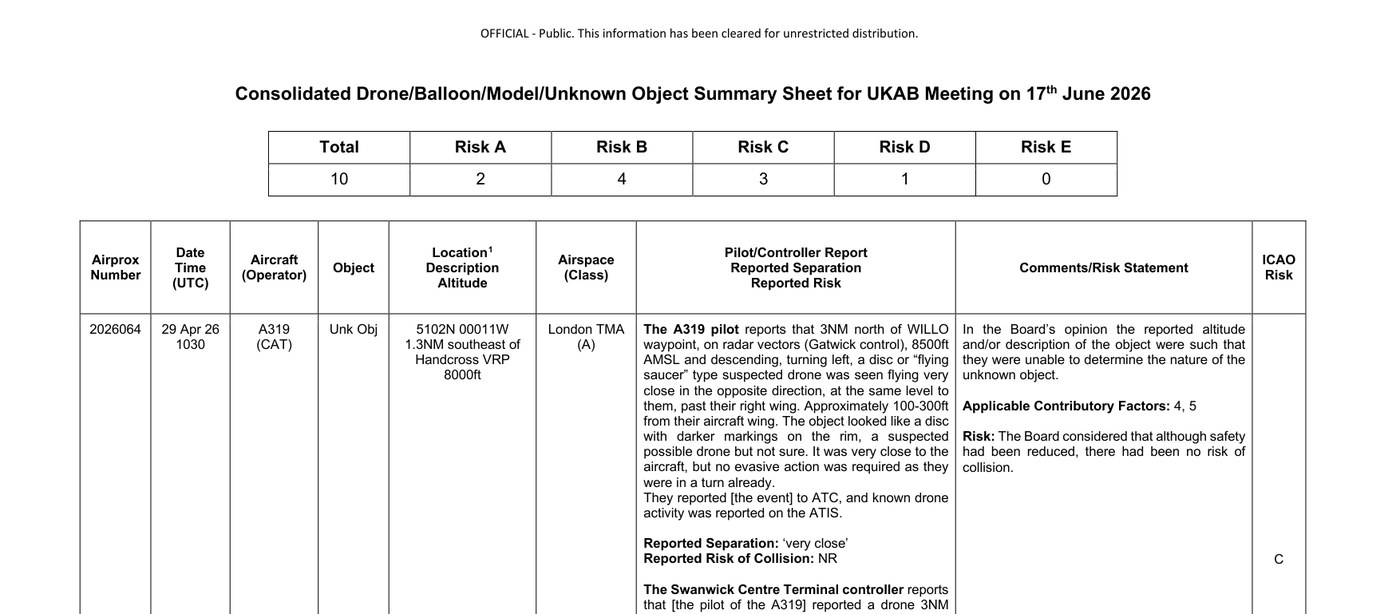
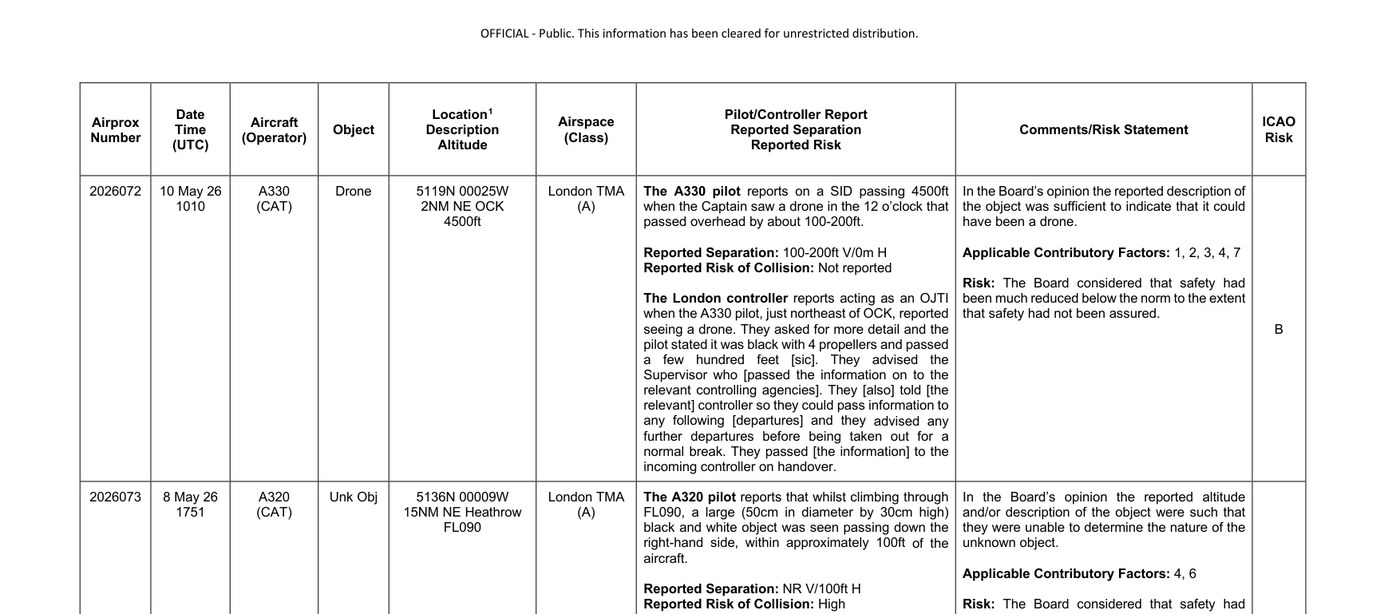
When the Pentagon's UAP office published its annual report for fiscal year 2024 on 14 November 2024, the headline numbers were familiar: hundreds of cases, most explained away as balloons, drones and satellites, and no evidence of anything otherworldly. Buried in the figures was one line that the aviation press caught immediately. Out of 392 reports that reached the office through the Federal Aviation Administration, exactly one was flagged as a possible flight safety issue: a commercial airline crew had reported a near miss with a "cylindrical object" off the coast of New York. No date, no airline, no image, and no resolution were released. It remains, in the government's own words, under analysis.
What did witnesses see at Atlantic Ocean off the coast of New York?
The case exists as a single line in a federal document, but it is among the most consequential lines in the entire report. In its Fiscal Year 2024 Consolidated Annual Report on Unidentified Anomalous Phenomena, released to the public on 14 November 2024, the Department of Defense's All-domain Anomaly Resolution Office (AARO) disclosed that a commercial flight crew had reported a near miss with a "cylindrical object" while flying off the coast of New York.
The number that gives the line its weight is this: of the 757 new UAP cases AARO logged in the reporting window, and of the 392 reports that reached the office through the Federal Aviation Administration, this was the only one the office identified as involving a possible flight safety issue. One case, out of nearly four hundred routed from the nation's air traffic system, was serious enough to be singled out as a hazard to a passenger aircraft.
What the crew actually saw is almost entirely absent from the public record. The unclassified report gives no date, no flight number, no airline, no altitude, and no image. It offers the object a single adjective, cylindrical, and it states that the encounter was close enough that a professional airline crew judged it a near miss. AARO recorded that the case was still being analyzed at the time of publication. Everything beyond those facts has not been released, and this case file does not guess at it.
What is the official explanation?
AARO is the official narrative here, and the official narrative is that the case is unresolved. The FY2024 report covered 757 cases newly reported between 1 May 2023 and 1 June 2024, lifting the office's total caseload past 1,600 reports since its 2022 stand-up. Director Jon Kosloski, who had recently taken over the office, stressed that across that entire caseload AARO had "discovered no evidence of extraterrestrial beings, activity, or technology," and that it had resolved hundreds of cases to ordinary causes: balloons, birds, drones, manned aircraft, and SpaceX Starlink satellites, several of the latter pinned down by correlating the time and direction of multiple sightings against satellite passes.
The New York near miss was not among the resolved cases. It sat in the residual set the office is careful to describe in process terms rather than conclusions. AARO said that more than 900 reports across its holdings lack sufficient scientific data for analysis and are retained in an active archive, and that its attention is on what Kosloski called "the truly anomalous, where we don't understand the activity." The cylindrical object off New York is in that unresolved space: not attributed to a balloon or a drone, not attributed to anything else, and not closed.
The reporting channel matters to how seriously the line should be read. The 392 FAA-sourced reports come from the aviation safety system, not from the public tip line, which means trained crews and controllers, structured reporting, and a built-in bias toward filtering out the obviously mundane before anything is logged. That AARO drew a flight safety flag around exactly one of those 392 is the most specific thing the government has said about this encounter.
What did the witnesses think it was?
The witness is an anonymized commercial flight crew, and that anonymity is a limitation this file states plainly: we cannot interview them, name them, or check their account against a second angle, because the government has not released enough to make any of that possible. What can be said is what the reporting pathway implies. Airline pilots are among the most scrutinized observers in any UAP dataset. They are sober, trained, instrument-equipped, and operating inside a safety culture that penalizes false alarms, and they filed this through the FAA rather than posting it to social media.
There is also a documented pattern that gives the report context without inflating it. AARO's FY2024 report separately noted cases in which aircrews described being trailed or shadowed by UAP, and the recent history of US aviation includes other crew-reported encounters that entered official channels, from the 2023 commercial-corridor sightings to earlier military and civilian near approaches. A lone cylindrical object reported as a near miss off one of the busiest oceanic gateways in the world fits a known category of report: professional aviators describing a close pass by something they could not identify. It does not, on the public record, rise above that category, and this file does not push it there.
Is the New York Cylindrical Object Airliner Near-Miss real? The two-pass assessment
Pass one, how this could be mundane. The honest weight of probability, given AARO's own resolution record, sits here. A "cylindrical object" seen from a fast-moving flight deck and described in one word is compatible with a long list of prosaic things: a weather or research balloon and its train, a mylar or party balloon at altitude, a drone, a distant aircraft or its contrail foreshortened into a tube, or airborne debris. AARO resolved the large majority of its describable cases to objects exactly like these. With no instrument data, no image, no second witness, and no released kinematics in the public version, a prosaic explanation cannot be excluded and is the most likely single outcome. The office's decision to keep the case open reflects missing data as much as genuine strangeness, and saying so is not a hedge, it is the state of the evidence.
Pass two, if it is what the crew reported. A genuine near miss with a solid object in controlled airspace over the New York oceanic approach is a flight safety event regardless of what the object turns out to be. That is the point the government itself made by flagging it: out of 392 FAA reports, this is the one that crossed the line from curiosity to hazard. If the object was an uncoordinated drone or a stray balloon, it is a serious airspace-intrusion problem near a major hub. If it was something the office cannot yet bin, then a trained crew had a close encounter with an unidentified craft at airliner altitude and lived to file it, and the only authority that has reviewed the raw data declined to call it solved. Either reading makes the case worth recording. AARO singling it out is the affirmative signal here, not a UFO website's enthusiasm.
This is a deliberately spare file because the public record is spare. We present exactly what the United States government documented, the framing it chose, and nothing it did not release. No date is shown because none has been published; no image of the object appears because none exists. The tier is Unknown: there is no official resolution, no demonstrated prosaic cause, and no extraordinary claim to discredit, only a flight safety flag drawn around a single cylindrical object off the coast of New York and left open.
Sources
- media.defense.gov/2024/Nov/14/2003583603/-1/-1/0/FY24-CONSOLIDATED-ANNUAL-REPORT-ON-UAP-508.PDF
- defensescoop.com/2024/11/14/uap-aaro-chief-unveils-pentagon-annual-caseload-analysis-new-efforts/
- www.flyingmag.com/dod-nearly-800-uap-reports-received-in-past-year/
- www.newsweek.com/pentagon-ufo-report-uap-new-incidents-1986148
- thedebrief.org/2024-uap-annual-report-released-in-wake-of-congressional-hearing-addressing-claims-of-u-s-secret-programs/
More cases from this region: UFO sightings in United States