The Oberwesel Train Photo
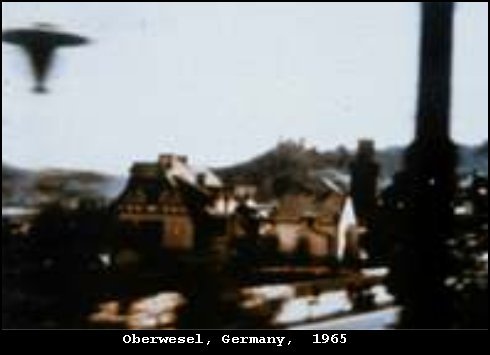
For sixty years this photo has circulated with the same two sentences: a passenger on a Rhine valley train saw a dark disc rise alongside the carriage and caught it on film. The witness was never traced, the negative was never examined, and the most thorough catalog of cases like it identified the "disc" as something trains pass every few seconds.
What did witnesses see at Oberwesel?
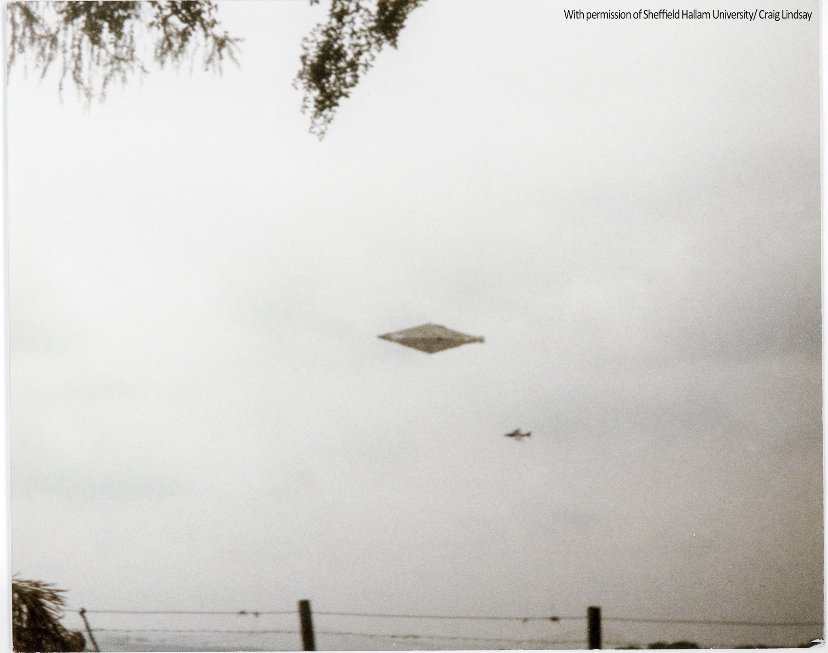
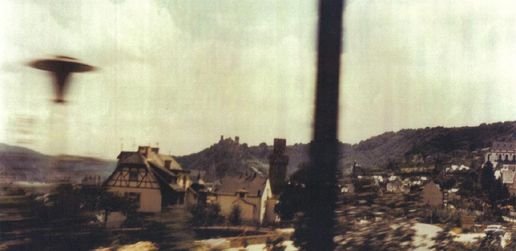
A blurred dark disc or spindle shape with a whirling smear beneath it, against the Rhine riverside landscape. The caption that has circulated since the photo books of the 1980s: passenger Harry Haukler, riding a train through Oberwesel, saw a dark disc rise into the air alongside the train and snapped one photo. Even the date is unstable; archives carry both 8 March and August 1964.
More footage and images of this sighting
What is the official explanation?
No official investigation of any kind, German or otherwise. The case exists purely in civilian UFO literature, and NICAP's own archive note concedes the report lacks crucial details and that the photo may not show a real object. The earliest traceable print source is a 1986 photo book.
What did the witnesses think it was?
Harry Haukler is a name only: no interview, no biography, no camera data, and no first-hand account beyond the recycled caption has ever surfaced.
The dispute
The dispute is that the Oberwesel photograph almost certainly shows no flying object at all, but rather a stationary trackside structure smeared into a disc by camera motion. The specific counter-explanation comes from the FOTOCAT catalog, the photographic case database maintained by Vicente-Juan Ballester Olmos, which groups Oberwesel with several visually identical photographs and identifies a concrete mechanism: a trackside pole, sign, or lamp post crossing rapidly in front of a camera shooting from a moving vehicle, which produces exactly this blurred disc-with-appendage form. The Caelestia project goes further and files the image flatly as an identified lamp post. This is not an apparatus assertion or a hand-wave. It is a named, method-shown counter-explanation that points at an ordinary object, backed by a demonstrated technique and by a pattern of look-alike images that behave the same way, which is what gives it real weight.
What makes that prosaic reading hard to resist is that the case has almost no evidentiary spine to defend. There was no official investigation of any kind, German or otherwise. The case lives entirely in civilian UFO literature, and NICAP's own archive note concedes the report lacks crucial details and that the photo may not show a real object. The named witness, Harry Haukler, is a name only, with no interview, no biography, no camera data, and no first-hand account beyond the recycled caption. The earliest traceable print source is a 1986 photo book, decades after the claimed 8 March 1964 date (some archives say August 1964), and the basic facts are unstable down to the month.
Where it falls short of closing the core claim is the physical evidence. The original negative was never examined, so the one piece of evidence that could confirm or kill the motion-blur reading was never put under analysis. The photographic chain was never reconstructed for this exact frame. FOTOCAT identifies the mechanism by analogy to visually identical photos rather than by proving it on Oberwesel's own negative, and the only member of that look-alike family verified down to its real-world object is a different photograph, the Andorra 1975 image, not this one. No lamp post, pole, or sign at the Oberwesel trackside has ever been located and tied to this picture, and no analyst has positively identified the specific object that produced it. There is no confession and no recovered prop. So the counter-explanation comes very close to settling the image as ordinary, and the disc almost certainly is not a real object, but the specific claim is undercut by resemblance rather than formally closed by proof on this frame.
Is the Oberwesel Train Photo real? The two-pass assessment
Pass one, the ordinary reading. The skeptical case here is strong and it is not a hand-wave. The FOTOCAT catalog, the photographic case database maintained by Vicente-Juan Ballester Olmos, groups Oberwesel with a family of visually identical photographs and names a concrete mechanism: a trackside pole, sign, or lamp post crossing rapidly in front of a camera shooting from a moving train, which smears a stationary object into exactly this dark disc with a whirling appendage beneath it. The Caelestia project files the image flatly as an identified lamp post. The mechanism is real and it has been demonstrated to produce this precise form. The case also has almost no spine to defend against it. There was no official investigation of any kind, German or otherwise. NICAP's own archive note concedes the report lacks crucial details and that the photo may not show a real object. The named witness, Harry Haukler, is a name only, with no interview, no biography, no camera data, and no first-hand account beyond the recycled caption. The earliest traceable print source is a 1986 photo book, more than two decades after the claimed date, and the basic facts are unstable down to the month, with archives carrying both 8 March and August 1964. On the ordinary reading this is a motion-blurred piece of trackside furniture, and very little stands in the way of that conclusion.
Pass two, what survives. What survives is narrow but specific: the mechanism was never actually run on this photograph. The original negative was never examined. The photographic chain was never reconstructed for this exact frame. FOTOCAT identifies the cause by analogy, by sorting Oberwesel into a look-alike family, rather than by proving the blur on Oberwesel's own film. And the family itself does the heavy lifting on resemblance, not on this case: the only member physically verified down to the real-world object is a different photograph, the Andorra 1975 image, not this one. No lamp post or sign at the Oberwesel trackside has ever been tied to this picture, and no analyst has positively identified the specific object behind it. So the decisive physical evidence, the one thing that could confirm or kill the motion-blur reading, was never put under analysis.
Verdict: Barely Disputed. This sits a clear step below Strongly Disputed because none of the three closing moves is present. There is no confession from anyone connected to the photo. There is no recovered prop, no located lamp post or sign tied to this event. And there is no positive identification of the specific object that produced this image, only a mechanism asserted by resemblance to other pictures. A method-shown counter-explanation that is proven on a sibling photo and assumed for this one is exactly the profile of a case that largely fails to stand on its own merits yet is not formally closed. The threadbare evidence cannot withstand the prosaic reading, so the disc almost certainly is not a flying object. But the page stops short of discredited because the proof was never run on this frame.
Sources
More cases from this region: UFO sightings in Germany