The Palomar Sky Survey Transients: Pre-Sputnik Flashes Linked to Nuclear Tests and UAP Reports (Palomar Observatory, California, 1949 to 1957)
More than a hundred thousand star-like flashes sit inside photographic plates exposed between 1949 and 1957, before any artificial satellite existed. Two papers released in September 2026 place them 20,000 to 35,000 kilometres above the Earth and clustered over a handful of specific places on the ground.
What did witnesses see at Palomar Observatory?
The Palomar sky survey flashes are a genuine astronomical puzzle from the years before Sputnik. They appear on one photographic plate and never again.
Between 19 November 1949 and 28 April 1957 the first Palomar Observatory Sky Survey, known as POSS-I, photographed the northern sky onto glass plates from Palomar Mountain in San Diego County, California. Decades later the VASCO project, short for Vanishing and Appearing Sources during a Century of Observations, digitised those plates and began cataloguing point sources that behave like nothing in the sky today. The working sample now runs to 107,875 transients. Each one is star-like and compact, each sits in a single exposure, and each is absent from every later survey of the same patch of sky.
The shape of the images is the part that carries the argument. The sources show compact, circular point-spread functions rather than the streaks a moving object leaves across a long exposure, which the researchers read as very brief flashes rather than steady points of light. The September 2026 modelling paper puts the characteristic flash duration at roughly 320 milliseconds and describes the profiles as consistent with specular reflection, the mirror-like glint a flat polished surface throws when the angle between the Sun, the surface and the camera happens to line up.
That reading has an obvious modern parallel, and the authors state it themselves rather than hiding it. Transients with the same signature turn up routinely in present-day sky surveys and are generally interpreted as glints off human-made satellites and space debris at high altitude. The difficulty is chronological. POSS-I finished its run in April 1957 and Sputnik 1 launched in October 1957, so whatever threw these flashes was above the Earth before anything had been put there.
More footage and images of this sighting
What is the official explanation?
There is no official narrative attached to this case, and that absence is itself worth stating plainly. No agency has assessed the POSS-I transients. The All-domain Anomaly Resolution Office has not commented on them, no government body has claimed or disclaimed them, and nothing in the Department of War PURSUE releases touches the Palomar plates. The tier here is Unknown for the strict reason the method page sets out: no official explanation exists to weigh.
What does exist is peer review. The statistical core of the case was published in Scientific Reports on 20 October 2025 under the title "Transients in the Palomar Observatory Sky Survey (POSS-I) may be associated with nuclear testing and reports of unidentified anomalous phenomena", DOI 10.1038/s41598-025-21620-3, by Stephen Bruehl of the Department of Anesthesiology at Vanderbilt University Medical Center and Beatriz Villarroel of Nordita at the KTH Royal Institute of Technology and Stockholm University.
That paper built a daily dataset covering 19 November 1949 to 28 April 1957, a span of 2,718 days, and joined three records: transients identified on the plates, above-ground nuclear tests, and reported UAP sightings. Transients appeared on 310 of those days, which is 11.4 per cent, and none at all on 88.5 per cent of them. At least 124 above-ground nuclear tests were conducted from 1951 until the Sputnik launch. A transient was 45 per cent more likely to be recorded on a date within one day either side of a test than outside that window. Sharpening the window tightens the result: transients appeared on 18.5 per cent of the days immediately following a test, which the paper states as a 68 per cent higher chance than on days unconnected with testing. Separately, for every additional UAP report logged on a given date there was an 8.5 per cent increase in the number of transients identified that date. The follow-up modelling paper describes these temporal correlations as sitting at the three sigma level.
Two further papers went up in September 2026 and are the reason this case is being written now. Both are preprints and have not completed peer review, which the archive states rather than glosses.
What did the witnesses think it was?
The people looking at this material are astronomers and statisticians rather than eyewitnesses, and the useful testimony is what their measurements constrain.
The first September paper, "Modelling Palomar Transients: Constraints from Reflection Geometry and Orbital Altitude" (arXiv 2609.05105, submitted 4 September 2026), is by Beatriz Villarroel, Alina Streblyanska of the Instituto de Astrofisica de Canarias, Hichem Guergouri of CERIST in Constantine, Algeria, Brian Doherty, Matthew Shultz and Stephen Bruehl. It asks where the objects were, using the one thing an orbiting reflector cannot avoid: the Earth's shadow. Sunlight cannot reach an object inside the shadow cone, so a population at a given altitude must show a measurable deficit of flashes in the direction opposite the Sun, and the angular width of that deficit encodes the altitude.
Run on the angular profile of the deficit around the antisolar point, the method returns a characteristic altitude of about 20,000 to 25,000 kilometres. A second and broader estimate based on the altitude dependence of the global shadow deficit gives about 20,000 to 35,000 kilometres, extending into the geosynchronous region at 35,786 kilometres. Across that adopted range the inferred sizes of the reflecting facets run from centimetre scales up to roughly 3 metres, with inferred rotation rates near 0.2 revolutions per minute, which is very slow.
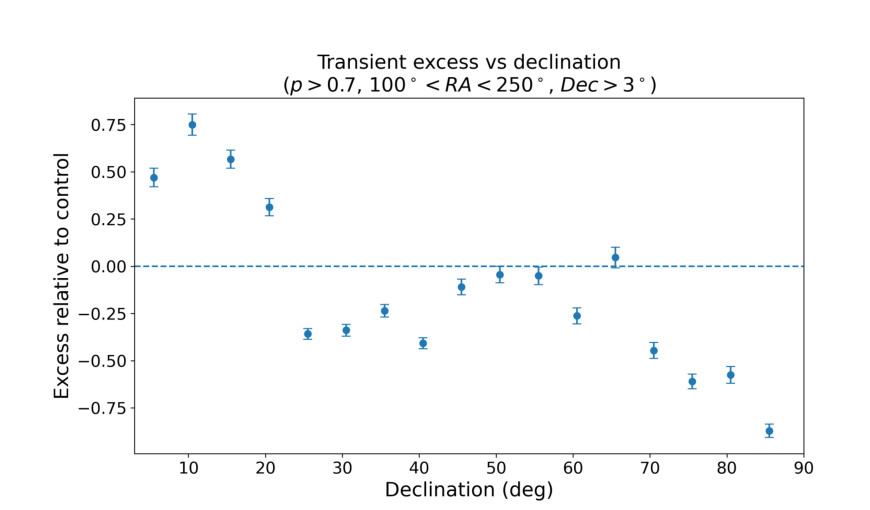
A second geometric result cuts against the simplest natural answers. Asteroids, comets and zodiacal dust concentrate near the ecliptic plane. The high-probability Palomar transients do the opposite: they are depleted near the ecliptic and show a pronounced excess at low declinations near the celestial equator, which is where Earth-orbiting populations sit rather than Solar System debris.
The paper also reports a morphological detail it cannot fully explain. Flashes often occur in near-collinear groups along a path, with activity concentrated at the start and end of the track, and closely spaced double flashes appear at those endpoints. The doubles are separated perpendicular to the direction of travel rather than along it, by an angular separation of about 5 arcseconds, which the authors say is not readily explained by one reflecting facet flashing twice and points instead to multiple surfaces or an extended structure.
The second September paper, "Earth-Projected Clustering of Historical Optical Transients in the Palomar Observatory Sky Survey-I (POSS-I)" (arXiv 2609.09461, submitted 8 September 2026 and revised 21 September 2026), is led by Stephen Bruehl with Villarroel, Guergouri, Doherty and Streblyanska. Taking the geosynchronous altitude estimate as given, it projects each transient down to the latitude and longitude it would have sat above, then tests whether those ground positions are random.
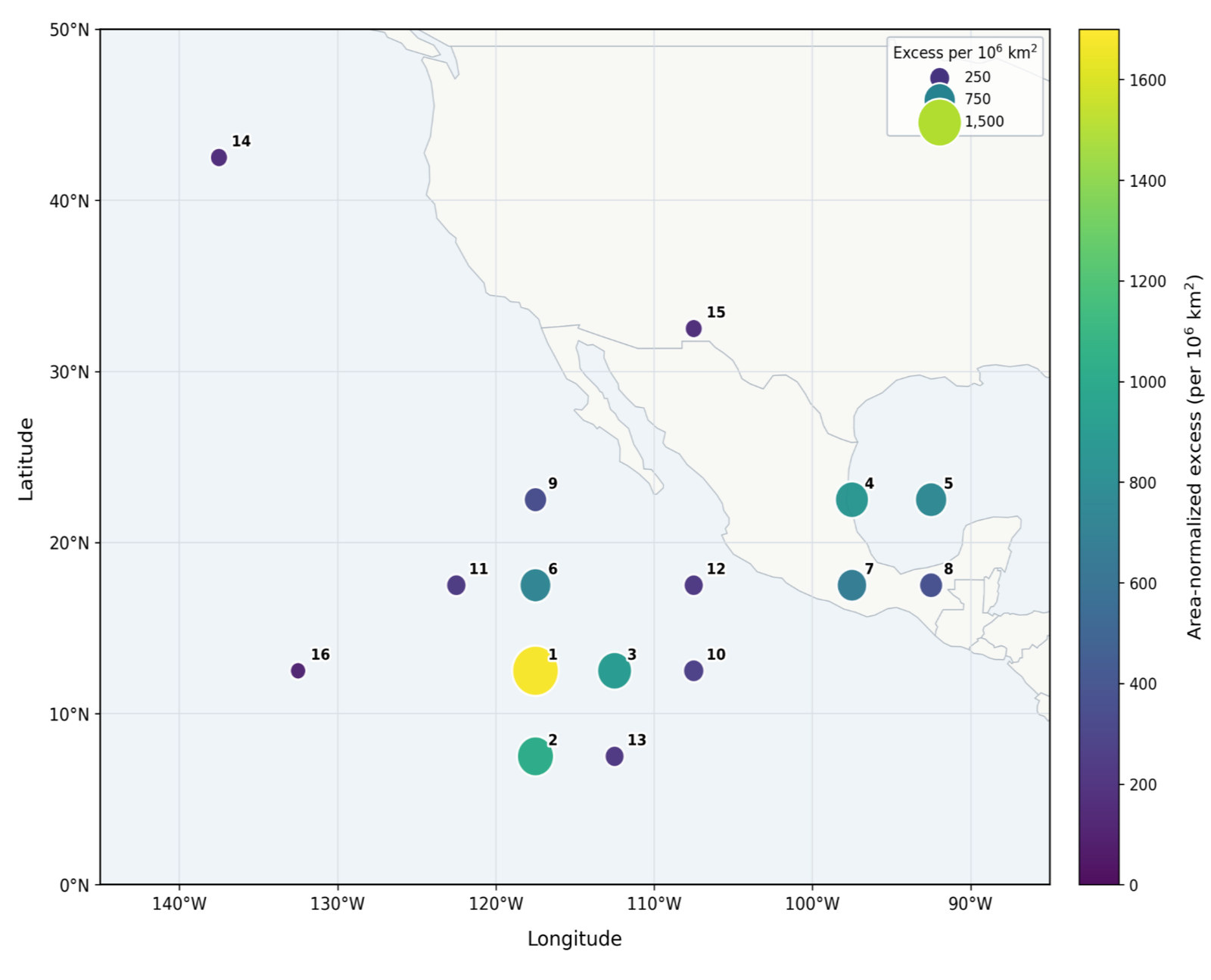
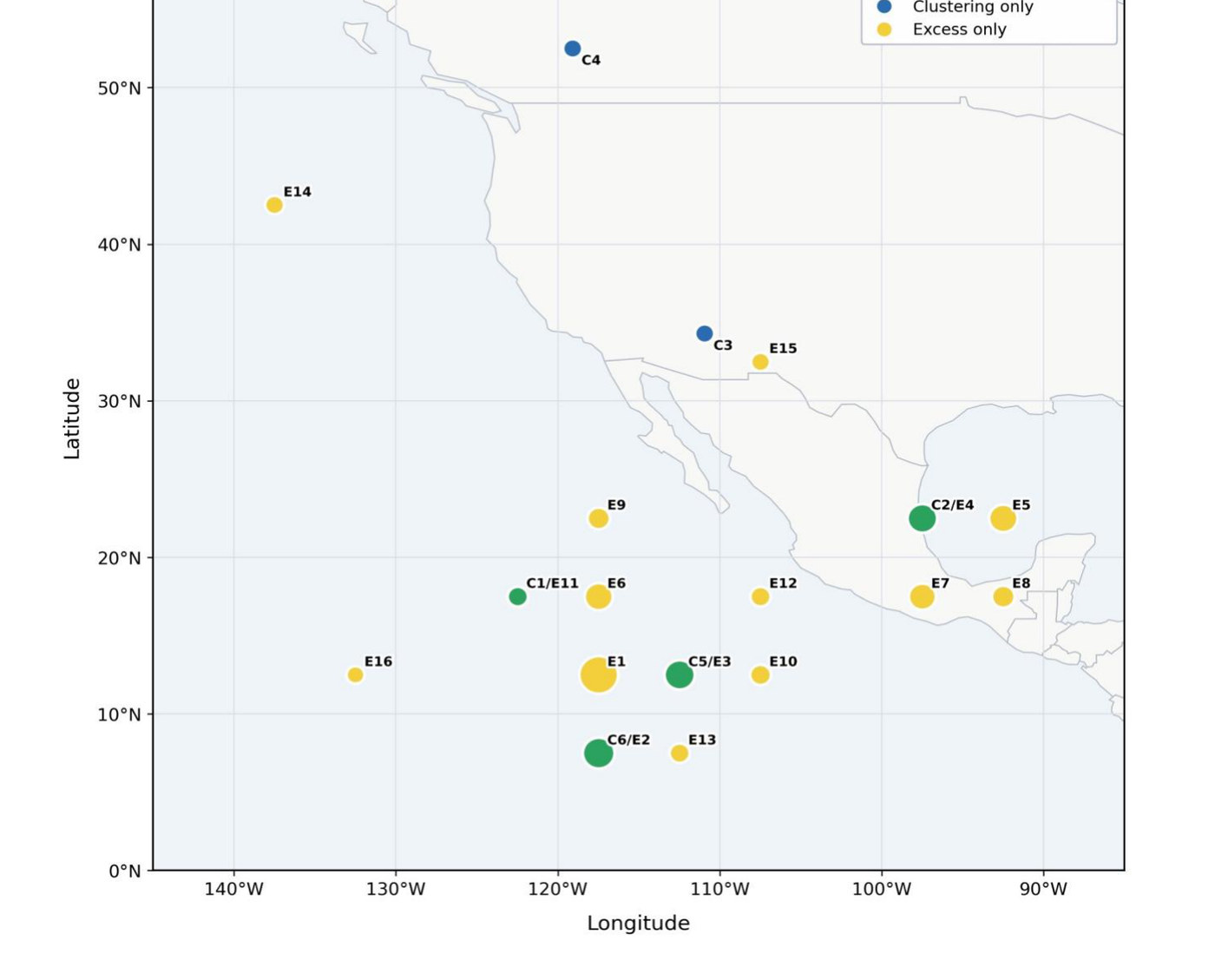
They are not. Comparing counts in 5 degree by 5 degree cells against plate-aware random controls that reproduce the survey's real sky coverage, the analysis found 16 statistically significant hotspots. An independent two-step cluster analysis found 6 highly distinct clusters with a silhouette value of 0.70, against 0.60 in random control samples. Three regions came out of both methods: the eastern Pacific off the west coast of southern Mexico and Central America, the southern Gulf of Mexico, and the southwestern United States around Sedona in Arizona and the Deming, White Sands and El Paso corridor.
The nuclear result then acquires a geography. Transients accounting for the reported testing association showed location specificity at p below .0001: exclusively Pacific positions during Pacific testing, and primarily southwestern United States positions during testing at the Nevada site. The modelling paper notes that the statistical findings on the nuclear correlation have been independently reproduced by Doherty, by Cann and by Sinkkonen in separate 2026 work.
Is the Palomar Sky Survey Transients: Pre-Sputnik Flashes Linked to Nuclear Tests and UAP Reports (Palomar Observatory, California, 1949 to 1957) real? The two-pass assessment
Pass one, how could this be mundane. The strongest prosaic candidate is the one the researchers spend the most effort on: plate defects. Emulsion flaws, dust grains and radioactive contamination all produce star-like marks on a single plate and on no other, which is exactly the observational signature at issue. The VASCO team's answer is a machine-learning classifier trained to separate defects from genuine astronomical point sources, and the clustering analysis uses only a high-probability subset selected by that model. The clustering paper concedes, without being pushed, that a single plate carrying an unusual number of star-like defects could manufacture an apparent hotspot in both of its analyses, and that because both analyses draw on the same transient sample their agreement alone does not rule this out. Its stated defence is that most hotspots were supported by multiple independent plates.
The second prosaic candidate is survey bias. If POSS-I simply photographed some parts of the sky more often, apparent hotspots would follow the schedule rather than the sky. This is the objection the plate-aware random controls were built for, and the paper reports that one of its own results failed that test: the cluster over British Columbia in the real data appears in the random control data too, so the authors flag it as probably an observing artefact and set it aside. A paper that discards one of its own clusters is behaving properly.
A third candidate is natural debris, and here the modelling paper argues against its own convenience. Pure ice fragments should sublimate away at these altitudes rather than persist. Diffuse reflectors, meaning dirty icy or rocky material, should smear into elongated profiles across the exposure and would need far larger reflecting areas to reach the observed brightness, neither of which matches compact sub-second points. Short-lived cometary debris should show irregular or rapidly evolving rotation rather than the slow stable tumble the photometry implies. Metallic asteroid fragments with freshly exposed flat faces remain on the table, though the authors note that the charged-particle environment should roughen surfaces rather than polish them, and describe the polishing idea as speculative.
The honest limits of the geography belong in pass one as well, and the clustering paper states them itself. The fixed 5 degree grid means a broad concentration can be split across adjacent cells while a tight one inside a cell cannot be resolved, so the 16 hotspots must not be read as 16 independent physical sites, and the centre of a significant cell is not the centre of the underlying concentration. The authors call for replication at multiple cell sizes, with shifted grid origins, and with plates from other observatories.
Pass two, if the correlations are real. Three measurements point the same way and none of them depends on believing anything about UAP. The shadow-deficit geometry puts the population in Earth orbit rather than in the Solar System at large. The declination distribution puts it near the equatorial plane, where orbital populations live and where asteroid and comet debris does not. The flash morphology says the reflectors are flat, polished and slowly turning rather than round and rough. Together those describe a population of small specular surfaces in high Earth orbit during a period when the human species had put nothing in orbit at all.
The authors explore both natural and non-natural toy models and decline to close the question, and the archive follows them. Their modelling favours non-smooth geometries, which they list as cubes, icosahedra or flying saucer-like shapes, over simple spheres, and they note that the inferred properties resemble the size and behaviour of objects reported by Redstone-Mercury and Apollo astronauts, adding that the same population might already be present in the 1950s plates while being interpreted later as material shed from spacecraft. That is a speculation and is labelled as one on the page.
What the case does not support is any claim that these flashes are the same phenomenon as ground-level UAP sightings. The link between the two is statistical and indirect: on days when more UAP reports were filed, more transients were recorded on the plates. Correlation across a daily time series does not identify the objects, and a shared driver, including some unrecognised atmospheric or geophysical effect of the tests themselves, remains live. The peer-reviewed paper's own framing is that the findings may help elucidate the nature of POSS-I transients, which is a considerably narrower claim than the headlines it produced.
The tier is Unknown. Two independent geometric methods and a peer-reviewed statistical result agree that something reflective was in high Earth orbit before Sputnik, the prosaic candidates have been tested rather than waved at, and no official body has offered any account at all. The September 2026 papers are preprints and the case will be revised as they clear review or fail to.
Sources
- www.nature.com/articles/s41598-025-21620-3
- arxiv.org/abs/2609.05105
- arxiv.org/abs/2609.09461
- www.scientificamerican.com/article/did-astronomers-photograph-ufos-orbiting-earth-in-the-1950s/
- www.space.com/space-exploration/search-for-life/were-unexplained-flashes-of-light-in-70-year-old-sky-surveys-caused-by-ufos-or-nuclear-testing-why-not-both-researchers-say
- www.nbcnews.com/video/new-study-links-flashes-in-1950-to-ufo-sightings-270339653550
- www.sci.news/astronomy/cold-war-transients-14688.html
- www.minorplanetcenter.net/iau/lists/ObsCodesF.html