The 1947 Roswell Crash
On a Tuesday afternoon, 8 July 1947, the public information officer at Roswell Army Air Field, 1st Lt Walter Haut, handed the local press a release on the authority of base commander Colonel William Blanchard. This case file covers what witnesses reported, the official narrative, and a two-pass assessment with its evidence tier.
What did witnesses see at Foster Ranch?
On a Tuesday afternoon, 8 July 1947, the public information officer at Roswell Army Air Field, 1st Lt Walter Haut, handed the local press a release on the authority of base commander Colonel William Blanchard. It opened: "The many rumors regarding the flying disc became a reality yesterday when the intelligence office of the 509th Bomb Group of the Eighth Air Force, Roswell Army Air Field, was fortunate enough to gain possession of a disc through the cooperation of one of the local ranchers and the sheriff's office of Chaves County." The Roswell Daily Record ran it the same afternoon under the banner "RAAF Captures Flying Saucer On Ranch in Roswell Region." For a few hours, the United States Army had officially told the world it held a flying disc.
The rancher was William Ware "Mac" Brazel, foreman of the Foster Ranch about 75 miles northwest of Roswell, near Corona. Weeks earlier, riding out after a violent thunderstorm with the young neighbor boy Dee Proctor, Brazel had come on a wide scatter of wreckage strewn across the pasture: not a smooth disc, but a litter of light, tough material. He collected some, showed pieces to neighbors Floyd and Loretta Proctor, and after the "flying saucer" talk filled the papers in early July he drove to Roswell and reported it to Sheriff George Wilcox on 6 to 7 July. Wilcox called the air base. The base sent its intelligence officer, Major Jesse A. Marcel of the 509th, the only group then cleared to handle atomic weapons, together with a Counter Intelligence Corps man, Sheridan Cavitt.
Brazel's own description, printed in the Roswell Daily Record of 9 July 1947 under the headline "Harassed Rancher Who Located 'Saucer' Sorry He Told About It," is one of the cleanest first-hand records in the whole case. He said the find was rubber strips, tinfoil, "a rather tough paper," sticks and tape, with some pieces carrying small "eyelets." He estimated the whole gathered bundle weighed only about five pounds and, when laid out, the foil and paper and sticks would have made a bundle three feet long and seven or eight inches thick. He said there was no sign of any metal engine, no propeller, no instruments, and that he could not make the pieces fit together into anything resembling a kite or a balloon. He added that he had previously found two weather balloons on the ranch and that "what he found this time did not in any way resemble either of these."
Marcel went further. In interviews recorded from 1978 to 1979 (the ones that pulled the case out of obscurity), he described foil-thin metal that "was possible to flex back and forth, even to wrinkle, but you could not put a crease in it that would stay, nor could you dent it." He said the small structural beams "were very hard, although flexible, and would not burn," and that he held his cigarette lighter to a parchment-like piece and it "would not burn, wouldn't even smoke." He recalled small markings, like figures, along some of the beams. He drove a carload of the debris back to Roswell, stopped at his own house in the middle of the night and woke his wife and eleven-year-old son, Jesse Marcel Jr, to show them. The son, who became a physician and Army flight surgeon, gave a consistent account of the same materials for the rest of his life, including the foil that sprang back flat and a beam with violet or pink geometric symbols.
What is the official explanation?
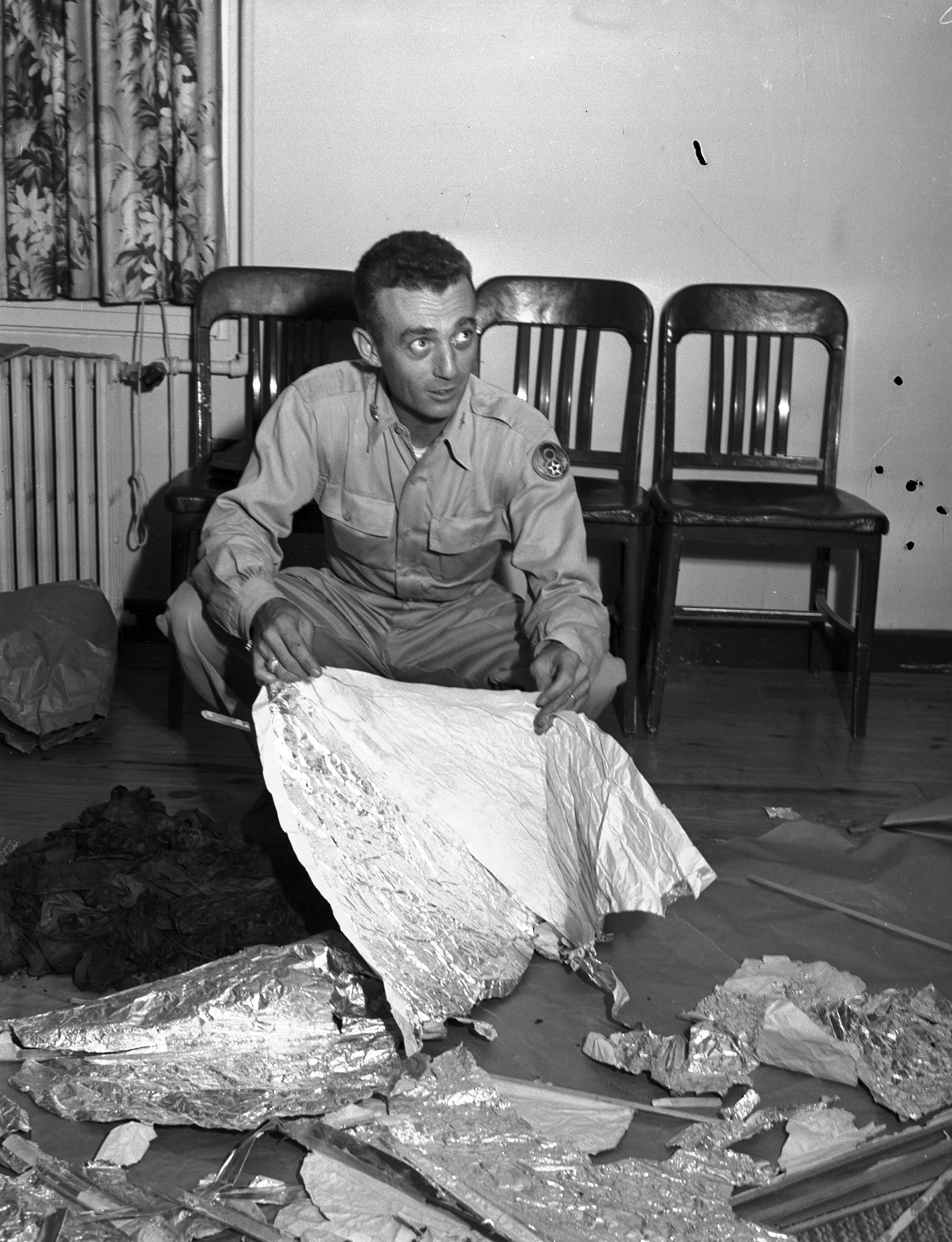
The official posture reversed within a single day, and that reversal is the spine of the case. Hours after Haut's "flying disc" release, the debris had been flown to Eighth Air Force headquarters at Fort Worth Army Air Field, Texas. There the commanding general, Brigadier General Roger Ramey, with his chief of staff Colonel Thomas DuBose and weather officer Warrant Officer Irving Newton, told the press it was nothing but a misidentified weather balloon and its radar reflector. Fort Worth Star-Telegram photographer J. Bond Johnson photographed Marcel kneeling on the office carpet holding the foil and balsa wreckage, and those pictures, carried nationally on 9 July 1947, became the canonical images of the case. Newton identified the material as a standard rawin radar target. The "captured disc" story was dead by the next news cycle.
The contemporaneous federal paper trail is thin but pointed. An FBI teletype from the Dallas field office, timestamped 7-8-47 and marked URGENT to the Director and to the SAC at Cincinnati, recorded what the Eighth Air Force had told the Bureau by phone: "THE DISC IS HEXAGONAL IN SHAPE AND WAS SUSPENDED FROM A BALLON BY CABLE, WHICH BALLON WAS APPROXIMATELY TWENTY FEET IN DIAMETER." The teletype then states the object "RESEMBLES A HIGH ALTITUDE WEATHER BALLOON WITH A RADAR REFLECTOR, BUT THAT TELEPHONIC CONVERSATION BETWEEN THEIR OFFICE AND WRIGHT FIELD HAD NOT BORNE OUT THIS BELIEF," and that the "DISC AND BALLOON BEING TRANSPORTED TO WRIGHT FIELD BY SPECIAL PLANE FOR EXAMINATION." That single line, that Wright Field had not borne out the weather-balloon belief, is the strongest official-era hint that men inside the chain were not satisfied with the balloon answer even on day one.
For decades there was no government investigation at all. That changed in the 1990s. At the request of Congressman Steven Schiff of New Mexico, the General Accounting Office searched federal holdings and on 28 July 1995 issued report GAO/NSIAD-95-187, "Government Records: Results of a Search for Records Concerning the 1947 Crash Near Roswell, New Mexico." The GAO found only two surviving 1947 records: the 509th Bomb Group history noting recovery of a "flying disc," and the FBI teletype above. More striking was what was gone. The GAO found that Roswell Army Air Field administrative records covering March 1945 to December 1949, and all outgoing messages from October 1946 to December 1949, had been destroyed, and that the disposition form "does not indicate what organization or person destroyed the records and when or under what authority."
The Air Force answered first in a 1994 report and then in a 1997 follow-up, "The Roswell Report: Case Closed," largely written by 1st Lt James McAndrew with Colonel Richard Weaver. The Air Force concluded "with a great degree of certainty" that the debris came from Project Mogul, a then-classified program of high-altitude balloon trains, mostly neoprene balloons with rawin radar reflectors, sonobuoys and a battery box, designed to detect Soviet nuclear tests by listening for the shockwave in the upper atmosphere. It pinned the wreckage specifically on NYU Mogul Flight 4. The 1997 report addressed the later "bodies" reports by attributing them to anthropomorphic crash-test dummies dropped from high-altitude balloons in the 1950s, a chronology many on all sides found unconvincing because those drops postdate 1947 by years.
What did the witnesses think it was?
Marcel believed to his death in 1986 that the debris was not man-made. In his recorded accounts he was explicit that he had handled weather balloons and radar targets in his career and that this was nothing of the kind, and he resented being photographed with substituted balloon wreckage at Fort Worth, insisting the material he flew from the ranch did not look like what appeared in Ramey's office. His credibility has been attacked (his self-described military record was later shown to be inflated in places), and that is fair to log, but his core physical description of the material has never depended on his resume, and it is corroborated.
The corroboration is the reason this case did not die as one man's story. Jesse Marcel Jr, a credentialed physician and military officer with no financial stake, described the same foil that would not hold a crease and the same beams bearing small violet, pink or purple symbols, consistent across decades of telling. Colonel Thomas DuBose, the Fort Worth chief of staff who stood in the room, stated under oath in a 1991 affidavit that the weather-balloon story was a cover and that the real debris had been shipped to Wright Field on higher orders. Bill Brazel, Mac's son, recalled finding leftover scraps on the ranch later and described foil that returned to shape after being balled up, the famous "memory metal." Walter Haut, the officer who wrote the original press release, left a notarized statement to be opened after his death asserting he had seen the craft and bodies, though that document surfaced only in 2007 and is treated cautiously even by sympathetic researchers.
There is also a second testimonial layer that researchers Stanton Friedman and William Moore gathered and that later investigators Kevin Randle and Donald Schmitt pursued: accounts (some firsthand, many secondhand, several from people who were elderly or who reported through relatives) of a separate body-recovery site and of small non-human bodies. The most cited is Grady "Barney" Barnett, relayed through friend Vern Maltais in an official-era interview, describing metallic wreckage and small bodies in the desert. These accounts are genuinely weaker than the debris testimony: they are later, more removed, and in several cases contaminated by the crash-test-dummy and hospital-morgue confusions the Air Force documented. An honest file separates the strong tier (the physical-debris witnesses, the surviving documents, the destroyed records) from the contested body testimony, and does not lean the verdict on the latter.
The dispute
The counter-explanation is that the Roswell debris was not a craft but the wreckage of a classified high-altitude balloon train from Project Mogul, a program built to detect Soviet nuclear tests. This is the official position of the U.S. Air Force, set out in the 1997 "Roswell Report: Case Closed" written by 1st Lt James McAndrew and Colonel Richard Weaver, which attributed the metallic debris to NYU Mogul Flight 4 (neoprene balloons, radar reflectors, sonobuoys, batteries) and attributed the later body reports to crash-test dummies dropped in the 1950s. It traces back to the same-day cover story from Brigadier General Roger Ramey at Fort Worth, who declared the find a weather balloon and radar reflector within hours of the "flying disc" announcement.
Unlike a bare apparatus assertion, this debunk has a civilian method shown behind it. Joe Nickell of the Committee for Skeptical Inquiry and balloon engineer Charles B. Moore demonstrated that aluminized Mylar-type laminate reproduces the exact anomalous properties the witnesses reported: it is extremely light, tear resistant, and springs flat after being crumpled, matching Mac Brazel's "tough paper" and tinfoil and Jesse Marcel's foil that would not hold a crease. They also identified the "hieroglyphics" that Marcel and his son described as the pinkish-purple flower and geometric patterns printed on reinforcing tape from wartime toy manufacturers, tape that was used on the radar targets. That is a concrete, testable account of why the materials looked uncanny without being extraterrestrial.
The case does not close, however, and the page's own documentary record is why. Dr. Albert Crary's diary records "No balloon flight again on account of clouds" for June 4, 1947, the very date Flight 4 was supposed to have launched, meaning the specific flight blamed for the debris may never have flown. Researchers David Rudiak and Brad Sparks found detailed errors in Moore's published Flight 4 reconstruction, and Moore himself shifted from rejecting the balloon explanation in 1979 to firmly endorsing it by 1992 (a shift David Halperin documents as more ambivalent than Moore later admitted). On top of the chronology problem, the FBI teletype states Wright Field "had not borne out" the balloon belief on day one, the GAO found that Roswell base records from March 1945 to December 1949 were destroyed without explanation, Colonel Thomas DuBose swore in a 1991 affidavit that the weather-balloon story was an ordered cover, and Marcel insisted the Fort Worth photos showed substituted material.
So this is a strong, method-shown counter-explanation that is nonetheless substantively contested at its foundation: the identified material is genuinely persuasive, but the launch chronology and the documentary trail leave it unable to fully account for what happened. Per this archive's verdict the case stays in the Disputed tier, with the conventional debunk explaining the debris properties but not the Flight 4 timing problem or the records destruction, so the case largely stands.
Is the 1947 Roswell Crash real? The two-pass assessment
Pass one, the entirely ordinary reading. The material Brazel and Marcel describe (lightweight foil, balsa-like sticks, tough paper, tape, rubber, total weight a few pounds, no engine, no instruments) is a precise match for a balloon-borne radar target, and the official Project Mogul explanation is not a hand-wave. Mogul trains really existed, really launched from Alamogordo in summer 1947, really drifted toward Corona, and really used neoprene balloons with rawin reflectors made of foil-laminated paper on balsa frames. The "memory metal" is the strongest single anomaly, and it is also the most cleanly answered: investigator Joe Nickell of the Committee for Skeptical Inquiry, working with former Mogul scientist Charles B. Moore, showed by hands-on test that aluminized Mylar-type laminate is extremely light, resists tearing, shrugs off hammer blows, and springs back flat after being crumpled, exactly the behavior witnesses found unearthly. The "hieroglyphics" have a mundane candidate too: the reinforcing tape on the radar targets was sourced, during wartime shortage, from a toy and novelty maker and carried pinkish-purple flower and geometric designs, which lines up with the violet symbols the Marcels recalled. On this reading the case is an honest misidentification turned cover-up: the Army hid Mogul (a real secret) behind a weather-balloon lie, then shredded paperwork, and the secrecy itself manufactured the mystery.
Pass two, if it is not that. The Mogul identification has a hard, documented problem that keeps the case open. The Air Force pinned the debris on Flight 4, but the diary of Dr Albert Crary, who ran the New Mexico balloon work, records for 4 June 1947: "No balloon flight again on account of clouds." If Flight 4 was scrubbed, it could not have left the radar-target debris attributed to it, and researchers David Rudiak and Brad Sparks have laid out detailed errors in Moore's published Flight 4 reconstruction. Charles Moore's own behavior cuts against tidiness: in a 1979 interview he reportedly ruled the balloon explanation out on the description given to him, then only in 1992 reversed to firmly identifying the debris as a Mogul neoprene train, a shift David Halperin documents as more ambivalent than Moore later admitted. On top of that sit the surviving FBI line that Wright Field "had not borne out" the balloon belief, the GAO's finding of wholesale unexplained destruction of base records, DuBose's sworn statement that the balloon story was an ordered cover, and Marcel's lifelong insistence that the Fort Worth display was substituted material. If real and not Mogul, the floor interpretation is a recovered aircraft or device of unknown origin that the United States hid behind a balloon story; the ceiling, advanced by the body witnesses, is a crashed craft with non-human occupants.
Weighing it under this archive's rules: the official-apparatus debunk (the same-day reversal, the cover-story photos, the destroyed records) is logged in pass two as evidence the event was real enough to need closing, not as a strike against the case. The only method-shown, civilian, independent analysis on the table, Nickell and Moore's memory-metal demonstration, genuinely explains the most famous anomaly and pushes hard toward a balloon. But that analysis does not close the case, because the very flight it relies on (Flight 4) is contradicted by the project director's own diary, and because the documentary record (the FBI teletype, the GAO destroyed-records finding, the DuBose affidavit) is not accounted for by "a man mistook a radar target for a saucer." A counter-explanation exists and is serious; it does not finish the job. That is the textbook definition of the Disputed tier, tierClass contested, and that is where this stands.
Sources
- ufologie.patrickgross.org/rw/f/fbimemo01.htm
- sgp.fas.org/othergov/roswell.html
- gao.justia.com/executive-office-of-the-president/1995/7/government-records-nsiad-95-187
- muller.lbl.gov/teaching/physics10/Roswell/USMogulReport.html
- skepticalinquirer.org/newsletter/roswell-ufo-strange-metal-mystery/
- www.davidhalperin.net/roswell-and-mogul-the-memories-of-charles-b-moore-part-1/
- kevinrandle.blogspot.com/2022/12/roswell-crash-date-and-mogul-problem.html
- web.archive.org/web/20251126104948/https://www.angelfire.com/indie/anna_jones1/daily_record.html
- web.archive.org/web/20251217102749/https://www.angelfire.com/indie/anna_jones1/daily_record02.html
More cases from this region: UFO sightings in United States