The Rotating Cube UFO Video: An Unattributed Viral Clip, Measured
A pale cube turning above a desert ridgeline spread across social media in November 2026 with no witness, no location and no date attached to it. Measurement finds one clear defect, and it is in the soundtrack rather than the picture.
What did witnesses see?
A fifty nine second video of a pale cube turning slowly above a hazy desert ridgeline began circulating in November 2026. It carries no witness, no location and no date, and no person has ever claimed to have filmed it.
The oldest traceable appearance of the footage is an upload to X timestamped 8 November 2026 at 20:26:52 UTC. The media identifier that X assigns at upload, 2119527094288060416, decodes to that moment. The post that carried it into circulation came from the account @UAPWixy, an aggregator with 44,815 followers, eight hours and thirty eight minutes later, at 9 November 2026 05:05:00 UTC. The post's media facet carries no replacement field, which means the account uploaded the file itself rather than re-sharing another user's post, so the trail ends at an aggregator and not at a camera.
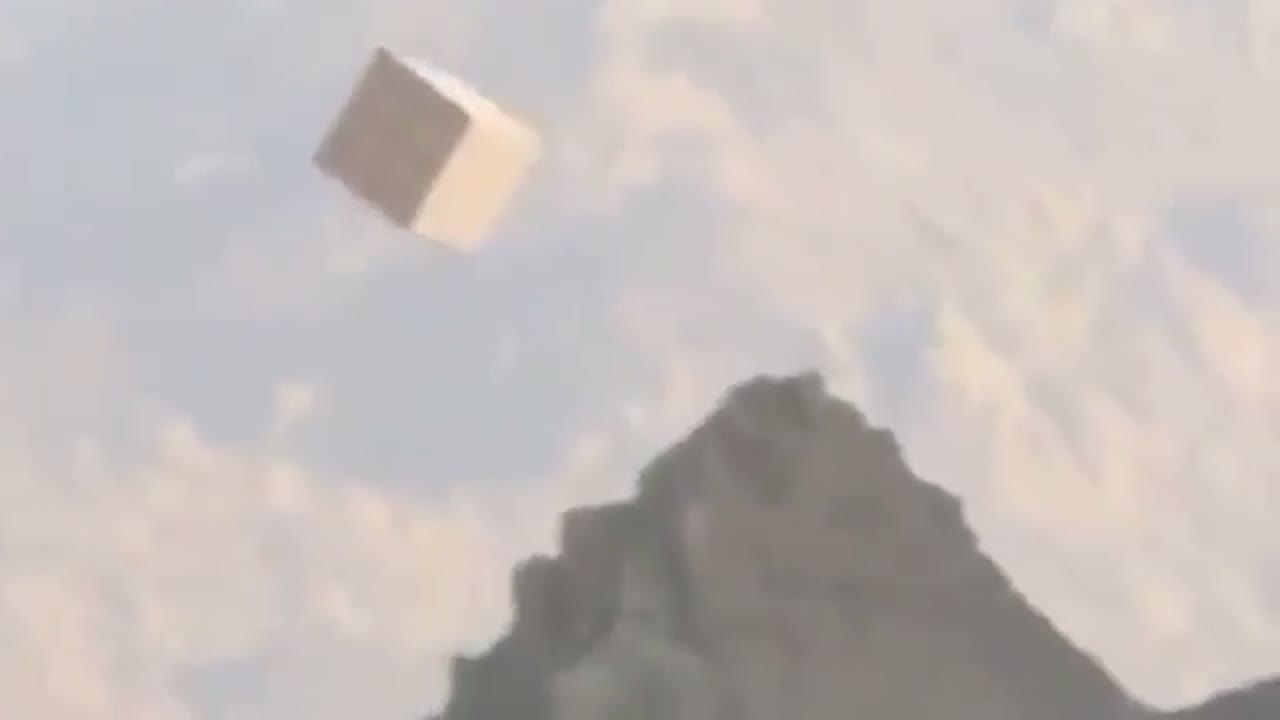
The caption is the entire claim ever made for the clip, and it reads in full: "A 'Cube' shaped UFO spins while it hovers behind these mountains." No place is named. No date of filming is given. No witness is identified. Every later description of this object, including the ones calling it a sighting, rests on that one sentence.
The file as served is 640 by 360 pixels, thirty frames per second, 1,772 frames, 59.095 seconds, with a stereo soundtrack. The object is a cube of roughly sixty to seventy pixels across at its largest, rendered with a shadowed face and a sunlit face, turning as it drifts. It ends the clip by passing behind a ridge, which is the only depth information the footage offers and which places the object at or beyond the distance of that ridge.
More footage and images of this sighting
What is the official explanation?
There is no official narrative of any kind. No agency has been asked about this footage, no agency has commented on it, and because no location or date has ever been attached to it there is no jurisdiction that could be asked.
This matters more than it usually would. The ordinary instruments this archive reaches for all require a place and a time: an aviation weather record to establish whether the sky was visible, a solar or lunar ephemeris to test a light source, a flight history to test an aircraft, a launch catalogue to test a re-entry. None of them can be run on a clip with no coordinates and no clock. The absence of an official position is not secrecy here, it is the predictable consequence of an anonymous upload.
What did the witnesses think it was?
There is no witness. That is the central fact of this case and it should not be softened.
The account that posted the clip did not claim to have filmed it, did not say where it was filmed, and did not say when. No person has since come forward. Searches of the usual sighting databases for a matching report turned up nothing that could be tied to this footage.
The substantive response came instead from a researcher. Brian Decker, who writes at Enigmatic Ideas, published an analysis on 12 November 2026 and posted it to r/UFOs himself, which makes that thread a primary document rather than second-hand chatter. Rather than argue about the video, he asked a better question: how often has anyone ever reported a rotating cube at all?
Working from the National UFO Reporting Center database, which held 162,714 reports in the release he used, Decker found 168 filed under the cube shape, about one in every 969. Of the 160 that carried coordinates, the reports spread across 41 states with no dramatic hotspot, roughly tracking population density, with Florida the strongest single state and Oklahoma over-represented for its size. Forty three were international, the United Kingdom and Canada leading with eight each across more than twenty five countries.
He then mined the narrative text rather than trusting the shape field, and found that only 27 reports in the whole database describe a rotating or spinning cube, 18 of them within the last six years. He published all 18 with their report numbers, dates and locations.
Decker is careful about his own data in a way his coverage has not been. He points out that NUFORC asks witnesses to pick a shape from a fixed list, and that the chosen shape often contradicts the witness's own words. His example is an Oklahoma report filed as a cube whose narrative describes a large stationary object and two spheres, with no cube mentioned anywhere. His count of 168, he says plainly, is therefore an estimate.
His conclusion is that most cube reports are probably cube-shaped mylar balloons catching the sun, and that the spinning is simply what a tumbling balloon looks like when it has flat faces, since a spinning sphere still looks like a sphere. He does not stretch it further than that: "But I can't explain all of them away, either."
The commenters in his own thread supplied the specific technical objections to the video: that the rotation axis changes at about nine seconds, that a close-up repeats on a thirty second cycle, that the audio repeats, and that the cube holds steady while the camera shakes. Those are claims with evidence attached, so this archive tested them rather than repeating them.
Is the Rotating Cube UFO Video: An Unattributed Viral Clip, Measured real? The two-pass assessment
PASS ONE: how could this be mundane, and what does measurement actually show?
Four tests were run on the file itself. Two of them found nothing, and those are reported first because a case that only lists its hits is not evidence, it is advocacy.
The background is as rigid as genuine footage. If a scene is generated rather than filmed, the terrain tends to deform, so that no single projective transform can reconcile one frame with the next. This was tested by tracking features with Lucas-Kanade optical flow and fitting a homography with RANSAC over half second frame pairs, with every clip resampled to the same 640 by 360 working resolution. The clip returned an inlier fraction of 0.817 and a median reprojection residual of 0.79 pixels. Five genuine handheld clips already published by this archive were run through the identical pipeline as controls and returned inlier fractions from 0.797 to 0.985 and residuals from 0.12 to 0.90 pixels. The subject sits inside that range on both measures, and one control is worse than it on both. So the claim that the background changes is not supported, and an initial impression from a contact sheet that the ridge was morphing turned out to be ordinary panning and zooming.
The haze is consistent with the geometry the caption claims. The clip ends with the cube passing behind a ridge, so the object cannot be nearer than that ridge and must carry at least as much atmospheric veiling. Measured across frames 1000 to 1200, against a local sky median of 199 grey levels, the cube's shadowed face sits 49 grey levels below sky while the ridge silhouette sits 83.5 below. The cube is therefore the more veiled of the two, at 0.59 times the ridge's contrast, which is what a more distant object should look like. Edge softness is near identical, a ten to ninety percent rise of 6.0 pixels across the cube against 7.0 across the ridge. The object looks artificially crisp to the eye because it is a simple high albedo solid with clean face shading, not because its edges are physically sharper. This test acquits the clip.
The soundtrack is a loop, and this is the one firm finding. The audio energy envelope correlates with itself at a lag of 30.04 seconds at 0.889, which is 6.76 standard deviations above the median across all lags. A spectrogram autocorrelation gives a sharper and more isolated result: a single peak at 30.047 seconds at 0.5395, standing 20.58 standard deviations clear, against a time-shuffled control of -0.0001 and a next-best unrelated lag of 0.195. The clip runs 59.095 seconds, which is 1.97 of those cycles. The repeat is not a copy and paste: the raw waveform correlation at that same lag is only 0.188, against a self-match control of 0.99924 and a shuffled control of 0.00018, so the same audio content has been re-rendered at a different offset rather than duplicated byte for byte, which is what looping and re-encoding produces.
The picture does not share that cycle. A whole-frame correlation sweep across every possible offset found no peak at thirty seconds, or anywhere else: the best non-trivial offset reached 1.04 times the random-pairing control, which is flat. So the audio repeats on a thirty second cycle and the image does not. A soundtrack that cycles independently of the footage it accompanies was laid over that footage. It is not the sound of the scene.
PASS TWO: if the object is real, what would it be?
Nothing in the measurements rules out a physical object, and the two tests that could have impugned the imagery both failed to. On the footage alone, the strongest ordinary candidate is the one Decker reaches for on the base rates: a cube-shaped mylar balloon, tumbling as loose balloons do, catching sunlight on one face while another stays shadowed. That matches the appearance here closely, including the bright face and dark face and the slow irregular turn, and it is consistent with the object drifting steadily in one direction until terrain hides it.
What cannot be done is to test that candidate, because there is no location, no time and no wind record to test it against. The same gap blocks every other candidate.
The honest verdict is narrower than either camp would like. The soundtrack of this clip is demonstrably constructed, which tells you the file was produced rather than simply recorded, and that is a real finding about the artifact. It is not a demonstration that the imagery is synthetic, and the two physical tests available at this resolution both declined to convict. The case is tiered Disputed on that basis and not more harshly.
A NOTE ON THE COVERAGE, AND A CORRECTION
Cybernews published an account of this story on 13 November 2026 which hardens Decker's own hedges into statements he did not make. It reports that "Decker was keen to point out that it wasn't until 2023 that a cube option was checkable." What Decker wrote is the opposite: "I haven't been able to confirm when NUFORC added 'cube' as a shape option," and on Reddit, "I'm not sure when NUFORC added 'cube' as a shape option to their sightings form. So that trend could also just be a result of a new checkbox. If anyone knows this it would be good info." The uncertainty is the point of his sentence, because if the checkbox is new then the post-2023 rise in cube reports may be an artifact of the form rather than a change in the sky. Reported as settled, it quietly resolves the very question he flagged as open.
This archive has now resolved it, and Decker's caution was justified. Archived captures of the NUFORC report form were unreadable on the day this case was first published, because the Wayback Machine answered every request with a rate-limit response, but the same captures read normally on a later attempt. Two of them settle the question. The capture of 26 October 2022 carries a shape menu of 24 options reading Changing, Chevron, Cigar, Circle, Cone, Cross, Cylinder, Delta, Diamond, Disk, Egg, Fireball, Formation, Light, Other, Oval, Rectangle, Sphere, Star, Teardrop, Triangle and Unknown. There is no Cube in it. The capture of 2 June 2023 carries Cube, sitting in alphabetical order between Cross and Cylinder.
So the cube option was added to the NUFORC form at some point between 26 October 2022 and 2 June 2023, and the consequence is the one Decker named: a rise in cube-shape reports dated after 2023 cannot be read as a change in the sky, because before that revision the structured form had no way to record a cube at all. Any trend line across that boundary is measuring the questionnaire.
The same comparison turns up two further things neither Decker nor the coverage mentions, and both cut the same way. The 2023 revision did not only add Cube. It also added Flash and Orb, and it dropped Delta. The entire orb vocabulary that now dominates discussion of this subject therefore entered NUFORC's structured data in the same change, so the same artifact warning applies to orb-shape counts with considerably more force, given how much weight orb reports currently carry. And the 2023 form lets a witness record a First Choice, a Second Choice and a Third Choice of shape where the 2022 form took one, so a single report can now contribute to three shape tallies. Shape counts before and after that revision are not comparable quantities.
One methodological note on how this was established, because it nearly produced a false answer. Three later captures, from April 2025, June 2026 and June 2025, returned HTTP 200 and contained no occurrence of the word cube, which reads at first glance as the option having been removed again. They are not evidence of anything. Each is about 50 kilobytes against the 79 to 90 kilobytes of the captures that hold the real form, and none of them contains the word triangle either, so the shape menu is simply absent from those pages and the zero count is an artifact of a capture that did not include the form. A keyword count is only meaningful once a control term confirms the thing you are counting inside is present at all.
WHAT WOULD SETTLE THIS
A named person saying where and when they filmed it. Failing that, the original file with its camera metadata intact, rather than a 640 by 360 re-encode served by a social platform. Either would restore the instruments that an anonymous upload removes.
Sources
- x.com/UAPWixy/status/2119657484319384018
- enigmaticideas.com/forget-the-triangles-lets-talk-uap-cubes/
- www.reddit.com/r/UFOs/comments/1xukvum/after_the_viral_uap_video_this_week_how_many/
- cybernews.com/news/ufo-uap-ai-cube-viral-footage-debunk/
- web.archive.org/web/20221026025501/https://nuforc.org/reportform/
- web.archive.org/web/20230602130600/https://nuforc.org/reportform/