Multiple Bright Lights Reported over Seoul, South Korea on 26 October 2026
The one object in the submitted footage sits motionless to within four pixels while the camera swings more than five hundred, and the full Moon was forty degrees up in exactly that part of the sky.
What did witnesses see at Northern Seoul?
A resident of northern Seoul filmed a brilliant white light burning through a broken cloud deck on the evening of 26 October 2026. The structured report was filed the same night through the sighting form at ufosighting.report and relayed to r/UFOs, giving a time of 9:00 PM Korea Standard Time and a position of 37.60 north, 126.94 east, deliberately randomised by the archive to within about five kilometres at the reporter's request.
The filing records five or more objects, shape "light", ten witnesses, a duration of 30 minutes, and capture on an Apple iPhone 17 Pro. Of the five observables it answers No to wings, rotors, exhaust plume, noise, sudden extreme acceleration and extreme speed with no signatures, Yes to "hard to observe clearly", and Unsure to flight without visible means of lift. Asked why the sighting could not be a common object, the reporter wrote: "Too fast and silent for a drone. Multiple lights moving in strange patterns."
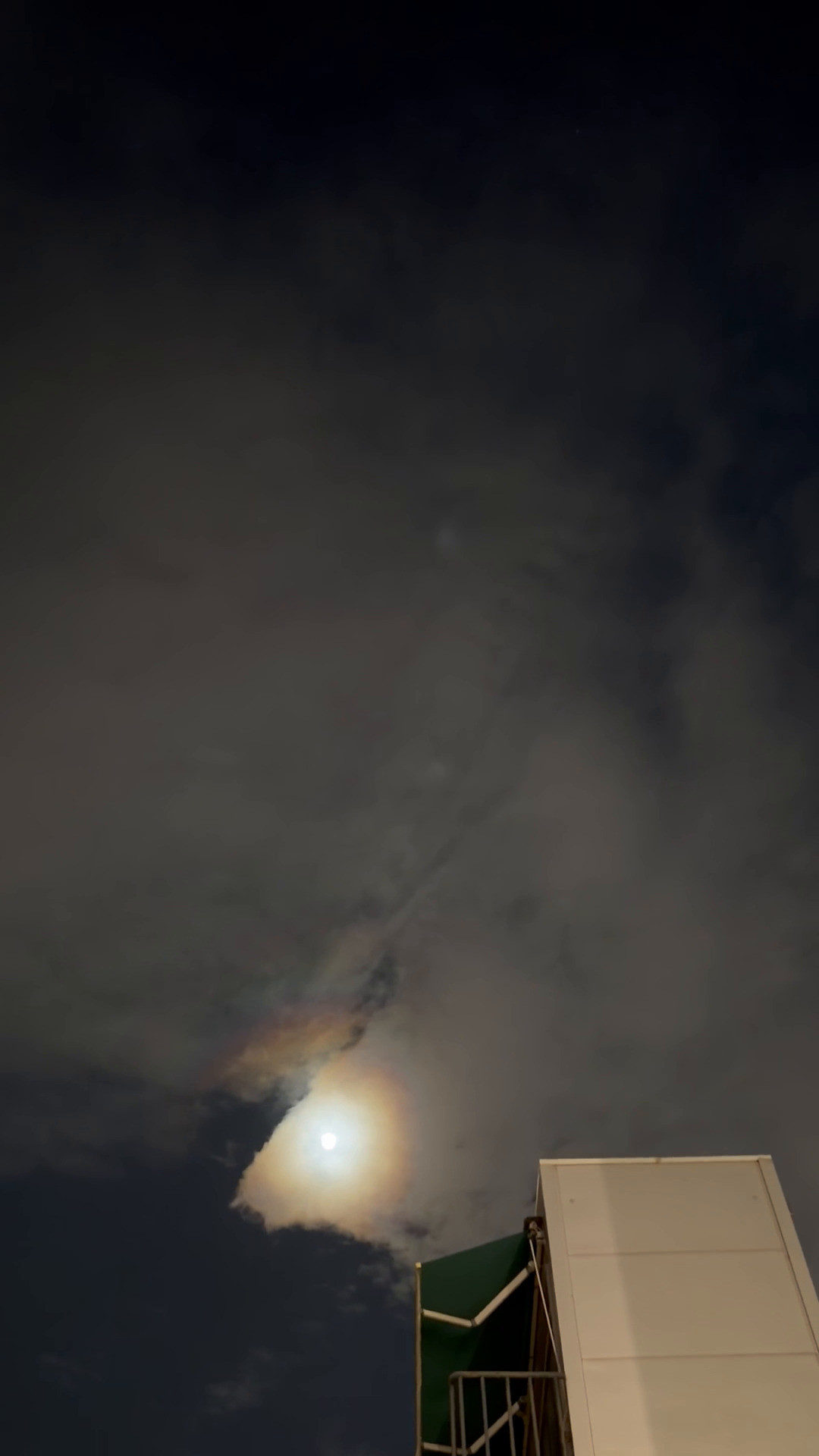
The original file recovered from the archive runs 34.70 seconds at 1920 by 1080 and 30 frames per second. It contains one luminous source, not five. The source is a saturated disc, at or above grey level 254 in every frame, sitting inside a break in a thick, textured cloud layer, with a balcony railing, a pale awning and an overhead cable crossing the lower part of the frame.
More footage and images of this sighting
What is the official explanation?
No Korean government body, airport authority or police force has commented on this event, and no official narrative exists.
A search of the Korean press through the Naver news index, which this archive has used successfully on earlier Korean cases, returned no article about a sighting over Seoul on 26 October 2026. The nearest matches were unrelated pieces dated 8 August, 10 August, 29 September, 1 October and 14 October 2026. The reporter's statement that "more than 5 sightings were reported today over Seoul in different locations" therefore stands as the reporter's own claim, with no corroboration found in Korean media.
The sighting form carries an automated sky-context block listing ISIS 1 at 17 degrees above the southwest at 11:45 UTC. That block is a lead and not a verdict, and this archive has twice recorded it pointing at the wrong answer. It is also computed for 11:45 UTC while the stated sighting time of 9:00 PM KST is 12:00 UTC.
What did the witnesses think it was?
The reporter's own narrative is more measured than the structured fields, and it is the most useful text in the filing:
"Went on for about 2-3 minutes then they flew away in different directions. Not flying in a pattern. Could be projector lights but I doubt it. One of them stopped suddenly and stood there for more than 30 mins, then we left. It kept changing size - getting bigger and smaller, even flashed several times."
Three things follow from that paragraph. The duration field of 30 minutes and the account's "about 2-3 minutes" describe different things, the second being the group and the first being the single light that stayed. The reporter raises a prosaic explanation unprompted. And the behaviour attributed to the object that remained, holding position for over half an hour while swelling, shrinking and flashing, is the behaviour this case turns on.
Is the Multiple Bright Lights Reported over Seoul, South Korea on 26 October 2026 real? The two-pass assessment
Pass one, how could this be mundane.
The decisive measurement is that the light does not move. Every tenth frame of the original was sampled, the luminous source was located by intensity-weighted centroid of its saturated core, and camera motion was recovered independently by phase correlation on the same frames with a 420 pixel disc around the light blanked out. The masked correlation returned a median response of 0.757, so the registration locked onto genuine background structure, cloud texture and the building, rather than onto the object itself. That control matters, because on a featureless sky the object can be the only thing the correlation can see, and this archive has recorded that failure before.
Over the 34.8 seconds measured, the camera travelled 519 pixels horizontally and 515 vertically. The light travelled 518 and 508. Once camera motion is removed, the light's residual displacement has a median of 4.0 pixels and a maximum of 8.2, which is 0.8 per cent of the camera's own travel, against a random-pairing control of 197.6 pixels on a frame diagonal of 2203. The source is fixed in the sky. The hovering, the floating around and the moving in strange patterns are the handheld phone.
The sky at that moment is not ambiguous. JPL Horizons for 37.60 north, 126.94 east at 12:00 UTC on 26 October 2026 puts the Moon at azimuth 98.3 degrees, elevation 40.5 degrees, apparent magnitude -12.68, with 99.70 per cent of the disc illuminated. The US Naval Observatory independently returns Full Moon, 100 per cent illuminated, with the exact full phase at 13:12 KST that same day and moonrise at 17:23. Every other candidate was below the horizon: Venus at -46.9 degrees, Mars at -30.8, Jupiter at -36.1, the Sun at -39.7. The single exception was Saturn, up at azimuth 137.8 and elevation 45.5 but at magnitude +0.44, fainter than the Moon by about thirteen magnitudes and incapable of lighting a cloud deck.
The footage then supplies its own confirmation. The enlarged frame shows the full diffraction sequence of a lunar corona: a saturated white core, a blue-white inner aureole, then yellow, then orange, then a distinct reddish-brown outer ring, with iridescent colour banding along the cloud edge above it. The radial colour profile is measured and runs the right way, from a neutral to blue-dominant centre at red 234.8, green 241.0, blue 242.9 outward to a strongly red-dominant aureole at red 166.5, green 150.7, blue 121.8, against a far-sky background that is near neutral at red 56.8, green 55.8, blue 52.9. That ordering, blue inside and red outside, is produced by diffraction around cloud water droplets and is not produced by a light source in open air.
Every element of the witness's description of the object that stayed then follows without strain. A full Moon holds position for far longer than thirty minutes. Its apparent size and brightness change as cloud of varying opacity drifts across it, which is the "getting bigger and smaller" and the flashing. It is silent, it has no wings, rotors or exhaust, and it is hard to observe clearly through cloud.
Pass two, if real, what is it.
There is no residual object in this footage. The single source it contains is the Moon, measured as fixed, identified by two independent ephemerides, and confirmed by a diffraction signature that requires an intensely bright source behind water droplets.
What the footage cannot settle is the rest of the report. The filing describes five or more lights that flew away in different directions over two to three minutes, and the submitted clip does not contain them. Those lights are neither confirmed nor refuted here; they are simply absent from the only evidence available, and no Korean news coverage was found that would corroborate them. If further footage emerges this case will be revisited.
The tier is Strongly Disputed rather than Discredited, following the precedent this archive set at Campo Largo and Spring Hill. The reporter filed promptly through a structured form, submitted the original file, described what was seen accurately enough that the identification can be made from his own words, and volunteered a prosaic explanation himself. An honest witness plus genuine footage plus a misidentification is not a hoax, and nothing in this file suggests one.
Sources
- ufosighting.report/sighting/13190/multiple-bright-lights-hovered-and-floated-erratically-over
- www.reddit.com/r/UFOs/comments/1xfvwwf/multiple_bright_lights_hovered_and_floated/
- aa.usno.navy.mil/api/rstt/oneday?date=2026-10-26&coords=37.60,126.94&tz=9
- ssd.jpl.nasa.gov/horizons/app.html
- mesonet.agron.iastate.edu/request/download.phtml?network=KR__ASOS
More cases from this region: UFO sightings in South Korea


