The UFO Photographed from the SS Ramsay (1957)
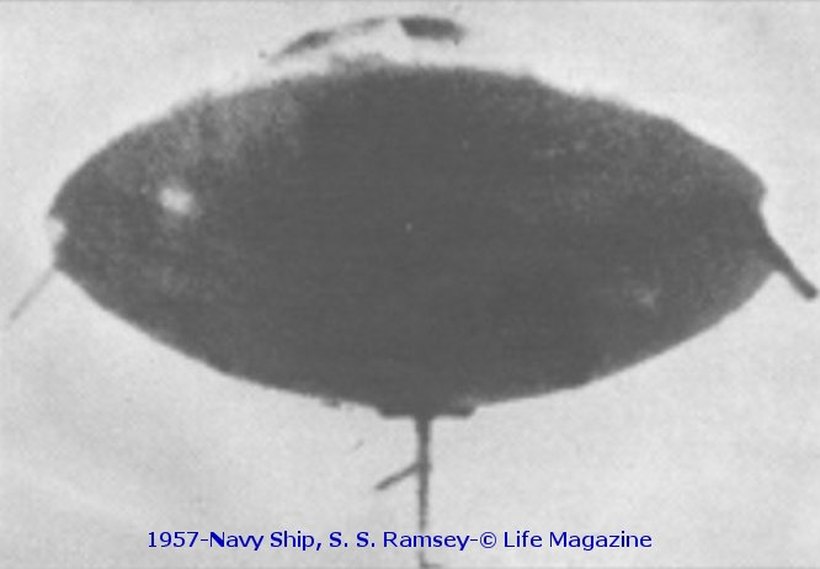
On or about 2 December 1957, around half past two in the afternoon, the British cargo vessel SS Ramsay was steaming down the Southern California coast on a run from Vancouver to Port Elizabeth by way of Panama. This case file covers what witnesses reported, the official narrative, and a two-pass assessment with its evidence tier.
What did witnesses see at Off the coast of San Pedro / Southern California?
On or about 2 December 1957, around half past two in the afternoon, the British cargo vessel SS Ramsay was steaming down the Southern California coast on a run from Vancouver to Port Elizabeth by way of Panama. The ship's radio officer, a man who signed his account Z. Thad Fogl of Harleyford Road, London, S.E.11, said the second officer drew his attention to something hanging in the sky off the beam. In Fogl's own words, as carried in Flying Saucer Review, "Sure enough, there was a queer looking object hovering in the distance."
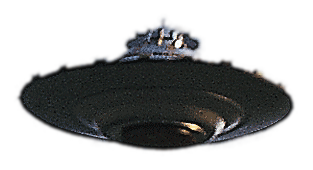
Fogl described a disc-shaped craft roughly a mile away. He said, "It was silver and black. There was no smoke or any gases coming from it. However, under the disc, a red light pulsated." He added that "The disc was rather thick, and had a flat dome. There were no ports," and he noted dark patches he took for exhausts and what looked like a ladder or a depression on the body. He said he ran for his Yashica C twin-lens reflex camera and managed two frames before the thing left. By his telling the object "moved very slowly and stayed with us for a few minutes. Then it shot with quick acceleration towards a rugged mountain, and the desert coast of sun-baked California."
The two negatives were not developed until the ship reached Durban, South Africa, where the prints came back showing a dark lens-shaped object with a thin spike or line trailing beneath it. One of those frames became the canonical image, a grainy black-and-white print of a heavy oval disc that was later miscaptioned in American reprints as having been shot from a United States "Navy ship".
Fogl also attached a second, earlier maritime episode to his story. He said that in late November 1955, aboard the Panamanian steamer Eagle (call sign HOOF) running Rotterdam to Philadelphia, the crew first heard an ear-splitting roar that shook the hull, and that days later, near dusk, he and other officers watched four large flat black discs hang motionless at high altitude, ringed by a shimmering heat-haze, before one vanished and reappeared elsewhere. That 1955 account was never photographed and rests on his word alone, but it framed him as a repeat witness when the 1957 picture surfaced.
What is the official explanation?
There was no government investigation of this case. The SS Ramsay photograph never entered Project Blue Book as a tracked sighting, and no air force or navy file adjudicated it. It lived and died entirely inside civilian UFO publishing, which makes the editorial handling the closest thing to an "official" record.
The picture and Fogl's interview first appeared in Flying Saucer Review vol. 5 no. 1, dated January/February 1959, under the title "UFO Snapped from Ship". Flying Saucer Review was then the most respected UFO journal in Britain, and its imprimatur is what carried the image outward. From there the photograph was reproduced widely. By the mid-1960s it was being reprinted in mass-circulation venues, and the surviving caption on the most-copied print credits Life magazine, which ran the image in a UFO photo feature around April 1966 amid the publicity over the Michigan "swamp gas" sightings. The image also circulated through the British illustrated press of the period. For years it was presented to readers as one of the clearer ship-board UFO photographs on record.
The single most important entry in the documentary trail is the exposure published in Flying Saucers / UFO Reports, issue 3, October 1967, a Dell magazine, by the photographer and photo-analyst Ralph Rankow. Rankow reported that the SS Ramsay "UFO" was a fabrication. According to that account, the disc was assembled from two bases of a plastic F-104 Starfighter model kit joined dome to dome, dressed with model antennae and a small ladder part, then hung on a fine silk thread and photographed against the sky with the Yashica. Rankow noted Fogl's own worry that the suspending thread might show in the frame, which it faintly does as the thin line beneath the disc.
The editorial side does not come out clean. The original FSR write-up had been shepherded by editors Brinsley le Poer Trench and later Gordon Creighton, and by the account that later circulated, the British UFO Research Association (BUFORA) had been told the picture was a hoax roughly three years before any public correction, and chose to delay disclosure. That allegation about BUFORA sitting on the matter is a later claim from inside British ufology rather than a minuted document, and it should be read as such, but it is consistent with how long the picture kept running as genuine after doubts existed.
What did the witnesses think it was?
Fogl's own position on his own photograph changed more than once, which is central to weighing him. In the original 1959 telling he presented the sighting as real and was, by his account, irritated by the response it drew. He said that when he first approached Brinsley le Poer Trench at Flying Saucer Review, the editor told him the craft was Venusian and explained its propulsion, claims Fogl found baseless and infuriating, and that the flood of mail, including a letter from an American boy who mailed a dollar asking for a print, left him uncomfortable with what the story had become.
Then he disowned it. Fogl contacted Gordon Creighton, by then an FSR editor, and admitted that he had fabricated the picture and the account. His stated motive, quoted in the Rankow material, was not to prove a fake was easy but to make a point about the field: "to show the public that certain people make utter fools of themselves," adding that "far too many people make a racket of the UFO business, writing phony books supported by faked pictures." He had also moved into sensitive work, joining Hawker Siddeley on rocket propulsion under MI5 vetting, and a public association with flying saucers was a professional liability, which gave him a second reason to bury the affair. He then said nothing for about forty years.
The last turn is the recantation. In July 2001, by then living in British Columbia and encouraged by his wife to set the record straight, Fogl sat for a recorded interview with the veteran Canadian investigator Graham Conway of UFO*BC, written up by Conway under the title "The Aftermath" dated September 2001. In that interview Fogl reversed his confession and insisted the 1955 and 1957 sightings had been genuine all along, claiming he had only called the photograph a hoax to escape the false stories being attached to it. Conway, who devoted six decades to the subject and died in February 2007, recorded the reversal without independent verification of it. No new negatives, no new witnesses, and no physical evidence accompanied the 2001 reversal, so it stands as an elderly witness's contested word against his own earlier signed confession and against an independent demonstration of how the picture was built.
The dispute
The dispute here is not a fragile counter-theory, it is a confession plus an independently shown method, which is why this case sits in the strongest disputed tier rather than as an unexplained photograph. The radio officer who took the picture, Z. Thad Fogl, told Flying Saucer Review editor Gordon Creighton outright that he had fabricated both the photograph and the surrounding story. Fogl's stated purpose, quoted in the later exposure, was a deliberate stunt: "to show the public that certain people make utter fools of themselves," because "far too many people make a racket of the UFO business, writing phony books supported by faked pictures." A confession from the photographer is the single most decisive form of counter-evidence a photo case can carry.
The method was then demonstrated independently. The photographer and photo-analyst Ralph Rankow, writing in the Dell magazine Flying Saucers / UFO Reports issue 3, October 1967, reported that the disc had been built from two bases of a plastic F-104 Starfighter model kit, fitted with model antennae and a small ladder piece, then hung on a fine silk thread and photographed against the sky with Fogl's Yashica camera. This is a positive identification of the specific real-world object, a named model kit, not a vague "could have been a model" hypothesis. The thin vertical line visible beneath the disc in the canonical print matches the suspending thread that Fogl reportedly worried would betray the rig. Confession, identified props, shown method, and a physical artifact in the image all point the same way.
The only material pushing back is Fogl's own later reversal. In July 2001, by then living in British Columbia, Fogl sat for a recorded interview with the Canadian investigator Graham Conway of UFO*BC, written up as "The Aftermath" in September 2001, in which he retracted his confession and insisted the sightings were genuine, saying he had only labelled the photo a hoax to shake off the false stories attached to it. This recantation is weighed as motivated testimony from an aging witness with a clear interest in clearing his name, offered roughly four decades after the fact with no new negatives, no corroborating witnesses, and no physical evidence. A late, unsupported walk-back does not undo an original confession that is backed by an independent reconstruction of the exact props. The case is therefore filed as Strongly Disputed, proposedDiscredit set true for human review, with the recantation honestly recorded rather than buried.
Is the UFO Photographed from the SS Ramsay (1957) real? The two-pass assessment
Pass one, the ordinary explanation. This is one of the rare cases where the mundane account is not a guess, it is documented and method-shown. The witness himself confessed to Gordon Creighton that he fabricated the picture and the story. An independent analyst, the photographer Ralph Rankow, published in Flying Saucers / UFO Reports issue 3, October 1967, the specific construction: two F-104 Starfighter plastic model bases joined to make the lens-shaped disc, antennae and a ladder part added for detail, the whole thing suspended on a silk thread and photographed with Fogl's Yashica. The faint vertical line under the disc in the surviving print is consistent with that thread, which Fogl reportedly feared would show. The motive is on record in Fogl's own words, a deliberate demonstration that the public is fooled by faked saucer pictures. That is a confession plus a named real-world object, the model kit, plus a shown method, plus a suspension artifact visible in the image itself. There is essentially nothing left for an unknown to occupy.
Pass two, if it were real. If one set the confession aside, the object as described, a thick metallic disc with a flat dome, a pulsing red underside light, no visible means of propulsion, hovering then accelerating away, would be a textbook 1950s structured-craft report. But there is no path to "real" here that survives the evidence. The only thing arguing for authenticity is Fogl's 2001 recantation to Graham Conway, made roughly forty years after the fact, with no negatives, no corroborating witnesses, and no physical evidence, by an elderly man who had every reason to want his name cleared of a hoax. Per the principle that witnesses are not wholesale-discredited and that a motivated walk-back is weighed as such, the recantation is logged and respected, but it cannot outweigh the original confession combined with an independent reconstruction of the exact props.
Because there is a witness confession, an identified real-world object (the F-104 model kit parts), a demonstrated fabrication method from a named independent analyst, and a physical artifact of that method in the photograph, this case meets the threshold for the strongest disputed tier. It is filed as Strongly Disputed with a discredit proposed for human review. It is not filed as unexplained, because the photograph has been explained, by the man who took it and by the analyst who rebuilt it.
Sources
- rr0.org/science/crypto/ufo/enquete/dossier/Fogl/
- web.archive.org/web/20230610145148/https://www.ufocasebook.com/life1957.html
- web.archive.org/web/20230927205011/https://www.ufocasebook.com/2008c/tfogl.html
- web.archive.org/web/20250130120750/https://www.ufocasebook.com/life1957.jpg
More cases from this region: UFO sightings in United States