The Fort Belvoir Ring Photographs
At about nine in the morning on a day in September 1957, an Army private stationed at Fort Belvoir, Virginia, was called out of his barracks by other soldiers to look at something approaching across the sky. This case file covers what witnesses reported, the official narrative, and a two-pass assessment with its evidence tier.
What did witnesses see at Fort Belvoir?
At about nine in the morning on a day in September 1957, an Army private stationed at Fort Belvoir, Virginia, was called out of his barracks by other soldiers to look at something approaching across the sky. What he saw was a dark, solid-looking ring, a perfect O hanging against a cloudy sky. The Condon Report, which investigated the case as Case 50, records his estimate that the object was about 60 feet in diameter and five to six feet thick, drifting along faster than the surrounding clouds while staying high above the treetops yet below the cloud deck. He grabbed a Kodak Brownie box camera from his car and shot six exposures in sequence from the parking lot between two of the post's temporary buildings, identified in the report as T741 and T742.
The striking part of the sighting was not the ring itself but what happened to it. In the first frames the ring is a clean, dark, non-reflective loop. Then, over a span the witness put at roughly 30 to 60 seconds, a white vapor began to creep around the ring and swallow it. By the later frames the dark ring is buried inside a puffy, opaque white cloud, the kind of shapeless mass you would never connect with the sharp black O of the opening photographs unless you had watched the change happen in real time. The whole event, from first sight to the ring being fully engulfed, lasted the witness said not more than about five minutes.
The witness was not alone. The Condon investigators recorded that roughly 15 men saw the phenomenon and that at least two of them photographed it. The private, then a draftsman with the Post Engineers, did not report what he had seen to anyone official. In his own words quoted in the report, "I was only a private in the Army, the only thing mentioned was that it was strange and maybe someone was experimenting so we didn't tell anybody that we even took these pictures." He added, "I didn't want to get in trouble so when I came home I had the pictures developed then." The film sat for years. Only later did a friend send the prints to civilian UFO researchers, and the sequence of a black ring turning into a cloud became one of the more arresting photographic puzzles of the late 1950s flap.
What is the official explanation?
Officially, this case is unusual because the official apparatus did not merely assert an answer, it demonstrated one. The photographs reached the U.S. Air Force sponsored Condon Committee (the University of Colorado UFO Project) in 1966 through Dr. James McDonald, who had received them from the National Investigations Committee on Aerial Phenomena (NICAP). The Condon Report's Case 50, written up in the published Scientific Study of Unidentified Flying Objects, treats the sequence as a genuine photographic record and then sets out to identify what was photographed.
Two independent threads converged on the same answer. First, a 1967 magazine article by Ralph Rankow in Flying Saucers UFO Reports, which presented the ring as a complete mystery, drew a letter from Jack Strong, then a graduate student at the University of Wisconsin, who wrote that he had personally attended bomb demonstration tests at Fort Belvoir and described clouds from those tests that matched the photographs. Second, a Colorado project investigator went to Fort Belvoir itself. The report records that "Sergeant-Major A. M. Wagner, interviewed at Ft. Belvoir, immediately identified the pictures as showing a cloud produced by 'atomic bomb simulation demonstrations' which were frequently carried out at Ft. Belvoir for visiting officials and military cadets."
The method was spelled out in physical detail. The report states that "Five 55-gal. drums of gasoline, diesel fuel, TNT, and white phosphorus are arranged in a circle and detonated," and that "the white phosphorus produces a white smoke that eventually envelopes the black vortex produced by the diesel fuel." In plain terms, the detonation throws up a stable smoke vortex ring, a doughnut of rotating air made visible by black soot from the burning diesel, and the slower white phosphorus smoke then drifts in and wraps around it. That is exactly the two-stage behavior the witness photographed: a dark ring first, a white cloud second.
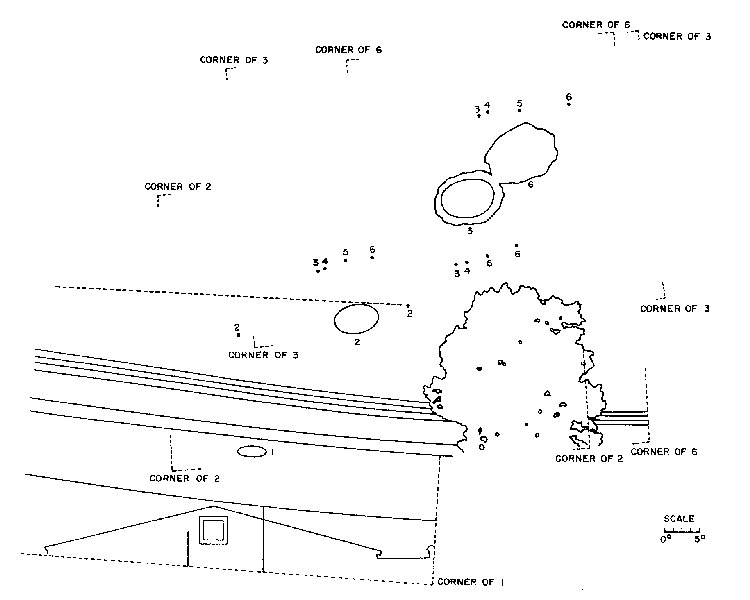
The investigators did not stop at testimony. They obtained photographs of an actual demonstration. The report notes that pictures of one of the tests were secured through Sergeant-Major Husted, and that "Plates 38, 39, and 40 were made by Sergeant First Class James O'Dell." A site map (the report's own figure) showed the bomb demonstration site, and the ring and cloud in the 1957 photographs were drifting radially away from that point, consistent with an origin at the demonstration ground. On that combined basis the Condon Report closes the case with the line, "This case is considered positively identified as an atomic bomb simulation demonstration of the type commonly carried out at Fort Belvoir during this period." When TIME magazine reported the Condon Report's release on 17 January 1969 in its article "Investigations: Saucers' End," it summarized the same finding, that technicians "identified the UFO as a vortex ring formed when diesel oil, gasoline and white phosphorus was exploded by TNT to simulate atomic-bomb explosions during demonstrations."
What did the witnesses think it was?
The private who took the photographs believed at the time that he had seen something genuinely strange. His own account, preserved in the Condon Report, shows a young soldier who thought the object odd enough to grab a camera and shoot a six-frame sequence, yet cautious enough to keep the prints to himself rather than risk trouble by reporting them. He framed the possibility carefully, "maybe someone was experimenting," which in hindsight reads as close to the actual answer, though he plainly did not connect what he saw to the routine demonstrations on his own post. He was identified in the original Flying Saucers magazine treatment under the pseudonym Jim Stone, because the photographer asked to stay anonymous, and the Condon Report likewise refers to him only as Private X. That anonymity is part of why the case circulated for years as an unexplained mystery before anyone tied the imagery to Fort Belvoir's own activities.
He was far from the only witness, which is part of what gives the sighting weight as an honest report rather than a fabrication. The Condon investigation recorded that about 15 men watched the ring drift and transform, and that at least two of them took pictures, so the visual event itself is multiply attested by people standing in the same parking lot. None of these witnesses claimed a spacecraft. They reported, accurately, a dark ring that turned into a white cloud, and the disagreement was never about what was seen but about what it was.
The most important corroborating witness, though, cut against the mystery. Jack Strong, the University of Wisconsin graduate student, was himself a witness to the cause. He had stood at Fort Belvoir bomb demonstrations and watched these vortex clouds form, and on seeing Rankow's published photographs he recognized them at once and wrote in to say so. His testimony is civilian, independent of the military chain of command, and based on first-hand observation of the very demonstrations the report blames. Alongside Sergeant-Major Wagner's immediate identification and Sergeant First Class O'Dell's photographs of an actual test, the witness picture is consistent end to end: real soldiers honestly photographed a real object, and a separate set of real witnesses recognized that object as a man-made smoke ring from the base's own atomic-bomb-simulation show.
The dispute
The dispute is not really a dispute about what was photographed, it is a positive identification of the cause. The Colorado UFO Project (the Condon Committee) investigated the six photographs as Case 50 and concluded they show a vortex smoke ring produced by Fort Belvoir's routine atomic-bomb-simulation demonstrations. The mechanism was spelled out and is repeatable: five 55-gallon drums of gasoline, diesel fuel, TNT, and white phosphorus are set in a circle and detonated, the diesel soot forms a stable black vortex ring, and the white phosphorus smoke then drifts in and envelops it. That is exactly the sequence the witness photographed and timed, a clean dark ring that became a white cloud in under a minute.
What lifts this above an unsupported official claim is the independent, method-shown corroboration. A civilian graduate student, Jack Strong of the University of Wisconsin, who had personally attended bomb demonstrations at Fort Belvoir, saw Ralph Rankow's 1967 magazine reproduction of the photographs and recognized the phenomenon on sight, writing in to describe the same clouds. Separately, a project investigator went to the base, where Sergeant-Major A. M. Wagner immediately identified the pictures, and the team obtained photographs of an actual demonstration (the report's Plates 38 to 40, taken by Sergeant First Class James O'Dell). The Condon Report's own site map showed the ring and cloud drifting radially away from the demonstration ground.
The report's closing line is unambiguous: "This case is considered positively identified as an atomic bomb simulation demonstration of the type commonly carried out at Fort Belvoir during this period." The same finding was reported contemporaneously by TIME on 17 January 1969. Crucially, none of this impeaches the witnesses. The private and the roughly 15 men with him honestly reported a real object, and there is no claim of a hoax. The case is strongly disputed because the specific real-world cause has been positively identified and physically demonstrated, not because the photographs were faked. The remaining basis for treating it as anomalous is essentially that the original photographer did not know what the demonstrations on his own post looked like, which the later evidence resolves.
Is the Fort Belvoir Ring Photographs real? The two-pass assessment
Pass one, how this could be entirely ordinary. The ordinary explanation here is not a guess, it is a demonstrated mechanism with named witnesses and supporting photographs. A vortex ring is a well-understood piece of fluid dynamics: a ring-shaped detonation throws up a rotating doughnut of air that holds its shape for a surprisingly long time as it drifts, and any smoke caught in that circulation outlines a clean, dark loop. Fort Belvoir, then home to the Army Engineer School, ran atomic-bomb-simulation demonstrations for visiting officials and cadets, detonating five 55-gallon drums of gasoline, diesel fuel, TNT, and white phosphorus arranged in a circle. The diesel soot makes the black ring; the white phosphorus smoke drifts in afterward and engulfs it. That is precisely the two-stage transformation the witness photographed, a dark ring first and a white cloud second, and the timing he gave (30 to 60 seconds for the smoke to take over, the whole event under five minutes) fits a drifting smoke ring far better than any solid craft. The ring's radial drift away from the known demonstration site, the immediate identification by Sergeant-Major A. M. Wagner, the independent recognition by graduate student Jack Strong who had attended the tests, and the official demonstration photographs taken by Sergeant First Class James O'Dell (the Condon Report's Plates 38 to 40) all point at the same prosaic source. This is about as cleanly identified as a 1950s photographic case gets.
Pass two, if it were genuinely unexplained, what would it be. Stripped of the identification, the raw report is a dark, sharply defined ring roughly 60 feet across, moving faster than the clouds, that transforms into a cloud in under a minute. Taken cold, that is the kind of object that fed the smoke-ring and donut-shaped UFO reports of the era and would sit in the unexplained pile as a low-altitude ring-form anomaly. But this case does not get to stay cold. The counter-explanation is not an official assertion floated without a method, and it is not a contested psychological argument; it is a positive identification of the specific real-world cause, the Fort Belvoir atomic-bomb-simulation vortex, backed by a repeatable physical mechanism, a matching independent civilian eyewitness to the cause, and photographs of an actual demonstration. That is the standard for the strongly disputed tier rather than the barely disputed one. The witnesses were honest and the photographs are real, so this is not a hoax and not a discredited fabrication; it is a real object correctly identified. For those reasons the case is filed as Strongly Disputed: the imagery is authentic, but the ring was a man-made smoke vortex from the base's own demonstrations, not an unknown craft.
Sources
- files.ncas.org/condon/text/case50.htm
- www.project1947.com/shg/condon/case50.html
- content.time.com/time/subscriber/article/0,33009,838878-2,00.html
- files.ncas.org/condon/text/cs50fg05.htm
- files.ncas.org/condon/text/images/cs50fg05.gif
More cases from this region: UFO sightings in United States