The Tagish Lake Photographs
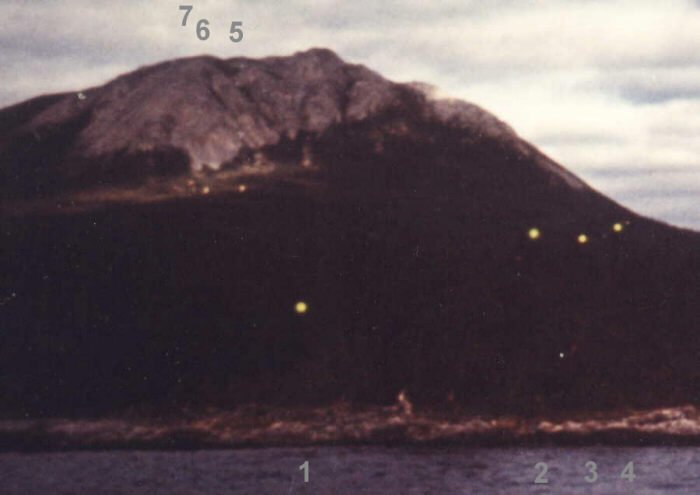
Two couples were boating on Tagish Lake, a long glacial lake roughly 100 km south of Whitehorse, on a morning around 1970. This case file covers what witnesses reported, the official narrative, and a two-pass assessment with its evidence tier.
What did witnesses see at Tagish Lake?
Two couples were boating on Tagish Lake, a long glacial lake roughly 100 km south of Whitehorse, on a morning around 1970. The boats were separated. Jim Conacher ran a smaller open boat close to the shoreline to stay out of the chop while George and his wife followed five to eight kilometres back in a larger closed boat, out in the middle of the lake and too far behind to see Jim's boat at all. A little after 10 in the morning, Jim and his wife saw seven glowing orbs hanging over the slope of a mountain on the far side. Four of them sat lower and nearer, four objects that Jim later described as yellowish, perhaps with a faint green cast, looking slightly hazy or diffused rather than sharp-edged. Three more, an amber colour, sat higher up on the mountainside. To the eye each one looked about half the diameter of a full moon. Jim put their real size at three to four feet across.
The objects were not still. They drifted slowly for the whole sighting, which lasted about fifteen minutes, and over that time the four lower objects worked their way up the mountain to join the three already higher up. The lower four were not lit by sunlight, since the trees around them were in shadow, which is why Jim and later analysts thought the objects might be glowing on their own. The three higher up sat in ground already washed in amber sunrise light, so those could have been catching the sun. At some point during the fifteen minutes Jim raised his camera, a good 35 mm rig believed to be a Leica with a standard 50 mm lens loaded with slow slide film, and took a single frame. As far as anyone involved knew, that one exposure was the only photograph he ever took of the objects. Then the orbs lost interest, moved off and were gone.
When the slide came back from the lab about a week later, the frame showed exactly what Jim had described: four yellowish objects low against the treed slope and three amber objects higher up the mountain. One of the lower objects, catalogued by Jasek as UFO number 4, had three small bluish points clustered around it. Jim's wife was the only other person who actually watched the event happen. George never saw the orbs in the air at all; he became part of the story only because Jim made him a couple of slide duplicates afterward, and it was George, in 1998, who still had one of those duplicates in a drawer.
What is the official explanation?
There is no public investigation file on this case in the conventional sense, because the photograph sat private for nearly three decades. What official handling exists comes from the witnesses' own account of what they did with the slide soon after 1970. Jim Conacher, by his family's account a methodical man who wanted an answer, was unsettled by the image. One of the duplicate slides was handed to the Weather Office, and the Weather Office forwarded it to the Department of National Defence in Ottawa, the federal body that fielded Canadian UFO reports in that era. About a year later the witnesses asked what the analysis had found. The answer they were given was that the information was classified. No report, no identification, and no further correspondence ever came back to them. That is the entire extent of the official record the witnesses could point to, and it cannot be independently checked because the slide and any file went into a government channel and never re-emerged.
The substantive investigation is civilian and came late. After local publicity in May and June 1998, Yukon UFO investigator Martin Jasek, a civil engineer with a bachelor's degree in civil engineering and a master's in water resources engineering, was told a UFO photograph had been taken near Tagish Lake years earlier. In July 1998 he tracked down George, the secondhand witness still living in Whitehorse who held a surviving slide duplicate. Jasek copied the slide, interviewed the witness and ran a photographic analysis, publishing his report in August 1998 and updating it on 12 September 1998. The work was carried as a feature in Flying Saucer Review, the long-running British journal, in 1998 (Volume 43, Number 3).
Jasek's method was photogrammetric. On 5 September 1998 a photographer returned to the site and shot a reconstruction frame from within about ten metres of where he judged the 1970 photo was taken, using the same 50 mm focal length so the geometry would match. By scaling rock formations on a small island in the frame and adding the mapped distance from that island to the shoreline, Jasek estimated the lower objects sat roughly 300 metres from the camera, which made the nearest object, UFO number 1, about 1.4 metres across at most, close to four and a half feet. That sits squarely on top of Jim's own three-to-four-foot eyeball estimate, an internal consistency Jasek treated as meaningful. The three mountainside objects, mapped at around five kilometres out, would have had to be at least six metres across to appear as they do, so the set was not uniform in size. Jasek was candid that his read came from experience as a photographer, not as a specialist in faked UFO images, and his judgement on hoax was a character judgement: Jim Conacher was Chief of the Inspection Division of the Canadian Grain Commission, a senior federal official who travelled on grain missions to China and Russia, and Jasek argued such a man had little reason to torch his credibility on a fabricated picture.
What did the witnesses think it was?
Jim Conacher believed he had photographed something genuinely unexplained, and he did not treat it as a trophy. According to his daughter Lenore Conacher, who put her name to a UFO*BC page about her father on 29 January 1999, "I do recall him showing me the photograph of the strange objects over Tagish Lake." She described him as "a highly intelligent, analytical man of scientific bent and solid integrity," a man who found the objects "very perplexing," who actively sought expert explanations and who stayed unsatisfied with the answers he got. That is the behaviour of someone trying to identify a puzzle, not someone selling a story. Conacher had spent thirty-five years with the Government of Canada and ran a grain-inspection division of roughly four hundred people before retiring and taking temporary residence near Tagish Lake, which is how he came to be on the water that morning.
The corroboration is real but limited, and the case is honest about that. Jim's wife was beside him and saw the whole fifteen-minute event; both she and Jim had died by the time Jasek investigated, so neither could be interviewed. George, the surviving firsthand source Jasek actually spoke to in 1998, never saw the orbs in flight. His value is as a chain-of-custody witness: he confirmed the circumstances Jim described to him at the time, he held a duplicate of the original slide for nearly thirty years, and he was the one who routed a copy to the Weather Office and on to Ottawa. So the photograph rests on two eyewitnesses who are gone, one secondhand witness who preserved the image, and a daughter who remembers being shown it as a child. What none of the witnesses ever did was claim the objects were craft or assign them any identity. Conacher's own stance was that he did not know what they were and wanted someone to tell him.
The dispute
The serious counter-explanation is earthquake lights, and it does not come from a debunker but from a peer-reviewed geophysics paper. Robert Theriault of Quebec's Ministere des Ressources Naturelles and Friedemann Freund, an adjunct physics professor at San Jose State University and senior researcher at NASA's Ames Research Center, published "Prevalence of Earthquake Lights Associated with Rift Environments" in Seismological Research Letters in 2014 (Volume 85, Number 1, pages 159 to 178). They used Conacher's Tagish Lake photograph as a case study of earthquake lights, luminous orbs that some research links to seismic stress. Their proposed mechanism is that mechanical stress in certain rocks activates electronic charge carriers, "positive holes," that flow to the surface, ionize the air and produce glowing balls of light. They reproduced Conacher's frame with the caption "Earthquake lights from Tagish Lake, Yukon-Alaska border region, around the 1st of July, probably 1972 or 1973 (exact date unknown); estimated size 1 m diameter," used with Conacher's permission. The hook is that there is a real, catalogued magnitude 6.7 earthquake in the Cross Sound region of Southeast Alaska on 1 July 1973, confirmed in the USGS catalog at 57.84 N, 137.33 W. National Geographic, reporting the paper, stated plainly that the team "noticed that the timing of Conacher's photo seemed to place it just a few hours before" that quake.
The reason this is a barely disputed case and not a strongly disputed one is that the explanation rests on a date the explanation itself admits it does not have. The witnesses, through Jasek's 1998 interviews and through Lenore Conacher, placed the photograph around 1970. Freund's team did not date the photo independently; they hedged to "probably 1972 or 1973" and then matched it to a known quake, which is reasoning backward from the catalog to the picture. If the photo really is from around 1970, the 1 July 1973 earthquake cannot be its cause, and the entire link collapses. The date is the load-bearing fact and it is unresolved.
There are also physical frictions the seismic reading has to absorb. The Cross Sound epicenter sits roughly 250 to 300 km from Tagish Lake, a long way for surface luminous phenomena to be seen as discrete metre-scale orbs hanging over a specific mountain slope. The objects in the frame are not one uniform glow but a structured set, four lower and nearer plus three higher and more distant, that slowly migrated up the mountainside over fifteen minutes and were photographed at an estimated few hundred metres for the nearest one. Jasek's photogrammetry put the nearest object near 1.4 metres across, broadly consistent with the paper's 1 metre estimate, so the two analyses at least agree the things were small and close, not a far-off atmospheric flare. Earthquake lights remain a genuinely contested phenomenon in seismology, so invoking them explains one unknown with another. The earthquake-lights paper is the strongest natural explanation on the table and it is published, named and method-bearing, which is why the case is disputed at all. But it identifies a candidate cause, it does not pin this specific photograph to that specific quake, and it cannot until someone fixes the date. That keeps the case standing.
Is the Tagish Lake Photographs real? The two-pass assessment
Pass one, the ordinary readings. A deliberate hoax is the first thing to rule in or out, and the case is unusually resistant to it on motive. The photographer was a senior Canadian federal official, Chief of the Inspection Division of the Canadian Grain Commission, identified by name with his family's cooperation, who kept the slide private for nearly thirty years, routed it through official channels for an answer, and never made a public claim about it. People building a hoax publicize it; Conacher did the opposite. That is not proof the image is untouched, but it removes the usual engine of a fake. The leading prosaic explanation is instead natural: earthquake lights, advanced in a 2014 peer-reviewed paper by Theriault and Freund, tied to a real and catalogued magnitude 6.7 Cross Sound earthquake on 1 July 1973. That is a substantial, named, method-bearing explanation and it has to be taken seriously. Other mundane candidates such as lens flares, reflections off the water or film artifacts sit lower, because the objects were watched moving and changing position by eye for fifteen minutes before any photo was taken, which optical artifacts do not do.
Pass two, if the photograph shows something real and unidentified. Then it is a small flock of self-luminous objects, on the order of a metre to a metre and a half across, hovering and slowly climbing a mountainside near Tagish Lake on a 1970s morning, glowing in shadow under their own light rather than reflecting the sun, with one of them ringed by three smaller bluish points. The witness count is thin, two firsthand observers now deceased plus a custody witness and a family member, and the only physical evidence is one surviving slide duplicate of a single frame.
The weighing. This is not Verified Unexplained, because there is a serious, published, mechanism-bearing natural explanation in play and the original slide never passed through independent forensic photo analysis. It is also not Strongly Disputed, because that tier needs a confession, a recantation, recovered props, or a positive identification of the specific real-world cause of this image, and the earthquake-lights paper supplies none of those. It supplies a candidate phenomenon and a candidate quake, then concedes it does not know the year of the photograph, hedging to "probably 1972 or 1973" while the witnesses say around 1970. An explanation that cannot establish the photo predates by hours the event it blames has not closed the case. It has raised a strong, honest doubt. That is exactly Barely Disputed: a real counter-explanation exists, it is the best on offer, and the case largely still stands because the link is unproven on its own central fact.
Sources
- www.ufobc.ca/yukon/tagish.htm
- www.ufobc.ca/yukon/tagishjimconacher.htm
- www.eurekalert.org/news-releases/544938
- www.sci.news/othersciences/geophysics/science-earthquake-lights-01662.html
- www.nationalgeographic.com/science/article/140106-earthquake-lights-earthquake-prediction-geology-science
- earthquake.usgs.gov/fdsnws/event/1/query?format=text&starttime=1973-06-25&endtime=1973-07-05&minmagnitude=5.5&maxlatitude=61&minlatitude=56&minlongitude=-142&maxlongitude=-132
More cases from this region: UFO sightings in Canada