The Cowichan District Hospital Sighting
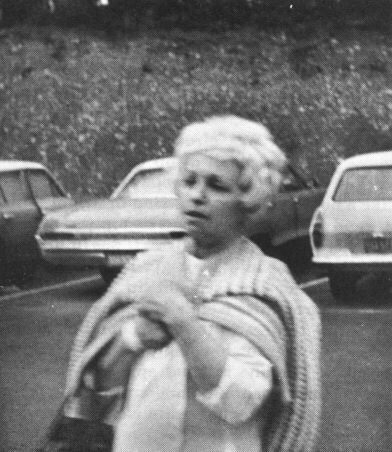
In the dark before dawn on 1 January 1970, around 5 a.m., Doreen Kendall, a practical nurse on the extended-care ward on the second floor of the Cowichan District Hospital in Duncan, British Columbia, went to a window to let a little air in for a restless elderly patient. This case file covers what witnesses reported, the official narrative, and a two-pass assessment with its evidence tier.
What did witnesses see at Cowichan District Hospital?
In the dark before dawn on 1 January 1970, around 5 a.m., Doreen Kendall, a practical nurse on the extended-care ward on the second floor of the Cowichan District Hospital in Duncan, British Columbia, went to a window to let a little air in for a restless elderly patient. As she pulled the drapes, in her own words, "a brilliant light hit me in the eyes." About 60 feet away, hovering just above the children's ward in the wing that jutted out at right angles to her left, roughly at third-floor height, sat a large circular object she said she could see "so big and bright I could see everything clearly."
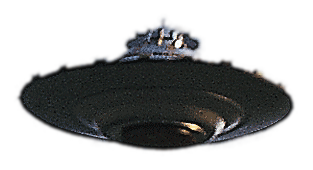
She described it carefully. "The object was circular and had what I guess you would call a top and bottom. The bottom was silvery, like metal, and was shaped like a bowl. There was a string of bright lights around it like a necklace." The top was a transparent dome made of a glass-like material, lit from inside. The craft was tilted toward her, which let her see down into the dome. She estimated it spanned about five of the children's ward windows, putting its diameter at least 50 feet.
Inside the dome stood two figures in front of a large instrument panel that took up nearly half the interior. "They looked like fine, tall, well-built men. They were dressed in tight-fitting suits," she said, with dark material covering their heads, "but their hands were bare and I noticed how human they looked." They appeared to be working at the panel, one behind the other, with what looked like stools nearby. Kendall watched, transfixed. "I never felt so peaceful in all my life. I wish I could have talked to them."
Then the rear figure seemed to notice her. He turned, touched the other on the back as if to alert him, and the second figure reached for a control. "He pushed it back and forth and the saucer, or whatever you'd call it, started to circle slowly, still close to the building, in an anticlockwise direction." It circled four or five times, moved off along the roof of the children's ward, receded into the distance, and vanished behind trees, departing toward the northeast at high speed. The whole encounter was silent.
Kendall called a colleague. Frieda Wilson, a registered nurse, reached the window in time to see the object as a brilliant light. "I'd say it was quite a bit larger than a car," Wilson said. "It was all just tremendously bright." Two more nurses, recorded by Magor as Mrs. Clackson and Mrs. Appleby, came to another window and caught the light receding in the distance. Two further nurses looked out seconds too late and saw nothing, the object already gone behind the trees. Kendall logged the event in the hospital schedule that morning: "At 5 a.m. I saw a flying saucer as low as the third floor of the hospital when I pulled the curtains. There were two men or figures in the dome flying towards Victoria. The bottom of the saucer was brilliantly lit and also the dome. New Year's morning."
The hospital encounter did not stand alone that day. Around the same pre-dawn hour a husband and wife driving nearby reported a bright light "as big as a house" hovering overhead. That evening, near Cobble Hill and Cowichan Bay, the Drummond family watched a glowing object over the water. Jim Drummond, a ship's pilot, put a telescope on it and described an egg-shaped craft with a transparent top and a set of lights inside, hanging perhaps 900 feet above the water, dropping to about 300 feet when a porch floodlight came on, and throwing out a thin beam of light broken into dots and dashes before it shot upward and away. Neighbours including George Hallett confirmed a large silent orange light over the water for several minutes, and diners at the Deer Lodge in Mill Bay reported a large ball of light at roughly the same time.
What is the official explanation?
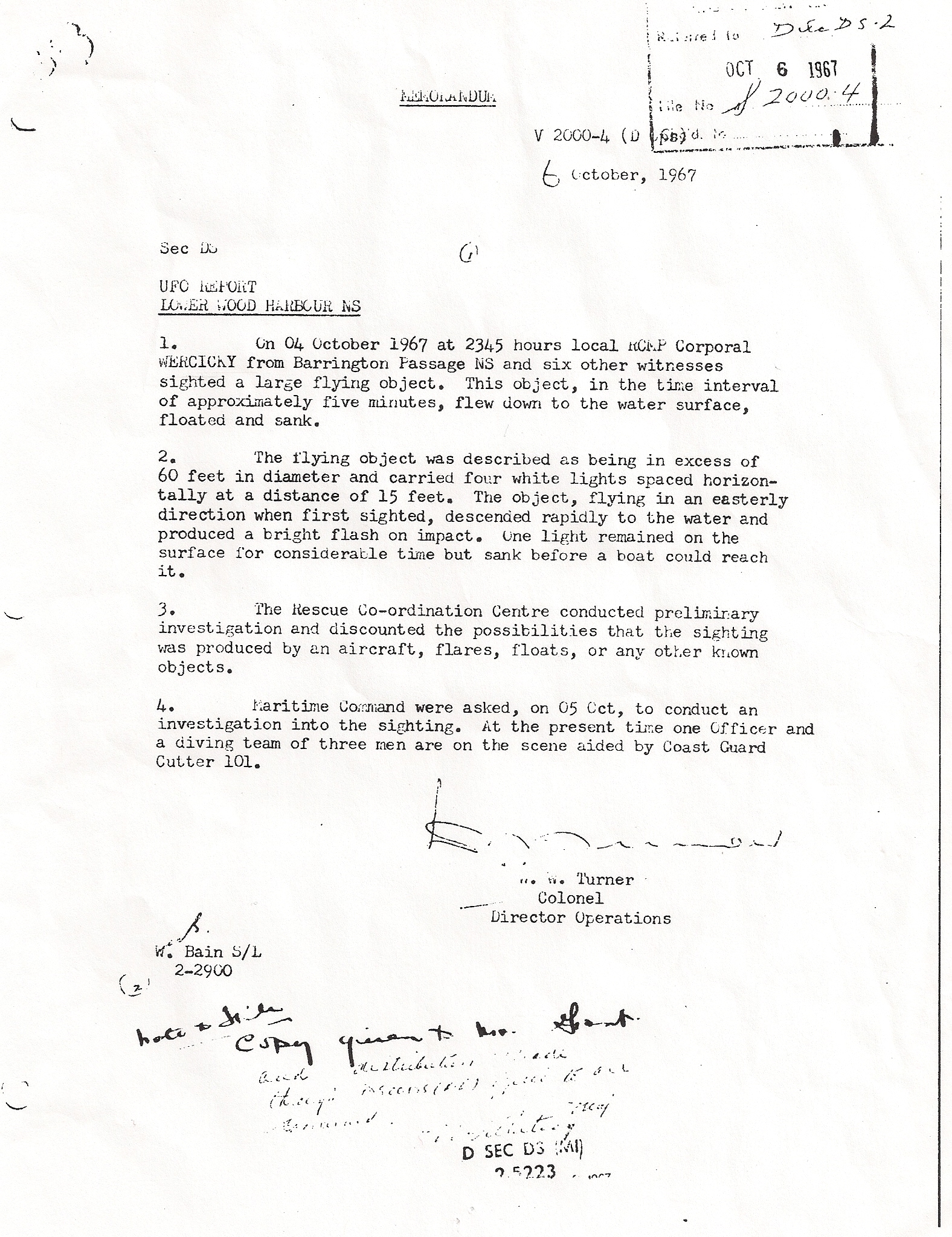
There was no military scramble and no government press release, but the case did pass through official Canadian channels for the period. UFO reports in Canada then routed through the Royal Canadian Mounted Police and the National Research Council of Canada. An RCMP officer investigated the hospital sighting. The Royal Canadian Mint, in the official text for its 2023 commemorative coin on this case, states plainly that "the RCMP officer who investigated the case was puzzled and could not explain the incident." That is an official paraphrase rather than a quoted file, but it records the outcome: the investigating Mountie reached no conventional explanation.
The substantive contemporaneous investigation was civilian and journalistic. John Magor, a longtime newspaperman who ran Canadian UFO Report from Maple Bay, interviewed Kendall and the hospital staff and published a detailed write-up, "UFO Occupants Seen Near Hospital," in Canadian UFO Report in 1970. Magor described himself as a skeptic who had never seen an object he could not identify, and he was visibly unsettled by the case. He gathered character references on the nurses, noting that friends and former patients said they would "accept their word under any circumstance," and he laid out the geometry of the building, the wards, and the object's position in careful detail. His conclusion was measured: the witnesses were credible and competent, no prosaic explanation he could find fit the close range and the observed occupants, and the case stood as an unexplained close encounter. He explicitly recorded that the two strongest 1 January sightings, the hospital and the truck-driving couple, occurred before any publicity, which he treated as a point in their favour.
A second, independent investigation came from Dr. P.M.H. Edwards, a professor at the University of Victoria, who looked into the case and corresponded with the National Research Council. A letter of his dated 18 February 1970 entered the file. As summarized by later researchers who have cited it, Edwards interviewed Kendall, examined the hospital layout, weighed aircraft, prank, and atmospheric explanations, judged the primary witness sincere and stable and the account internally consistent, and classed the sighting as unexplained. The case also reached the international research community quickly: the French group GEPA carried it in Phénomènes Spatiaux number 23, first quarter of 1970, and the American Aerial Phenomena Research Organization picked it up through Magor's reporting.
The original press record is anchored by the Victoria Daily Times article of 5 January 1970, with local follow-up in the Duncan-area Cowichan Leader the same week. No physical trace, photograph, or radar return was ever produced. The investigation rested entirely on the testimony of the nurses and the cluster of corroborating witnesses across the district that day.
What did the witnesses think it was?
Doreen Kendall never wavered. She was a practical nurse in her mid-fifties, on a routine night shift, and she logged the event in the hospital record the same morning, before any reporter or researcher was involved. She insisted on the human quality of the figures and on the peacefulness of the experience, and in the days after she reported a bright white light that seemed to follow her car between Ladysmith and Duncan on subsequent nights before it stopped. There is no record, in 1970 or in any of the coverage since, of Kendall recanting or softening her account. Frieda Wilson, the registered nurse who reached the window second, corroborated the brilliant object even though she did not see the figures, and she dismissed the prank theory that was already circulating at the time. "Some people say we were looking at a plastic bag with candles in it, put there as a joke," Wilson said. "But it would take a million candles to make it as bright as that." Wilson likewise never retracted.
Magor recorded two further nurse witnesses, Mrs. Clackson and Mrs. Appleby, who saw the bright object receding from another window, which gives the hospital event at least four staff witnesses and possibly five. Beyond the hospital, the district produced an unusually broad spread of independent witnesses for a single day: the unnamed husband and wife driving in the pre-dawn hours, the Drummond family with their telescope that evening, ship's pilot Jim Drummond describing the beam of light, neighbours including George Hallett, and diners at the Deer Lodge. These people did not know each other's reports when they came forward, and the early ones had no newspaper account to copy from. That breadth is part of why both Magor and Edwards treated the New Year's Day cluster as something more than one nurse's misperception.
The people closest to Kendall vouched for her steadiness, and nothing in her behaviour fit a hoaxer. She gained no money and no fame she sought, kept nursing, and told the same account to a skeptical journalist, a university investigator, and the RCMP.
The dispute
A specific counter-explanation exists, and it is the reason this case sits in the disputed column rather than the unexplained one, but it is weak where it counts. The claim is that the object was a homemade hot-air balloon released as a New Year's party prank. It surfaced in 2023, fifty-three years after the event, after the Royal Canadian Mint announced its commemorative coin. Two elderly Vancouver Island men came forward separately. Dan Hughes, then 81, of Duncan, told reporter Darron Kloster of the Times Colonist and Vancouver Sun that friends Les and Renee Palmer had built and launched the device near the hospital: a lightweight wooden cross with small candles at the four ends, strings attached, the whole thing covered by a plastic dry-cleaning bag, inflated with a portable hair dryer and lit, which then "sailed higher and higher." Hughes suggested the printed patterns on dry-cleaning bags of the era could be mistaken for figures. Separately, Jan White, then 79, a Victoria barber, told the Delta Optimist that he and George Halkyard had built larger balloons from ironed-together lumberyard plastic sheets on an aluminum frame holding a pie plate of burning Sterno, and that one was brought to the Palmers' New Year's party.
There are real problems with treating this as a solved hoax. The two accounts conflict on the most basic facts: who built the device, what it was made of, how big it was, and how it was flown. Neither man claims to have built the specific object Kendall saw, only that balloons were in the air. The confessions came more than half a century later, with no contemporaneous evidence at all, no photograph of any device, no police or newspaper note of a prank from 1970, and no witness from the hospital changing their story. Crucially, the balloon theory is not new. It was already being floated in early 1970, and nurse Frieda Wilson rejected it on the spot with the line that it would take a million candles to match the brightness she saw. The original geometry argues against a drifting bag too: Kendall described a tilted, roughly 50-foot domed disc at about 60 feet range, holding station and circling the building anticlockwise four or five times before departing under apparent control, with two figures who reacted to being watched. A candle-lit dry-cleaning bag does not hold a fixed station against wind, does not circle a building counter-clockwise on command, and does not present a tilted metallic underside with a necklace of lights and a populated instrument panel.
The investigators who looked hardest did not buy a prosaic answer at the time. The RCMP officer could not explain it, John Magor found no conventional fit despite approaching as a skeptic, and Dr. P.M.H. Edwards of the University of Victoria judged the witness sincere and the account inconsistent with a simple prank or misidentified aircraft. Even Chris Rutkowski, the veteran Canadian UFO researcher who reviewed the 2023 confessions, treated them as possible but unproven, framing his piece with a question mark and noting the men disagree with each other and that no independent evidence backs either story. So the dispute is genuine and on the record, but it is an unconfirmed, internally contradictory, decades-late recollection set against multiple contemporaneous witnesses, two careful 1970 investigations, and a witness who pre-emptively rejected the very theory. That is enough to mark the case disputed, not enough to close it.
Is the Cowichan District Hospital Sighting real? The two-pass assessment
Pass one, the ordinary explanations. A drifting object lit from within is the obvious candidate, and the period press, the 2023 claimants, and modern skeptics all converge on a candle-lit balloon or plastic bag. Other mundane options would be a misidentified aircraft or helicopter, a bright planet or astronomical effect seen through a window at an odd angle, or a reflection on the glass. Each runs into the specifics of the testimony. A reflection does not get corroborated by four other nurses at two windows and a district full of independent witnesses across the same day. A planet or aircraft does not present a tilted 50-foot domed disc at 60 feet, circle the building anticlockwise several times, and then accelerate away. The balloon is the only ordinary explanation with a named method and named people behind it, and it is the strongest mundane case, which is why this file is disputed. But that case is built on two conflicting confessions offered fifty-three years later with zero physical or documentary support, contradicted by the controlled station-keeping and circling Kendall described, and pre-rebutted in 1970 by Wilson on the brightness. As a hoax with the method actually shown, it is asserted, not demonstrated.
Pass two, if the testimony is taken at face value. Then this is a close-range daylight-clear observation of a structured craft with a transparent dome, an instrument panel, and two roughly human-sized occupants who appeared to register being watched and responded by maneuvering away. It belongs to the occupant or close-encounter category, with the operators looking notably human, dark-suited and head-covered but bare-handed, which Kendall stressed. The same district produced a second telescope-aided observation that evening by a ship's pilot describing a domed object and a segmented beam, suggesting whatever was active over the Cowichan Valley that New Year's Day was seen by people who had no contact with one another.
Weighing both passes: the case carries strong, consistent, multi-witness testimony, two contemporaneous investigations that found no conventional fit, an RCMP officer who could not explain it, and a witness who never recanted in over fifty years. Against that sits one real but weak counter-explanation, a late, internally contradictory, evidence-free balloon claim that does not match the reported behaviour of the object and was already rejected by a witness in 1970. An official-style inability to explain is not a mark against the case, it is a sign the event was solid enough to resist closing. Under the project rules a contested, unproven natural-explanation reconstruction is not enough to push a case to strongly disputed, and there is no confession by the witnesses, no recovered prop tied to this sighting, and no positive identification of the specific object. The balloon theory is a claim with its own modest evidence tier, not a verdict. The case largely stands. Tier: Barely Disputed.
Sources
- www.ufobc.ca/History/1970/Version1%20saved/ufooccupants.htm
- www.mint.ca/en/shop/coins/2023/1-oz-pure-silver-glow-dark-coin-canadas-unexplained-phenomena-duncan-incident
- web.archive.org/web/20240119155148/https://podcastufo.com/a-1970-ufo-and-occupant-report-from-british-columbia-explained/
- www.ufoinsight.com/ufos/close-encounters/cowichan-hospital-encounter
- caballodetroy.medium.com/a-ufo-in-a-canadian-hospital-281f466b8e27
- www.timescolonist.com/highlights/ufo-encounter-at-duncan-hospital-depicted-on-canadian-coin-7771737
- www.delta-optimist.com/highlights/i-dont-think-theyll-arrest-me-now-island-barber-helped-make-ufo-that-became-legendary-in-duncan-7821040
More cases from this region: UFO sightings in Canada