The Karnes City Uranium Mine UFO
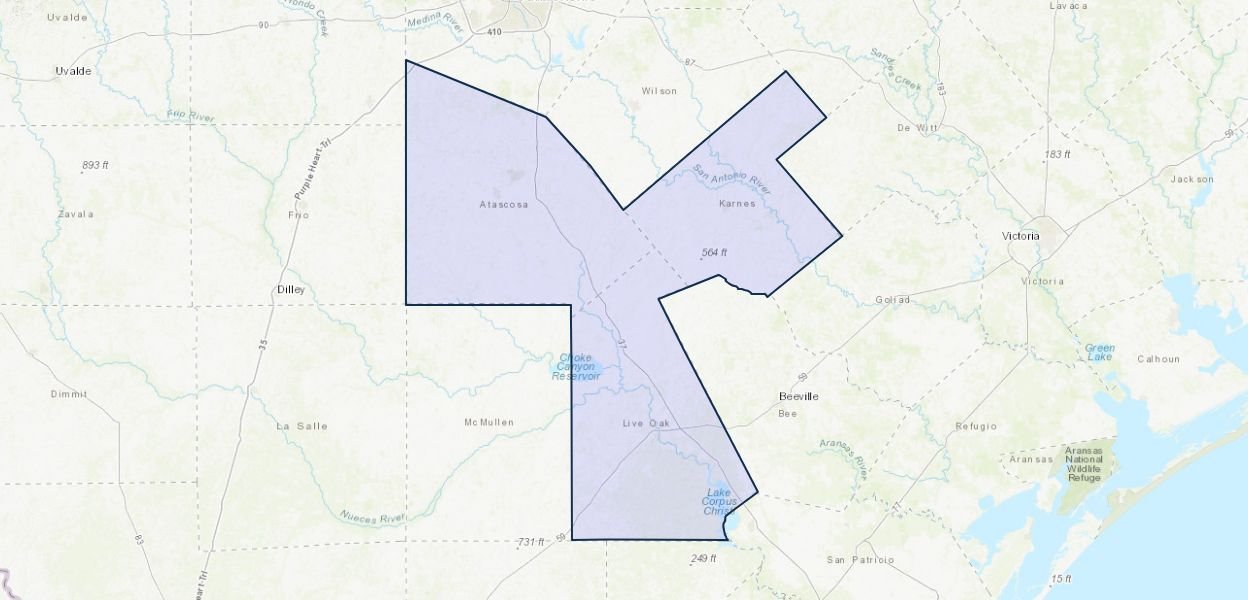
The entire account comes from one man, identified as Michael Harvey in the source attribution and signed "Marcus Harvey" at the foot of the text. This case file covers what witnesses reported, the official narrative, and a two-pass assessment with its evidence tier.
What did witnesses see at Open-pit uranium mine west of Karnes City?
The entire account comes from one man, identified as Michael Harvey in the source attribution and signed "Marcus Harvey" at the foot of the text. He says that in the summer of 1971 he was working the night shift for Conoco Oil Co. at an open-pit uranium mine west of Karnes City, Texas, one of six men running Caterpillar 657B earth-moving scrapers in the pit.
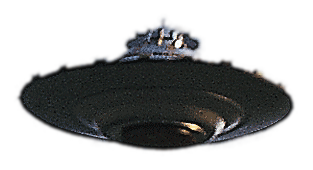
By his telling it was about 11:10 at night, just after a shift change, when the whole 85-acre pit suddenly lit up "as if it was daylight." The light was so intense he had to squint because it hurt his eyes. At the same moment he heard a high-pitched hissing noise, and the hair on his arms stood on end. He looked up and saw a round object hanging over the pit. There was a bright light coming from the center of its underside, and around its rim were what he described as hundreds of penlight-sized beams that alternated through all the colors of the spectrum, which he took to be lasers. The craft rose slowly at first, then shot straight up and out of sight in about ten seconds.
Harvey wrote that he and the five other workers were badly shaken, that he himself was "crying and shaking," and that the others reacted the same way. He frames the men as collective witnesses, but he is the only person who is named anywhere, and none of the other five has ever been identified or has come forward.
The claim the case is really built on comes two days later. Harvey says that when the "tap rock" overburden was stripped back to expose the ore where the object had hovered, the uranium had changed. Inside a circle about 250 feet across in the center of the pit the ore was now "a chalky white substance" that registered, in his words, "NO radioactivity at all." Outside that circle the ore was as potent as ever. He closes with his own theory: "I think the UFO needed the uranium for some reason."
What is the official explanation?
There is no official record of this event of any kind. The U.S. Air Force's Project Blue Book, the only government UFO investigation that produced case files, was terminated in December 1969, roughly eighteen months before the claimed 1971 date, so even in principle there could be no Blue Book entry for it. No sheriff's report, no mine-company incident log, no Atomic Energy Commission or Nuclear Regulatory Commission filing, and no newspaper story from 1971 has ever been produced. No civilian body created a case number for it either. The UFO Evidence catalog that hosts the report lists no investigator, no MUFON or NICAP designation, and no corroborating documentation, and the secondary write-ups that repeat the story all grade it "inconclusive" while conceding there is no photographic proof and that the timeline is thin.
The one part of the account that can be checked against the record is the industrial setting, and there it holds up. The Texas State Historical Association's Handbook of Texas entry on uranium mining states that "Continental Oil Company (CONOCO) and Pioneer Nuclear Corporation began a venture known as the Conquista project to mine uranium and build a 1,750-ton-per-day processing mill southwest of Falls City in Karnes County," that the project called for "mining ore by open pit methods within a thirty-five mile radius of the plant," and that "mining was scheduled to begin in 1971." The Nuclear Regulatory Commission's decommissioning record for the Conoco Conquista site confirms a Title II uranium operation in Karnes County near Falls City that processed ore from conventional open-pit mines, and contemporary Texas records show a radioactive-materials license issued to Continental Oil in September 1971. By 1975 the Handbook notes that ore for the Conquista mill was "trucked from ten open pit mines in Karnes and Live Oak counties." So an open-pit uranium operation run by Conoco, employing earth-moving crews on night shifts in Karnes County in 1971, is entirely real. That is the only element of the story the documentary record supports, and it corroborates the backdrop, not the object.
What did the witnesses think it was?
The single named witness, Michael or Marcus Harvey, presents himself as a working miner who had no idea what he saw and reached for the only frame he had, an alien craft drawing on the uranium. He does not claim contact, missing time, or any later harassment. He simply describes a luminous round object, the colored rim beams he called lasers, the hiss, the physical sensation of his arm hair rising, and the emotional aftermath, then offers the bleached non-radioactive ore as proof that something extraordinary happened. His parting line, "I think the UFO needed the uranium for some reason," is his own interpretation rather than anything he says he was told.
He insists five other men were present and reacted the same way, which would make this a six-witness event. In practice it is a one-witness event. Not one of the other Caterpillar operators has ever been named, located, or quoted, in 1971, in 1999, or since. There is no foreman, no mine supervisor, no radiation-safety officer, and no company geologist on record describing a 250-foot circle of suddenly inert white ore, which is exactly the kind of anomaly that would have triggered instrument readings, paperwork, and talk in a regulated uranium operation. Harvey's testimony stands or falls entirely on his own word, written down nearly three decades after the fact.
The dispute
The dispute is not over a competing identification of a craft but over whether anything happened at all, and over one specific claim that can be tested. The account is a single email from Michael Harvey, signed "Marcus Harvey," that first appeared on rense.com on 28 May 1999 and describes an event the writer dates to the summer of 1971. No contemporary 1971 record, no photograph, no named co-witness from the six men he says were present, and no investigation of any kind has ever surfaced. Project Blue Book had already closed in December 1969, so there was never an official channel that would have logged it. The case therefore rests entirely on one person's memory, written down roughly twenty-eight years later, with nothing to check it against.
The one checkable claim is fatal to the story as told. Harvey says that two days after the sighting the uranium ore inside a 250-foot circle had turned "chalky white" with "NO radioactivity at all," while the ore just outside stayed potent. Radioactivity is a property of atomic nuclei, governed by half-life, and natural uranium ore is dominated by U-238, whose half-life is about 4.5 billion years. Nothing about a bright light or a passing object can switch that off in two days, or in two centuries. The decrease in activity over that span is effectively nil. This is not an official assertion or a contested reconstruction, it is settled nuclear physics, and it positively refutes the single most evidential detail in the account.
What keeps this at "Barely Disputed" rather than stronger is what the dispute does not contain. No one has shown a confession, recovered fabricated props, or matched the sighting to a named real-world object such as a specific aircraft, drone, balloon, or rocket launch. The witness has never walked the story back. The industrial setting is genuine: the Texas State Historical Association's Handbook of Texas and NRC records confirm that Continental Oil (Conoco) ran an open-pit uranium operation in Karnes County in 1971, exactly the kind of site Harvey describes, which gives the tale a plausible stage. So the honest position is that the case is uncorroborated and its key physical claim is impossible, yet it has not been affirmatively proven a hoax. It fails on evidence and physics without crossing into a demonstrated fabrication, which is the definition of barely disputed here.
Is the Karnes City Uranium Mine UFO real? The two-pass assessment
Pass one, how this is entirely ordinary. The whole case is a single first-person email, first posted publicly on 28 May 1999, describing an event the writer places in the summer of 1971. There is no contemporary documentation of any kind, no photograph, no named second witness out of the six he claims, no investigator, and no official file. That alone leaves nothing to test. Worse, the one piece of "physical evidence" the story leans on cannot be true as described. Uranium ore cannot be stripped of its radioactivity overnight, or in two days, by a bright light passing overhead. The radioactivity of uranium comes from the slow decay of its nuclei, and U-238, the dominant isotope in natural ore, has a half-life of about 4.5 billion years. Over a couple of days the loss of activity is immeasurably small, essentially zero. There is no physical mechanism by which illumination from above turns potent ore into a "chalky white substance" with "NO radioactivity at all" inside a neat 250-foot circle while leaving the ore just outside it unchanged. That central claim is not merely unverified, it is physically impossible, which means the most evidential part of the account is the part that most clearly did not happen. The bright light, the hiss, the rim of colored beams, and the standing arm hair are all describable as embellished or invented memory, and the bleached-ore detail reads like a layman's idea of what a powerful craft "should" leave behind.
Pass two, if real. Taken at face value the report would be a low-altitude object that lit an 85-acre pit, emitted a high-pitched tone, displayed a ring of multicolored beams, departed vertically in seconds, and somehow neutralized the radioactivity of the ore beneath it. If any of that were genuine it would be one of the strongest physical-trace cases on record, an object that altered the nuclear properties of matter. Nothing supports it beyond one man's word, and the trace it points to is the one thing physics forbids.
Tier and why. This is not "Strongly Disputed." No one has produced a confession, recovered hoax props, or identified a specific mundane object, drone, balloon, or rocket that the account misreports, and the lone witness has never recanted. What we have instead is an uncorroborated 1999 anecdote about a 1971 event whose load-bearing evidential claim is refuted by basic nuclear physics, set against a backdrop (a real Conoco open-pit uranium mine in Karnes County in 1971) that checks out and lends the story surface plausibility. The verified setting keeps this from being dismissible outright, but the absence of any corroboration and the impossibility of the ore claim keep it from standing as unexplained. That places it at "Barely Disputed": the case largely fails on evidence and physics, while stopping short of a demonstrated hoax.
Sources
- rense.com/ufo3/ufomine.htm
- www.ufoevidence.org/cases/case1070.htm
- www.tshaonline.org/handbook/entries/uranium-mining
- www.nrc.gov/info-finder/decommissioning/uranium/conoco-phillips-company
- www.usgs.gov/publications/mapping-abandoned-uranium-mine-features-using-worldview-3-imagery-portions-karnes
- www.britannica.com/science/uranium-238
- www.ufoinsight.com/ufos/close-encounters/karnes-city-uranium-mine-ufo
More cases from this region: UFO sightings in United States