The Salt Lake City Ring Photographs
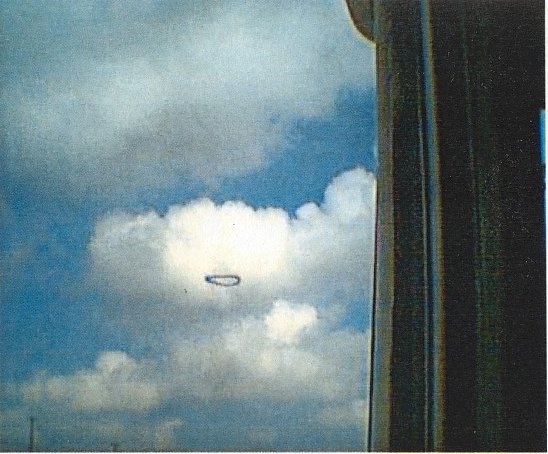
Around midday on 1 March 2001 a truck driver was making a regular delivery run through downtown and north Salt Lake City. This case file covers what witnesses reported, the official narrative, and a two-pass assessment with its evidence tier.
What did witnesses see at Beck Street industrial corridor?
Around midday on 1 March 2001 a truck driver was making a regular delivery run through downtown and north Salt Lake City. By his own account he first noticed a bright flash, and immediately after the flash a black ring appeared in the sky. He kept a small digital camera in his cab, an Aiptek pen camera that he said he had started carrying because it was more convenient than the Sony Mavica he used to use, and in rapid sequence he shot seven frames as the ring hung in the air.
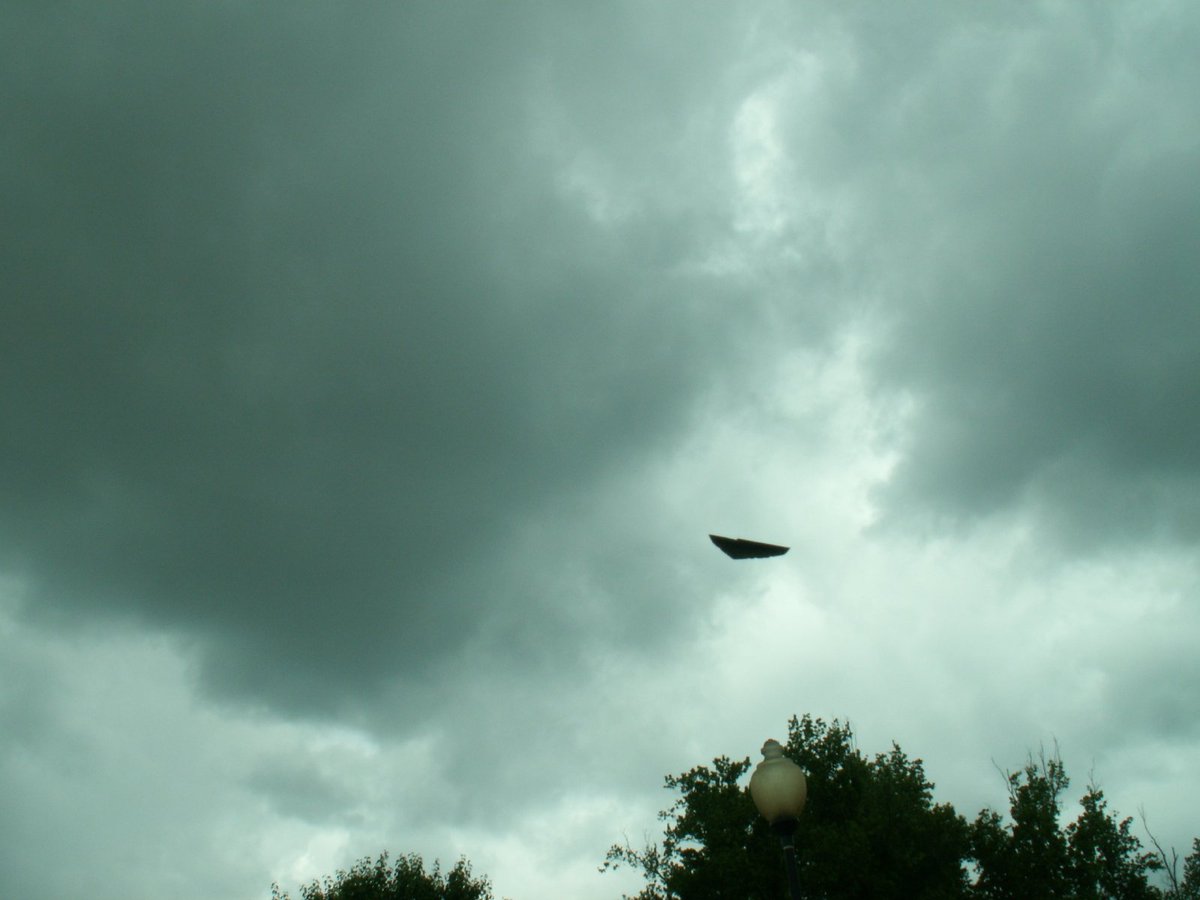
The photographs show a well formed dark ring against partly cloudy sky. The first two frames were taken out of the driver's side window, which appears to have been rolled down, and the rest were shot through the windshield as the truck moved. Across the sequence the ring drifts from left to right, that is west to east relative to the frame, which the investigator attributed to the truck turning toward the northwest as it ran north along Beck Street rather than to fast motion of the ring itself. The driver described very little movement of the ring and said it held its circular shape the whole time. He noticed what he called a "spike" on one side of the ring and a slight counterclockwise rotation, and that detail is visible in frames six and seven where a hook-like feature appears on the ring that is not obvious in the earlier shots. He said the movement of the spike "was very eery." The ring eventually either drifted into the cloud cover or simply vanished, and he was not sure which. He was firm on one point that later proved central to the case: in his words the ring "did NOT appear to be smoke" and was clearly and sharply defined.
Two other people reportedly saw the same ring. One was a second truck driver following behind the witness, who did not want to be identified and was never interviewed. The third was a worker at a facility on Beck Street who was outside on a break when he saw it; he described it to the primary witness as a "giant dark ring" and did not mention the preceding flash, though he may simply not have been outside when the flash occurred. He never responded to the investigator's attempts to reach him.
What is the official explanation?
There is no government file on this case. The Air Force closed Project Blue Book in 1969, so by 2001 no official body collected civilian UFO reports, and the only investigation of the Salt Lake City ring was a private one.
That investigation was carried out by William Puckett of UFOs Northwest, and it carries unusual weight because of who Puckett is. He worked as a meteorologist for the National Weather Service and then spent twenty-seven years with the Environmental Protection Agency, he holds a master's degree in atmospheric science from Colorado State University, and he is a professional member of the American Meteorological Society. He found the case after the trucker posted it on the Coast to Coast AM website, contacted the man by email, and gathered the extra detail that does not appear in the radio account.
Puckett then did what a meteorologist would do. He pulled the surface weather observations, winds aloft, and radar data for Salt Lake City on 1 March 2001. He found early morning drizzle giving way to partly cloudy skies, cloud bases near 4,000 feet by midday, very light winds aloft, and minimal atmospheric mixing, which he noted was consistent with a ring that barely moved and held its shape. Using a cloud base of 4,000 feet and an estimated viewing angle of about 45 degrees, he calculated the ring sat roughly a mile away horizontally and a little over a mile in slant range, near the base of the clouds. He checked the National UFO Reporting Center and MUFON databases and the local Salt Lake City newspapers and media, and found no other reports of the ring and no record of any fire, explosion, or unusual event that midday that might have made it.
He also filed a Freedom of Information Act request with Hill Air Force Base, about thirty miles north, asking whether the base had logged any UFO reports, whether it had run any operation such as munitions blasting that might produce a ring, and whether its radar had caught anything anomalous. The archived Hill AFB FOIA response is brief and answers only the first question: no UFO activity was viewed or reported. Puckett noted the base never addressed the question about its own operations, and he reasoned that an installation thirty miles away was an unlikely source for a ring over a city airport at midday in any case. His written conclusion was a flat "Unidentified," and he leaned the case toward an exotic reading by comparing it to the 1965 Rex Heflin photographs near Santa Ana, California, where a disk-shaped object appeared to leave a dark ring of particulate exhaust behind as it departed, a case re-examined favorably by Ann Druffel, Robert Wood, and Eric Kelson in the Journal of Scientific Exploration, Vol. 14, No. 4 in 2000.
What did the witnesses think it was?
The primary witness, who was never publicly named, believed he had photographed something genuinely strange and not a hoax. He put his real email address on a public server, sat for an interview with Art Bell, and pushed back on the obvious read by insisting the ring "did NOT appear to be smoke." He was struck by the spike on the ring and its faint rotation, which he found unsettling rather than mundane. Puckett's own assessment of the man was that he had nothing to gain, was willing to attach his identity to the report, and was probably telling the truth, and on that basis Puckett ruled out a hoax. Puckett's reasoning there is worth keeping: he asked why a hoaxer would bother to fake only a ring rather than build a whole saucer, and treated the very modesty of the claim as a mark of honesty.
The corroboration is real but thin. Three people reportedly saw the ring, yet only the truck driver was ever interviewed directly. The Beck Street worker's account reached Puckett secondhand, forwarded inside an email from the primary witness, and the worker himself never answered when Puckett tried to reach him. The second trucker who was following behind declined to be identified and was never interviewed at all. So the case rests on one fully documented witness, one secondhand statement, and one anonymous non-participant, plus the seven photographs.
The dispute
The dispute turns on a single prosaic mechanism: that the dark ring photographed over the Beck Street industrial corridor on March 1, 2001 was a vortex ring, the same toroidal structure as a blown smoke ring, made visible by soot or condensate rather than any emitting craft. This reading is not advanced by a named agency or skeptic. There is no government file at all, because the Air Force closed Project Blue Book in 1969 and no official body collected civilian UFO reports by 2001. The counter-explanation is the archive's own Pass-One analysis, anchored to the location: Beck Street is a refinery corridor, with the Chevron refinery in continuous operation since 1948 plus the Marathon and former North Salt Lake refineries, so a transformer or industrial blast is named as the probable source of a soot-laden vortex ring.
On the other side, the only formal investigation, by William Puckett of UFOs Northwest, returned a flat "Unidentified" and leaned exotic by comparing the photographs to the 1965 Rex Heflin images. The exotic reading rests almost entirely on one interviewed witness's impression that the ring "did not appear to be smoke" and was clearly and sharply defined, with a spike on one side and a slight counterclockwise rotation. The prosaic side answers that this is exactly the judgment a sharp dark vortex ring routinely fools people into making, which blunts the strongest piece of anomalous testimony.
What keeps this short of a closed debunk is method. The vortex-ring explanation fits every detail of the record, but it was never demonstrated, never traced to an actual transformer or industrial event, and explicitly "never checked" and "never ruled out" by any investigator. No source was identified, no technique was reproduced, no confession or measurement was produced. The corroboration on the witness side is real but thin: three people reportedly saw the ring, yet only the truck driver was interviewed directly, and the second driver and the facility worker were never questioned. The result is a well-supported ordinary hypothesis sitting beside an untested anomaly, with the photographs themselves accepted as real and the object unexplained on the record. A strong candidate mechanism that nobody bothered to verify against the actual scene is a hypothesis, not a verdict, so the case largely stands as Disputed.
Is the Salt Lake City Ring Photographs real? The two-pass assessment
Pass one, the ordinary reading. A dark ring that hangs in the sky, holds a near-perfect circle, and slowly frays is one of the most recognizable prosaic phenomena there is: a vortex ring, the same toroidal structure as a blown smoke ring, made visible by soot or condensate. The physics is well understood and method-shown. As NBC Connecticut meteorologist Ryan Hanrahan explained after a transformer blew in Branford, Connecticut in May 2016 and threw a black ring into the sky, a smoke vortex forms "when there is a blast through a circular structure," and because a transformer is a cylinder the burst exits as a stable doughnut. The same dark rings have been documented from fireworks mortars, refinery and industrial detonations, and power line and transformer faults across Ohio, Texas, Germany, and over Disneyland. The signature is exact: a bright flash, then a dense dark ring that propagates as a self-reinforcing vortex and keeps its shape for minutes in still air before unraveling or being absorbed into cloud. Every reported detail of the Salt Lake City ring fits that template, the preceding flash, the stable black toroid, the minimal drift in light winds, the slow rotation, and the final dissolution into the clouds.
What makes the ordinary reading strong here is the location, and this is the hole in the formal investigation. Beck Street is not a random downtown street. It is the spine of Salt Lake City's heavy industrial corridor along Interstate 15, lined with oil refineries, the Chevron refinery in continuous operation since 1948 and the Marathon and former North Salt Lake refineries running tens of thousands of barrels a day, plus their flare stacks, high-voltage substations, and gravel and cement operations. Puckett placed the ring directly over this corridor, writing that the trucker first photographed it while heading north on Beck Street, yet he filed his FOIA request with an Air Force base thirty miles away and never queried the refineries, the rail yards, or the power utility sitting underneath the ring. A flare detonation, a transformer fault, or any circular industrial blast in that corridor is a far better fit to "bright flash then a stable black ring" than anything Hill AFB was doing. The absence of a newspaper item about an explosion is weak counter-evidence, because a transformer pop or a flare event is routine in a refinery district and rarely makes the paper. So the prosaic explanation is not just available, it is the local default, and it was left uninvestigated.
Pass two, if it is genuinely anomalous. The case for strangeness is the one Puckett built. The witness was sincere, had nothing to gain, and insisted the ring was sharply defined and not smoke-like. There were additional witnesses, and Puckett, a trained meteorologist, judged the atmospheric conditions consistent with the ring's stability and could not in his own analysis pin it to a known source. He tied it to the Heflin lineage, where a structured craft seemed to shed a dark ring as it left. If one of those rings really did come from an emitting craft, this would be a daylight, multi-witness, photographed instance of the same thing.
Weighing them, the exotic reading leans almost entirely on a single interviewed witness's impression that the ring "did not appear to be smoke," which is exactly the judgment a sharp dark vortex ring routinely fools people into making, while the ordinary reading is supported by documented physics and by the industrial geography the photographs were taken over. Puckett's "Unidentified" verdict is honest but incomplete, because the most probable source was never checked. No independent analyst has tied this specific ring to a specific named blast, so there is no method-shown discredit, only a strong and largely unrebutted prosaic competitor. That is the definition of a contested case. Tier: Disputed. The photographs are real and the object is unexplained on the record, but a well-documented ordinary mechanism, an industrial or transformer vortex ring over the exact corridor where it was shot, fits every detail and was never ruled out.
Sources
- web.archive.org/web/20080821141209/http://www.ufosnw.com/sighting_reports/2001/ringufo/ringufo.htm
- web.archive.org/web/20151017225058/http://www.ufosnw.com/sighting_reports/2001/ringufopicts/ringufopicts.htm
- web.archive.org/web/20101222063354/http://ufosnw.com/sighting_reports/2001/ringufo/hillfoiaresp.pdf
- www.nbcconnecticut.com/news/local/smoke-rings-visible-after-explosion-have-scientific-explanation/56762/
- www.marathonpetroleum.com/Operations/Refining/Salt-Lake-City-Refinery/
- saltlakecity.chevron.com/
- www.anndruffel.net/articles/ufo/reanalysisofthe1965heflinufophotos.html
More cases from this region: UFO sightings in United States