The Bruno Facchini Encounter at Abbiate Guazzone, Varese (1950)
On the night of 24 April 1950, in the hamlet of Abbiate Guazzone near Tradate in the Province of Varese, a 40-year-old factory mechanic named Bruno Facchini stepped out of his house at roughly 10 in the evening. This case file covers what witnesses reported, the official narrative, and a two-pass assessment with its evidence tier.
What did witnesses see at Abbiate Guazzone?
On the night of 24 April 1950, in the hamlet of Abbiate Guazzone near Tradate in the Province of Varese, a 40-year-old factory mechanic named Bruno Facchini stepped out of his house at roughly 10 in the evening. A violent thunderstorm had just passed. Facchini had gone out to the external toilet shack, the only one the newly built house had, and stopped to smoke a cigarette. In a field next to his home, about 200 yards off near a power-line pylon, he noticed intermittent flashes of light. He first took them for lingering lightning, then realized the flashes were coming in bursts, like the sparks of a welding arc, from a fixed point on the ground.
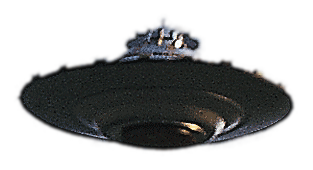
Walking closer, Facchini made out an immense dark shape, which he described as a ball with the top crushed flat, a flattened sphere. He put it at roughly 10 meters across and 7 meters high, dark and metallic, its surface marked with vertical and horizontal stripes or panels at regular intervals. A small external ladder, lit by a greenish light, led up to a lighted rectangular opening with an open hatch. Through the opening he could see an interior with a second ladder, rows of bottles or cylinders connected together, and what looked like gauges and tubes.
Around and on the object were figures, three or four of them, wearing close-fitting grayish one-piece suits with helmets and masks. From the front of each mask ran a flexible pipe that reminded him of a breathing tube, and inside the transparent part of the masks he thought he saw liquid; the faces behind were very pale. He judged the figures to be about human height, around 1 meter 70. One of them stood on a kind of platform or pneumatic lift against the side of the craft and appeared to be welding a bundle of tubes, which produced the spark-flashes that had drawn him in. The air around the scene felt unusually warm, and a constant buzzing droned the whole time, which he compared to a giant beehive or a large electrical generator.
Believing he had stumbled on stranded pilots in trouble, Facchini approached to within four or five meters and called out an offer of help in Italian. The figures answered only with guttural sounds and strange gestures. The buzzing swelled into a roar. Frightened, Facchini turned and ran. Glancing back, he saw one of the figures raise a device it carried at its side and aim it at him. A beam or ray struck him in the back. He said it felt as though he had been cut in two by a jet of compressed air; he was thrown to the ground, striking his head on a boundary stone. When the figures finished their work they went back inside, a lighted hatch closed, the buzzing intensified, and the object lifted and moved off sideways at speed.
The next morning Facchini went back to the field. He found four circular depressions about one meter wide each, set out in a square roughly six meters on a side, the grass inside and around them scorched, and scattered pieces of metal on the ground which he assumed were welding slag. He gathered some of the fragments and kept them.
What is the official explanation?
There was no immediate official inquiry of the kind a modern reader expects, and that absence is itself part of the case. Facchini reported what he had seen to the police headquarters (Questura) in Varese. According to the account he gave investigators years later, he was advised to keep quiet about it, in some tellings for reasons of public order, so as not to alarm the population, in others for vague security reasons. Whether through that instruction or his own fear of ridicule, Facchini said nothing publicly for roughly two years. Police are reported to have visited the field and seen the ground traces, and the metal fragments were submitted for laboratory analysis.
The fragments are the closest thing the case has to documented physical evidence, and several analyses are on record across the literature. The samples were first sent to a metals research institute in Novara (named in the sources as the Istituto di Ricerche per lo Studio dei Metalli), which reported the material to be a heat-resistant, antifriction metal, the kind of alloy used in bearings rather than anything exotic. The early Italian private investigator Renato Vesco of Genoa examined fragments in 1951 and concluded they were essentially bronze, with a high proportion of tin and traces of lead. A later metallurgical test reported in the literature put the composition at about 74 percent copper and 19 percent tin with trace elements, noting that under magnification the metal showed a yellow-white color but contained no element that could not be found on Earth. In plain terms, every analysis that touched the material described an ordinary terrestrial bronze or antifriction alloy, not an unknown substance.
The case entered the public record through the popular illustrated weekly La Domenica del Corriere in the summer of 1952, more than two years after the night in question, with the magazine's artist Walter Molino producing the dramatic cover-style illustration the story is still remembered by. From there it was picked up by the first wave of Italian ufologists. It was written up by Carminati Ghidelli in the magazine Dischi Volanti around 1960, discussed by Alberto Perego, handled by Umberto Corazzi, who reportedly received one of the metal samples and then lost it, and covered by journalist Bruno Ghibaudi. The British Flying Saucer Review carried Antonio Giudici's article The case of Bruno Facchini in volume 20, number 6, for November-December 1974, pages 30 to 31. The veteran researcher Ezio Bernardini of the Centro Ufologico Nazionale re-interviewed Facchini in 1981. The episode is logged in Jacques Vallee's Magonia catalogue of humanoid cases. No government body in Italy ever produced a formal report identifying the object, and no official explanation was ever issued.
What did the witnesses think it was?
Bruno Facchini was, by every description, an unremarkable working man: around 40 in 1950, a factory mechanic, married, with a young son or two, living in a modest new house in a small hamlet. He was not a flying-saucer enthusiast and had nothing obvious to gain. The detail that gives his story its peculiar texture is that he did not interpret what he saw as a hostile alien attack. He thought he had come across pilots whose machine had broken down in the storm and who were repairing it, which is why he walked up and offered to help. The welding, the tools, the breathing tubes, the workmanlike activity, all read to him as mechanics at work, not as a menacing visitation. He believed he had been hurt only because he had startled them and run.
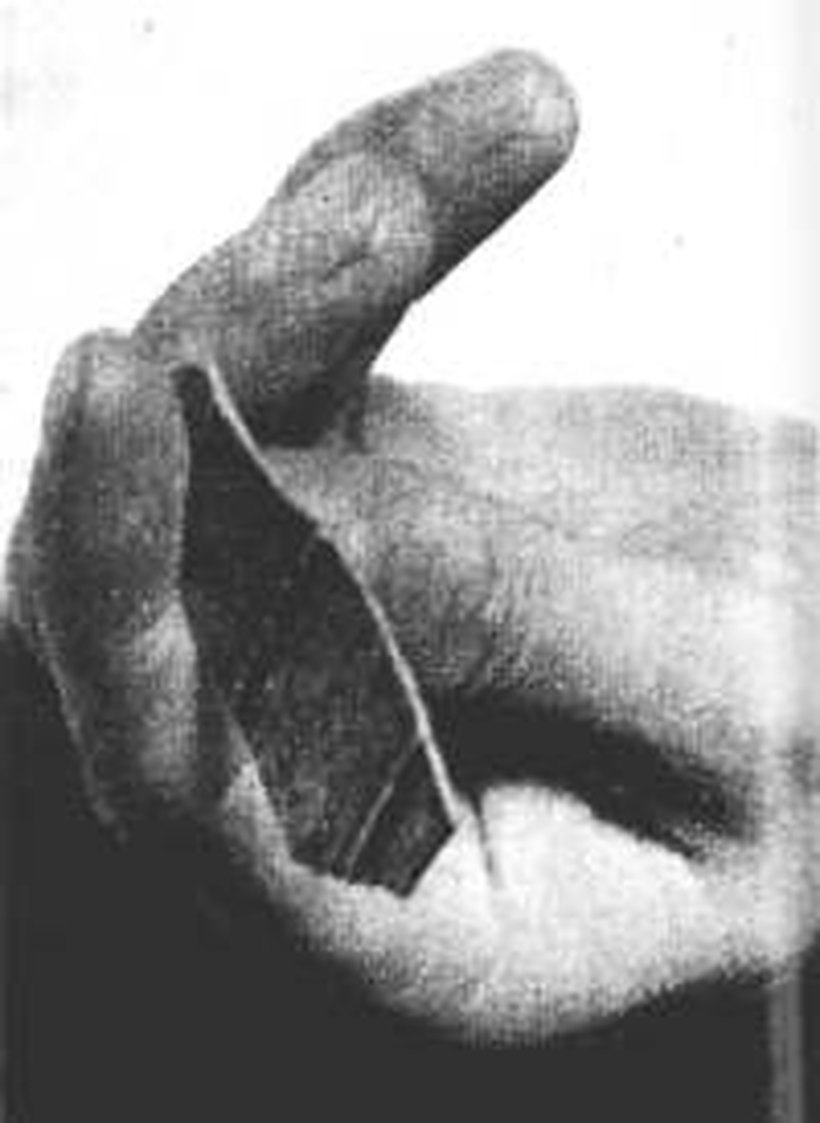
The physical aftermath was real enough to be examined. Facchini complained of feeling unwell, with hot flushes across his face and no accompanying fever. Several days after the night in the field a doctor looked at his back and, according to the account, found a blackened mark where the beam had struck. The mark is said to have spread until it covered much of his back, and he suffered pain from it for about a month, requiring treatment he found expensive. He kept his scorched jacket and damaged boots, and later allowed himself to be photographed holding them, and holding one of the metal fragments in his hand. Those photographs are among the few tangible records the case left behind.
Corroboration is where the case is thin and where its weakness lies. No independent witness is recorded as having seen the lights in the field, the object, or the figures. The supporting evidence is the man himself, the ground traces police are said to have viewed, the injury a doctor is said to have examined, and the metal that several analysts handled before the last sample was lost. Facchini paid a social price for telling the story. He became a target of mockery in his own community, came to regret having spoken at all, and according to the regional press lived out his life under the weight of it. He held to the same account for more than three decades, repeating it consistently to Bernardini in 1981 as he had told it in the 1950s, without embellishing it into the lurid abduction tale that later foreign retellings sometimes grafted onto it.
The dispute
The dispute is not a method-shown debunk; it is a set of evidentiary weaknesses that keep the case from rising to fully verified. First and most serious, the entire encounter rests on one witness. No independent person is recorded as having seen the lights in the field, the object, or the figures, even though Facchini placed the craft only a couple of hundred yards from a populated hamlet on a night when others were presumably home. The ground depressions and burned grass that police are said to have viewed were never independently dated or tied forensically to that specific night.
Second, the physical evidence that did exist points the ordinary way. The metal fragments Facchini recovered were analyzed more than once, and the findings converge on a terrestrial alloy: the metals research institute in Novara called the material a heat-resistant antifriction metal; the early investigator Renato Vesco concluded in 1951 that the samples were essentially bronze with a high tin content and traces of lead; and a later metallurgical test reported in the literature gave a composition of roughly 74 percent copper and 19 percent tin, explicitly noting it contained no element that could not be found on Earth. Crucially, even this unremarkable material no longer exists for re-testing, the last known sample having been received and then lost by the investigator Umberto Corazzi.
Third, the chain of transmission is long and was shaped by sensational media. The event went unrecorded in print for over two years, surfacing only in the summer of 1952 in the popular weekly La Domenica del Corriere, complete with a dramatic Walter Molino illustration, and was then elaborated by successive ufologists across the 1950s, 1960s, 1970s, and 1980s. Some foreign retellings, including the English-language version that names beam weapons and waves of emerging creatures, drift well beyond what Facchini himself described, which was workmen repairing a machine.
None of this amounts to a confession, recovered hoax props, or a positive identification of a specific real-world object, the bar required for a strong dispute. There is no demonstrated aircraft, balloon, drone, or staged prop, and the witness held to a consistent, non-lurid account for more than thirty years at real social cost. The counter-explanation is therefore weak and partial, an argument from missing corroboration, lost samples, and ordinary metallurgy rather than a shown mechanism, which is why the case sits at Barely Disputed and largely stands.
Is the Bruno Facchini Encounter at Abbiate Guazzone, Varese (1950) real? The two-pass assessment
Pass one, the ordinary readings. The encounter rests on a single witness, alone, at night, immediately after a violent thunderstorm, the exact conditions under which atmospheric electricity, after-images, and a frightened imagination can all conspire. A man startled in a dark field and convinced he was struck by something could plausibly have stumbled and fallen against the boundary stone he says he hit, producing a real bruise or pressure injury that a doctor then documented honestly without endorsing any cause. The metal is the strongest natural anchor: every analysis that examined it, from the Novara institute calling it antifriction metal, to Vesco finding ordinary bronze with high tin, to the later test giving roughly 74 percent copper and 19 percent tin, described a perfectly terrestrial alloy with no element foreign to Earth. The ground traces and burned grass were never independently dated to that night. A deliberate hoax is also conceivable, although no method, prop, confession, or motive has ever been shown, and the social ruin Facchini suffered argues against a man inventing a tale for gain. The two-year silence before publication, and the role of a sensational illustrated weekly in launching the story with a dramatic Walter Molino picture, mean the version that spread was shaped by retelling, not by a contemporaneous record.
Pass two, if real. Taken at face value, this is a landmark early close encounter of the third kind: an apparently nuts-and-bolts craft down in a field undergoing repair, occupants in pressure suits with breathing apparatus doing visible mechanical work, a directed-energy effect that injured the witness, and physical after-traces in the soil. The behavior Facchini described is striking precisely because it is mundane, beings fixing their machine rather than performing for an audience, which is not the shape of a story a 1950 Italian mechanic would have absorbed from popular culture, since the modern abduction and humanoid templates did not yet exist. The retained jacket, boots, and metal, the documented back injury, and the police visit to the traces all point to something physical having happened, even if its nature stayed unidentified.
Weighing the two passes, no method-shown debunk exists. No one has produced a confession, recovered hoax props, or positively identified a specific aircraft, balloon, drone, or staged device as the real cause. The official handling, an instruction to stay quiet rather than an investigation that explained the event, is logged as evidence the report was taken seriously at the time, not as a mark against it. What genuinely weakens the case is structural: one uncorroborated witness, no surviving physical sample (the last metal fragment was lost in the hands of an investigator), a gap of more than two years before any record, and analyses that found the recovered metal to be ordinary bronze. That is a real but partial counterweight, an absence of corroboration and of surviving evidence rather than a demonstrated explanation. Under the tiering rules that places the case at Barely Disputed: it stands on a consistent, decades-stable witness account with documented injury and traces, dented but not closed by the single-witness problem, the missing samples, and the terrestrial metallurgy.
Sources
- ufologie.patrickgross.org/htm/abbiateguazzone.htm
- ufo.it/2015/11/18/1950-abbiate-guazzone-ir3/
- www.varesenews.it/2016/01/gli-alieni-in-italia-nel-1950-ad-abbiate-guazzone/479110/
- web.archive.org/web/20240614065731/https://www.varesenoi.it/2023/04/29/sommario/la-varese-nascosta/leggi-notizia/argomenti/la-varese-nascosta/articolo/la-varese-nascosta-5.html
- ufofyi.blogspot.com/2009/09/varese-italy-1950-bruno-facchinis-wild.html
- ufologie.patrickgross.org/pics/abbiateguazzone02.jpg
- ufologie.patrickgross.org/pics/abbiateguazzone01.jpg
More cases from this region: UFO sightings in Italy