The Alleged Mexico City Crash (1950)
There was no sighting in the ordinary sense. This case file covers what witnesses reported, the official narrative, and a two-pass assessment with its evidence tier.
What did witnesses see at Mountains south of Mexico City?
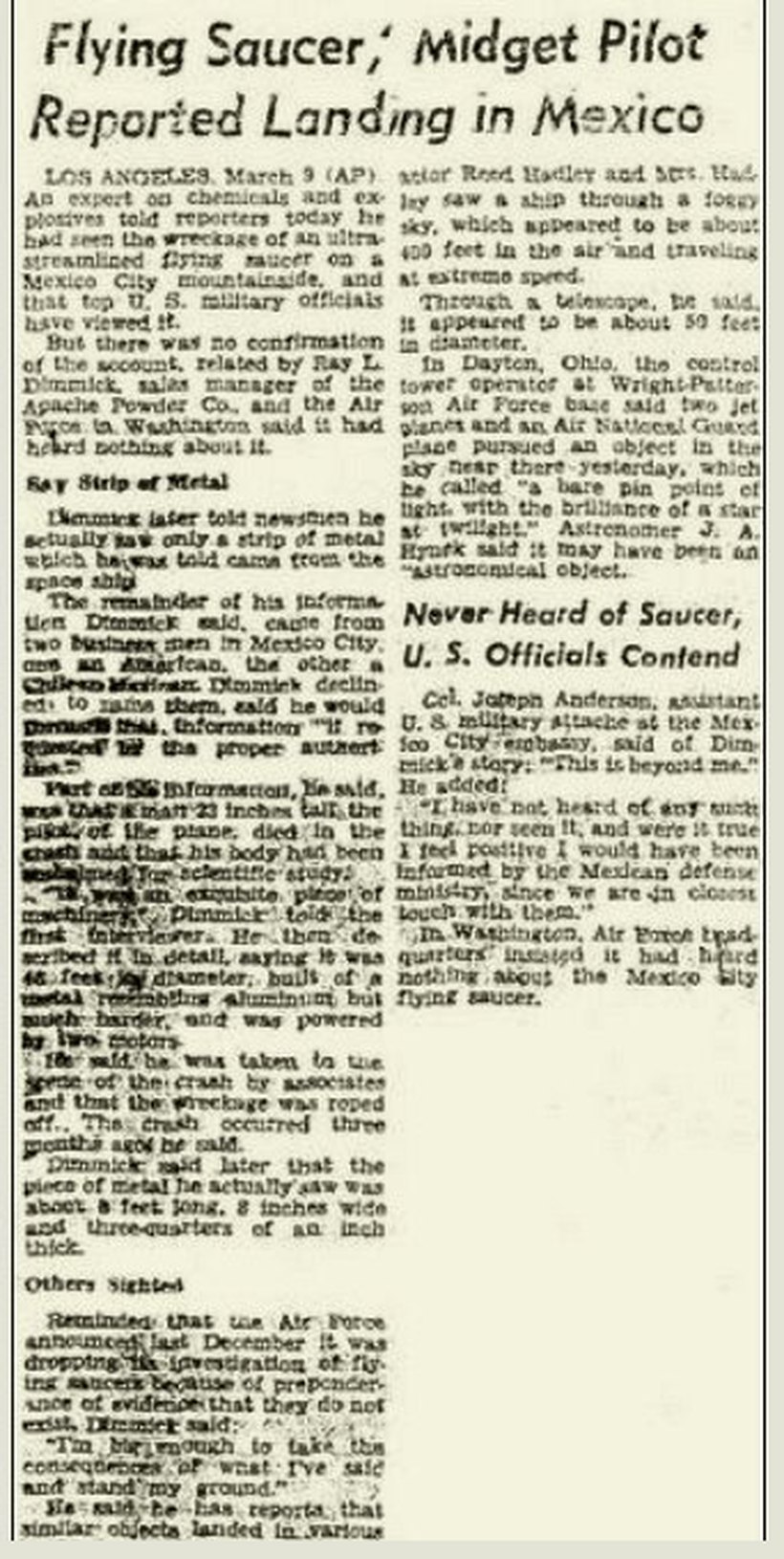
There was no sighting in the ordinary sense. What exists is a story told to reporters. On 9 March 1950, in Los Angeles, Ray L. Dimmick, the sales manager of the Apache Powder Company and a widely known amateur golfer, told the Associated Press that he had seen the wreckage of an ultra-streamlined flying saucer on a mountainside near Mexico City and that top United States officials had viewed it. The account ran the next morning under the Washington Times-Herald headline "Flying Saucer, Midget Pilot Reported Landing in Mexico," carried on the AP wire with a Los Angeles dateline of March 9.
As first reported, the craft was about 46 feet across by some accounts and 48 feet by others, built of a strange metal resembling aluminum but much harder, and powered by two motors. It had crashed, the story went, in the mountains roughly thirty miles south of Mexico City around December 1949. Inside was a single dead occupant, a man described as a midget about 23 inches tall, with a large head and a small body. That pilot, the account said, had been embalmed and kept for scientific study. Dimmick said he had personally handled a piece of the wreckage, a strip of the aluminum-like metal he gave variously as six to eight feet long, eight inches wide and three-quarters of an inch thick.
Within a day the story narrowed sharply. Dimmick told newsmen he had in fact seen only the strip of metal, which he was told had come from the saucer. Everything else, the crash, the body, the embalming, the dimensions of the craft, came secondhand from two businessmen he had met in Mexico City, one an American and one a Chilean, whose names he refused to give. He would name them, he said, only if requested by the proper authorities. Pressed on the retreat, he held his ground on the part he claimed to have touched, telling reporters, "I'm big enough to take the consequences of what I said and stand my ground." So the only thing in the entire account with a firsthand witness was a length of metal, and even that was identified as saucer wreckage only on the say-so of men who were never produced.
What is the official explanation?
The official response was immediate and dismissive, and it came from more than one direction. In Washington the Air Force said it had heard nothing about any such crash. The timing mattered: the Air Force had publicly announced in December 1949 that it was discontinuing its flying saucer investigations, citing what it called a preponderance of evidence that the objects did not exist, so a fresh crash-retrieval claim landed at a moment when the service was actively closing the subject down rather than opening files.
On the ground in Mexico the denial was just as flat. Colonel Joseph Anderson, the assistant United States military attache in Mexico City, told reporters, "It's beyond me. I have not heard of any such thing," and added that he would have been informed by Mexican authorities had anything of the kind occurred. No Mexican military communique, no recovery order, and no chain-of-custody record for either the craft or the embalmed body was ever produced by anyone, then or since. The claim that the remains were taken to a military installation appears only downstream in retellings and traces to no contemporary document.
There was one curious official wrinkle. According to Richard Geldreich's review of the contemporary coverage, Washington ordered the Air Force to question Dimmick, and a Master Sergeant named Richard L. Coleman conducted that questioning. The press coverage that followed quoted Coleman's framing of the matter rather than fresh statements from Dimmick himself, which Geldreich reads as the service effectively putting words in the witness's mouth. That an explosives salesman's secondhand "yarn" drew an order from Washington to interrogate him is itself notable, though it cuts both ways: it can be read as evidence the authorities took crashed-saucer talk seriously enough to manage, or simply as routine due diligence during a noisy news week. The broader press handling was openly skeptical. Time magazine, in its issue of 20 March 1950, ran the story in a press column titled "The Press: The Saucer-Eyed Dragons," treating Dimmick's account and the rash of similar tales as a media phenomenon, deadpan wire copy printed by credulous editors, and likening the mood to historical waves of people seeing dragons in the sky.
What did the witnesses think it was?
The single named witness is Ray L. Dimmick, and what he actually claimed to know firsthand shrank to almost nothing within twenty-four hours. By his own revised account he never saw the saucer, never saw the body, and never visited the crash site. He believed, or at least asserted, that a strip of metal he handled in Mexico City was a fragment of a wrecked spacecraft, and he believed the two businessmen who told him the rest of the story. Those two men, an American and a Chilean, were the supposed primary witnesses to the crash and the corpse, and they were never named, never interviewed, and never came forward. There are, in other words, no corroborating witnesses on the record at all. Everyone who could have confirmed the core of the tale is either anonymous or hostile to it.
Dimmick's own conduct is the most telling thing about the case. He was not a contactee or a saucer enthusiast building a following; he was a chemicals and explosives salesman who told a sensational story to reporters and then, when the heat came, walked back everything except the piece he said he had personally touched. He did not produce that piece for analysis. He did not produce his sources. He offered to name them only to "the proper authorities," a condition that conveniently kept them out of the press. His closing line, that he was big enough to take the consequences and would stand his ground, is the posture of a man defending his credibility, not a man with evidence. No metallurgical report on the alleged metal strip, no photograph of the craft or the pilot, and no statement from the embalmer or any Mexican official ever surfaced to support any part of what the two unnamed men were said to have described.
The dispute
The dispute is straightforward and it is mostly internal to the claim itself. The core counter-explanation, advanced contemporaneously by the skeptical press and by the official apparatus, is that this was a secondhand tall tale with no substance behind it. Ray L. Dimmick, the only named source, conceded within roughly a day of the first AP story on 9 March 1950 that he had personally seen only a strip of metal and that the crash, the 23-inch embalmed pilot, the 48-foot craft and the two motors all came from two businessmen in Mexico City whom he refused to name. Those men were never produced, never interviewed, and never corroborated. No body, no craft, no photograph, and no metallurgical analysis of even the metal strip ever materialized.
Who advanced the counter-explanation and on what basis. The United States Air Force in Washington said it had heard nothing of any such crash, in a period when it had just announced in December 1949 that it was shutting down its saucer investigations. Colonel Joseph Anderson, the assistant US military attache in Mexico City, denied it on record, saying "It's beyond me. I have not heard of any such thing," and noting he would have been told by Mexican authorities. Time magazine, on 20 March 1950, filed the episode under press credulity in "The Press: The Saucer-Eyed Dragons," treating it as wire-service yarn. The timing is the strongest circumstantial blow: the story clustered with the early-1950 "little men from Venus" crash wave, including the Aztec, New Mexico tale that Silas Newton and Leo GeBauer were later shown to have fabricated to sell fake alien-technology gear.
Why it does not fully close the case to the harshest level. The counter-explanation, persuasive as it is, rests on inference rather than on a demonstrated fabrication of this specific claim. Dimmick walked the story back in part, but he never confessed to inventing it; he insisted to the end that he had handled the metal strip and offered to name his sources to "the proper authorities." No hoax prop was recovered for this case, the two anonymous witnesses were never identified and unmasked, and no investigator ever positively pinned the story to a named hoaxer the way the Aztec affair was cracked by later reporting. So the case is best read as an unproven secondhand claim that almost certainly has no real craft behind it, weakened badly by its own teller and by official denial, but not closed by a confession, a recovered prop, or a positive identification of the real object. That places it in the "barely" band rather than the strong one.
Is the Alleged Mexico City Crash (1950) real? The two-pass assessment
Pass one, the ordinary explanation. The most economical reading is that there was never any craft or body, only a story. The structure of the claim is the giveaway. The dramatic content, a 46 to 48 foot saucer, a 23-inch embalmed pilot, two motors, an exotic alloy, all of it came from two men who were never named and never appeared, while the one named witness retreated within a day to claiming only that he had handled an unidentified strip of metal. That strip was never tested and never shown to be anything but metal. The case carries no photograph, no recovered hardware in any chain of custody, no Mexican military record, and on-record denials from both the United States Air Force and Colonel Joseph Anderson, the assistant military attache in Mexico City. It also did not arrive in a vacuum. It broke in the exact stretch of early 1950 when crashed-saucer and "little men from Venus" stories were multiplying in the American press, the same season Frank Scully was promoting the Aztec, New Mexico tale that Silas Newton and Leo GeBauer were later exposed as having fabricated to sell phony "alien technology" detection gear. Time treated Dimmick's account on 20 March 1950 as one more deadpan wire yarn in that flood. A secondhand story from anonymous sources, partially recanted by its teller, fits a hoax or a tall tale passed along in good faith far more naturally than it fits a real retrieval.
Pass two, if real. For this to be a genuine event, a 48-foot metal craft and a 23-inch humanoid would have come down near Mexico City around December 1949, been recovered and embalmed, and shown to unnamed United States officials, all without leaving a single document, photograph, or named witness, and with the only physical token a metal strip that was never analyzed. That is an extraordinary amount of nothing for an extraordinary claim. Nothing in the record points to a specific identified aircraft, balloon, or ordinary object either, so the "real-world cause" is not positively pinned down; what is established is only that the story has no producible support.
Where this lands. The reasons to doubt are strong: a secondhand chain, anonymous primary witnesses, a same-day partial walk-back, zero physical evidence, official denial, and a perfect fit with a documented hoax wave. But the bar for a harsher verdict is specific and it is not met here. There is no confession from Dimmick, no recovered hoax prop, and no positive identification of the actual object or cause. Dimmick hedged but never admitted fabrication, and his anonymous sources were never run down and exposed, so we cannot show that this particular story was manufactured the way the Aztec hoax was. That leaves a counter-explanation that is highly plausible but not proven to the confession-or-positive-ID standard. The case is Barely Disputed: it largely fails on its own merits, yet the discrediting rests on a strong inference rather than a demonstrated fabrication of this specific claim.
Sources
- web.archive.org/web/20250130125552/https://www.ufocasebook.com/mexicocity1950.html
- mexicounexplained.com/the-mexico-city-flying-saucer-crash-of-1949/
- www.thinkaboutitdocs.com/1950-mexico-city-ufo-crash-with-midget-pilot/
- medium.com/@richgel99/1950-ray-l-17f6c0a4307d
- web.archive.org/web/20200914224146/https://www.ufocasebook.com/mexicomidgetpilot.jpg
- time.com/archive/6607733/the-press-the-saucer-eyed-dragons/
More cases from this region: UFO sightings in Mexico