The Wayne City Car Chase
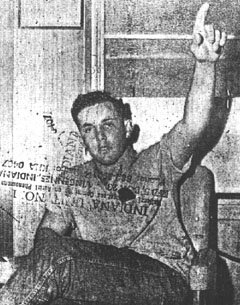
On the night of Sunday 4 August 1963, eighteen-year-old Ronnie Austin and his girlfriend Phyllis Bruce, also eighteen, were driving home from the Kerasotes drive-in theater in Mount Vernon, Illinois, where they had seen "The Great Escape. This case file covers what witnesses reported, the official narrative, and a two-pass assessment with its evidence tier.
What did witnesses see at Wayne City and Keenes?
On the night of Sunday 4 August 1963, eighteen-year-old Ronnie Austin and his girlfriend Phyllis Bruce, also eighteen, were driving home from the Kerasotes drive-in theater in Mount Vernon, Illinois, where they had seen "The Great Escape." They left around 11:30 p.m. and headed east on Illinois Route 15 toward Austin's family farm near Keenes, in Wayne County. Near the Mount Vernon airport Austin noticed a round ball of bright white light just above treetop level, about 20 degrees above the horizon to the southwest. In the contemporary account that Jeffrey G. Liss wrote for FATE Magazine, the light "had a fuzzy outline and appeared to be the size of a washtub."
As they drove on, the couple realized the light was keeping pace with the car. When Austin sped up, it sped up, and the chase reached speeds Liss put at up to 120 miles an hour. The object darted ahead, crossed the road, dropped toward the car to within an estimated 100 feet, and changed from brilliant white to a duller orange. When it passed close overhead the car radio broke into a loud whining static and the engine sputtered and nearly died. Austin also reported a "cooling effect," though he himself told Liss he had been so frightened that a sudden chill would not have surprised him. Phyllis Bruce, asked whether the thing was a plane, answered plainly: "No, it's not an airplane, it doesn't have flashing red and green lights."
Austin first drove Bruce to her home, where the light hung perhaps 500 feet to the east and her sister Forestine came out to look. When Austin then drove on alone toward his own farm, the object followed and dropped low behind him. He reached home barely able to speak, gasping to his father, "Dad, something followed me home." His parents Orville and Mrs. Austin, his fifteen-year-old sister Roxie, and his brother all came out and watched the light from the kitchen windows, and Roxie thought she saw "something small projecting from the light." The family was shaken enough that they phoned Dr. S. W. Conarski in Fairfield, who advised giving Ronnie a sedative. The whole encounter ran roughly from 11:30 p.m. to about 12:25 a.m. and unfolded along several different gravel roads and lanes, not a single straight stretch, which is why the witnesses kept insisting the light was tracking the car rather than sitting still on the horizon.
What is the official explanation?
The official response was unusually heavy for a teenage sighting. The Wayne County Press of 5 August 1963 ran the story under the headline "Keenes Boy Chased Home By 'Flying Saucer'," and within days the report had reached the Evansville Courier ("Strange Light Chases Area Teen-Ager's Car," 6 August) and the Chicago American ("Mystery Lights Jolt S. Illinois," 9 August). The Austin encounter sat inside a wider southern Illinois flap that same week, with reports from Fairfield and a sighting by Mount Vernon's former mayor Harry Bishop. Far from ignoring it, Project Blue Book flew a team from Wright-Patterson Air Force Base in Dayton, Ohio, headed by the Blue Book director himself, Lt. Col. Robert J. Friend, with Capt. Hector Quintanilla and Sgt. Charles Sharp. The 12 August front page of the Wayne County Press reported that "A TEAM OF AIR FORCE PHYSICISTS were in Fairfield over the week end checking last week's light-in-the-sky stories." The officers examined Austin's car, took compass deflection readings off the body, recorded loosely as "six point something" at the front, "four point something" on top, and "two point something" at the trunk, and, according to the family, told Ronnie to wash the car right away.
Despite that effort, Blue Book closed the case as conventional. The Air Force position, echoed by Blue Book consultant Dr. J. Allen Hynek, was that Austin had seen a bright astronomical body, the planet Jupiter or the moon through haze, and that a related mid-week regional sighting was a jet refueling operation. The case does not appear among the Project Blue Book "unidentified" cases compiled from the microfilm, so it was carded as explained. The two police officers who reached the Austin farm during the event reached the same conclusion on the spot. State Trooper Richard Gidcumb, who arrived around 12:45 a.m., said, "I have no doubt he saw something, he wasn't putting it on, but what they showed us was the Eastern Star." Wayne City village marshal George Sexton agreed, and Deputy Sheriff Harry Lee, arriving about 1:10 a.m. after the close approach was over, saw only "a large, unblinking white star" slowly gaining altitude to the south. Lee added that Ronnie "looked scared to death" and that he believed the boy had seen something. NICAP's field investigator Francis Ridge later obtained the relevant Blue Book microfilm pages and argued that the heavy on-site response, a physics team led by the Blue Book director, made no sense if the answer were really a planet, since a refueling operation or an astronomical body could have been ruled in or out without flying anyone to Illinois.
What did the witnesses think it was?
The witnesses never accepted the star explanation. Ronnie Austin was, by every account, genuinely terrified rather than performing. NICAP field investigator Francis Ridge, who ran the Indiana Unit No. 1 team and later served as Indiana MUFON State Director, a CUFOS field investigator, and founder of the UFO Filter Center, recorded that in the weeks after the event the boy "had lost 18 pounds and was afraid to go outside at night." Phyllis Bruce had ruled out an aircraft on the scene because there were no flashing navigation lights. The corroboration matters here: this was not one excited teenager but two principals plus Phyllis's sister Forestine, the parents Orville and Mrs. Austin, the Austin siblings Roxie and her brother, and ultimately the responding officers, all of whom agreed a bright unfamiliar light was present, even where they disagreed about what it was.
Ridge's central objection to the official answer was geometric rather than emotional. As he put it, Jupiter and the moon cannot "move back and forth over a road" or change position in the sky and chase a car the way the witnesses described. The witnesses described the light crossing in front of the car, dropping to roughly 100 feet, hovering over a specific farmhouse, and finally departing toward the southeast, none of which a fixed planet does. Deputy Lee's own report, that Ronnie "looked scared to death," and the parents' call to a doctor for a sedative, are the kind of detail that does not fit a boy who simply mistook a planet for a chase. The family stood by the account for decades, and the Wayne County Press revisited it on 13 November 1997 under the headline "UFO Visited Wayne County 34 Years Ago," with the principals still maintaining what they had said in 1963.
The dispute
The dispute is the astronomical misidentification. Two law officers who reached the Austin farm during the event, State Trooper Richard Gidcumb and Wayne City marshal George Sexton, concluded on the spot that the bright object the family was watching was a star, with Gidcumb naming the "Eastern Star," and Deputy Sheriff Harry Lee, arriving a little later, saw only "a large, unblinking white star" gaining altitude to the south. The United States Air Force, through Project Blue Book and its consultant Dr. J. Allen Hynek, formally adopted essentially the same explanation, that Ronnie Austin had seen the planet Jupiter or the moon through haze, and carded the case as explained rather than unidentified. In August 1963 Jupiter was a prominent evening object, and a bright low planet really can seem to pace and dart relative to a moving car, which is a documented perceptual effect on rural night roads.
The reason this stays at Barely Disputed rather than anything stronger is that the counter-explanation is an assertion of identity without a shown method that fits the reported behavior. The witnesses, and later NICAP investigator Francis Ridge working from the Blue Book microfilm, pointed out that the light was described crossing in front of the car, dropping to roughly 100 feet, moving back and forth over different gravel roads as the car turned, hovering over a particular farmhouse, and finally leaving toward the southeast, none of which a fixed planet or the moon does. The police identification covers the late phase, the high steady "star" still in the sky when officers arrived after the close approach had ended, and does not address the earlier low, lateral, color-changing chase that the two principals reported. The concurrent radio static and engine trouble are likewise unaddressed by the astronomical answer. No confession, recantation, recovered prop, or positive identification of a specific aircraft, balloon, or rocket has ever been produced for the close-approach phase. The official finding is partial, contested, and method-light, so the case largely stands while remaining genuinely disputed.
Is the Wayne City Car Chase real? The two-pass assessment
Pass one, the ordinary reading. The most economical mundane explanation is the one the on-scene police and Blue Book both reached: a brilliant astronomical body misjudged as a pursuer by a frightened young driver. In August 1963 Jupiter was a dominant evening object, and a bright planet or a hazy moon low on the horizon will appear to "pace" a moving car, hold a fixed angular height, and seem to dart when the observer's own motion changes, the classic moving-car illusion. The object reportedly never rose much above the low sky, never showed structure to the trained observers, and was identified independently by two officers as a star, with one naming the "Eastern Star." The radio whine, the engine miss, and the "cooling" can be read as ordinary car trouble plus fear, and Austin himself conceded the chill might have been nerves. On this reading the heavy Air Force visit reflects a 1963 flap and political pressure, not hard physics.
Pass two, if the core report is accurate. Then this is a textbook close encounter of the second kind: a low, luminous, color-changing object that descended to roughly 100 feet, kept station with a car through repeated turns onto different roads, and coincided with radio interference and engine trouble, witnessed by multiple people including law enforcement, and taken seriously enough that the director of Project Blue Book personally led a physics team to read the car for residual magnetism and have it washed. A planet does not cross in front of a car, drop to treetop level, hover over a specific farmhouse, and then leave to the southeast. The lateral, road-following motion and the concurrent electromagnetic effects are exactly what the astronomical explanation cannot reproduce.
The official astronomical finding is a real counter-claim, advanced by two officers on the night and adopted by Blue Book, so this is not an undisputed case. But it remains an assertion of identity, not a shown method. No one has reconciled the back-and-forth motion over the road, the close low approach, or the concurrent car effects with Jupiter or the moon, and the very weight of the Air Force response cuts against a trivial misidentification. The counter-explanation is partial and contested, and the case largely stands. Tier: Barely Disputed.
Sources
- www.nicap.org/630804waynecity_dir.htm
- nicap.org/articles/lissart.htm
- www.nicap.org/reports/austinufoi.htm
- nicap.org/bios/detailed/Ridge_F_detailed%20_bio.htm
- www.theufochronicles.com/2018/02/ufos-invaded-tri-state-1963.html
- www.ufoinsight.com/ufos/close-encounters/wayne-city-ufo-chase
More cases from this region: UFO sightings in United States