AARO's Private 2025 UAP Workshop and the Two Foreign Governments on the Roster: FOIA Case 26-F-1773 (14 September 2026)
A Pentagon FOIA release puts two foreign government bodies on the attendee roster of an invite-only AARO science workshop whose public white paper never mentions either of them.
What happened
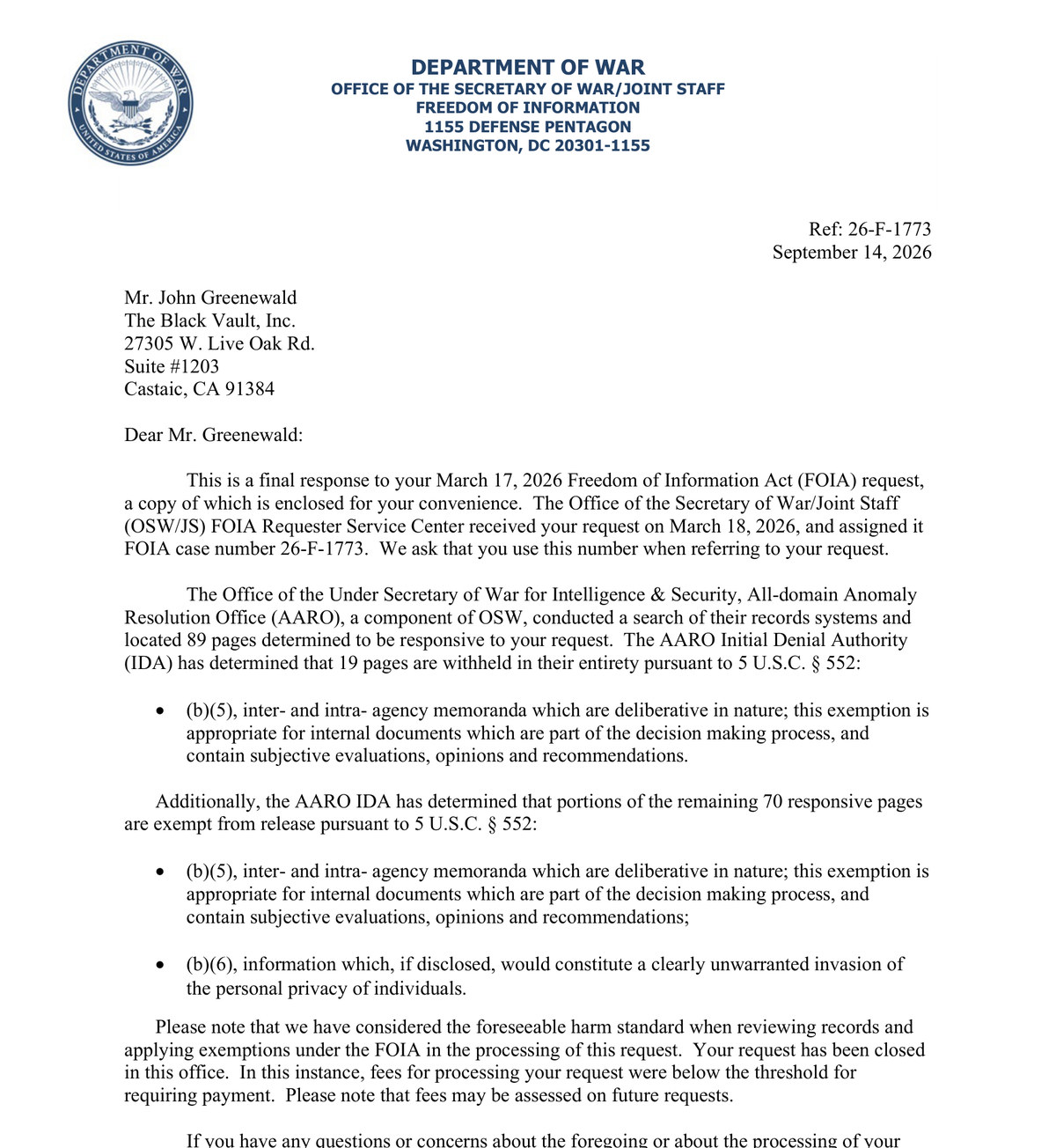
On 14 September 2026 the Department of War released records on a private UAP workshop that the Pentagon sponsored in Virginia. The release carries FOIA case number 26-F-1773 and was issued to John Greenewald of The Black Vault, who had filed the request on 17 March 2026, one day after DefenseScoop first reported that the workshop had taken place at all.
The determination letter is signed by Douglas McComb, Acting Chief of FOIA for the Office of the Secretary of War and Joint Staff, with Daniel Mullin named as the action officer. It records that AARO, a component of the Office of the Under Secretary of War for Intelligence and Security, searched its records systems and located 89 pages determined to be responsive. Nineteen of those pages were withheld in their entirety under exemption (b)(5), the deliberative process privilege. Portions of the remaining 70 pages were withheld under (b)(5) and under (b)(6), personal privacy.
The event behind the paperwork is the 2025 UAP Workshop: Narrative Data, Infrastructures, and Analysis, held on 5 and 6 August 2025 at the headquarters of Associated Universities, Inc., Suite 700, 2650 Park Tower Drive, Vienna, Virginia, across from the Dunn Loring Metro station. The released invitation letter describes it as a new collaboration between AARO, Associated Universities, Inc. and Florida State University, building on an earlier workshop funded by the National Science Foundation in 2024 titled Unidentified Anomalous Phenomena (UAP): A Dialogue on Science, Public Engagement and Communication. The invitation is signed on behalf of the organizing committee by Gretchen Stahlman of the Florida State University School of Information and Tim Spuck of Associated Universities, Inc.
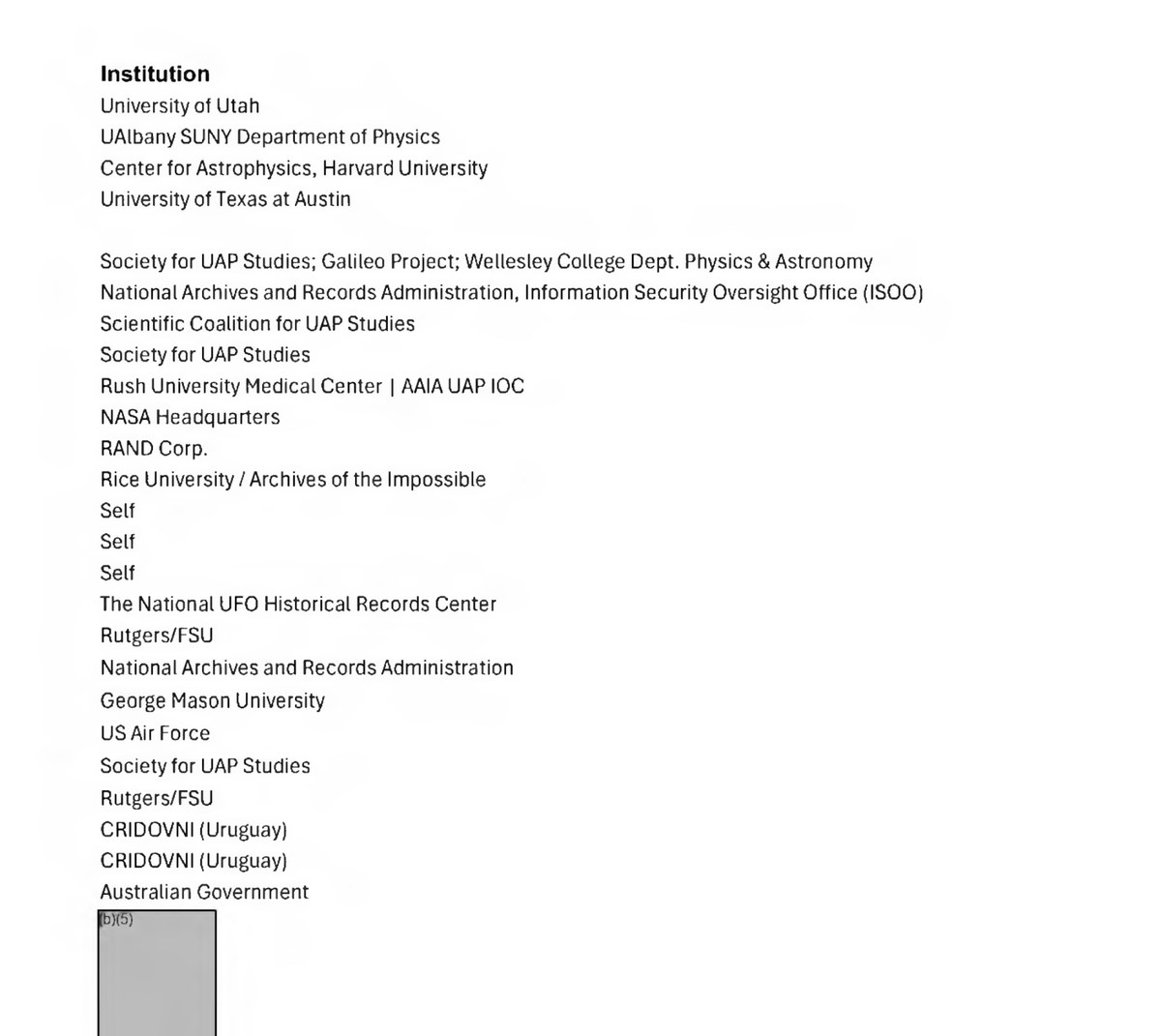
The single most consequential page in the release is the attendee roster. Every last name, first name and email address is covered by one mass (b)(6) redaction block, and the entire job-title column is covered by another, so not one individual participant can be identified from the document. What survives is the institution column, and it reads: University of Utah; UAlbany SUNY Department of Physics; Center for Astrophysics, Harvard University; University of Texas at Austin; one blank cell; Society for UAP Studies, Galileo Project and Wellesley College Department of Physics and Astronomy; National Archives and Records Administration, Information Security Oversight Office; Scientific Coalition for UAP Studies; Society for UAP Studies; Rush University Medical Center with AAIA UAP IOC; NASA Headquarters; RAND Corp.; Rice University and Archives of the Impossible; Self; Self; Self; The National UFO Historical Records Center; Rutgers and FSU; National Archives and Records Administration; George Mason University; US Air Force; Society for UAP Studies; Rutgers and FSU; CRIDOVNI (Uruguay); CRIDOVNI (Uruguay); and Australian Government. Below that last line sits a tall grey (b)(5) box, so an unknown number of further institutions are withheld as deliberative material.
Two foreign government bodies therefore appear on the face of the roster. Two rows are assigned to CRIDOVNI, the commission that receives and investigates reports of unidentified flying objects inside the Uruguayan Air Force. One row reads simply Australian Government, with no department, service or agency named.
The next released page carries the attendance and lodging columns, headed Attending both days?, Needs lodging?, 8/4 Hotel and 8/5 Hotel. Those rows carry no labels of any kind, because the names beside them are redacted, so the released pages do not permit any individual row to be matched to any institution. This archive deliberately makes no claim about which participant requested which hotel night.
Documents and images
What is the official position?
AARO published its own account of the workshop in February 2026 as an information paper, 2025 UAP Workshop: Narrative Data, Infrastructures, and Analysis, carrying the public release number 26-P-0344. A clearance form inside the FOIA release shows that paper being submitted for prepublication review on 9 February 2026 under the name of its author, listed as Kosloski, Jon, rank SES, title Director, office All-domain Anomaly Resolution Office. The same form records the intent that Associated Universities, Inc. would publish the white paper on its website and that AARO would amplify it on social media and host direct links to it from AARO.mil.
That published paper is the official narrative, and it is accurate as far as it goes. It states that the workshop brought together 40 participants from government, academia, and independent research organizations. It describes the subject matter at length, namely the difficulty of standardising narrative UAP reports that arrive from military logs, civilian reporting systems, archives and social media in inconsistent formats, and the opportunities and hazards of applying large language models to that material. It carries four appendices: the invitation letter, the guidelines for conduct, the workshop agenda and the breakout session prompts.
It does not carry a participant list, and the omission is not accidental. The paper explains the reasoning in its own words. It records that participant privacy was an important consideration throughout workshop planning, that Institutional Review Board approval governed data collection and security, and that the planning committee decided not to publicize the workshop online beforehand to limit outside attention and encourage comfort and open discourse among an intimate group of participants. Attendees could list a first name on a name tag with no institutional affiliation, could remove themselves from sessions, and could not be photographed without consent. The paper also notes that outside participation was limited due to budget constraints and institutional capacity.
Tested against the released records, the published paper contains zero occurrences of Australia, Australian, New Zealand, Uruguay, CRIDOVNI, foreign, or Five Eyes. The word international appears three times, every one of them describing an aspiration or a data stream rather than a person in the room: once calling for international collaboration in UAP research, once recommending that reporting forms be internationalised and translated, and once listing international partner databases among possible data sources.
The same test run on the agenda is sharper still. The working agenda in the FOIA release names fifteen speakers, panellists and moderators with their affiliations. Appendix C of the published paper is recognisably the same agenda, with the same sessions at the same times, and every one of those fifteen names has been removed from it, along with the venue address and the restaurant names. The public document kept the structure of the workshop and deleted the identities.
On the specific question of Australian attendance, the Department of War has not answered it. The researcher Grant Lavac, who has previously obtained Five Eyes UAP records by FOIA, asked the Australian Defence media team which branch attended and received no reply, then put the question to a Department of War official. The response he reports receiving on 3 October 2026 was: "We refer you to the government of Australia to comment on the activities of their personnel." Lavac characterises that as a tacit confirmation. It is more precisely a refusal to answer, and the distinction matters, because the Department neither confirmed nor denied that an Australian official attended.
What the people involved say
The released correspondence is where the workshop stops being a document and starts being a set of people making arrangements, and the fullest thread concerns the Uruguayan delegation.
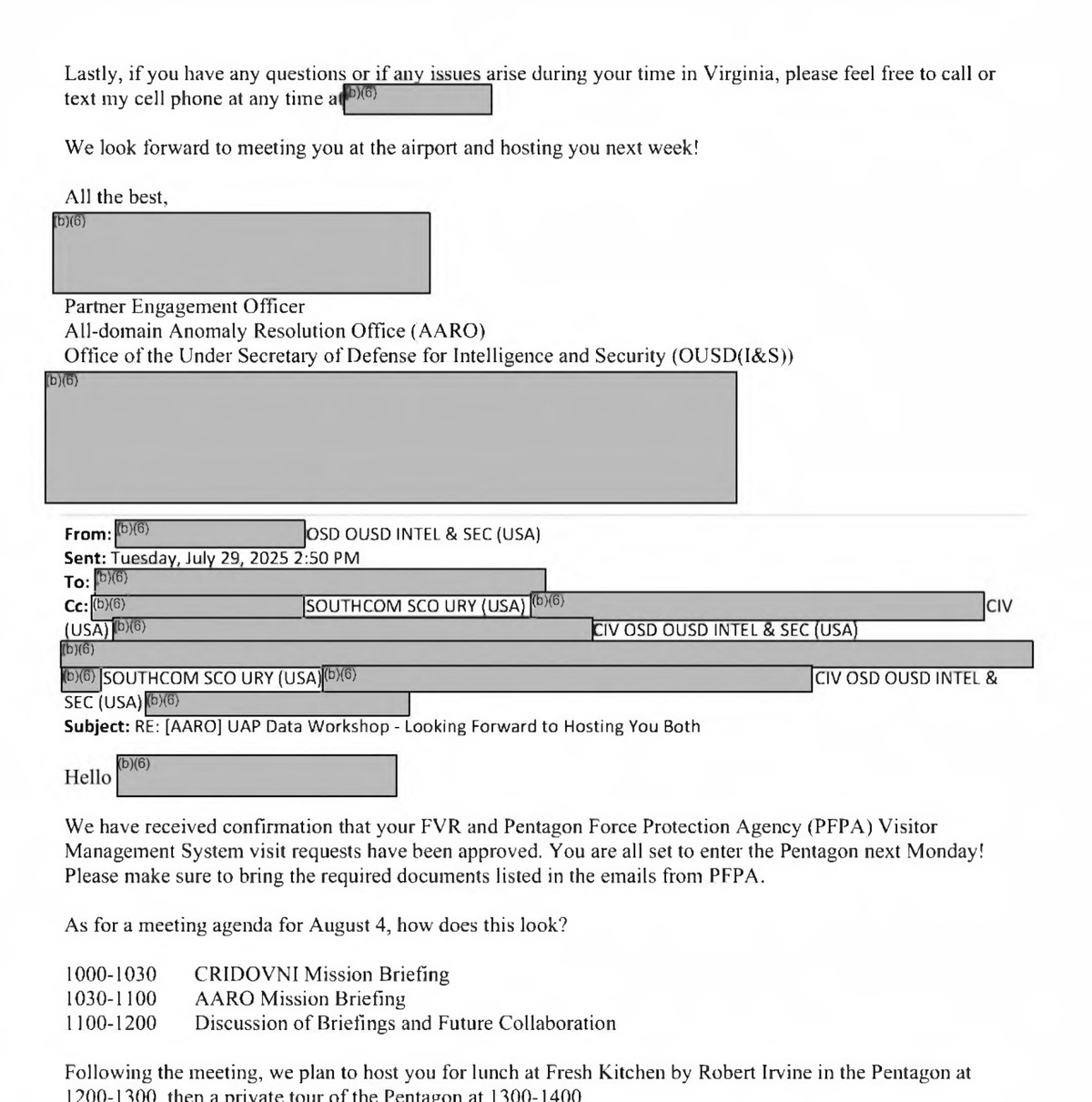
In July 2025 an AARO partner engagement officer, whose name is redacted, wrote to two CRIDOVNI representatives about a separate meeting at the Pentagon on 4 August 2025, the day before the workshop opened. The officer confirmed that their Foreign Visit Request and their Pentagon Force Protection Agency visitor management requests had been approved, with the Security Cooperation Office for Uruguay at US Southern Command copied on the exchange and the Embassy of Uruguay in Washington submitting the request. The proposed agenda is quoted in the document: "1000-1030 CRIDOVNI Mission Briefing / 1030-1100 AARO Mission Briefing / 1100-1200 Discussion of Briefings and Future Collaboration". Afterwards, the officer wrote, "we plan to host you for lunch at Fresh Kitchen by Robert Irvine in the Pentagon at 1200-1300, then a private tour of the Pentagon at 1300-1400."
AARO set out what it wanted to learn. The officer listed the topics of interest as the CRIDOVNI investigative process; the analytic methods and tools it uses, with the specific question "How does CRIDOVNI analyze narrative data, particularly for cases with little or no technical data?"; the most interesting UAP cases in the CRIDOVNI database; "How CRIDOVNI operates within Uruguay Air Force"; and its partnerships with scientific, governmental and other UAP research organizations in South America. The officer added that AARO had obtained a copy of El misterio OVNI: los archivos oficiales abiertos by Eduardo Aguirre Pacheco and had translated several of the cases in it, asking which sections the delegation would recommend reading beforehand.
The logistics are domestic in a way official records rarely are. The Uruguayan representative replied that he would be travelling with his wife, that they would stay on in the United States as tourists afterwards, that he needed the hotel room from 2 August, and that he would cover the extra night and the difference for his wife himself. He wrote that he and his wife are both Catholic and would gladly attend Mass. AARO's reply is the detail that no summary of this release has carried: "Dr. Kosloski plans to pick you and your wife up from the hotel on August 3 and drive you to mass." A follow-up corrects the plan, noting that because Kosloski lives in Maryland he would find a local church closer to their Virginia hotel instead. The Director of the Pentagon office responsible for unidentified anomalous phenomena personally drove a foreign UAP investigator and his wife to a church service on the Sunday before the workshop. The Uruguayan reply reads: "For Sunday Mass, feel free to choose, as any option will be very good for us. It will also be a pleasure to share a meeting with Dr. Jon Kosloski later."
Two further passages change the shape of the story. Asked whether other South American guests would attend, the AARO officer answered that there were none, and explained why: "I sent an invitation to the workshop to the Chilean [redacted] here in D.C. to invite participants from SEFAA, but I did not receive a response." SEFAA is the Chilean air force body that succeeded CEFAA, an organisation this archive has cited elsewhere. The same message states that "AARO plans to hold a follow-on data workshop in early 2026", written in July 2025, before the first workshop had even convened, and asks the Uruguayans to pass on contact details for other South American UAP research organisations so that invitations could be extended to them too.
The same paragraph contains AARO's own characterisation of who was coming: "Most of the workshop participants are from U.S.-based universities or UAP research organizations, along with several people from U.S. federal agencies." That sentence is true and it is also the shape of the omission that the published white paper would later repeat.
One further number is worth recording. The invitation letter sent to prospective participants describes "a small group of 25-30 experts". The finished workshop, by AARO's own published count, had 40.
Is the AARO's Private 2025 UAP Workshop and the Two Foreign Governments on the Roster: FOIA Case 26-F-1773 (14 September 2026) real? The two-pass assessment
Pass one, the mundane reading, and it is a strong one. Nothing in this release describes a cover-up. A government science office convened an academic workshop on data standardisation, hired a university consortium to host it, invited researchers on the basis of expertise, and published a synthesis paper six months later. Liaison with a friendly foreign counterpart is ordinary statecraft, and it was conducted through ordinary channels: an embassy-submitted Foreign Visit Request, a Security Cooperation Office, a visitor management system. The redactions are routine. Withholding names and emails under (b)(6) is what a FOIA office does with a list of private citizens, and the organisers had promised those people privacy under an Institutional Review Board protocol before any of them agreed to come. The white paper's silence on individual identities is therefore not evasion, it is the promise being kept.
The Australian line in particular will not carry much weight. It is one string in a self-reported affiliation column on an RSVP spreadsheet, with no name, no department and no service attached, and with no corroborating document anywhere else in the 70 released pages. A roster is a list of who was expected, not proof of who walked through the door. The Department of War's referral to Canberra is a refusal to answer and not an admission, and this archive does not treat it as one. If a reader wants a single honest sentence on that question, it is this: the released records show that a seat was allocated to an entity recorded as Australian Government, and nothing released so far establishes who filled it, or whether anyone did.
Pass two is about what the documents do establish, which is more interesting than the headline that led to them. The checkable finding here is not about Australia at all. It is that the public record of this workshop was constructed by subtraction. Appendix C of the published paper is the internal agenda with fifteen named speakers removed; the published paper describes 40 participants from government, academia, and independent research organizations and never once uses the word foreign; and the words Australia, Uruguay and CRIDOVNI appear nowhere in it. Two of the seats, on the face of the roster, belonged to the air force of a foreign state, and a reader of the only public document could not learn that. The invitation letter that AARO's partners sent to prospective attendees had promised that "all outcomes will be communicated promptly, publicly, and transparently", and on the question of who was in the room that promise was kept only in the aggregate.
None of that is unlawful and little of it is even unusual. It is, however, exactly the gap that makes FOIA necessary, and it is the second time in two years that a foreign government's participation in US UAP coordination has surfaced through a document request rather than through either government's own disclosure.
The second finding is that AARO was building a network rather than holding an event. It courted Chile's SEFAA through a diplomatic contact and was turned down, it asked Uruguay to broker introductions to other South American bodies, it briefed and was briefed at the Pentagon on mission-level work, it discussed future collaboration as a named agenda item, and it had already decided on a follow-on workshop for early 2026 before the first one opened. Whether that second workshop happened, and who attended it, is not answered by this release.
What cannot be established from these documents is recorded here plainly. No individual participant can be named from the roster, because every name, title and email is redacted. No row in the attendance and lodging table can be matched to any institution, so no claim is made about the movements of any delegate. The number of institutions hidden behind the (b)(5) block at the foot of the roster is unknown, which means the visible institution column accounts for 25 of the 40 participants and the remaining affiliations are simply not public. Nineteen pages were withheld in full. The Uruguayan Air Force website at fau.mil.uy returned an identical 1,998 byte page on every path tested from this environment, so CRIDOVNI's standing is cited here from AARO's own correspondence, which asks the commission to brief on "How CRIDOVNI operates within Uruguay Air Force", rather than from the Uruguayan government directly.
Tier Unknown. There is no official narrative here to accept or reject, only a public account and a fuller private one, and the distance between them is the finding.
Sources
- www.theblackvault.com/documentarchive/behind-aaros-private-uap-workshop-new-records-detail-participants-foreign-outreach-and-future-plans/
- documents3.theblackvault.com/documents/osd/26-F-1773.pdf
- www.aaro.mil/Portals/136/PDFs/Information%20Papers/2025_UAP_Workshop_Paper.pdf
- defensescoop.com/2026/03/16/dod-ufo-workshop-uap-research-aaro/
- grantlavac.substack.com/p/did-australia-attend-aaros-secret
- www.aaro.mil/
- aui.edu/
- www.explorescu.org/
More cases from this region: UFO sightings in United States