The House Adopts the UAP Disclosure Act as an NDAA Amendment
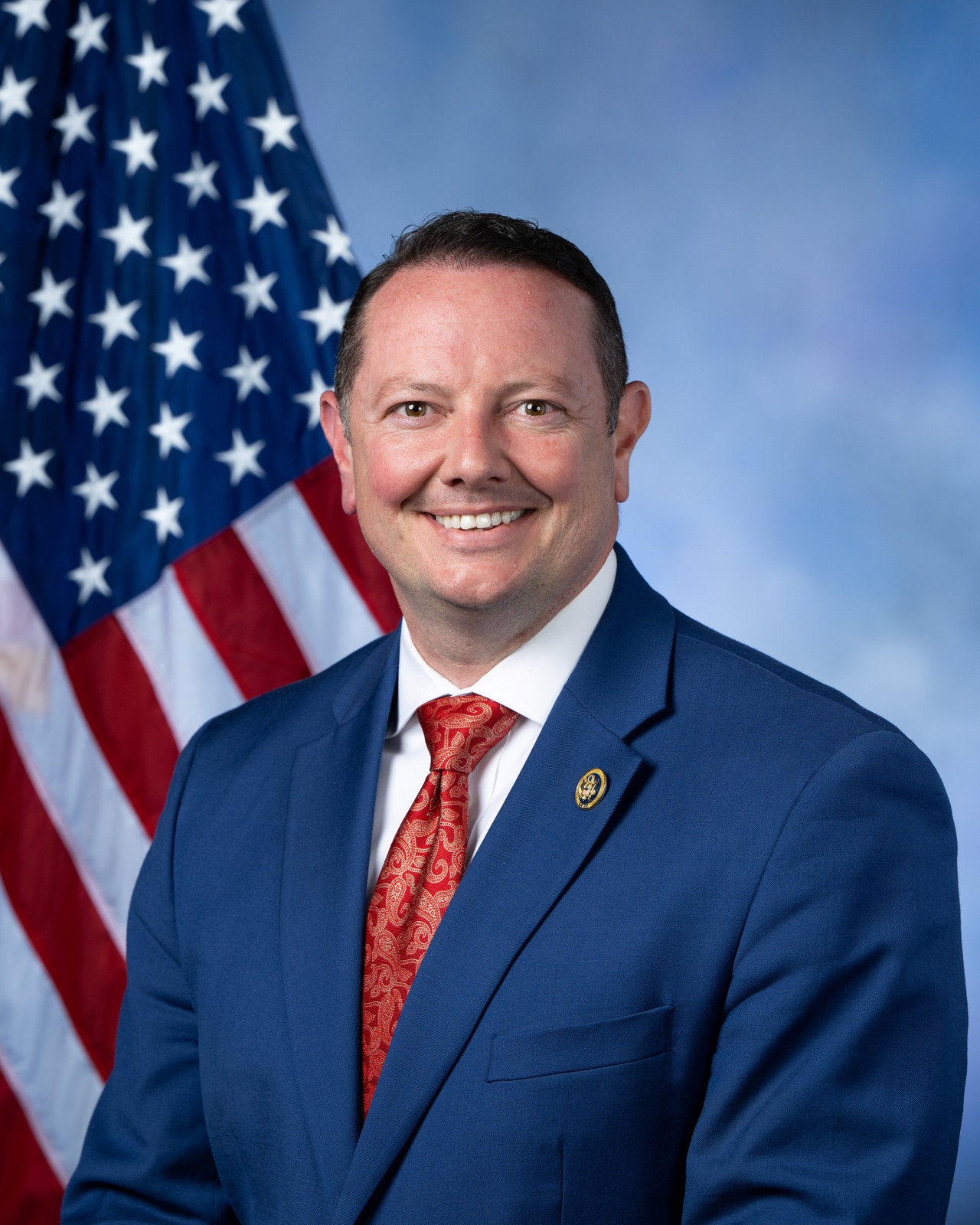
On 22 July 2026 the United States House of Representatives finished its work on H.R. 8800, the National Defense Authorization Act for Fiscal Year 2027, and in the course of that work adopted Representative Eric Burlison's Unidentified Anomalous Phenomena Disclosure Act as an amendment to the bill. This case file covers what witnesses reported, the official narrative, and a two-pass assessment with its evidence tier.
What happened
On 22 July 2026 the United States House of Representatives finished its work on H.R. 8800, the National Defense Authorization Act for Fiscal Year 2027, and in the course of that work adopted Representative Eric Burlison's Unidentified Anomalous Phenomena Disclosure Act as an amendment to the bill. Burlison represents Missouri's 7th district. His amendment carried the number 1044 in the House Rules Committee queue for H.R. 8800, was originally filed on 17 June 2026, and was replaced by a revised text dated 15 July 2026. The sponsors listed on the Rules Committee page are Burlison of Missouri, Crane of Arizona, Carson of Indiana, Luna of Florida, Moskowitz of Florida, and Begich of Alaska, a lineup that puts two Democrats alongside three Republicans behind a Republican author.
The procedural route to the floor was ugly and is the most instructive part of the story. The House Armed Services Committee ordered H.R. 8800 reported on 15 June 2026 by a vote of 44 to 12. The first rule for floor consideration, H.Res. 1398, did not make amendment 1044 in order; the Rules Committee approved that rule on an 8 to 4 party line vote with no separate recorded vote on Burlison's proposal, and on 30 June 2026 the rule itself was defeated on the House floor, 198 to 224. Burlison later said he voted against his own party's rule specifically to keep the UAP proposal alive. The Rules Committee then met again on 20 July 2026 and this time designated the revised Burlison amendment "Made in Order." The replacement rule, H.Res. 1438, passed the House on 21 July 2026 by 214 to 211. The Committee of the Whole worked through the amendment list on 21 and 22 July, rose on the evening of 21 July leaving H.R. 8800 as unfinished business, and completed consideration the next day. The bill passed 216 to 212, Roll no. 278, on 22 July 2026.
What the amendment actually does is a records statute, not a finding about anything anomalous. It would add a new subtitle to title XVII of the NDAA establishing an Unidentified Anomalous Phenomena Records Collection at the National Archives and Records Administration within 60 days of enactment. Federal agencies would have 300 days to identify, organize and transmit covered UAP records to that Collection. Destruction, alteration or mutilation of covered records would be barred outright. An independent nine member UAP Records Review Board, nominated by the President and confirmed by the Senate, would hold subpoena authority to compel records and testimony and would decide whether specific material stays protected under standards written into law rather than standards written by the agency holding the file. Records transmitted to NARA would have to be publicly disclosed within 30 days and made digitally available within 180 days. Any record more than 25 years old would face automatic disclosure unless the President affirmatively certifies that continued postponement is necessary. Disclosure obligations extend to covered government contractors, and the text carries definitions of "non-human intelligence" and "technologies of unknown origin," plus an eminent domain provision allowing the federal government to acquire recovered technologies of unknown origin and biological evidence of non-human intelligence held by private entities. The revised 15 July text moved primary oversight away from the Armed Services and Intelligence committees toward the House Committee on Oversight and Government Reform and the Senate Committee on Homeland Security and Governmental Affairs, and added new language clarifying that the measure would not create additional access to classified Special Access Programs.
VERIFIED AGAINST THE CONGRESSIONAL RECORD. The open question in an earlier version of this file, whether the amendment was adopted by voice vote or by a separate recorded vote, is now answered, and the answer is on the public record. The Congressional Record for 22 July 2026 prints the amendment under the heading "AMENDMENT NO. 315 OFFERED BY MR. BURLISON OF MISSOURI" at pages H5116 to H5121. Amendment No. 315 is the floor designation; 1044 was its number in the Rules Committee queue. It was never put to the House on its own. At page H5077 Representative Mike Rogers of Alabama, the chairman of the Armed Services Committee, rose and said "Mr. Chair, pursuant to House Resolution 1438, I offer amendments en bloc," and the Clerk designated "Amendments en bloc No. 5 consisting of amendment Nos. 266" through 315 and then 317 through 320, "printed in part A of House Report 119-755." Fifty four amendments in one package, with the UAP Disclosure Act sitting at number 315 in the middle of it. The disposition, at page H5123, is two lines: "The Acting CHAIR. The question is on the amendments en bloc offered by the gentleman from Alabama (Mr. Rogers). The en bloc amendments were agreed to." That is a voice vote on a bundle. There was no division and no separate question on the UAP language. The numeric gap is real rather than a slip: amendment No. 316, offered by Mr. Grothman, was lifted out of the en bloc and taken separately immediately afterwards. And Burlison did not speak. His name appears exactly once in the entire day's proceedings on H.R. 8800, in the heading above his own amendment text. The furthest this framework has ever advanced in the House was achieved without a word said on the floor and without a single member being recorded for or against it.
What is the official position?
The official announcement came from the sponsor's own office. The press release on burlison.house.gov, dated 22 July 2026 and headed "House Adopts Burlison Amendment Establishing UAP Disclosure Framework," opens: "WASHINGTON, D.C. - The House today adopted Congressman Eric Burlison's (MO-07) Unidentified Anomalous Phenomena Disclosure Act as an amendment to the Fiscal Year 2027 National Defense Authorization Act." It states that the amendment "would establish a statutory framework for preserving, reviewing, and publicly disclosing unidentified anomalous phenomena (UAP) records," that it "would create a permanent UAP Records Collection at the National Archives, establish an independent UAP Records Review Board, and extend disclosure requirements to covered government contractors," and that "By bolstering in law authorities for carrying out disclosure, it would support President Trump's Presidential Unsealing and Reporting System for UAP Encounters (PURSUE)." The release closes: "The Fiscal Year 2027 National Defense Authorization Act now moves to the Senate for consideration." That page returns HTTP 403 to automated fetching and was read in a browser rather than by a crawler, which is worth stating plainly rather than pretending otherwise.
The legislative record around it comes from the Congressional Research Service In Focus product IN12704 on FY2027 NDAA status. It records the House bill as H.R. 8800 and the Senate companion as S. 4784, full committee consideration in the House on 4 June 2026, a committee vote of 44 to 12 to order H.R. 8800 reported on 15 June, the first rule H.Res. 1398 failing 198 to 224 on 30 June, the second rule H.Res. 1438 passing 214 to 211 on 21 July, and on 22 July the House completing consideration and passing the bill as amended 216 to 212. The same product records that on the Senate side a cloture vote on the motion to proceed failed 50 to 46 on 14 July 2026 and that the Senate had taken no further procedural steps toward floor consideration.
The amendment is not writing on a blank page. A UAP Records Collection already exists in law. Sections 1841 to 1843 of the FY2024 NDAA, Public Law 118-31, directed the National Archives to build it. NARA's own records management guidance states the statutory requirement that "by October 20, 2024, each federal agency review, identify, and organize each Unidentified Anomalous Phenomena (UAP) record in its custody for disclosure to the public and transmission to the National Archives," describes the Collection as comprising "copies of all Government, Government-provided, or Government-funded records relating to unidentified anomalous phenomena, technologies of unknown origin, and non-human intelligence," and instructs agencies withholding material to cite "the specific grounds for postponement in section 1843 of the NDAA or declassification guide" under Executive Order 13526. NARA's public research page confirms that UAP records received under the 2024 NDAA "will be accessioned into Record Group 615" and added to the catalogue "on an ongoing, rolling basis." What the existing law lacks, and what amendment 1044 would supply, is the independent board, the contractor coverage and the eminent domain clause.
The executive branch programme the release name-checks is PURSUE, the Presidential Unsealing and Reporting System for UAP Encounters, run out of the Department of War at war.gov/ufo. Its first tranche went live on 8 May 2026 with just over 160 files, at least a hundred of them redacted. The Debrief's Micah Hanks, reporting the rollout the same day, quoted the department's framing, "In response to President Donald J. Trump's directive for transparency on U.S. government information regarding Unidentified Anomalous Phenomena (UAP)," and noted candidly that "It remains unclear whether any formal directives or other Presidential actions were behind the new release of UAP records." That is precisely the gap the amendment is pitched at. No statement from the White House, the Department of War or the Office of the Director of National Intelligence responding to the 22 July adoption could be located.
VERIFIED DIRECTLY AGAINST THE CLERK OF THE HOUSE. The research above noted that clerk.house.gov returns HTTP 403 to automated retrieval. This archive opened the roll call record in a browser and confirms it verbatim. Roll Call 278 of the 119th Congress, 2nd Session, is recorded as taken on 22 July 2026 at 4:37 PM on the question "On Passage" of H.R. 8800, the National Defense Authorization Act for Fiscal Year 2027. Status: Passed. Yeas 216, Nays 212, Present 0, Not Voting 3. By party, Republicans split 209 yea to 7 nay with 2 not voting, Democrats 6 yea to 205 nay with 1 not voting, and the sole Independent voted yea. That settles the date question: the vote on the bill carrying this amendment was taken on 22 July 2026, and the 23 July date that circulates in coverage is the date the reporting appeared.
Two further details from the Congressional Research Service product, updated 24 July 2026, sharpen the picture. H.Res. 1438 made 320 floor amendments in order, identified in House Report 119-755, which is the pool from which the en bloc packages were assembled, and the rule also provided that on passage the engrossed text sent to the Senate would carry the Safeguard American Voter Eligibility Act, which had passed the House as an amendment to S. 1383. That matters for the amendment's prospects, because it means the vehicle arriving in the Senate carries an unrelated and contested election measure alongside the UAP records regime. As of 6 August 2026 the engrossed House text still has not been published: the Government Publishing Office carries the introduced and reported versions of H.R. 8800 and no engrossed version at all. On the Senate side nothing has moved. Cloture on the motion to proceed to S. 4784 failed 50 to 46 on 14 July 2026 and no further procedural step has been taken.
What the people involved say
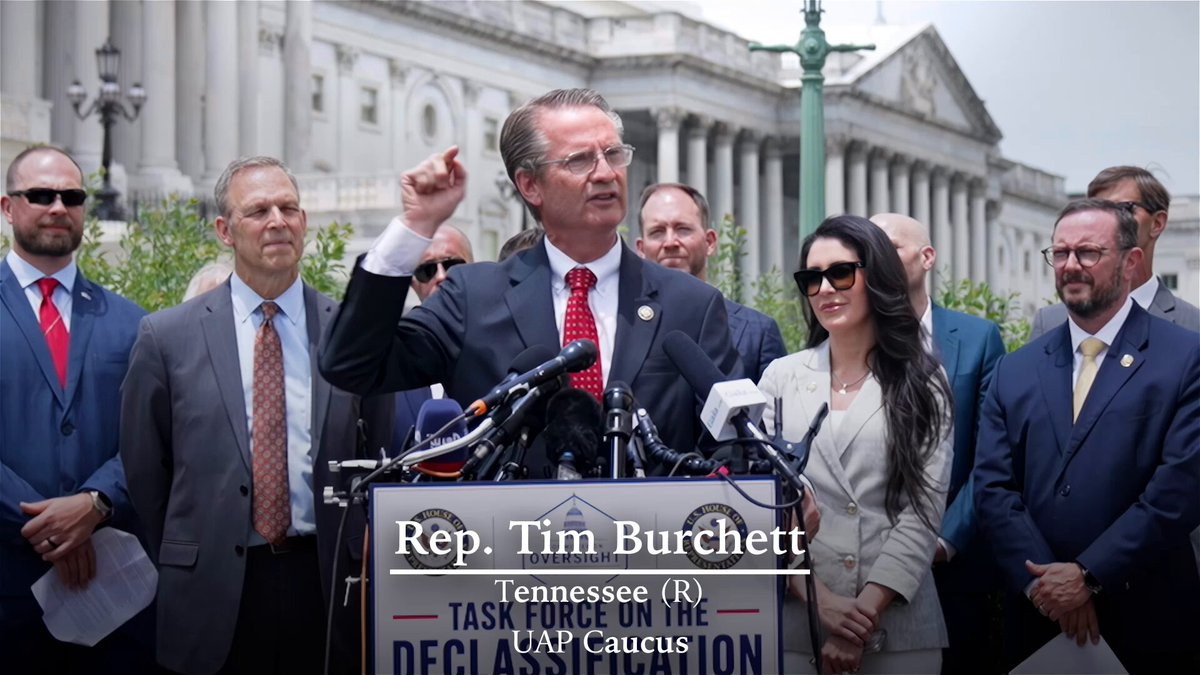
Burlison himself supplied the most quotable material. In the official release he said, "The government belongs to the American people. For too long, UAP records have remained scattered across agencies and outside meaningful oversight. This amendment would create an independent review process to preserve those records, review them, and make them available to the public pursuant to law." Speaking to Newstalk KZRG on 24 July 2026 he described the mechanism in blunter terms: "It basically sets a posture of having the declassification switch on. In order for them to stop something, they have to actually take action to stop it." He was equally blunt about the fight: "It was difficult to get that in there. We had to fight staffers, really staffers, people that are unelected, who kept throwing every excuse in the book." He described objections rolling in from the Armed Services Committee and then from Judiciary on jurisdictional grounds, said he went directly to House Judiciary Chairman Jim Jordan, who reportedly had no objection, and confirmed that when the proposal was initially left out he voted against a procedural rule from his own party to keep it alive. On the bipartisan character of the effort he said, "I never thought in a million years I'd be agreeing with Chuck Schumer on something. But when it comes to transparency and accountability for the American people, we do agree." A month earlier, on 30 June 2026, after the Rules Committee declined to make his amendment in order, he had told the same outlet, "The UAP information belongs to the American people. Transparency is a simple step toward restoring public trust."
The cosponsor list is the corroborating testimony that matters most in a policy case. André Carson of Indiana and Jared Moskowitz of Florida are Democrats; Eli Crane of Arizona, Anna Paulina Luna of Florida and Nick Begich of Alaska are Republicans. Five members from both parties put their names to a records regime with subpoena power and an eminent domain clause.
The advocacy community's posture toward this architecture is on record, though no organisational statement responding specifically to the 22 July adoption could be found. In July 2025, ahead of the FY2026 cycle, Christopher Mellon, former deputy assistant secretary of defense for intelligence and board chairman of the UAP Disclosure Fund, told DefenseScoop that "More can and should always be done," and that "NORAD's historical failure to inform AARO of UAP incidents is inconsistent with the intent of Congress when AARO was created." Retired Navy Rear Admiral Timothy Gallaudet argued in the same reporting that piecemeal fixes "dilute, distract, and compete with the authorities and priority of the UAP review board in the UAPDA," which is a direct argument that the board is the thing that matters. After the first PURSUE release in May 2026, Mellon told DefenseScoop, "Data alone is not disclosure. Releasing raw files without context may confuse more than clarify." Ryan Graves of Americans for Safe Aerospace said "Ambiguous imagery without that surrounding data is hard for pilots, researchers, or the public to evaluate responsibly." Jordan Flowers of the Disclosure Foundation said "Transparency requires not just releasing files, but accounting for their provenance and integrity." Writing on 9 June 2026, Harvard's Avi Loeb argued for an expert group with classified access rather than a blanket dump, observing that in the releases so far "the data is not good enough, as we don't know the distance to objects and some crucial information was redacted."
The opposition is documented too, and it is institutional. Kevin Wright reported in the Roswell Daily Record on 28 July 2024 that Dr. Sean Kirkpatrick, the former director of the Pentagon's All-domain Anomaly Resolution Office, confirmed AARO had lobbied against components of the UAP Disclosure Act, saying there was "no need for additional legislation" and that the office "convinced Congress last year to not go down that road," and that AARO's objection extended specifically to the Records Review Board, which it characterised as duplicative of AARO's own congressional mandate and a waste of taxpayer money. The same reporting states that during November 2023 negotiations the Office of the Under Secretary of Defense for Intelligence and Security submitted a 33 page line by line rewrite of the Senate-passed UAP Disclosure Act, seeking to concentrate the eminent domain authority in AARO rather than in an independent civilian board.
The amendment is not the only pressure Burlison has applied to the records question, and the parallel track matters for judging whether a statutory Records Collection would find anything to collect. On 22 May 2026 he sent a 10 page production request to the MITRE Corporation, the federally funded research and development centre operator, demanding records and assets that would establish whether MITRE holds or ever held material on unidentified anomalous phenomena and associated unexplained technologies. DefenseScoop reporter Brandi Vincent obtained the correspondence and published it on 27 May 2026. The request instructs MITRE to designate a senior official to coordinate the response, to issue a preservation hold, to provide an index of where records are located, to produce unclassified responsive records in native electronic format with complete metadata within 45 days, to identify classified or sponsor-controlled material separately, and to arrange a classified briefing for cleared committee staff.
Two features of that request are worth noting alongside the amendment. The first is its reach backwards: Burlison asked for material dating to 1930, which is roughly two decades before the modern UFO era is conventionally dated to begin. The second is its reach sideways, naming Lockheed Martin, Northrop Grumman, Raytheon, Boeing, General Dynamics, SAIC, Leidos, Battelle, The Aerospace Corporation, Booz Allen Hamilton, BAE Systems and Bigelow Aerospace among the entities whose UAP-related work he wants identified. MITRE told DefenseScoop that "If any relevant material is found, we will coordinate with the federal agencies responsible for the work to determine how to best provide any assets." That is a carefully bounded answer rather than a denial, and it points directly at the gap the amendment is written to close, because a contractor holding records on a sponsor agency's behalf is exactly the custody arrangement that the contractor-coverage provision would bring inside the statute.
Is the House Adopts the UAP Disclosure Act as an NDAA Amendment real? The two-pass assessment
Pass one, the sober reading. An amendment adopted by one chamber is not law, and the specific thing adopted here has already been killed once, at the last possible moment, by the exact process it now has to survive again. The Schumer-Rounds Unidentified Anomalous Phenomena Disclosure Act of 2023 was inserted into the Senate's FY2024 NDAA, S. 2226, at pages 1939 to 2004, and that bill passed the Senate on 27 July 2023 by 86 to 11. Douglas Dean Johnson's contemporaneous tracking describes the proposal as establishing "a nine-member Unidentified Anomalous Phenomena Records Review Board, appointed by the President and confirmed by the Senate," explicitly modelled on the President John F. Kennedy Assassination Records Collection Act of 1992, Public Law 102-526, which created the Assassination Records Review Board as an independent agency to reopen material that the holding agencies still considered too sensitive to release. In conference the guts came out. Writing for Covington's government contracts practice on 9 January 2024, Stephanie Barna documented that the enacted version, sections 1841 to 1843 of Public Law 118-31, kept the Collection at NARA and the 25 year outer limit but dropped both the eminent domain mandate over "recovered technologies of unknown origin and biological evidence of non-human intelligence" and the independent board of "qualified and impartial citizens nominated by the President and confirmed by the Senate." Those were, in her framing, exactly the features with the most effect on private sector holders. Schumer refiled the act in July 2025 as a proposed FY2026 NDAA amendment and it again went nowhere. So the precedent is not encouraging. The House margin here was four votes, 216 to 212. The Senate companion, S. 4784, could not even clear cloture on the motion to proceed, failing 50 to 46 on 14 July 2026. A conference committee can strip a House amendment exactly as easily as it stripped a Senate one, and the same Pentagon offices that submitted a 33 page rewrite in 2023 are still there. Even in the best case, a nine member Senate-confirmed board is only as real as the nominations, confirmations, staff and appropriations behind it; the JFK board it is modelled on took years to seat and did not finish its work until 30 September 1998. Nothing in this amendment declassifies a single page by itself. And it should be said clearly that this is a records and classification measure. Its statutory definitions of "non-human intelligence" and "technologies of unknown origin" are drafting conventions in a disclosure regime, not congressional findings that any such thing exists.
Pass two, what actually changes if it is enacted as written. Three things, and they are structural rather than cosmetic. First, the default flips. Today an agency decides what to release and cites section 1843 grounds to postpone; under the amendment the presumption runs toward disclosure on a 25 year clock and the President has to affirmatively certify to keep something back. Burlison's own description is the honest one: the declassification switch is on, and stopping a release requires taking action. Second, the decision-maker moves outside the agencies that hold the records. An independent, Senate-confirmed board with subpoena power to compel documents and testimony is a fundamentally different animal from a review conducted by the office that classified the material in the first place, which is precisely why AARO fought it. Third, coverage extends to government contractors, and the eminent domain clause restores the provision the FY2024 conference removed, which reaches material held in private hands. Layered on top is the point the press release makes and the one that matters most for the archive's purposes: PURSUE currently rests on a presidential directive from February 2026, and The Debrief's reporting could not even establish that a formal executive order underpins it. A programme built on executive discretion can be ended by the next administration on its first afternoon, and the files can go back in the drawer. A statute has to be repealed by both chambers and signed. Putting the National Archives Collection, the Review Board and the disclosure timelines in law converts a favour into an obligation.
Tier: Unknown. This is a documented legislative action and a matter of public record, not a sighting. No anomalous object, image or witness observation is involved, so no evidential tier applies to it. It is filed here because the archive treats major disclosure actions as first-class cases, and because the House adopting a UAP records statute with a subpoena-empowered independent board is the furthest this framework has ever advanced in the chamber that killed it last time.
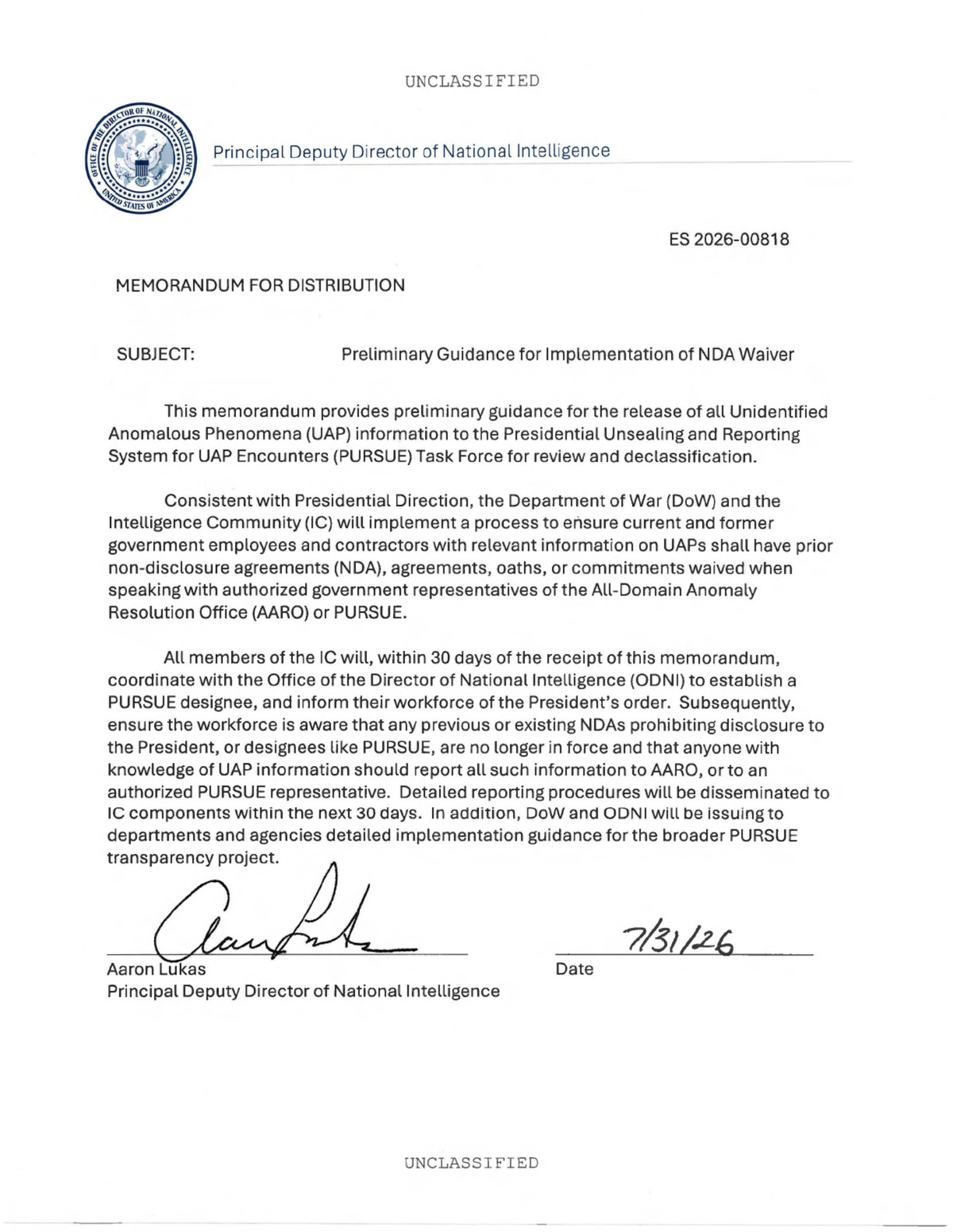
A fourth structural change is in the text and deserves to be pulled out, because it connects this amendment to the executive branch's own disclosure push. Section 1747 does not stop at eminent domain. Subsection (d) gives the Review Board access to "all testimony from unidentified anomalous phenomena witnesses, close observers and legacy program personnel and whistleblowers within the Federal Government's possession as of and after the date of enactment of this Act." Subsection (e) goes further and directs that the Board "shall solicit additional unidentified anomalous phenomena witness and whistleblower testimony and afford protections under section 1673(b) of the James M. Inhofe National Defense Authorization Act for Fiscal Year 2023 (50 U.S.C. 3373b(b))." That is the same statute the White House nondisclosure waiver of July 2026 was built on top of and, on this archive's reading, added nothing to. Under the amendment the reprisal protections Congress wrote in December 2022 would be wielded by an independent Senate-confirmed board that can compel documents and testimony, rather than by the office that classified the material. The executive route asks a witness to walk into a cleared room and talk to the Pentagon. The statutory route would have someone with a subpoena go and find them.
Sources
- clerk.house.gov/Votes/2026278
- burlison.house.gov/media/press-releases/house-adopts-burlison-amendment-establishing-uap-disclosure-framework
- www.everycrsreport.com/reports/IN12704.html
- www.newstalkkzrg.com/2026/07/23/house-approves-burlison-amendment-creating-framework-for-uap-records-disclosure/
- www.newstalkkzrg.com/2026/07/24/burlison-details-fight-to-pass-uap-disclosure-amendment-touts-healthcare-bill-support/
- www.newstalkkzrg.com/2026/06/30/burlisons-uap-disclosure-amendment-left-out-of-defense-bill/
- www.insidegovernmentcontracts.com/2024/01/implications-of-the-unidentified-anomalous-phenomena-uap-amendment-in-the-2024-national-defense-authorization-act-ndaa/
- www.archives.gov/records-mgmt/uap-guidance
- www.archives.gov/research/topics/uaps
- www.archives.gov/research/jfk/review-board
- defensescoop.com/2026/05/14/uap-trump-first-pursue-ufo-file-drop/
- defensescoop.com/2025/07/29/uap-disclosure-advocates-call-for-expanded-reforms-fiscal-2026-ndaa/
- thedebrief.org/trump-releases-ufo-files-with-rollout-of-new-presidential-unsealing-and-reporting-system-for-uap-encounters-pursue/
- www.rdrnews.com/opinion/columnists/last-year-the-pentagon-s-uap-office-hoodwinked-congress-will-it-happen-again/article_2884536a-4c49-11ef-9d18-c7cf2c044a16.html
- avi-loeb.medium.com/reality-should-not-be-classified-a-call-for-action-on-uap-disclosure-6569862d1eba
- govconfeed.com/article/house-revives-fy2027-ndaa-hr8800-floor-july-2026
- pelositracker.app/bills/119-hr-8800
- defensescoop.com/2026/05/27/rep-eric-burlison-request-for-uap-records-mitre/
- www.govinfo.gov/content/pkg/CREC-2026-07-22/html/CREC-2026-07-22-pt1-PgH5029-6.htm
More cases from this region: UFO sightings in United States