The Durban Letter: A 1953 Flying Saucer Seen From the Botanic Gardens
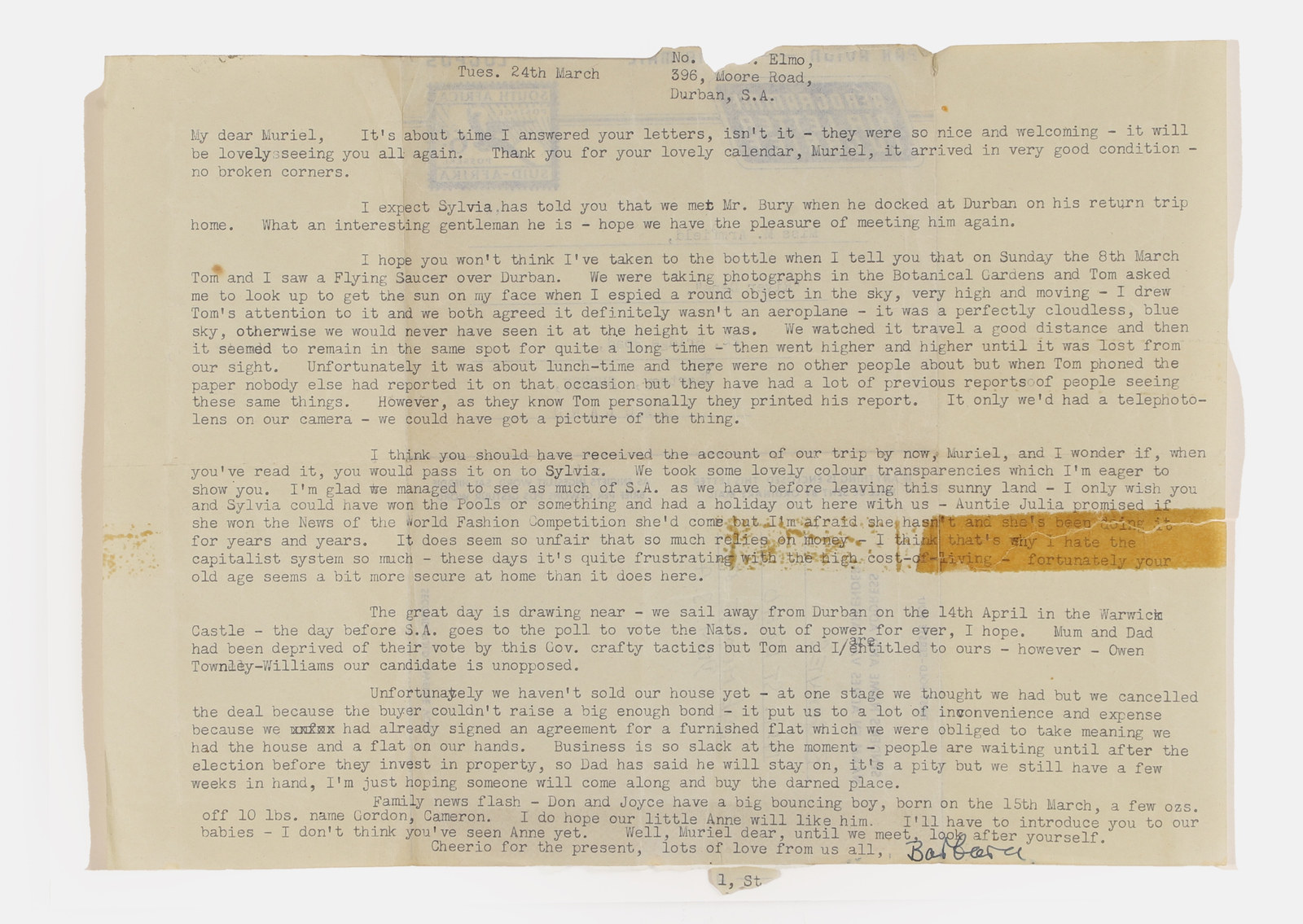
A private airmail letter written from Durban to Surrey in March 1953, unread by any researcher for seventy three years, describes a round object seen high over the Botanic Gardens by two people holding a camera. It is one of the few genuinely contemporaneous civilian UFO accounts from the formative years that was never written for publication.
What did witnesses see at Durban Botanic Gardens?
On Sunday 8 March 1953 a woman named Barbara Graves and a companion she referred to only as Tom were taking photographs in the Durban Botanic Gardens, on the lower slopes of the Berea above the city and its harbour. Sixteen days later, on Tuesday 24 March 1953, she sat down at a typewriter and told a friend in England what had happened. The first thing she did was pre-empt the obvious reaction. Her letter opens by hoping the recipient will not think she has "taken to the bottle" before telling her that on Sunday, she and Tom saw a flying saucer over Durban.
The sequence she describes is precise and unglamorous, which is part of what makes it interesting. They were photographing. Tom asked her to look up so the sun would fall on her face. It was while her head was tilted back for the shot that she spied, in her own words, a round object in the sky, very high and moving. Both of them looked. Both of them, she wrote, agreed it definitely was not an aeroplane, and she gave her reason rather than simply asserting it: the sky was perfectly cloudless and blue, and she noted that otherwise they would never have seen it at the height it was.
Then comes the part that matters most for any later analysis. They watched the object travel a good distance. It then appeared to remain in the same spot for what she described as quite a long time. Finally it went higher and higher until it was lost from their sight. Three distinct phases, in that order: lateral travel, an extended hover or apparent stationary period, then a sustained climb to vanishing point. She did not report structure, windows, portholes, colour changes, sound, or any of the embellishments that decorate second hand saucer stories of the period. She reported a round shape, great altitude, and a motion profile.
She also recorded a regret, and it is the regret of a photographer rather than a believer. She wished she had a telephoto lens. That single line is the most quietly damaging detail in the whole document and the most humanising: two people stood in a botanical garden with a camera in their hands, watched an unidentified object for what reads like several minutes, and came away with nothing on film because the lens they had could not reach it.
The letter itself is a physical object with its own description. Sworders catalogue it as a typed airmail letter with handwritten addresses, measuring 19.5 by 26 centimetres, sent from Barbara Graves in Durban, South Africa to Miss Muriel Armfield of Chertsey, Surrey. Its condition is noted as a tear to the side with a dark tape silhouette, plus the usual letter folds. The dimensions and the airmail format are consistent with a single folded sheet of the kind used for overseas correspondence in the early 1950s, which is why the auction house's two catalogue photographs show what reads as the two faces of one document rather than a letter and a separate envelope.
The vantage point is checkable and unusually good. The Durban Botanic Gardens were established in 1849 by the Natal Agricultural and Horticultural Society and moved in 1851 from the Umgeni River flats to the lower slopes of the Berea forest, where they remain. The institution describes itself as Africa's oldest surviving botanic garden. The site sits on rising ground a short distance inland from the Indian Ocean, with wide open sky and no tall obstruction, and it is exactly the sort of place where two people photographing plants on a cloudless Sunday would have an unobstructed dome overhead. That is a real, fixed, verifiable location, which is more than most 1953 civilian reports offer.
WHAT THE LETTER ITSELF ADDS, AND WHAT THE PRESS COVERAGE LEFT OUT. This archive did not work from the newspaper summary. It located the Sworders lot listing, downloaded the auction house's photograph of the document at full resolution, and read the letter end to end. Three things in it are absent from every secondary account of this case, and one of them changes the evidential picture materially.
First, the time of day. Barbara writes that the sighting happened "about lunch-time". No press report of the sale gives a time. That single word matters, because a midday sighting under a cloudless sky is precisely the regime in which a sunlit high altitude balloon is most visible and most often reported, so the detail strengthens the leading prosaic candidate rather than weakening it.
Second, and this is the important one, Barbara describes what happened when they tried to check the sighting against anyone else's. Her words, in full: "Unfortunately it was about lunch-time and there were no other people about but when Tom phoned the paper nobody else had reported it on that occasion but they have had a lot of previous reports of people seeing these same things. However, as they know Tom personally they printed his report." Three separate facts sit in that sentence. There were no other witnesses present. When Tom telephoned the newspaper on the day, nobody else had reported the object. And the paper ran Tom's account not because it had been assessed but because the staff knew him personally. The last point is a standing caveat on any contemporary Durban press cutting that may yet be found for this event: publication here is evidence that Tom made a report, not that anyone checked it.
Third, the letter is not only about a saucer, and its ordinariness is part of its authentication. It carries family news, a complaint about the cost of living, a booking on the Warwick Castle sailing from Durban on 14 April, a jab about the coming election, the birth of a ten pound baby named Gordon Cameron on 15 March, and a signature in ink. The saucer occupies one paragraph of five. This is a private letter that happens to contain a sighting, not a sighting report dressed as a letter, and that distinction is worth more than any assurance from a seller.
What is the official explanation?
There is no official narrative attached to this event, and that has to be stated plainly rather than papered over. No South African Air Force file, no Union Defence Force document, no Project Blue Book card, and no United Kingdom Air Ministry paper has been produced that records a 8 March 1953 sighting over Durban. The letter was private correspondence. It was never submitted to a newspaper, a government department, or a research body. Nobody investigated it in 1953 because nobody outside two households knew it existed.
What has been advanced is a corroboration claim, and it comes from the seller. Sworders of Stansted Mountfitchet, Essex, catalogue the document as Lot 44 in their Out of the Ordinary sale of 18 August 2026, with an estimate of 300 to 500 pounds. The lot footnote asserts that the sighting aligns with a documented wave of South African Air Force UFO reports and with the broader phenomena of the 1950s that followed the Project Blue Book investigations. In press coverage of the sale, most fully in The Independent of 28 July 2026, the auctioneers go further and state that two South African Air Force flying officers reported unidentified aerial objects above Durban on the same day, that their account was later preserved in a contemporary newsreel, and that this was unknown to the letter writer. Mark Wilkinson, Head of Sworders' Out of the Ordinary department, who joined the firm in 2016 after a career at Christie's beginning in 1979, is quoted saying the significance lies in it being a genuine surviving first hand eyewitness account written in 1953, and that no comparable private first hand UFO eyewitness letter from this period is known to have appeared on the open auction market.
This archive tried to run that corroboration down independently, and it does not currently hold up in the accessible record. NICAP's 1953 chronology, one of the fuller researcher compilations of that year, carries numerous March 1953 entries and contains no South African, Durban, or Natal entry for that month at all. Its only 1953 South African entry concerns 23 May, when South African headquarters announced in November that radar had tracked an unidentified object near the Cape at over a thousand miles an hour, cited to the Prescott Evening Courier and to The UFO Evidence. Loren E. Gross, in UFOs: A History, 1953: March to July, published in 1989 and one of the most granular month by month compilations in the field, indexes South African material at Brandvlei and Salt River. Neither is Durban.
The most telling check is a contemporary South African one. On 1 January 1954, ten months after the letter, The Outspan magazine published David Marais's survey "Are We Being Watched?", a deliberate three year round up of saucer reports over South Africa. It is thorough. It covers Kimberley in December 1950, the East African Airways Kilimanjaro sighting of February 1951, the Youngsfield radar contact at Cape Town, the Salt River sighting by F. Crawford and R. Waring in March 1953, Mossel Bay on 15 May 1953, Dr D. Beyers near Brandvlei on 26 May 1953, and an official report by South African Air Force pilot Captain L. P. T. Hager, DFC, at Port Alfred. It even covers Durban: on 7 September 1952 six white spherical objects were seen over the city by trained meteorological observers, named as J. A. Meyer and A. Smith, one of whom tracked an object through a theodolite for two minutes. What the article does not contain is any 8 March 1953 Durban event, and it does not mention two SAAF flying officers reporting over Durban that day. A contemporary South African compilation written to catalogue exactly this material has no such entry.
The Outspan article does establish two things worth keeping. First, that an official South African channel existed: reports were being added to the Union Defence Force's own Flying Saucer File at Defence Headquarters, and information was being exchanged with British military authorities. Second, that the official reflex of the period was already in place, since the article notes that one of the most consistent explanations offered for the saucers was that they were meteorological balloons mistaken by over enthusiastic observers.
One further lead deserves logging honestly rather than being converted into evidence. The BBC Archive holds a 1953 newsreel item described as covering two flying officers who reported seeing UFOs, prompting the news to send a reporter to interview them. That is tantalisingly close to the auctioneer's newsreel claim. This archive could not open the item, and nothing in the reachable record ties it to Durban, to March, or to the South African Air Force rather than the RAF. Until someone views the film and reads its shot list, it is a lead and not a corroboration.
Finally, the context. The letter was written roughly eight weeks after the CIA's Office of Scientific Intelligence convened the Scientific Advisory Panel on Unidentified Flying Objects from 14 to 18 January 1953, chaired by Howard P. Robertson of the California Institute of Technology. That panel recommended stripping unidentified flying objects of the special status they had been given and the aura of mystery around them. The Durban letter is a small unintended rebuttal to that programme, because it is precisely the kind of ordinary private testimony that the debunking policy was designed to stop people committing to paper.
THE LETTER UNDERCUTS THE SELLER'S CORROBORATION CLAIM, AND THAT HAS TO BE SAID. The auctioneer's footnote states that two South African Air Force flying officers reported unidentified objects over Durban on the same day and that a newsreel crew was dispatched to interview them. Barbara's own contemporaneous account says the opposite about the day itself: when Tom telephoned the newspaper, "nobody else had reported it on that occasion". Both statements can be true only under narrow conditions, for instance if the officers' report reached the press after Tom's call, or reached a different outlet, or concerned a different time of day. But no version of events lets the same day military report stand as clean, independent corroboration of what Barbara and Tom saw, and no secondary coverage of this sale acknowledges the conflict, because no secondary coverage appears to have read past the quoted saucer paragraph. Until the newsreel item and the officers' names are actually produced, the corroboration claim remains a seller's assertion that the primary document does not support and partially contradicts. What the letter does independently support is the auctioneer's weaker and more interesting claim, that the paper "had a lot of previous reports of people seeing these same things", which is contemporaneous evidence from a newsroom of a Durban area flap already under way before 8 March 1953.
What did the witnesses think it was?
Barbara Graves does not read like a claimant. She reads like a woman writing to a friend who is slightly embarrassed about what she is about to say. The opening joke about having taken to the bottle is not a flourish, it is a social defence, and it tells you exactly what the cost of reporting a saucer was in 1953. She did not tell a newspaper. She did not write to the Union Defence Force. She told Muriel Armfield, and then the paper went into a drawer for seventy three years.
Her reasoning is the strongest thing about her testimony. She did not simply declare the object unearthly. She stated a discriminator: the sky was completely cloudless and blue, and she connected that directly to why they could see the thing at all at its height. She then ruled out an aeroplane as a joint judgement, writing that they both agreed it definitely was not one. Whether her elimination is sound is a separate question, and this archive treats it as an argued opinion rather than a settled fact, but she argued it rather than asserting it, and she was honest enough to concede in the same breath that the object was at the edge of visibility.
Tom is the second witness and the case's real corroborating human being, and almost nothing is known about him. He is named only by first name in the letter, he was the one holding or directing the camera, and it was his instruction to Barbara to look up into the sun that put her eyes on the object in the first place. Two people watched it. Neither, on the evidence of the letter, tried to talk the other out of it.
Beyond the two names on the document, this archive could establish nothing. Searches for a Barbara Graves resident in Durban in the early 1950s and for a Muriel Armfield of Chertsey, Surrey in the same period returned no traceable civil registration, electoral, or genealogical record that can be tied to these specific people with any confidence. Both names are common enough that plausible near matches exist and none of them can be shown to be the right person. Rather than build a biography out of guesses, the honest position is that neither woman has yet been identified beyond what the letter itself says: a British connected woman living in Durban writing home to a friend in Surrey. If someone with access to Natal residential records or Surrey registration indexes closes that gap, it would materially strengthen the file.
The provenance is unglamorous in a way that argues for the document rather than against it. According to Sworders, the letter was found inside a box of unrelated ephemera bought at a flea market in the south west of England. It was not curated, not preserved as a UFO relic, and not passed down as a family legend. It survived because nobody thought it was worth throwing away. That is the opposite of the provenance profile of a fabricated artefact, which usually arrives with a story attached.
Set against all of that is a weakness the coverage has not dwelt on, and this archive will. Two people were photographing when it happened. They had a camera in their hands, pointed at the sky within seconds of the object being noticed, and they produced no image of it. Barbara's explanation is the lack of a telephoto lens, which is entirely plausible for a small format camera in 1953 against a high, small, unlit target in a bright sky. But plausible is not the same as evidenced. The single most valuable thing this case could have contained is missing, and it is missing from the one sighting in the era where you would most expect it to exist.
Is the Durban Letter: A 1953 Flying Saucer Seen From the Botanic Gardens real? The two-pass assessment
Pass one, the ordinary reading. The balloon explanation has to go first, because on the letter's own terms it is not merely available, it is close to a match. Barbara Graves describes a round object at great height that travelled a good distance, then appeared to hold the same spot for a long period, then rose higher and higher until it was lost to sight. That is a textbook profile for a high altitude balloon observed from the ground: horizontal drift under a lower level wind, an apparent stall as the balloon's motion carries it away from or towards the observer and the angular change collapses, then a steady ascent as it climbs through the layer into vanishing point. Round is what a balloon looks like. Very high is what a balloon is. Rising until lost from sight is what a balloon does at the end of its flight and almost nothing else does.
The local case for this is unusually concrete. Durban was and is a designated upper air radiosonde station. The Met Office global radiosonde station list carries it as WMO 68588, Durban Louis Botha, at 29 degrees 58 minutes south, 30 degrees 57 minutes east, elevation 8 metres, on the coast a short distance south of the Botanic Gardens. Sounding balloons were routine there. Better still, there is a documented local precedent for exactly this confusion: The Outspan's 1954 survey records that on 7 September 1952 six white spherical objects were seen over Durban by the city's own trained meteorological observers, J. A. Meyer and A. Smith, one of whom tracked an object through a theodolite. A theodolite at a weather station in 1952 is, above all else, a pilot balloon tracking instrument. Whatever those six objects were, the episode establishes that spherical high altitude objects were being watched and argued about over Durban in the months before Barbara Graves looked up. The same article records that the most consistent official explanation offered for South African saucers was that they were meteorological balloons mistaken by over enthusiastic observers. That explanation was in the air, literally and rhetorically, and it is the single strongest candidate here.
The other ordinary readings are weaker but should not be skipped. An aircraft at extreme altitude, or a contrail viewed end on so that it presents as a compact bright point that appears to hang before drifting, can produce a similar impression, though the sustained climb to vanishing point fits it less well than it fits a balloon. A bird or a wind borne insect close to the observer can be misjudged catastrophically for size and distance, but does not usually hold station for minutes and then climb steadily. Lens flare and emulsion artefacts can be dismissed outright, because the object was seen with the naked eye by two people and no photograph was taken. And underneath all of it sits the most basic problem in the whole subject: an unreferenced object in an empty blue sky has no scale, no distance, and no reliable velocity. Barbara Graves half concedes this herself when she notes that in any other sky conditions they would never have seen it at all. The absence of cloud that made the sighting possible is the same absence that removed every reference point for judging it.
The honest evidential hole is the photograph that does not exist. Two people with a camera, an object visible long enough to travel, hover, and climb, and nothing on film. The stated reason, no telephoto lens, is credible for the equipment of the day. It is still an absence, and it means this case rests entirely on testimony.
Pass two, if the report is exactly what it says. Then what you have is a small, clean, uncontaminated data point of the sort the field is chronically short of. It was written within days of the event. It was written to a private recipient, not to a newspaper, an investigator, or a government office, which strips out the publicity motive that shadows most 1950s civilian reports. It was written by someone who expected to be laughed at and said so in her first sentence. It was found in a box of junk at a flea market, not handed down as a treasured mystery. And it comes with a second witness present at the moment of observation. Sworders' Mark Wilkinson is probably right that comparable private first hand letters from this window are astonishingly scarce, precisely because the ridicule that Barbara Graves joked about kept most people from writing anything down.
The claimed corroboration, if it can ever be verified, would raise this case considerably. Two South African Air Force flying officers reporting unidentified objects over the same city on the same day, preserved on a contemporary newsreel and unknown to the letter writer, would be the kind of independent convergence that no amount of scepticism about a single civilian account can dissolve. But this archive checked and could not confirm it. NICAP's 1953 chronology has no March 1953 South African entry. Loren Gross's month by month compilation for March to July 1953 indexes South Africa at Brandvlei and Salt River, not Durban. Most damningly, The Outspan's January 1954 survey, written in South Africa specifically to catalogue three years of local saucer reports, covers a Durban meteorological sighting from September 1952 and a Salt River sighting from March 1953 and does not carry a Durban event on 8 March 1953 or any SAAF flying officers reporting over the city that day. A BBC Archive newsreel item from 1953 about two flying officers interviewed after reporting UFOs exists and may be the film in question, but nothing reachable ties it to Durban or to the SAAF, and until someone views it, it is a lead. The corroboration is currently a seller's claim, not a verified fact, and the article you are reading treats it that way.
There is also a fairness point that cuts both ways. Even if the SAAF report is confirmed exactly as described, a single high altitude balloon drifting over Durban on a cloudless Sunday would account for both sightings equally well. That would corroborate the existence of an object in the sky over Durban that day. It would not by itself corroborate the object's strangeness. Independent witnesses raise confidence that something was there, not that what was there was anomalous.
Weighing it: no official body ever adjudicated this event, no named analyst has advanced a specific counter explanation, no rocket launch, balloon flight record, or aircraft movement has been traced to it, and the strongest ordinary reading, a sounding or research balloon, remains a well fitting hypothesis rather than a demonstrated identification. There is no confession, no recantation, no recovered prop, and no positively identified real world object. Equally, there is no photograph, no instrument trace, and no confirmed second report. The case is testimonial, its provenance is good, its motive profile is clean, and it stands or falls on two people and a typewriter. That is why the tier here is Unknown. It is not unexplained in the strong sense, because a very plausible mundane explanation sits right on top of it and cannot be excluded. It is not disputed either, because nobody has actually disputed it. It is an unadjudicated first hand civilian account from the formative years of the subject, and its real value is as a document about what people saw and how they felt about saying so in March 1953.
Sources
- www.sworder.co.uk/auction/lot/lot-44---a-letter-detailing-a-flying-saucer-encounter/?lot=570151
- www.sworder.co.uk/auction/details/a1317-out-of-the-ordinary?au=1304
- www.independent.co.uk/news/uk/home-news/ufo-letter-durban-south-africa-b3022890.html
- sohp.us/collections/ufos-a-history/doc/1953-Mar-July.php
- sohp.us/history-of-the-usaf-ufo-programs/7-cia-robertson-panel.php
- artefacts.ceda.ac.uk/badc_datadocs/radiosglobe/africa.html
- durbanbotanicgardens.org.za/about/durban-botanic-gardens/general-history/
- www.sworder.co.uk/the-sworders-team/mark-wilkinson/
- www.the-saleroom.com/en-gb/auction-catalogues/sworders/catalogue-id-srswo10705/lot-e4a9f7db-d52b-4c5e-9ef7-b49101165d0d
More cases from this region: UFO sightings in South Africa