The Broad Haven School Sighting and the Dyfed Triangle
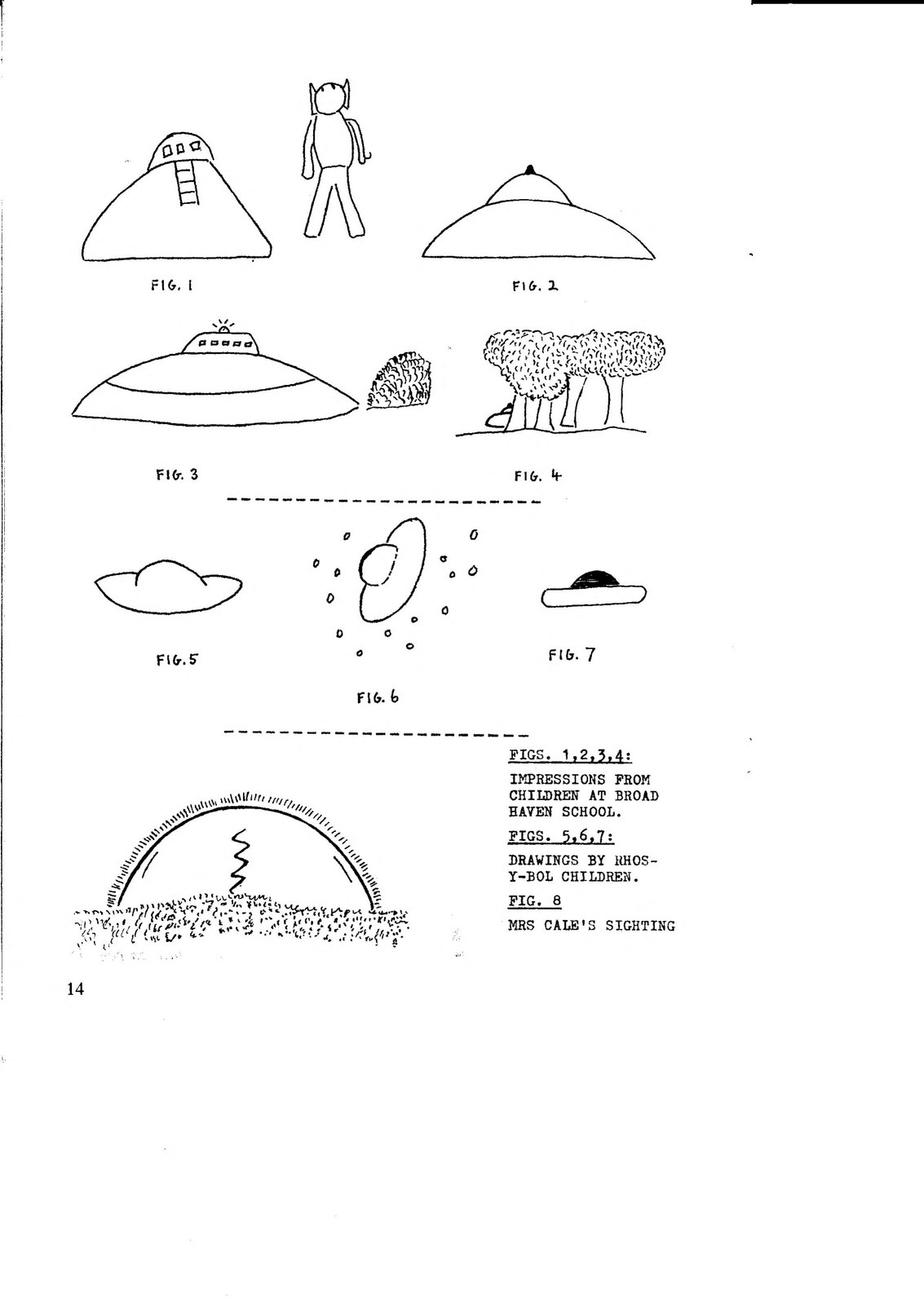
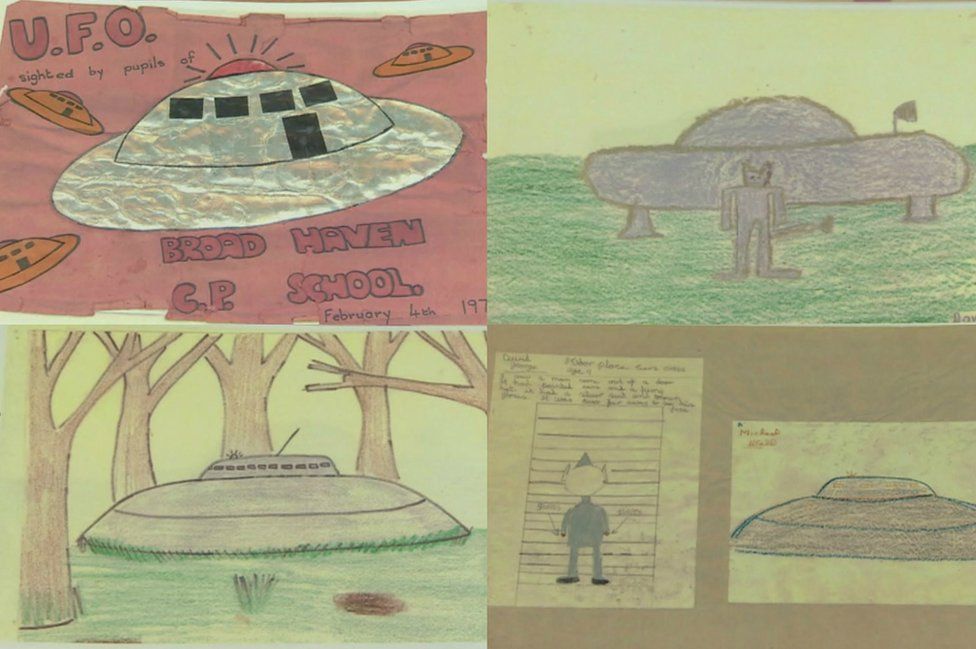
On 4 February 1977 up to fourteen pupils at Broad Haven County Primary School in Pembrokeshire reported a silver, domed object sitting in a field beyond their playground, and several described a silver-suited figure beside it. Their head teacher separated them and had them draw it, the drawings came out close, and west Wales spent the rest of the year in a UFO flap the press named the Dyfed Triangle. The Ministry of Defence told Parliament nothing unusual had happened while quietly asking the RAF Police to investigate.
What did witnesses see at Broad Haven County Primary School?
On Friday 4 February 1977, during the lunch break at Broad Haven County Primary School on the Pembrokeshire coast of west Wales, a group of pupils reported a silver object sitting on the ground in a field beyond the playground. The closest thing this case has to a contemporary field record is the BUFORA Journal for May and June 1977, which carried the report of the local British UFO Research Association investigator, the veterinary surgeon Randall Jones Pugh. Its editor, Norman Oliver, wrote that he was "somewhat bemused by the volume of reports involved" and summarised the core claim in one sentence: "up to 14 children at Broad Haven County Primary School near Pembroke stated that, between 1 pm and 3.45 pm on Friday, 4 February, they had seen a silvery metallic object on the ground within a quarter of a mile of the school, several of them also claiming a silver-suited figure was nearby."
The journal printed one of the fuller descriptions verbatim, from a nine year old named Jeremy Passmore. He said the thing was "silvery-green with a yellow-orange to red light. It had a disc at the bottom and a sort of dome on top of this with the light on top. I saw a person in a silverish-green suit about 350 yards away. The sighting lasted up to 20 minutes when the craft moved and vanished." The journal adds a detail that most retellings drop: some of the children said the object was cigar shaped and partly behind bushes, and that it first appeared to be "stuck", then seemed to try to take off before going behind the bushes.
The other names attached to the group come from the later literature rather than from the 1977 journal, and they should be read at that weight. Peter Paget's book The Welsh Triangle, published in 1979, is the source through which most of them travel, and it names Michael Webb, David Ward, Shaun Garrison, Philip Rees, Tudor Jones, Paul Williams and David Davies among the pupils, with Webb, Ward and Garrison playing football when the object was noticed and Rees recalling that "Shaun and David came running in and said that there was something there." A nine year old David George is separately reported as having described a figure in a silver suit moving about in the field. David Davies is the one witness who has stayed publicly on the record into adulthood. Speaking to BBC Radio Wales in 2017, forty years on, he described a silver cigar shape with "a dome covering the middle third", said it "popped up and then went back behind a tree", put the whole thing at only a few seconds, and remembered a mix of awe and a strong urge to run away. He was careful about what he was claiming, calling it an unexplained and strange aircraft rather than anything extraterrestrial.
David Clarke, who read the Ministry of Defence file, gives the group as fifteen children, mostly ten year old boys, with the object partly hidden by trees, two boys reporting a silver dome with a flashing light, and six of the children claiming they saw a tall man dressed in a silver space suit. At least one adult was reported as backing the children. A teacher, Mrs Morgan, is quoted saying "I saw it too, you know. It was real! When they went, a little whirlwind of dust came across the playground. It was almost as if they were saying goodbye."
The durations do not agree, and that matters. Passmore's twenty minutes, Davies's few seconds and later accounts that stretch the sighting across most of the afternoon cannot all be right. What the accounts do agree on is a shape: a broad base with a raised dome and a coloured light on top, seen in daylight on the ground, not in the sky.
Broad Haven was the opening of a wave, not an isolated report. Pugh had already logged a Broad Haven area case for 9 December 1976, when Mrs Dorothy Gale and her ten year old son, driving between Walton West and Rosepool, saw a very bright dome shaped flashing light above the hedge with a zig-zag nucleus like a bulb filament, an object they judged to be five or six feet across and fifteen to twenty feet up. Three days after the school sighting, on 7 February, about twenty children at Herbrandston School at Hakin, Milford Haven, watched a silver-white cigar shape pass over their playground at an estimated five hundred feet, silently, before it went into cloud. On 16 February, at Rhos-y-bol County Primary School on Anglesey, nine girls aged eight to eleven and their teacher Mrs Williams stopped a netball lesson to watch something with, in ten year old Gwawr Jones's words, "a black dome on top and a silver cigar-shaped base."
Through the spring the Pembrokeshire reports turned stranger. On 13 March a young man named Stephen Taylor, walking home near Llandeloy, described a pear shaped glowing object, then a large dark mass grounded in a field, then a six foot figure in a transparent suit with very high cheekbones and unnatural eyes, which he struck out at before running. On the morning of 26 March, Mrs Josephine Hewison at Little Haven sat up in bed at about 7.50 am and could not see her greenhouse, because a silver, windowless, three tiered object "like a jelly mould", wider than the greenhouse by fifteen feet, was parked in front of it. It vanished in the seconds she took to cross to the window and left not so much as a broken twig. Billy and Pauline Coombs at Ripperston Farm, Saint Brides, reported a running series of events including a glowing ball that followed Mrs Coombs's car up the farm track and, at about one in the morning a few nights later, a seven foot silver-suited figure at the living room window, with the family dog silent and agitated and afterwards refusing to go outside. On 19 April, Rosa Granville of the Haven Fort Hotel at Little Haven reported an oval, brightly lit object and two human-like figures in boiler suits who appeared to be measuring something, with flattened grass afterwards on ground overlooking a Royal Observer Corps bunker.
More footage and images of this sighting
National Archives catalogue entry for DEFE 24/1206, 'UFO reports and correspondence: April-October 1977', the Ministry of Defence piece containing the 1977 Welsh material including the school sightings and the RAF Police discreet enquiry. View source
What is the official explanation?
There is no single adjudicating official report on Broad Haven, but there is a paper trail, and it is more interesting than the public line the Ministry of Defence was running at the time. The relevant Ministry of Defence UFO desk papers sit in the DEFE 24 series at the National Archives at Kew. The piece that carries the 1977 Welsh material is DEFE 24/1206, catalogued as "UFO reports and correspondence: April-October 1977", a public record that was originally closed until 2005.
David Clarke, who worked as the National Archives consultant on the UFO file release programme and who has read this file, sets out the sequence. On 14 June 1977 the head of S4 (Air), the branch that handled UFO reports, took the unusual step of asking the RAF Police, in the form of the Provost and Security Service, to make a "discreet enquiry" into what was happening in Wales. The internal note is candid about how far outside normal practice this was. The writer told the police that "We have not invoked the assistance of P&SS before on UFOs", worried about diverting them from low flying complaints, and added the line that gives the whole episode its flavour: "I have not even told the Minister I am consulting you."
While that quiet enquiry was running, the public position was that nothing had happened. The Parliamentary Under Secretary of State told members of Parliament that the department had "no record of unusual activity in the area" beyond Mrs Granville's report. By December 1977 the head of the UFO desk was briefing the Defence Intelligence Staff in these terms: "There is always a steady public interest in UFOs and from time to time it tends to increase unaccountably. In the summer there was some concern in Wales, although the RAF Police thought this could have been the work of a practical joker." That is the closest thing to an official verdict on the Dyfed flap, and it is a one clause aside in a briefing note. No final Provost and Security Service report survives in the file.
The one named officer in the record is Flight Lieutenant Cowan at RAF Brawdy, who looked into the reports locally. He raised the possibility that a local prankster was at work and made the specific observation that the descriptions of the silver figures "fitted exactly the type of protection suit that would have been issued in the event of a fire at one of the local oil refineries." Milford Haven, a short drive from Broad Haven, was then one of the largest oil terminal and refinery complexes in Europe, so the suits were not a hypothetical. Rosa Granville, after writing to her member of parliament, was visited by a squadron leader from RAF Brawdy who, on her account, told her there was "absolutely nothing at RAF Brawdy" that could explain what she had seen, and asked her not to discuss the incident.
It is worth separating what is documented about RAF Brawdy from the folklore that grew around it. Documented: the airfield hosted what became No 1 Tactical Weapons Unit from 1974, flying Hawker Hunters and later Hawks, and immediately adjacent to it the United States Navy operated Naval Facility Brawdy, commissioned on 5 April 1974 and deactivated on 1 October 1995. NAVFAC Brawdy was publicly described as an "Oceanographic Research Station". It was in fact the largest station in the SOSUS undersea hydrophone network, a passive sonar system for tracking Soviet submarines in the Atlantic, staffed in 1980 by 22 United States Navy officers, 278 other ranks and 7 civilians. So there genuinely was a secretive American intelligence installation with a cover story sitting in the middle of the flap zone, and local people genuinely were told a false thing about it. Not documented, and specifically contradicted by a later on site survey of the abandoned facility, is the persistent claim of vast underground complexes beneath Brawdy. The survey found no underground areas or protected accommodation at all.
The school sightings did generate a small paper record of their own inside the ministry. When the Anglesey children's drawings and Gwawr Jones's letter reached RAF Valley, the covering note passed to S4 (Air) said the station could "offer no positive explanation or identification". The British government logged 435 UFO sighting reports in 1977 in total.
What did the witnesses think it was?
The evidential centre of this case is not the object. It is the headmaster and what he did with the children.
Ralph Llewellyn was the head teacher at Broad Haven County Primary School. Faced with a large group of excited pupils and a story that had already reached the press, he interviewed fifteen children separately and had them write and draw what they had seen without conferring. His conclusion, as recorded in the Ministry of Defence file, was that "After allowing for variations and embellishments [the head-teacher] is loathe to believe that the children are capable of a sustained sophisticated hoax." He said publicly that he did not disbelieve that they had seen something they had never seen before, and then declined further interviews.
One detail here is routinely reported wrongly and needs stating plainly, because it cuts both ways. The drawings were not made on the day. Clarke, working from the file, dates the separate interviews and the drawing exercise to Monday 7 February, three days after the sighting, with a weekend in between. Llewellyn's protocol was genuinely good and unusually rigorous for a primary school head with no training in this, but it was applied after the children had had three days to talk to each other, to their families and to reporters. Independent separated drawing is a strong test. It is a much weaker test when the separation happens seventy hours late.
Randall Jones Pugh was the other adult who mattered. A retired veterinary surgeon, he was BUFORA's regional investigations coordinator for the area and the correspondent through whom the story reached the national media. He was on the case fast. He took the initial report from a mother whose son and his friends had seen something near the school, interviewed the boy about an hour after the sighting, and had the child walk him to the spot. Rain had taken any ground trace, but Pugh found the boy's fright and the agreement of his schoolmates convincing. Pugh went on to log dozens of Dyfed reports for BUFORA through 1977, including Little Haven, Llandeloy, Llansteifan, Haverfordwest, Milford Haven, Pembroke Dock, Aberystwyth and Clarbeston, and in 1979 he published The Dyfed Enigma: Unidentified Flying Objects in West Wales with F. W. Holiday through Faber. His later trajectory should be on the record too, because it bears on how his own testimony ages rather than on the children's: Clarke reports that Pugh eventually concluded that UFOs were not craft at all but demonic visions, and withdrew from ufology.
The adult corroboration around the school is thin but not absent. The teacher named as Mrs Morgan said flatly that she saw it as well and described a small whirlwind of dust crossing the playground as the object left. The children themselves, according to local reporting, were sufficiently annoyed at being disbelieved that they got up a petition to the police asking for an investigation.
Across the wider flap, the adult witnesses were not the sort who are easy to wave away. The policeman who attended Ripperston Farm said in 1996, recalling twenty six years of service, that the Coombs household was "the most frightened family I have ever been to see", and that there was no doubt the couple had seen something unusual, though he could not say what. Rosa Granville was a hotel proprietor who went to her member of parliament rather than to a newspaper, and who was then asked by a serving RAF officer to keep quiet. Josephine Hewison's Little Haven report and Stephen Taylor's Llandeloy encounter both came to BUFORA through named investigators within weeks.
What the children believed then, and what they say now, has stayed remarkably stable in one narrow respect and modest in another. None of the Broad Haven pupils has ever confessed to inventing it, in fifty years, despite the case being revisited on television and radio at every anniversary. At the same time David Davies, the most visible of them as an adult, has not escalated. He does not claim aliens. He claims that on 4 February 1977 he saw a strange aircraft he still cannot identify, for a few seconds, and that it has stayed imprinted on him ever since.
The dispute
The dispute has two distinct halves, and they are usually mashed together to the case's disadvantage. The first half concerns the silver-suited figures reported across Pembrokeshire through the spring of 1977, at Ripperston Farm, at Little Haven and elsewhere. Here there is a genuine confession. In 1996 the broadcaster Ray Gosling, researching a BBC Radio 4 documentary on the West Wales flap, located a local businessman and Round Table member named Glyn Edwards, who admitted in the Western Mail that he had spent time in 1977 walking around the area in a borrowed silver asbestos fire suit. Edwards described it as having "a solid in-built helmet so I would have looked about 7ft tall", said he did it for fun, and said he dived into hedges when residents came out, some of them armed. That is a named individual, a stated method and a physical prop that matches the reported figures closely, including the seven foot height that so many accounts stress. It is also consistent with what Flight Lieutenant Cowan of RAF Brawdy had already written into the Ministry of Defence file in 1977, that the descriptions "fitted exactly the type of protection suit that would have been issued in the event of a fire at one of the local oil refineries", the Milford Haven complex being minutes away. Edwards, however, did not claim to have anything to do with the school, and said he could not explain the UFO.
The second half concerns the 4 February object itself, and here the counter-case is much weaker. The standard sceptical reading is that the children, at a distance of about a quarter of a mile and looking across a field through a hedge and a line of trees, misread a parked or derelict vehicle, most often given as a chrome sewage tanker, sometimes as farm machinery, occasionally with a since-demolished works building added to the scene. No named analyst has ever demonstrated this reconstruction. Nobody has identified the specific vehicle, produced a sightline study, or shown that a tanker was present. The only evidence offered against it, that the sewage works logged no tanker arriving that day, comes through Peter Paget's 1979 book rather than from a document, and is equally unverified. It is a plausible-but-unproven natural explanation on both sides of the ledger.
The genuine weakness in the pro-case is procedural rather than skeptical, and it is worth more than either counter-explanation. The independent separated drawing exercise by head teacher Ralph Llewellyn, which is what makes this case famous, did not happen on the day. David Clarke, reading the Ministry of Defence file, dates Llewellyn's separate interviews with fifteen pupils to Monday 7 February, three days after the sighting, with a weekend and the beginnings of national press interest in between. Separated drawing is a strong protocol. Applied seventy hours late to a group of ten year olds who had been talking to each other, to their parents and to reporters, it cannot rule out convergence, and the closeness of the drawings therefore proves less than it has been made to prove for half a century.
None of this closes the case. The official finding, the December 1977 briefing note recording that "the RAF Police thought this could have been the work of a practical joker", is an assertion with no surviving report behind it and, under this archive's rules, an apparatus verdict is never counted against a case, particularly one reached during an enquiry that the department deliberately concealed from its own minister. No pupil has recanted in nearly fifty years. The object in the field on 4 February 1977 has never been positively identified. The case therefore sits at Barely Disputed: a real confession that covers the figures but not the craft, a real procedural flaw in the drawings, and no explanation of the thing that was actually seen.
Is the Broad Haven School Sighting and the Dyfed Triangle real? The two-pass assessment
Pass one. How could all of this be entirely ordinary?
The strongest prosaic account of the 4 February sighting is mundane and specific. A shiny vehicle in or beyond the field, most commonly given as a chrome sewage tanker or farm machinery, low winter sun on bare metal, a hedge and a line of trees breaking the outline, and a quarter of a mile of distance. Excited ten year olds converge fast on a shared reading of an ambiguous shape, and the reading hardens each time it is retold. The three day gap before Llewellyn separated the children is a real contamination window, not a technicality. So is the fact that by the following week national television crews were filming the children at the site, which is about the worst possible environment for keeping fifteen young accounts independent. The internal inconsistencies point the same way: a sighting variously described as lasting a few seconds, up to twenty minutes, and most of an afternoon is a sighting whose duration nobody actually measured.
The silver figures have a documented mundane candidate and, unusually, a confession. Flight Lieutenant Cowan at RAF Brawdy noted in 1977 that the descriptions matched the fire protection suits issued for the Milford Haven refineries exactly. In 1996 the broadcaster Ray Gosling, making a Radio 4 documentary on the flap, tracked down a local businessman, Glyn Edwards, who admitted that he had walked around the area in 1977 in a borrowed silver asbestos fire suit with, in his words, "a solid in-built helmet so I would have looked about 7ft tall", diving into hedges when residents came out. He said he did it for fun. That is a named person, a named method, a matched physical description and a plausible route to the seven foot silver figure at the Coombs's window and the boiler-suited pair at Little Haven. The Ministry of Defence, quietly and off the record, landed in the same place: the December 1977 briefing says the RAF Police "thought this could have been the work of a practical joker."
Against the tanker reading, the only counter on the record is a claim carried through Paget's 1979 book that the sewage works confirmed no tanker went to the site that day, plus the point that the ground was boggy and most of the pupils were farm children who knew what farm machinery looked like. Neither has been independently verified, and neither is strong.
Pass two. If the core report is what the witnesses say it is, what is it?
It is a daylight, low altitude, apparently landed structured object, reported by more than a dozen separate observers and one adult, with a consistent and slightly awkward configuration that nobody has ever explained away in detail: a broad base, a raised dome, a coloured light on top, and, on several accounts, an initial impression that the thing was stuck before it moved. That same configuration turns up twelve days later and a hundred and fifty miles north in the mouth of a ten year old girl on Anglesey who had no connection to Broad Haven, and whose teacher also separated her class to draw. The official behaviour is its own piece of evidence. The MoD UFO desk went outside its own precedent to ask the RAF Police for a covert investigation, explicitly kept it from the minister, and simultaneously told Parliament there was no record of unusual activity. Under this archive's standing rule an official-apparatus finding is never counted against a case, and a covert enquiry run behind a public denial is logged here as what it is: a measure of how seriously the case was taken at the time.
The tier. Discredited is not available here and would not be right anyway. Strongly Disputed requires a confession, a recantation, recovered props, or a positive identification of the specific object. What exists is close to that but does not reach it. Glyn Edwards's confession is real and method-shown, but it is a confession to being a silver figure in the wider Pembrokeshire flap. It does not identify the object on the ground in the school field on 4 February, and Edwards himself did not claim to explain the UFO. The refinery suit match is an inference by an RAF officer, not an identification. The tanker is an untested hypothesis. The practical-joker line is an official assertion with no shown method and no surviving report behind it. None of the fifteen children has ever recanted, and the one who still speaks publicly has kept his claim deliberately small.
So: Barely Disputed. There is a serious, named, partially evidenced counter-explanation covering part of the flap, and there is a real methodological weakness at the heart of the school case in the three day gap before the drawings. Neither closes the 4 February sighting, and the object itself remains unidentified.
Sources
- archive.org/details/BUFORA_Journal_Volume_06_No_01_MayJun_1977
- archive.org/details/BUFORA_Journal_Volume_06_No_02_JulyAug_1977
- archive.org/details/BUFORA_Journal_Volume_06_No_03_SepOct_1977
- archive.org/details/BUFORA_Journal_Volume_06_No_04_NovDec1977
- www.fourcornersbooks.co.uk/articles/close-encounters-of-the-playground-kind/
- drclarke.substack.com/p/did-the-village-see-aliens
- walessince1945.wordpress.com/2023/11/25/the-welsh-bermuda-triangle-ufos-and-extraterrestrial-phenomena-in-1970s-pembrokeshire/
- flashbak.com/secrets-of-the-ufo-files-national-archive-finally-reveals-what-we-saw-in-the-skies-over-britain-450419/
- archive.org/details/bwb_KV-336-676
- shadowsofyourmind.medium.com/the-welsh-ufo-flap-of-1977-7033af29c671
- www.ufoinsight.com/ufos/close-encounters/broad-haven-school-ufo-incident
- www.rhyljournal.co.uk/news/23846646.ufo-sightings-pembrokeshire-broad-haven-triangle-story/
More cases from this region: UFO sightings in United Kingdom