The "Flying Saucer" Beside an A319 Over Handcross (UK Airprox 2026064)
A passenger jet on approach to Gatwick passed a rim-marked disc at its own altitude, close enough that the crew estimated the gap in hundreds of feet. Radar held nothing. The UK Airprox Board, which had already called seven other objects drones at the same meeting, went on the record saying it could not determine what this one was.
What did witnesses see at 1.3NM southeast of Handcross VRP?
At 1030 UTC on 29 April 2026 an Airbus A319 operated by a commercial air transport carrier was descending toward London Gatwick, on radar vectors from Gatwick control, roughly three nautical miles north of the WILLO waypoint. The crew were passing 8,500ft on altimeter and turning left. What happened next is recorded in the pilot's own words in the UK Airprox Board's published file, and it is worth quoting exactly rather than paraphrasing, because almost every press account of this event has compressed it.
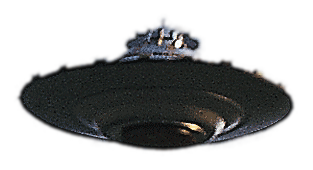
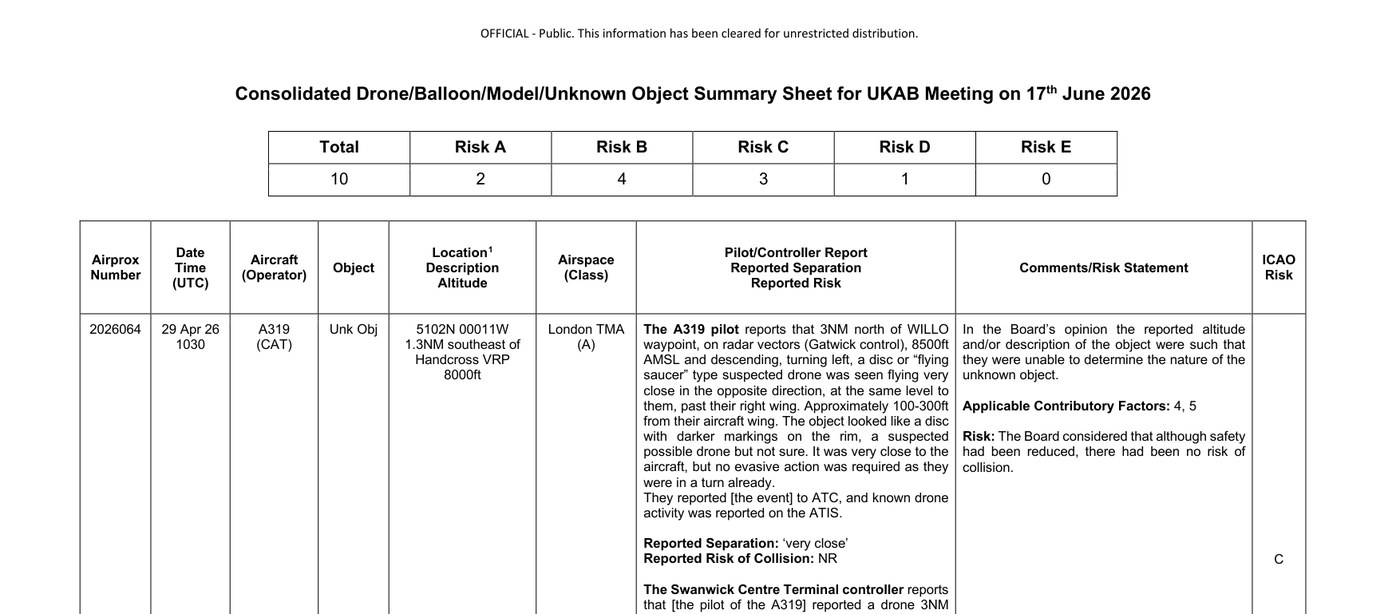
"A disc or ‘flying saucer’ type suspected drone was seen flying very close in the opposite direction, at the same level to them, past their right wing," the report states. "Approximately 100-300ft from their aircraft wing. The object looked like a disc with darker markings on the rim, a suspected possible drone but not sure. It was very close to the aircraft, but no evasive action was required as they were in a turn already."
Those two sentences carry the whole case. The object was a disc. It had darker markings around its rim. It passed at the same altitude, on a reciprocal heading, inside the length of a few wingspans. And the pilot who filed the report, a professional flying a passenger jet on approach to one of the busiest airports in Europe, declined to say what it was. The phrase in the file is "a suspected possible drone but not sure," which is a hedge the crew put there themselves and which no summary of this case is entitled to remove.
The Board logged the encounter in the London Terminal Control Area, Class A airspace, at 8,000ft, at position 5102N 00011W, which places it about 1.3 nautical miles southeast of the Handcross visual reporting point in the Sussex Weald, roughly seven miles north of Gatwick's runway. Reported separation was recorded as "very close." Reported risk of collision was not recorded by the crew.
What is the official explanation?
This case is unusual in the archive because the official narrative is not a denial, a balloon, or a silence. It is a formal safety finding by a national investigating body, and that body's conclusion is that it does not know what the object was.
The crew reported the event to air traffic control at the time. The Swanwick Centre Terminal controller's own statement is in the file: the A319 pilot "reported a drone 3NM north of WILLO at approximately 8500ft passing very close to the aircraft. The drone was described as a small flying saucer type shape. Subsequent aircraft were given warning, and nothing was seen by any other aircraft."
That last clause matters and cuts against the case. Traffic behind the A319 was warned and saw nothing.
NATS Operations Investigations then went to the radar. Their conclusion, as published: "Safety Investigations reviewed the radar at the time the pilot of [C/S] reported the sighting, however, no radar contacts associated with the drone were visible." There was no primary and no secondary return to correlate with what the crew saw.
The Board's own verdict is a single sentence and it is the reason this case sits in the archive at all: "In the Board's opinion the reported altitude and/or description of the object were such that they were unable to determine the nature of the unknown object."
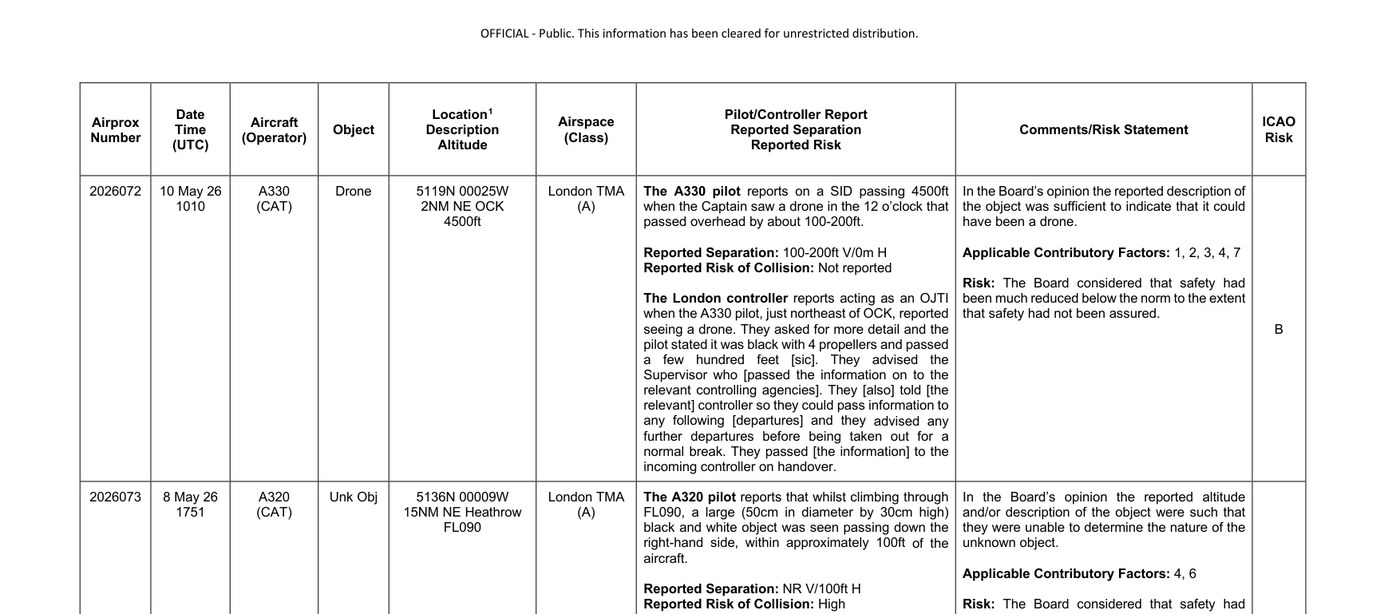
That wording is not casual. The same summary sheet contains seven other entries from the same meeting where the Board wrote the opposite phrase, "the reported altitude and/or description of the object were sufficient to indicate that it could have been a drone." The Board has a standard finding for "this was a drone" and it used that finding repeatedly on 17 June 2026. It did not use it here. In the Board's own classification, the object beside that A319 is filed as an unknown object, not a drone.
On risk, the Board recorded ICAO category C: "although safety had been reduced, there had been no risk of collision." Applicable contributory factors were 4 and 5, that is, the crew had no or late situational awareness of the object, and the crew were concerned by its proximity.
What did the witnesses think it was?
The crew's own framing is the most careful part of the record. They did not claim an anomalous craft. They reported a disc, described a physical detail that is hard to invent casually (darker markings around the rim), gave an honest separation estimate as a range rather than a single figure, and explicitly withheld an identification.
The controller's independent phrasing is close but not identical: a "small flying saucer type shape." Two people in different places, one in a cockpit and one at a radar console at Swanwick, both reached for the same word for the shape. The controller was relaying the pilot, so this is not corroboration of the object, but it does establish that the description was consistent from the first radio call, before anyone had time to reconsider it.
The one piece of context that the popular coverage has mostly left out, and that belongs in the pilot's account rather than in the official one, is what the crew added at the end: "They reported [the event] to ATC, and known drone activity was reported on the ATIS." Drone activity in the area was already being broadcast to arriving aircraft that day. The crew flew into an environment where drones were a known live hazard. That is the single strongest piece of prosaic context in the file, and it comes from the witnesses themselves.
Is the "Flying Saucer" Beside an A319 Over Handcross (UK Airprox 2026064) real? The two-pass assessment
Pass one, how could this be mundane. The obvious candidate is a drone, and the file gives it real support. Known drone activity was on the ATIS at the time, so at least one drone was being reported in that airspace on that day. The object was seen for a very short time, at closing speed, from a banking aircraft, at 8,000ft, through a cockpit window, by a crew whose attention was on an approach. Under those conditions a small quadcopter seen edge-on or at an oblique angle can present as a compact disc, and the "darker markings on the rim" could be motor housings or arms against a bright sky. A large balloon or a mylar cluster would also be a candidate for a lightweight object drifting at that level, although the reciprocal track argues against a purely wind-borne object. The absence of any radar return is not evidence of anything exotic. Small drones and balloons routinely produce no primary return at all, which is exactly why they are dangerous.
The honest weight of pass one is high. This was probably a drone. The Board itself said the altitude and description together were not sufficient to say so, but "not proven" is not the same as "unlikely."
Pass two, what if the identification is the problem. The reason this case is not simply filed away as a drone report is that the people whose profession is identifying objects in UK airspace looked at it and declined. The crew declined. The Board declined, in writing, while using the drone finding freely on seven of the other nine entries in the same document. Nothing behind the aircraft saw it, and nothing on radar saw it. So what survives is a report of a rim-marked disc holding a constant reciprocal track at a constant level in Class A controlled airspace, from a professional source, that the national investigator could not resolve.
That is what an Unknown looks like when it is generated by the aviation safety system rather than by a phone camera. There is no footage, there is no second witness to the object itself, and there is no anomalous performance claimed: no acceleration, no hover, no absence of visible lift. The object did nothing a drone could not do. It simply was not identified. The tier here is Unknown on the narrowest and most defensible reading of that word, which is that the only body with the authority and the data to name it went on the record saying it could not.
UPDATE, 4 August 2026. The Board's finding reached the national press five days after this file was built from the summary sheet. On 3 August 2026 IBTimes UK carried a second piece on the case, by Thea Felicity, reporting the Airprox Board's assessment that the encounter "reduced the safety margin available to the aircraft" and restating the pilot's description of a disc shaped object with darker markings around its rim passing in the opposite direction between roughly 100 and 300 feet from the right wing. The coverage adds no new witness and no imagery. Its value is confirmatory: the wording carried by the press matches the summary sheet this case was built from, and no party has since offered an identification of the object.
Sources
- www.airproxboard.org.uk/media/qwvl2etv/june-2026-drone-summary-sheet.pdf
- www.airproxboard.org.uk/reports-and-analysis/individual-airprox-reports/2026/
- www.ibtimes.co.uk/flying-saucer-zooms-within-feet-airbus-passenger-jet-coming-land-london-gatwick-1811891
- www.lbc.co.uk/article/pilot-flying-saucer-disk-plane-landing-gatwick-heathrow-5HjdfRr_2/
- www.dexerto.com/entertainment/pilot-reports-flying-saucer-passing-feet-from-passenger-jet-during-landing-3393921/
- www.ibtimes.co.uk/uk-air-safety-report-flying-saucer-near-miss-gatwick-1812084
More cases from this region: UFO sightings in United Kingdom