Two Unidentified Objects Over the London TMA in Thirty-Two Minutes (Airprox 2026073 and 2026084)
Two airliners left Heathrow thirty-two minutes apart on the same May evening, and each of them passed an object at its own altitude in Class A airspace. Neither object produced a radar return, and the UK Airprox Board returned the identical finding on both files: unable to determine the nature of the unknown object.
What did witnesses see at London Terminal Control Area?
On the evening of 8 May 2026, two airliners climbing out of London Heathrow into the same block of controlled airspace each passed an object at close range, thirty-two minutes apart. Neither object was identified. Both were filed separately with the UK Airprox Board, and both came back from the Board's 17 June 2026 meeting with the same finding: unable to determine the nature of the unknown object.
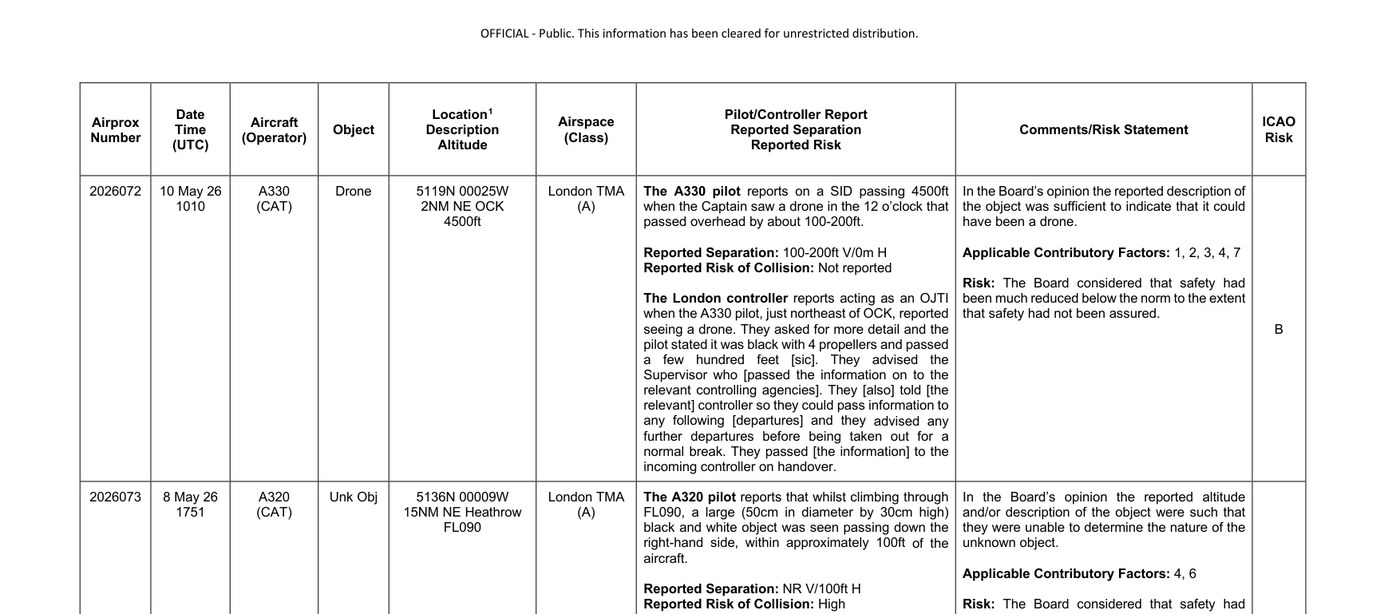
The first was at 1751 UTC. An Airbus A320 was climbing through flight level 090, about fifteen nautical miles northeast of Heathrow, in Class A airspace of the London Terminal Control Area. The pilot's report as published: "whilst climbing through FL090, a large (50cm in diameter by 30cm high) black and white object was seen passing down the right-hand side, within approximately 100ft of the aircraft." The crew put the reported risk of collision at High. That is the Board's file reference 2026073.
The second was at 1823 UTC, thirty-two minutes later. An Airbus A321, also departing Heathrow, was about two nautical miles northwest of the Lambourne VOR on an assigned radar heading of 040 degrees, passing roughly flight level 145 at 320kt indicated and 400kt true. The pilot's report: "they passed a black object of unknown but significant size with no discernible features. It was at the same altitude with a separation of 30-100m (estimated based on the closing speed and angle). They did not observe a collision." The captain was heads-down and did not see it. That is file 2026084.
The two objects are not described as the same thing. The first was given precise dimensions and two colours. The second was given no dimensions at all, only "unknown but significant size" and "no discernible features," which is what a very fast pass at 400kt true airspeed produces. What they share is altitude band, airspace, date, departure airport, and outcome.
What is the official explanation?
Both reports went to NATS Safety Investigations, and in both cases the radar had nothing.
For 2026073: "A NATS Investigation reports that there were no secondary or primary responses associated with the drone visible on the radar at the time of the event."
For 2026084: "analysis of the radar [replay] indicated that there were no associated primary or secondary contacts associated with the pilot's report [of the object], visible on radar at the approximate time of the event."
The controllers' accounts are in the file for the first event. The Northeast Departures controller "reported sighting a drone around half a metre in size and coloured black and white. The details taken and passed to GS Midlands. Reports were passed to following aircraft if necessary and no further incident was reported." Note that the controller writes "drone" while relaying a pilot report that did not use the word.
The Board's findings were identical in wording and different in consequence. On both files it wrote: "In the Board's opinion the reported altitude and/or description of the object were such that they were unable to determine the nature of the unknown object." Both are logged in the Object column as "Unk Obj," not as "Drone."
On risk they diverged. Airprox 2026073 was rated ICAO category B: "safety had been much reduced below the norm to the extent that safety had not been assured." Contributory factors 4 and 6, the second of which is the Board's code for a near airborne collision with an unpiloted airborne object, specifically an unknown object or balloon, as distinct from factor 7, which is its code for a near collision with a drone. The Board chose the unknown-object code.
Airprox 2026084 was rated category D: "there was insufficient information to make a sound judgement of risk." Contributory factors 4 and 5.
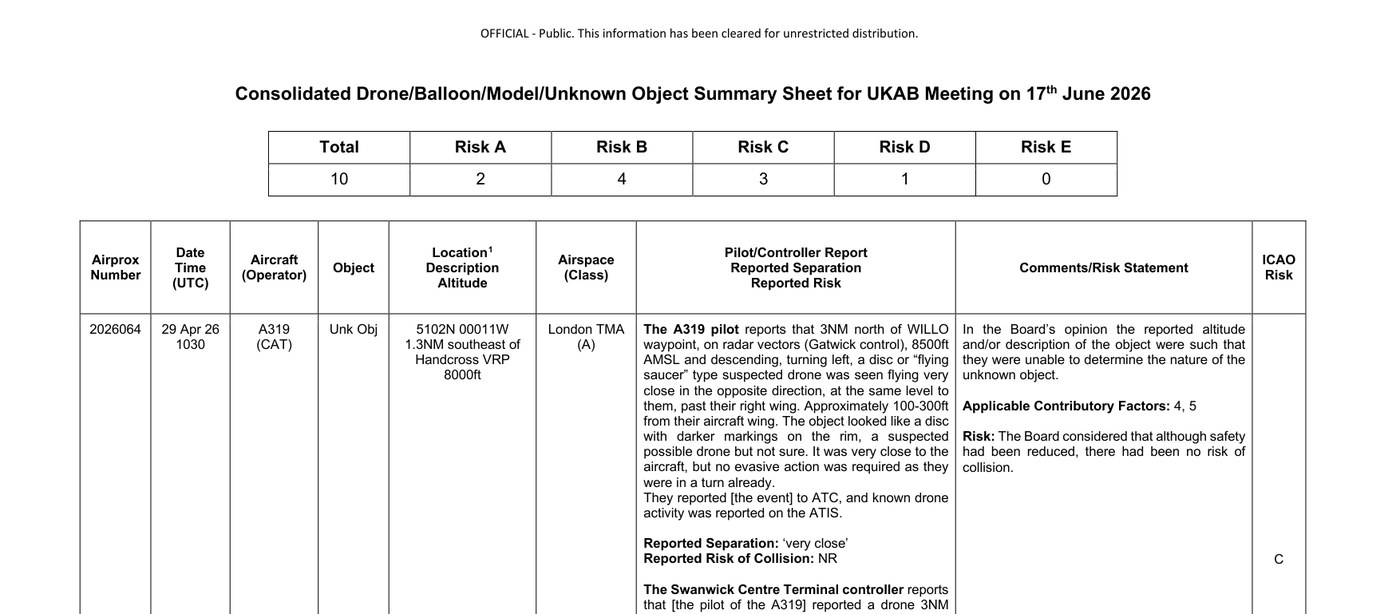
For context on how the same Board treats the same airspace on the same docket: at that 17 June meeting it cleared ten drone, balloon, model and unknown-object files. Two were rated Risk A, four Risk B, three Risk C, one Risk D. Seven of the ten got the finding that the description "was sufficient to indicate that it could have been a drone," including a small blue drone within a wingspan of an A320 on final approach over Windsor Castle and a silver circular drone alongside an A321 over Marlow. Three did not: these two, and the Handcross disc of 29 April.
What did the witnesses think it was?
The value of these two reports is that they come from crews with nothing to gain and a professional obligation to be precise, and they show that precision in opposite ways.
The A320 crew gave measurements. Fifty centimetres in diameter, thirty centimetres high, black and white, one hundred feet off the right side. That is a person estimating a real object seen well enough to size it, and it is a modest, unremarkable size that argues for a drone rather than against one. They rated the collision risk High, which is the honest reaction of someone who has just watched something the size of a small suitcase go past a passenger jet at nine thousand feet.
The A321 crew did the opposite and refused to embellish. Significant size, no discernible features, thirty to one hundred metres, and they said outright that the separation figure was inferred "based on the closing speed and angle" rather than observed. They also volunteered that the captain never saw it, which is a witness reducing the weight of their own report. Only one set of eyes was on that object.
Neither crew claimed anomalous behaviour. Neither used the word drone. Neither filed a complaint about a phenomenon. They filed safety reports, which is what the system is for.
Is the Two Unidentified Objects Over the London TMA in Thirty-Two Minutes (Airprox 2026073 and 2026084) real? The two-pass assessment
Pass one, how could this be mundane. Drones remain the leading candidate for both, and for the first one the leading candidate is strong: a half-metre black and white object at FL090 near a major departure corridor is a very ordinary description of a consumer or commercial quadcopter, and the controller reached for the word drone immediately. Balloons are a serious candidate too, and the Board's own contributory-factor code for the first event, factor 6, explicitly covers "an unpiloted airborne object (unknown object or balloon)." A mylar or weather balloon at 9,000ft would present as a compact object, would produce no radar return, and would be exactly the kind of thing nobody behind the aircraft would ever see again.
For the second, at FL145 and 400kt true, a bird strike near-miss cannot be dismissed either. At that closing speed a large bird gives a dark, featureless, size-indeterminate impression, which is close to what the crew described, though FL145 is at the extreme upper edge of the range for any bird and would be exceptional.
Two unidentified objects in the same airspace on the same evening is also less remarkable than it first sounds. This is some of the most densely trafficked and most closely watched airspace on earth, and the London TMA generates a steady stream of drone Airprox filings; the same monthly sheet carries eight other cases. A cluster of two in one evening is well within what a busy departure corridor produces.
Pass two, what if the identification is the problem. What resists the tidy drone reading is the Board's own consistency. Its file for the 17 June meeting shows an investigator that says "drone" when it can, seven times out of ten, including for objects seen for a moment from a moving jet. It declined to say it here, on both, and it coded the first one under near collision with an unknown object rather than near collision with a drone. Those are deliberate choices made by people with the full file, the radar replays, and the controller statements in front of them.
So the residue is this: on one evening, two commercial crews climbing out of the same airport reported objects at their own level, one measured and two-toned, one large and featureless, neither on radar, neither identified, one of them rated as having reduced safety below the point where it could be assured. There is no footage, no anomalous performance, and no second witness to either object. The tier is Unknown for the same narrow reason as the Handcross disc: not because the objects did anything strange, but because the national body that resolves these encounters formally could not resolve them.
Sources
- www.airproxboard.org.uk/media/qwvl2etv/june-2026-drone-summary-sheet.pdf
- www.airproxboard.org.uk/reports-and-analysis/individual-airprox-reports/2026/
- www.airproxboard.org.uk/reports-and-analysis/
More cases from this region: UFO sightings in United Kingdom