The ODNI Memorandum That Put the UAP NDA Waiver Into Force (ES 2026-00818)
For ten days the Trump UAP nondisclosure waiver existed only as an unnamed official's description of a document nobody had seen. On 31 July 2026 the Principal Deputy Director of National Intelligence signed the instrument that made it operational, and on 1 August the administration authorized a congressman to publish it. It is two unclassified pages, it puts a 30 day clock on all eighteen addressed intelligence organizations, and it says considerably less than the coverage of it does.
What happened
This case is a document, and unusually for this archive the document is in hand and can be read line by line.
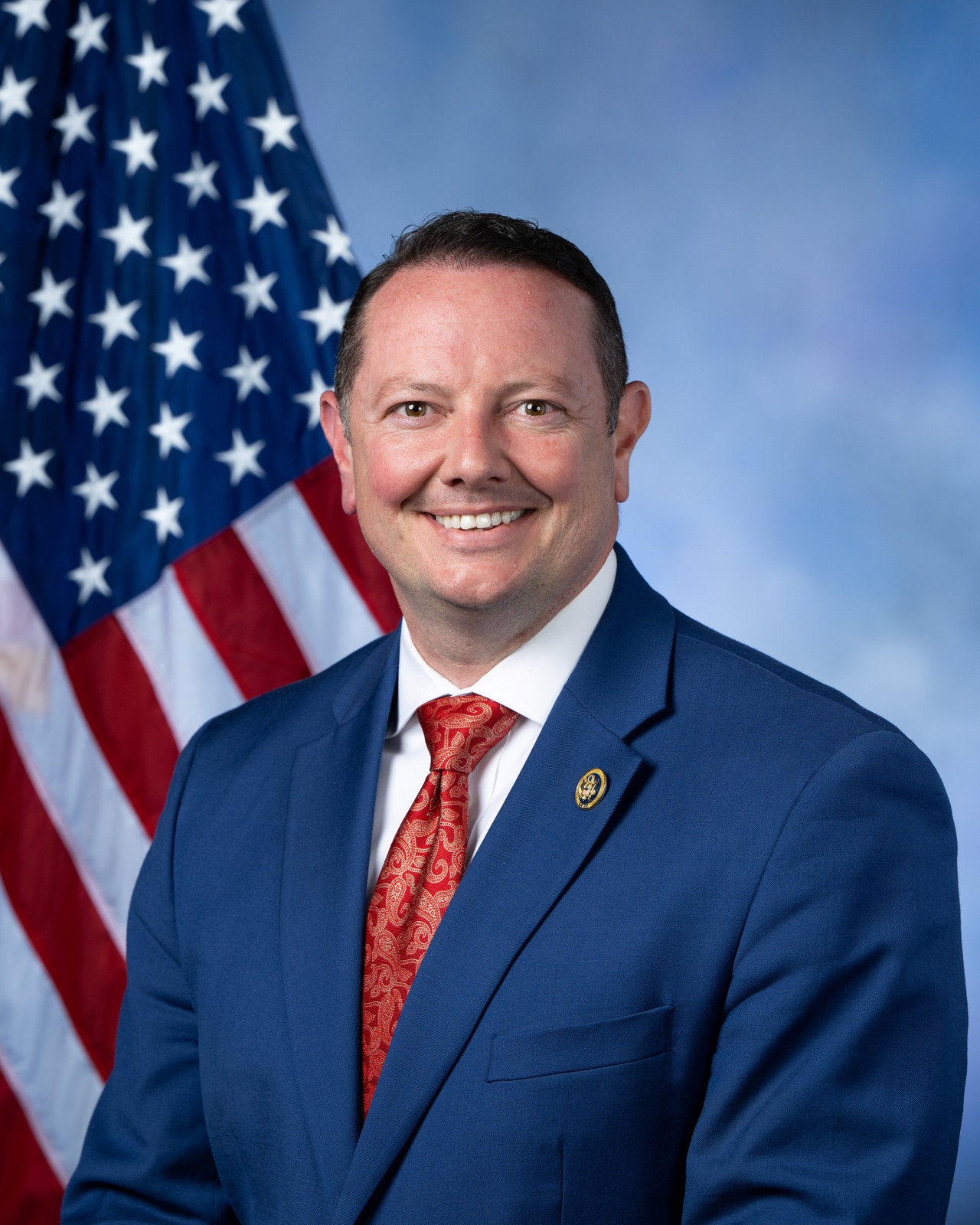
On 1 August 2026 the office of Congressman Eric Burlison of Missouri's 7th district published a press release headed "Rep. Burlison Releases Administration Memorandum on President Trump's UAP NDA Directive." The text states that Burlison "today released preliminary implementation guidance shared by the Trump administration regarding President Trump's directive concerning nondisclosure agreements (NDAs) for current and former government employees and contractors with information related to unidentified anomalous phenomena (UAP)," and it records the permission under which the publication happened: "The administration authorized Congressman Burlison's office to publicly distribute the memorandum." Attached to the release is a file named memorandum_2026.pdf, 519.21 KB, still served live from the House subsite.
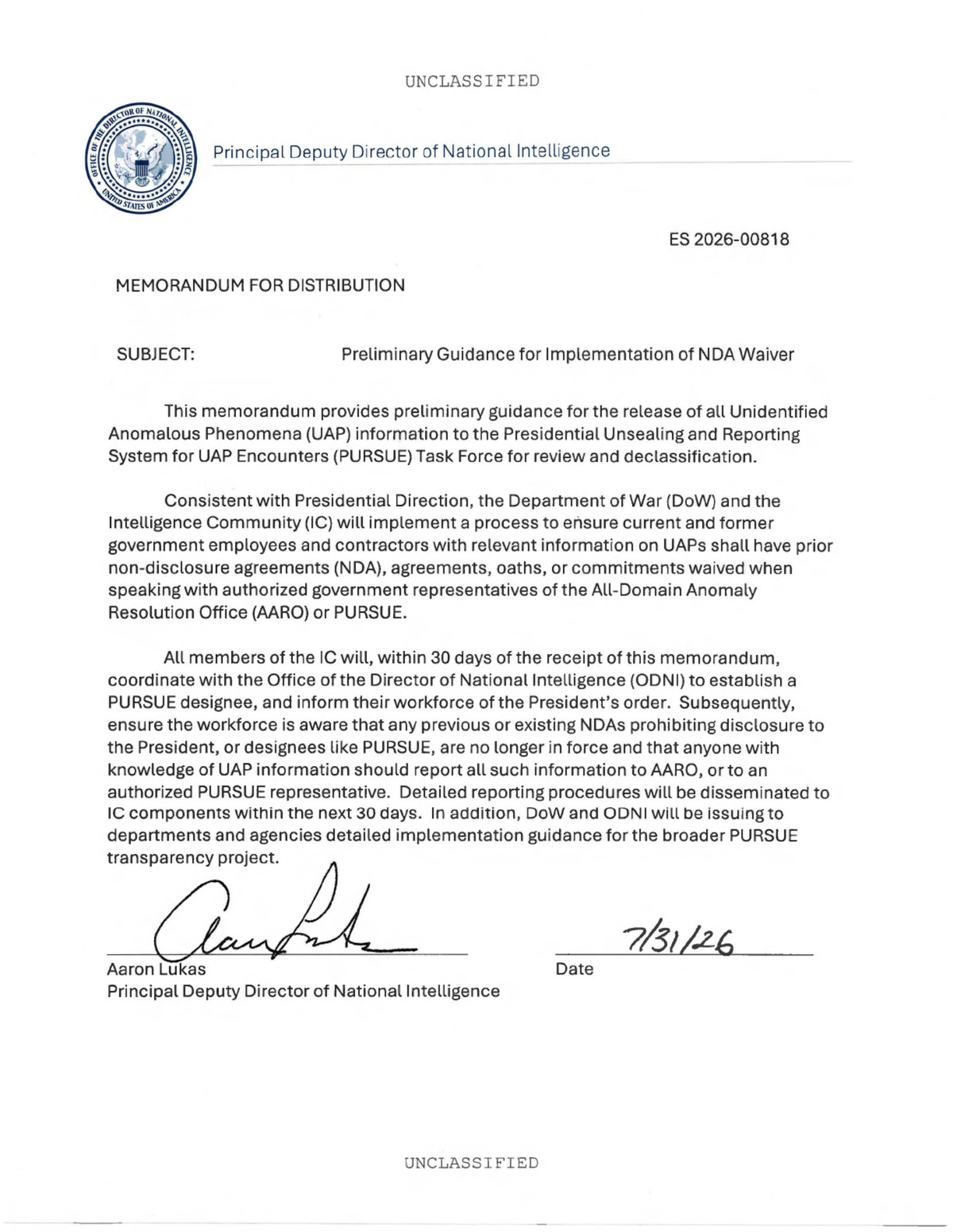
That file is a two page scanned memorandum on the letterhead of the Principal Deputy Director of National Intelligence, carrying the seal of the Office of the Director of National Intelligence. It is marked UNCLASSIFIED at the head and foot of both pages. It bears the serial ES 2026-00818. It is addressed MEMORANDUM FOR DISTRIBUTION, and its subject line reads "Preliminary Guidance for Implementation of NDA Waiver." It is signed in ink by Aaron Lukas, Principal Deputy Director of National Intelligence, and hand dated 7/31/26. The scan carries no text layer, so the wording below was read directly from the rendered page.
The body is three paragraphs. The first states that the memorandum "provides preliminary guidance for the release of all Unidentified Anomalous Phenomena (UAP) information to the Presidential Unsealing and Reporting System for UAP Encounters (PURSUE) Task Force for review and declassification."
The second is the waiver itself: "Consistent with Presidential Direction, the Department of War (DoW) and the Intelligence Community (IC) will implement a process to ensure current and former government employees and contractors with relevant information on UAPs shall have prior non-disclosure agreements (NDA), agreements, oaths, or commitments waived when speaking with authorized government representatives of the All-Domain Anomaly Resolution Office (AARO) or PURSUE."
The third sets the deadlines. "All members of the IC will, within 30 days of the receipt of this memorandum, coordinate with the Office of the Director of National Intelligence (ODNI) to establish a PURSUE designee, and inform their workforce of the President's order. Subsequently, ensure the workforce is aware that any previous or existing NDAs prohibiting disclosure to the President, or designees like PURSUE, are no longer in force and that anyone with knowledge of UAP information should report all such information to AARO, or to an authorized PURSUE representative. Detailed reporting procedures will be disseminated to IC components within the next 30 days. In addition, DoW and ODNI will be issuing to departments and agencies detailed implementation guidance for the broader PURSUE transparency project."
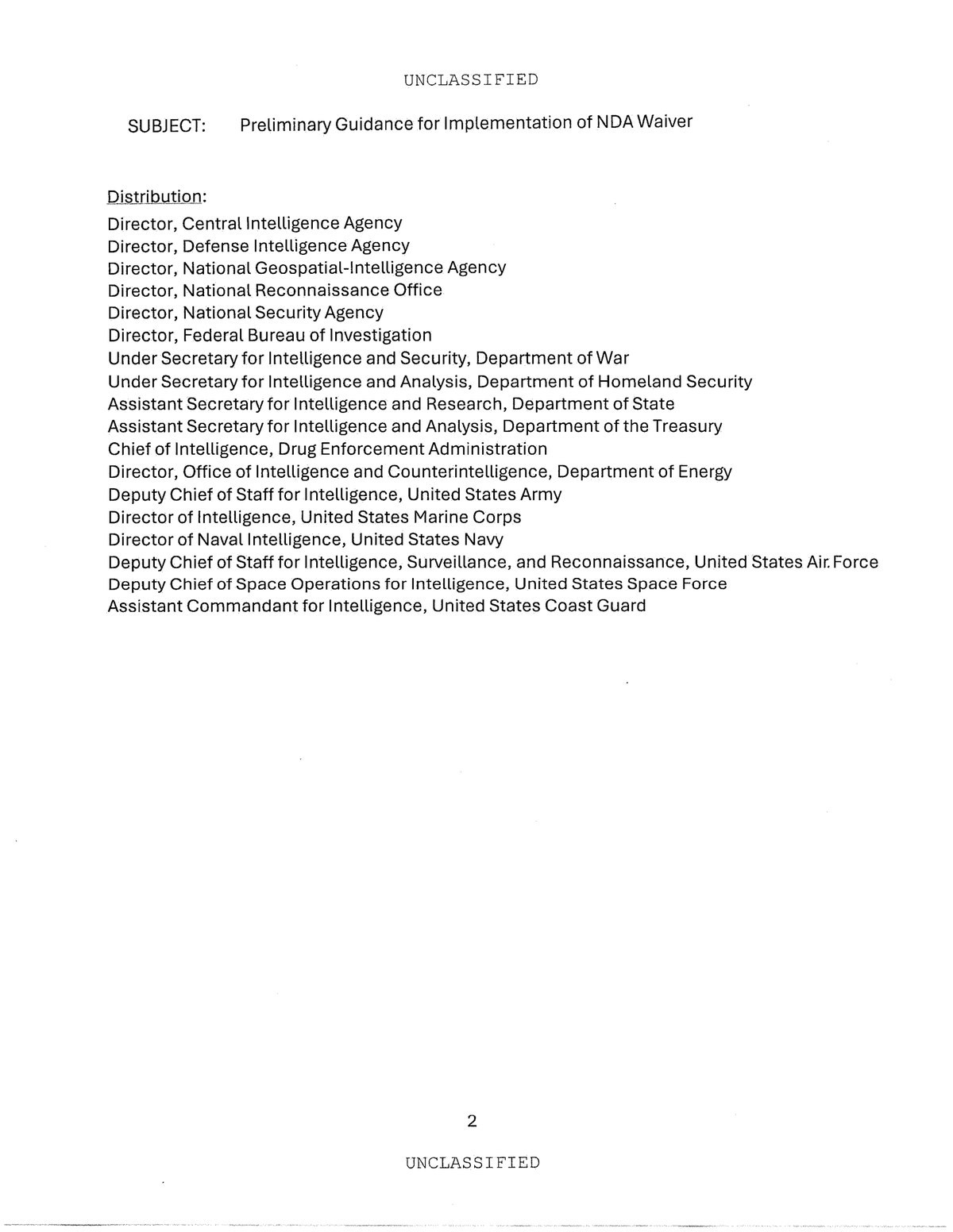
Page two carries the subject line again and then the distribution list, which is the part of the document that says most about its reach. Eighteen offices are addressed: the Directors of the Central Intelligence Agency, the Defense Intelligence Agency, the National Geospatial-Intelligence Agency, the National Reconnaissance Office, the National Security Agency and the Federal Bureau of Investigation; the Under Secretary for Intelligence and Security at the Department of War; the Under Secretary for Intelligence and Analysis at the Department of Homeland Security; the Assistant Secretary for Intelligence and Research at the Department of State; the Assistant Secretary for Intelligence and Analysis at the Department of the Treasury; the Chief of Intelligence at the Drug Enforcement Administration; the Director of the Office of Intelligence and Counterintelligence at the Department of Energy; and the service intelligence chiefs of the Army, Marine Corps, Navy, Air Force, Space Force and Coast Guard.
One small documentary wrinkle is worth recording because this archive dates things by documents rather than by coverage. Burlison's 1 August release refers back to "Wednesday, July 21, 2026." 21 July 2026 fell on a Tuesday. The directive itself was first reported on 21 July, and 31 July 2026, the date Lukas signed, was a Friday.
Documents and images
What is the official position?
This memorandum is the official narrative. That is what makes it unusual in this archive, where the official layer is normally a denial, a balloon, or a silence. Here the government is the author, the publisher is a member of Congress acting with the administration's permission, and the text is unclassified and complete.
What the memorandum officially establishes is narrow and procedural. It creates a route, not a right to speak publicly. The waiver in paragraph two attaches to a specific setting: prior NDAs, agreements, oaths or commitments are waived "when speaking with authorized government representatives" of AARO or PURSUE. Nothing in the two pages authorizes a former officer or contractor to speak to a journalist, a researcher, or the public. The destination of everything collected is stated in paragraph one: the PURSUE Task Force, "for review and declassification." Declassification review sits at the end of the pipeline, not at the start.
The operative machinery is the 30 day clock, and it runs from receipt rather than from signature, so the eighteen addressed organizations do not all start on the same day. Within that window each IC element must coordinate with ODNI to name a PURSUE designee and must inform its workforce of the President's order. A second 30 day window is set for ODNI to disseminate detailed reporting procedures to IC components. A third and looser commitment is that DoW and ODNI will issue departments and agencies detailed implementation guidance for what the memorandum calls "the broader PURSUE transparency project." On the face of the document, then, the substantive rules did not exist on 31 July. They were promised.
The statutory floor underneath all of this predates the memorandum by more than three years and is stronger than it. Section 1673 of the National Defense Authorization Act for Fiscal Year 2023, Public Law 117-263, codified at 50 U.S.C. 3373b, already directs the Secretary of Defense to establish a secure mechanism for authorized reporting of UAP events and of any federal or contractor program relating to unidentified anomalous phenomena, and states that an authorized disclosure "shall not be subject to a nondisclosure agreement entered into by the individual who makes the disclosure." The same section already prohibits reprisal, naming revocation or suspension of security clearances and termination of employment among the personnel actions that may not be taken against someone who makes an authorized disclosure. Congress, in other words, had already voided UAP NDAs for authorized reporting channels in December 2022. The Lukas memorandum is the executive branch instructing its own components to act as though that is true, and adding a deadline.
What the memorandum does not contain is as important as what it does. There is no grant of immunity from prosecution. There is no mention of civil penalties. There is no reference to criminal statutes governing the mishandling of classified information, which are unaffected by the waiver of a nondisclosure agreement. There is no list of what counts as UAP information. There is no appeal route for someone whose agency declines to recognize the waiver, and no named enforcement mechanism if an agency simply misses the 30 day deadline. The document is two pages long and it is titled preliminary guidance, and both of those facts are honest descriptions of it.
What the people involved say
The witnesses here are the people who described this instrument before anyone could read it, and the gap between their descriptions and the text is the substance of the case.
The first account came from the administration itself, through unnamed officials, when Fox News Digital broke the underlying directive on 21 July 2026. A senior administration official described the President directing the Department of War and the intelligence community to allow former employees and contractors with relevant UAP information to come forward and to "have their prior NDAs abrogated," and stressed the limit: this "was not a declassification directive." That account has held up well. The memorandum, read ten days later, does exactly what that official said and no more.
The second account is Congressman Burlison's. His office had been acting as an informal intake point since 21 July, publicly encouraging anyone who believed the directive applied to them to contact him for help navigating the process, and his 1 August release repeats that offer while extending it: anyone with questions "or who believes it may apply to them" should contact his office "or another Member of Congress if they need assistance navigating the process." He thanked the President and welcomed the guidance as "an important step toward increasing transparency." It is a notable arrangement. The administration authorized a legislator who has spent the year pushing the UAP Disclosure Act to be the publisher of the executive branch's own implementation memo, and the same legislator is offering himself as a channel for the witnesses it is meant to unlock.
The third account is the analytic commentary, and it is where the description parts company from the document. Writing on Medium in the days after publication under the title "UAP Disclosure is No Longer Optional," the astrophysicist Avi Loeb, who describes himself on that page as Chair of the UAP Science Advisory Council to the White House, Pentagon, FBI and intelligence agencies, characterized the effect of the waiver in these terms: employees and private contractors "can no longer be prosecuted, stripped of security clearances, or face civil penalties for exposing highly classified UAP data, provided they speak to authorized members of AARO or the PURSUE Task Force." He called the development "a structural shift from traditional intelligence containment to an organized, top-down transparency mandate," while acknowledging that for data collected by classified sensors "the disclosure will start in classified sessions."
The memorandum does not say the first of those things. Prosecution, security clearances and civil penalties appear nowhere in its two pages. The protection against clearance revocation and termination that Loeb describes is real, but it comes from 50 U.S.C. 3373b, enacted by Congress in December 2022, not from a preliminary guidance memo signed by a deputy director. This is the ordinary pattern by which a modest document acquires a large reputation, and it is worth marking at the moment it happens rather than years later when the inflated version is the one everybody remembers.
One category of witness is entirely absent so far. As of publication no former officer or contractor has been publicly identified as having used the AARO or PURSUE route under this waiver, no PURSUE designee has been publicly named by any of the eighteen addressed organizations, and no detailed reporting procedure has surfaced. The memorandum's own clock does not expire until the end of August 2026.
Loeb returned to the memorandum a few days later in a second essay, "Why Are There NDAs Prohibiting UAP Disclosure To President Trump?", and the second piece is a better argument than the first. Where the earlier one asserted protections the two pages do not contain, this one fastens onto the clause that is actually remarkable and asks the right question about it. His position is that "an NDA that specifically bars disclosure to the President is unlawful, because ordinarily any classified program, however compartmented, is understood to be accessible to the Commander-in-Chief upon request," and he is careful to supply the boring explanations before reaching for an interesting one, listing Special Access Programs and Unacknowledged Special Access Programs with stale access lists, contractor and corporate agreements operating under contract law rather than under classification authority, and career officials with "strong incentives to interpret ambiguous access rules conservatively." He also puts on the record what the body he chairs intends to do about whatever the memorandum shakes loose: the UAP Science Advisory Council, "under my leadership, will be delighted to analyze any new UAP data or materials that are shared with us as a result of the new set of rules enforced by Aaron Lukas' memo." That offer is the only documented connection of any kind between the council and this memorandum. The council does not appear on the distribution list, the UAP Governance Board to which it reports does not appear on the distribution list, and the reporting on the board's formation makes no mention of nondisclosure agreements, waivers or PURSUE. The council is covered separately at /cases/uap-science-advisory-council.
The category of witness this page recorded as entirely absent has now partly filled, and it filled in the direction the document's plain text predicts. On 8 August 2026, eight days after Aaron Lukas signed the memorandum, the New York Post published named, on the record reaction from the people the waiver is aimed at, and on the point that matters it was uniformly negative. Dylan Borland, an Air Force veteran and former private contractor who appeared as a witness before the House Oversight Committee's Task Force on the Declassification of Federal Secrets on 9 September 2025, told the paper: "This does nothing for the people who could have come forward and spoken already. Nothing has changed." He added: "I've done the committees, done private meetings, at this point, unless I'm speaking under oath to the public, what's the point?" Matthew Brown, a former defense industry contractor, was equally direct: "[Trump's order] frankly doesn't do anything new. It does not free whistleblowers to speak publicly." Brown went further on the institutions named in the memorandum's second paragraph, telling the Post that "AARO and ODNI should not have any leadership role in this project as they have discredited themselves." The counterweight is David Grusch, who welcomed the directive, said he hoped "it gives courage to those who have said nondisclosure agreements prevented them from telling Congress or the Executive Branch what they know", and noted that he "paid a severe personal and professional price" for testifying, adding that "others should not have to face the same barriers or retaliation to tell the truth." The Post also reported, this time from unnamed sources, that several further potential witnesses are unmoved and are still holding back their testimony and their best material, and the same article reported that two classified Air Force videos from Colorado remain withheld despite the directive, a claim that rests entirely on anonymous sourcing and is examined at /cases/colorado-springs-triangle-2023.
The objection Borland and Brown are making is not that the memorandum is a fraud. It is the reading of paragraph two that this page set out on 4 August. The waiver attaches to conversations with authorized government representatives of AARO or PURSUE, and nothing in the two pages authorizes anyone to speak publicly. Both men say they have already used the internal channels, repeatedly, and both say the thing they want and do not have is the ability to say it on the record. That is precisely the gap between the document and its reputation that this page flagged before anybody had reacted to it, and it is now being pointed out by the intended beneficiaries rather than by commentators. It is also the first evidence of how the instrument is landing with the audience it was written for, and eight days into a 30 day clock it is landing as a reason to keep waiting. Nothing else has moved. As of publication no PURSUE designee has been publicly named by any of the eighteen addressed organizations, no detailed reporting procedure has been published, and the only people publicly identified in connection with the waiver are three named men, two of whom have said they will not be using it.
Is the ODNI Memorandum That Put the UAP NDA Waiver Into Force (ES 2026-00818) real? The two-pass assessment
Pass one, the mundane reading, and here the mundane reading is largely correct.
This is a two page preliminary guidance memorandum from a deputy, not a presidential order, not a statute, and not a declassification. Read strictly, it does four things: it names PURSUE as the destination for UAP information, it waives prior NDAs for conversations held with authorized AARO or PURSUE representatives, it requires eighteen intelligence organizations to name a designee and brief their workforces within 30 days of receipt, and it promises that the actual reporting procedures will follow within a further 30 days. Everything operational is deferred. A bureaucracy that wanted to slow this down would not have to defy the memorandum; it could simply take the full window, name a designee, brief the workforce in the most minimal terms available, and wait for procedures that have not been written. The reprisal protections that would give a nervous witness real cover are statutory and already existed. Nothing in the memorandum adds to them.
There is also a plain reading of the publication route that cuts against the transparency framing. A document distributed to eighteen intelligence organizations was released not by ODNI, not on dni.gov, and not through a Department of War press release, but as a PDF attached to a congressman's press release, with the administration's permission. That is a disclosure with a deniability margin built into it.
Pass two, taking it at its highest, and there is a real case to be made.
First, the document exists and it is signed, which the underlying directive was not. Ten days earlier this archive recorded that the memorandum had no published number, no published signature date and no published text, and that the entire public evidentiary base was one outlet's exclusive sourced to anonymous officials. That gap is now closed. ES 2026-00818 has a serial, a signature, a date, and a distribution list, and anyone can read it. In a field where the central complaint for eighty years has been that the documents are described but never produced, a produced document is not nothing.
Second, the distribution list is broader than the subject matter obviously requires, and that is the most interesting single feature of the memorandum. UAP reporting has historically been framed as a military aviation problem. This memo goes to the Treasury's intelligence arm, to the Drug Enforcement Administration's Chief of Intelligence, to the Department of Energy's Office of Intelligence and Counterintelligence, and to the Coast Guard. Either that is boilerplate distribution to the full community, which is the mundane reading and probably the right one, or the drafters considered it plausible that relevant material sits in places nobody outside those buildings would think to look. The Department of Energy line is the one worth watching, given that its intelligence office inherits the nuclear weapons complex.
Third, the mechanism inverts the usual direction of a secrecy instrument. NDAs normally run outward from the government to the individual. Paragraph three declares that NDAs "prohibiting disclosure to the President, or designees like PURSUE, are no longer in force," which concedes on the record that such agreements were understood to exist and to have that effect. That is a striking thing for the Office of the Director of National Intelligence to put in writing, and it is the sentence that will be quoted longest.
The tier is Unknown, and for this case that word carries its narrowest sense. Nothing was seen and nothing is being adjudicated. What is unknown is whether the process this memorandum starts produces anything at all. The document is genuine, its contents are fully verified against the original, and its consequences are entirely in the future. The first test is falsifiable and dated: within roughly thirty days of receipt each of the eighteen addressed organizations was to have a PURSUE designee and a briefed workforce, and ODNI was to have issued detailed reporting procedures. This case will be revisited against that record.
UPDATE, 6 August 2026. Six days into a clock that runs 30 days from receipt, none of the tests set out above has produced anything public. No PURSUE designee has been named by any of the eighteen addressed organizations. No detailed reporting procedure has been published. No former officer or contractor has been publicly identified as having used either channel. The Department of War's rolling PURSUE releases did resume. On 7 August 2026 the department published a fifth tranche of 41 records drawn from the Department of War, the FBI, the CIA, the Department of State and the Executive Office of the President, spanning 1950 to 2026, and including four FBI witness interview forms recording incidents from 2026 itself. That is twenty eight days after the fourth tranche and seven days after this memorandum was signed. It does not prove the memorandum caused the release, and the records in it are declassification products rather than testimony from any waived nondisclosure agreement. What it does show is that the machinery kept moving inside the window the memorandum set. This was never evidence of obstruction either way. It is what the memorandum's own timetable predicts. The point of writing it down is that the timetable expires at the end of August 2026 and the record on that date is the thing worth having.
Update, 15 September 2026. The Department of War acted on this memorandum on 14 September 2026, forty five days after Aaron Lukas signed it, announcing a legal waiver for UAP disclosures to PURSUE. That instrument is covered at /cases/dow-pursue-nda-waiver-2026, and read against the text above it is narrower on two counts. Paragraph two of ES 2026-00818 waives prior "non-disclosure agreements (NDA), agreements, oaths, or commitments" for people "speaking with authorized government representatives of the All-Domain Anomaly Resolution Office (AARO) or PURSUE", and paragraph three repeats the pairing. The Department of War release routes disclosures to PURSUE only and does not mention AARO anywhere. Paragraph two here says obligations are waived without qualification; the Department of War release supersedes only "civil and administrative enforcement provisions", and adds a further condition absent from this memorandum, that the agreements were "previously executed within the United States". The 30 day clock this memorandum set for the intelligence community expired before the Department of War announcement, and the detailed implementation guidance promised in paragraph three has still not been published.
Sources
- burlison.house.gov/media/press-releases/rep-burlison-releases-administration-memorandum-president-trumps-uap-nda
- burlison.house.gov/sites/evo-subsites/burlison.house.gov/files/evo-media-document/memorandum_2026.pdf
- burlison.house.gov/media/press-releases/rep-eric-burlison-releases-statement-president-trumps-uap-nda-directive
- douglasmmessier.substack.com/p/guidance-published-for-uap-disclosure
- avi-loeb.medium.com/uap-disclosure-is-no-longer-optional-564443bd77ed
- www.newsnationnow.com/space/ufo/uap-whistleblower-system-pentagon-intelligence/
- uscode.house.gov/view.xhtml?req=granuleid%3AUSC-prelim-title50-section3373b&edition=prelim
- www.foxnews.com/politics/long-hidden-ufo-information-center-trump-push-free-former-officials
- avi-loeb.medium.com/why-are-there-ndas-prohibiting-uap-disclosure-to-president-trump-f86ae199567d
- defensescoop.com/2026/06/17/new-science-advisory-council-forms-to-help-us-government-resolve-the-uap-mystery/
- web.archive.org/web/20260808030642/https://www.war.gov/UFO/?releaseDate=Release+05
- www.cbsnews.com/news/ufo-files-pentagon-5th-release-documents-videos/
- nypost.com/2026/08/08/us-news/ufo-over-colorado-base-in-video-air-force-wont-share-sources/
- oversight.house.gov/hearing/restoring-public-trust-through-uap-transparency-and-whistleblower-protection/
- www.war.gov/News/Releases/Release/Article/4600020/department-of-war-issues-legal-waiver-to-authorize-unidentified-anomalous-pheno/
- www.theblackvault.com/documentarchive/department-of-war-issues-new-uap-disclosure-waiver-but-similar-protections-already-existed/
More cases from this region: UFO sightings in United States