Black Circular Objects Over the North Sea: Two RAF Airprox in Six Days
Two Royal Air Force crews reported black circular objects passing directly above them over the North Sea within six days. In the first, the tanker captain ducked and a Typhoon pilot in the same formation saw the same thing. Neither object appeared on radar, and the UK Airprox Board could not identify either one.
What did witnesses see at North Sea off the Norfolk and Yorkshire coasts?
Two separate Airprox were filed by Royal Air Force aircrew over the North Sea in February 2026. They are held here on one page because they are one short cluster of near-identical descriptions in adjacent airspace, but they are two distinct filings and are set out separately below.
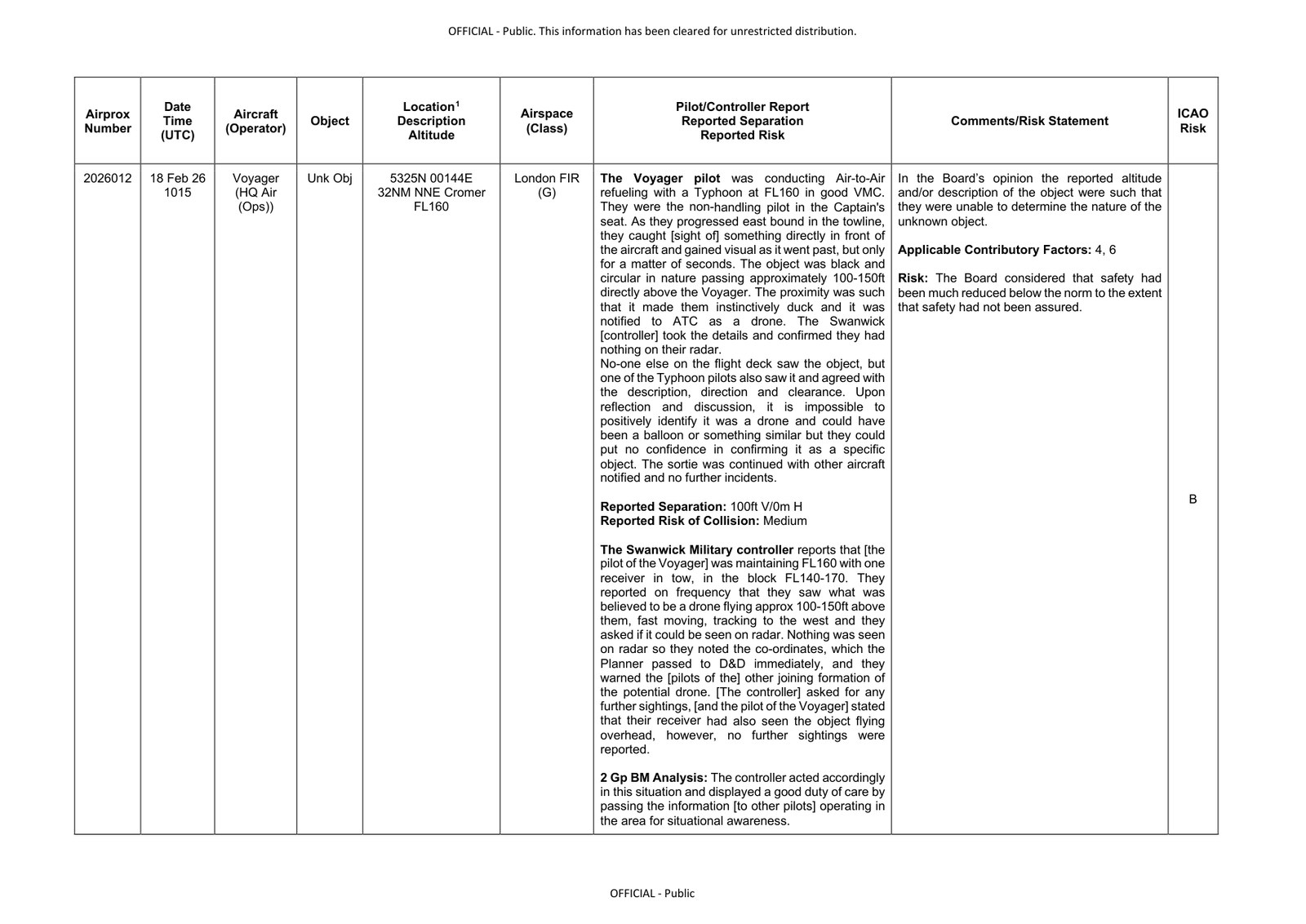
Airprox 2026012, 18 February 2026, 1015 UTC. A Voyager tanker of HQ Air (Ops) was conducting air-to-air refuelling with a Typhoon at FL160 in good visual conditions, 32NM north-northeast of Cromer, in Class G airspace of the London Flight Information Region. The reporting pilot was the non-handling pilot in the captain's seat.
In their own words, recorded on the Board's summary sheet: as they progressed eastbound in the towline, they caught sight of something directly in front of the aircraft and gained visual as it went past, but only for a matter of seconds. The object was black and circular in nature, passing approximately 100 to 150ft directly above the Voyager. The proximity was such that it made them instinctively duck. It was notified to air traffic control as a drone. The Swanwick controller took the details and confirmed they had nothing on radar.
No one else on the flight deck saw the object. One of the Typhoon pilots did, and agreed with the description, the direction and the clearance. Reported separation was 100ft vertically and 0m horizontally, and the crew rated the risk of collision Medium.
Airprox 2026014, 23 February 2026, 1521 UTC. A Typhoon of HQ Air (Ops) was operating with another aircraft in Danger Area 323A/B over the North Sea, at 5446N 00020E. Straight and level at 300kt and 12,000ft while setting up for the next event, the pilot observed a circular black object, which they compared in size to a car tyre, pass directly above them. They assessed it as approximately 300ft above, tracking east in straight and level flight. They separated away from the location and reported an Airprox to Swanwick East a few minutes later. Reported separation was 300ft vertically, and the pilot rated the risk of collision High.
What is the official explanation?
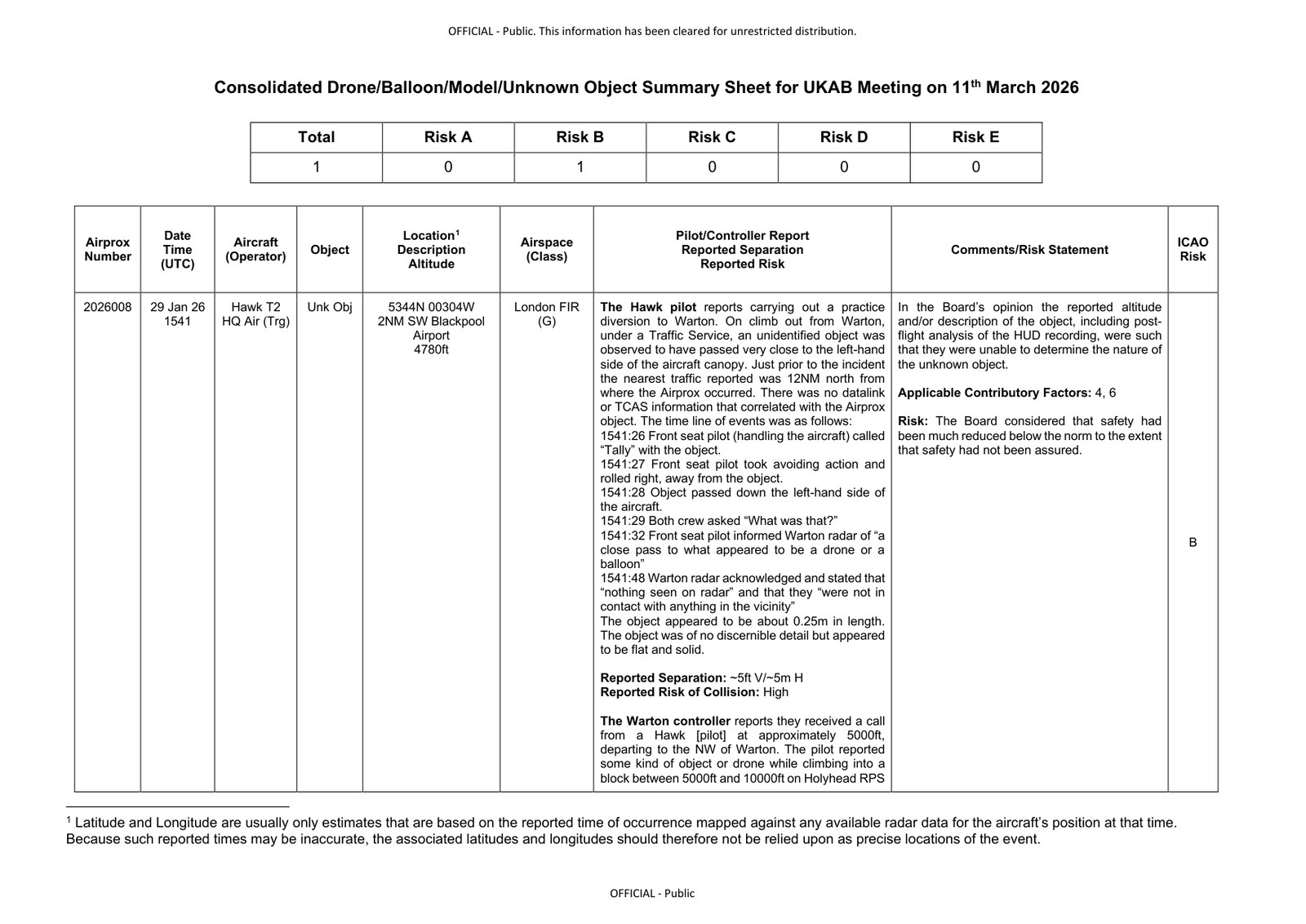
Both events were reviewed by the UK Airprox Board at its meeting on 22 April 2026 and published in the Consolidated Drone/Balloon/Model/Unknown Object Summary Sheet for that meeting. Both carry Unk Obj in the Object column.
On Airprox 2026012 the Board found, verbatim: "In the Board's opinion the reported altitude and/or description of the object were such that they were unable to determine the nature of the unknown object." Contributory factors 4 and 6 were applied. Factor 6 is near collision with an unpiloted airborne object, unknown object or balloon; the separate drone factor 7 was not applied, and none of the three conditional drone-operator factors were applied. Risk was assessed as ICAO category B: "The Board considered that safety had been much reduced below the norm to the extent that safety had not been assured."
On Airprox 2026014 the Board returned the identical finding of being unable to determine the nature of the unknown object. Contributory factors 4 and 5 were applied. Risk was assessed as ICAO category C: "The Board considered that although safety had been reduced, there had been no risk of collision."
The distinction the Board was drawing is visible on the same sheet. Of the four entries discussed at the 22 April meeting, two were found to be "sufficient to indicate that it could have been a drone" and were coded Drone, including a Risk A encounter with a yellow and black object on short final at Heathrow. The two RAF North Sea encounters were not, and were coded Unk Obj.
A correction to the secondary coverage is warranted here. Press reporting of the Voyager encounter has attributed to the Board the risk statement that "providence had played a major part in the incident and/or a definite risk of collision had existed." That sentence does appear on the same summary sheet, but it belongs to Airprox 2026011, the Heathrow drone encounter, which the Board rated Risk A. The Board's actual risk statement for the Voyager encounter is the Risk B wording quoted above.
No agency has publicly identified either object.
What did the witnesses think it was?
The evidential weight of 18 February rests on the corroboration, and it is unusually clean.
The reporting pilot's account is not a confident identification. It is the opposite. The summary sheet records that upon reflection and discussion, it is impossible to positively identify it was a drone, and it could have been a balloon or something similar, but they could put no confidence in confirming it as a specific object. A crew reaching for a mundane label and then declining to commit to it is a more reliable witness than one that does not.
The Typhoon pilot's account is independent in the way that matters. They were flying a separate aircraft in the same formation, and they agreed with the description, the direction and the clearance. Two crews in two airframes, agreeing on a black circular object passing 100 to 150ft above the tanker, is corroboration by independence rather than by conversation.
The Swanwick Military controller filed a separate statement. They report that the Voyager was maintaining FL160 with one receiver in tow, in the block FL140 to FL170, and reported on frequency seeing what was believed to be a drone flying approximately 100 to 150ft above them, fast moving, tracking to the west, asking whether it could be seen on radar. Nothing was seen on radar. The controller noted the coordinates, the Planner passed them to Distress and Diversion immediately, and the pilots of the other joining formation were warned. The controller asked for any further sightings and the Voyager pilot stated that their receiver had also seen the object flying overhead. No further sightings were reported. The Board's 2 Gp BM Analysis records that the controller acted accordingly and displayed a good duty of care.
On 23 February the Typhoon pilot reported the object to Swanwick East a few minutes after the event. The controller's statement records the details passed as a drone 200ft above the Typhoon at 12,500ft, tracking east, in the vicinity of D323A around 1520Z, and notes the pilot's own report gave 300ft and 12,000ft. That small discrepancy between the relayed and the filed figures is in the record and is left in it here.
Is the Black Circular Objects Over the North Sea: Two RAF Airprox in Six Days real? The two-pass assessment
Pass one, how could this be mundane. A weather balloon or a stray high-altitude balloon is the strongest prosaic candidate for both events, and both crews said so themselves. FL160 and 12,000ft over the North Sea are well above normal recreational drone operation and a long way offshore, which counts heavily against a hobby multirotor in both cases. Balloons, by contrast, routinely reach those altitudes and drift, and a black circular object the size of a car tyre is a reasonable description of a partially deflated or dark-skinned balloon seen for a second or two. That neither object produced a radar return is consistent with a small, largely non-metallic object, and it is consistent with a balloon.
There are two honest weaknesses. On 18 February the objects were seen for a matter of seconds by crews concentrating on air-to-air refuelling, one of the more demanding things a crew does. And a reported track can be unreliable: the controller's note that the object was "fast moving, tracking to the west" sits alongside the pilot's description of it passing directly overhead, and relative motion at closing speeds is easy to misjudge.
Against the balloon reading, three things are on the file. The Board had both reports and declined, twice, to determine what the objects were, when it had a ready made drone finding available and used that finding on two other entries at the same meeting. On 18 February the Board coded factor 6, near collision with an unpiloted airborne object, which is the code that covers a balloon, so the Board plainly did not rule a balloon out; what it ruled out was saying. And on 23 February the pilot described the object as in straight and level flight tracking east, which is a description of controlled or at least stable motion rather than drift, though a single glance is thin evidence for that distinction.
The cluster itself is worth stating plainly and then not overselling. Two RAF crews, six days apart, roughly 90NM apart in North Sea airspace, both reporting a black circular object passing a few hundred feet directly overhead, both unresolved. That is a pattern worth recording. It is not, by itself, evidence of anything beyond the fact that unidentified objects are being encountered at altitude over the North Sea often enough to generate two formal filings in one month. Two events is a small number, and the North Sea carries a great deal of balloon traffic.
Pass two, if these were not balloons, what were they. The file does not carry the case that far and nothing here should be read as claiming it does. What the file does carry is narrower and still substantial: on 18 February two aircrew in two separate aircraft independently described the same object at the same place and moment, nothing appeared on radar, a controller escalated it to Distress and Diversion in real time, and a national air safety investigator examined the result and stated that it could not determine what the object was.
Tier: Unknown, for both filings. No official identification exists, and the investigating body explicitly declined to make one.
Sources
- www.airproxboard.org.uk/media/3ikpobnb/april-drone-summary-sheet.pdf
- www.airproxboard.org.uk/reports-and-analysis/monthly-airprox-reviews/airprox-reports-2026/april/
- www.ibtimes.co.uk/flying-saucer-zooms-within-feet-airbus-passenger-jet-coming-land-london-gatwick-1811891
- www.airproxboard.org.uk/reports-and-analysis/individual-airprox-reports/2026/
More cases from this region: UFO sightings in United Kingdom