Five Feet From a Hawk Canopy: UK Airprox 2026008 Over Lancashire
A Royal Air Force Hawk crew took avoiding action against a flat, solid object roughly a quarter of a metre long that passed within about five feet of their canopy. Radar held nothing, no drone flights were notified, and the UK Airprox Board declined to call it a drone.
What did witnesses see at 2NM southwest of Blackpool Airport?
At 1541 UTC on 29 January 2026 a Hawk T2 of HQ Air (Training) was climbing out of BAE Systems Warton, in Class G airspace of the London Flight Information Region, having flown a practice diversion. The aircraft was under a Traffic Service and passing roughly 4,780ft about 2NM southwest of Blackpool Airport, over the Lancashire coast.
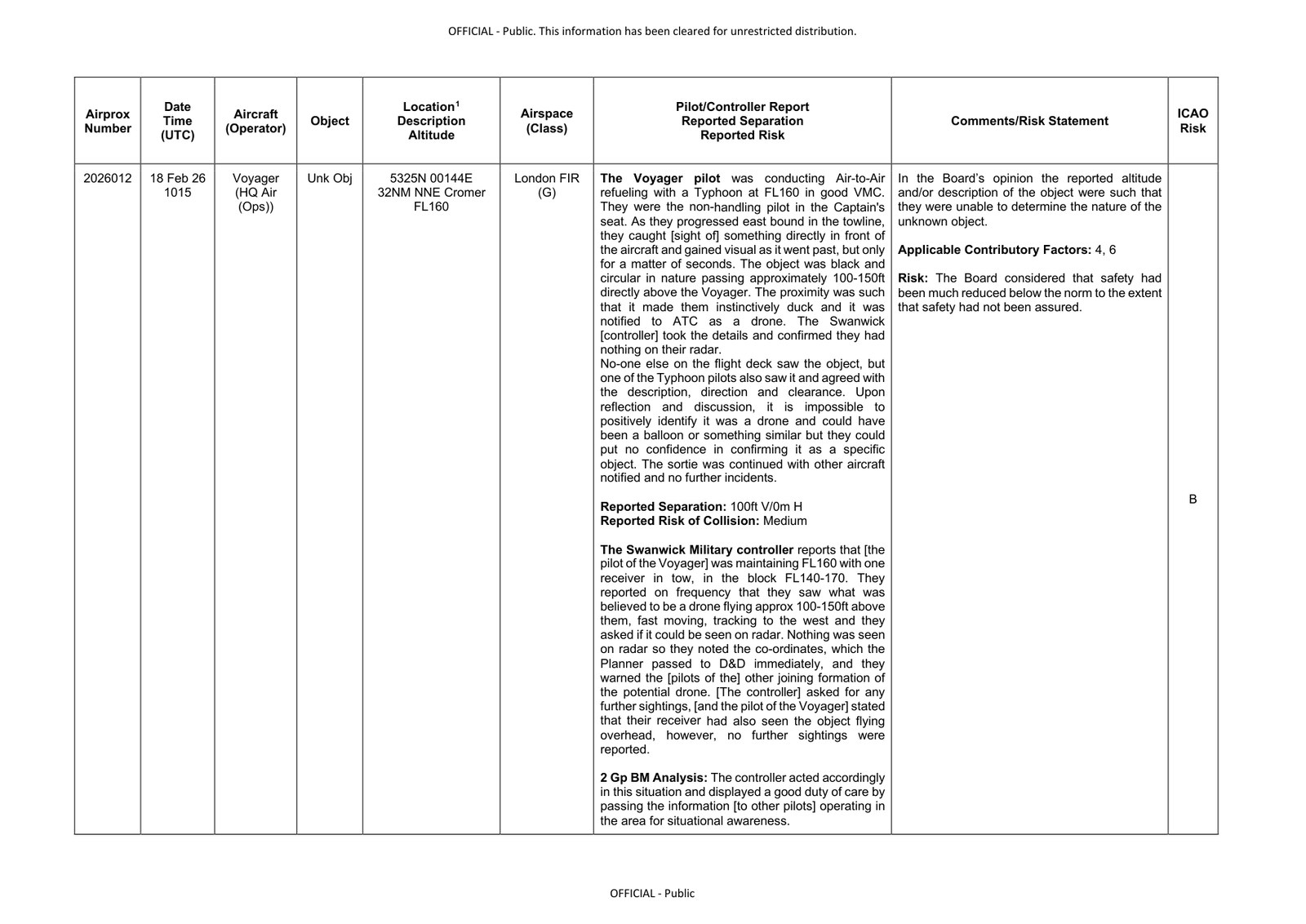
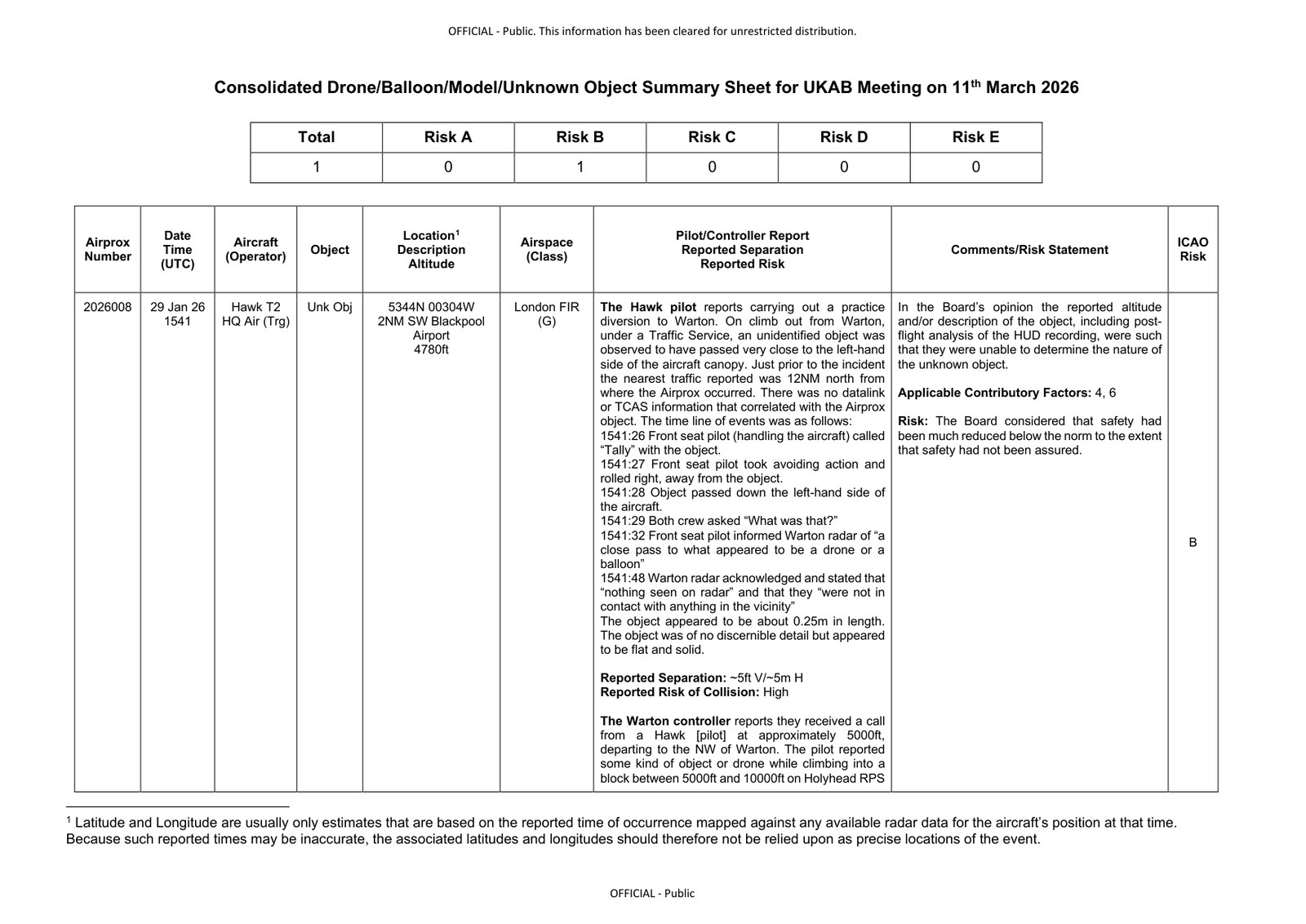
The UK Airprox Board's own consolidated summary sheet records the encounter to the second, taken from the crew's report:
1541:26, the front-seat pilot, who was handling the aircraft, called "Tally" with the object. 1541:27, the front-seat pilot took avoiding action and rolled right, away from it. 1541:28, the object passed down the left-hand side of the aircraft. 1541:29, both crew asked "What was that?" 1541:32, the front-seat pilot informed Warton radar of "a close pass to what appeared to be a drone or a balloon."
Warton radar answered at 1541:48 that "nothing seen on radar" and that they "were not in contact with anything in the vicinity."
The crew described the object as approximately 0.25m in length, of no discernible detail, but appearing flat and solid. Reported separation was about 5ft vertically and about 5m horizontally. The crew rated the risk of collision High.
Just before the encounter the nearest traffic reported to them had been 12NM north of where the Airprox occurred. There was no datalink or TCAS information that correlated with the object.
What is the official explanation?
The UK Airprox Board reviewed the event at its meeting on 11 March 2026 and published it as Airprox 2026008 in the Consolidated Drone/Balloon/Model/Unknown Object Summary Sheet for that meeting.
The Board's finding, verbatim: "In the Board's opinion the reported altitude and/or description of the object, including post-flight analysis of the HUD recording, were such that they were unable to determine the nature of the unknown object."
That wording matters, because the Board has a second standard finding available to it, that the reported altitude and description "were sufficient to indicate that it could have been a drone." It used that alternative on other entries in the same series. Here it did not. The Object column of the sheet reads Unk Obj, not Drone.
The Board applied contributory factors 4 and 6. Factor 6 is defined on the Board's own factor table as "an event involving a near collision by an aircraft with an unpiloted airborne object (unknown object or balloon)." The separate factor 7, near collision with a remotely piloted air vehicle, drone or model aircraft, was not applied. The Board also did not apply factors 1, 2 or 3, each of which is worded conditionally as "if the reported object was a drone."
Risk was assessed as ICAO category B: "The Board considered that safety had been much reduced below the norm to the extent that safety had not been assured." This was the only drone, balloon, model or unknown object Airprox discussed at the 11 March meeting.
The sheet also carries a UKAB Note: "There were no UAS NOTAMs for the area, time and date of the Airprox."
There is no separate official narrative beyond the Board's file. No agency has publicly identified the object.
What did the witnesses think it was?
The account on the record comes from two sources who reported independently.
The Hawk crew, whose report supplies the second-by-second timeline above, initially reached for a prosaic explanation themselves. The front-seat pilot's transmission to Warton radar within six seconds of the pass described "a close pass to what appeared to be a drone or a balloon." That is the language of a crew describing something small and unpowered, not something exotic, and the case is stronger for the fact that the aircrew reached for it first.
The Warton controller filed a separate statement. They report receiving a call from a Hawk pilot at approximately 5000ft, departing to the northwest of Warton, reporting "some kind of object or drone" while climbing into a block between 5000ft and 10000ft on Holyhead RPS 984hPa. The pilot avoided the object and continued with the sortie.
The crew's own description is the part that resists the drone reading. A quarter-metre object with no discernible detail, flat and solid, is a poor match for the multirotor airframes that produce most UK drone Airprox reports, which crews typically describe with rotor arms, colour, or lights.
Is the Five Feet From a Hawk Canopy: UK Airprox 2026008 Over Lancashire real? The two-pass assessment
Pass one, how could this be mundane. A small drone remains the obvious candidate and the crew themselves named it first. Lancashire is dense with recreational drone activity and the encounter happened at a time of day when flying is common. A balloon is the other candidate, and the crew named that too. At roughly 0.25m, flat and solid, a party balloon or a piece of wind-borne debris is entirely plausible, and the absence of a radar return argues for something small and non-metallic rather than something remarkable. It is also worth being blunt that a 0.25m object glimpsed for a fraction of a second from an aircraft doing several hundred knots is a very short look, and the crew were candid that they saw no detail.
Against that, four things sit in the file. There were no UAS NOTAMs for the area, time and date. Warton radar had nothing, and was not in contact with anything in the vicinity, with the nearest known traffic 12NM north. There was no datalink or TCAS correlation. And the Board had the HUD recording, examined it after the flight, and still declined to call it a drone.
That last point is what distinguishes this from an ordinary drone report. The UK Airprox Board is a body of professional investigators with the full file in front of them, including gun camera style footage, and its function is to classify. It has a ready made finding for probable drones and it uses that finding often. On this occasion it wrote that it was unable to determine the nature of the unknown object, and coded the outcome as a near collision with an unpiloted airborne object rather than with a drone. It declined to apply any of the three drone-operator conduct factors.
Pass two, if this was not a drone or a balloon, what is it. The honest answer is that the file does not support going further. What it supports is the narrow, verifiable claim: a military crew took avoiding action against a solid object at close quarters, a national air safety investigator examined the recorded evidence, and that investigator could not say what the object was.
Tier: Unknown. There is no official identification of the object, and the body best placed to make one explicitly declined to.
Sources
- www.airproxboard.org.uk/media/y45lk4su/march-2026-drone-summary-sheet.pdf
- www.airproxboard.org.uk/reports-and-analysis/monthly-airprox-reviews/airprox-reports-2026/march/
- www.airproxboard.org.uk/reports-and-analysis/individual-airprox-reports/2026/
More cases from this region: UFO sightings in United Kingdom