The Truk Atoll Foo Fighters: Two Objects Paced a B-24 from Truk to Guam, 2 May 1945
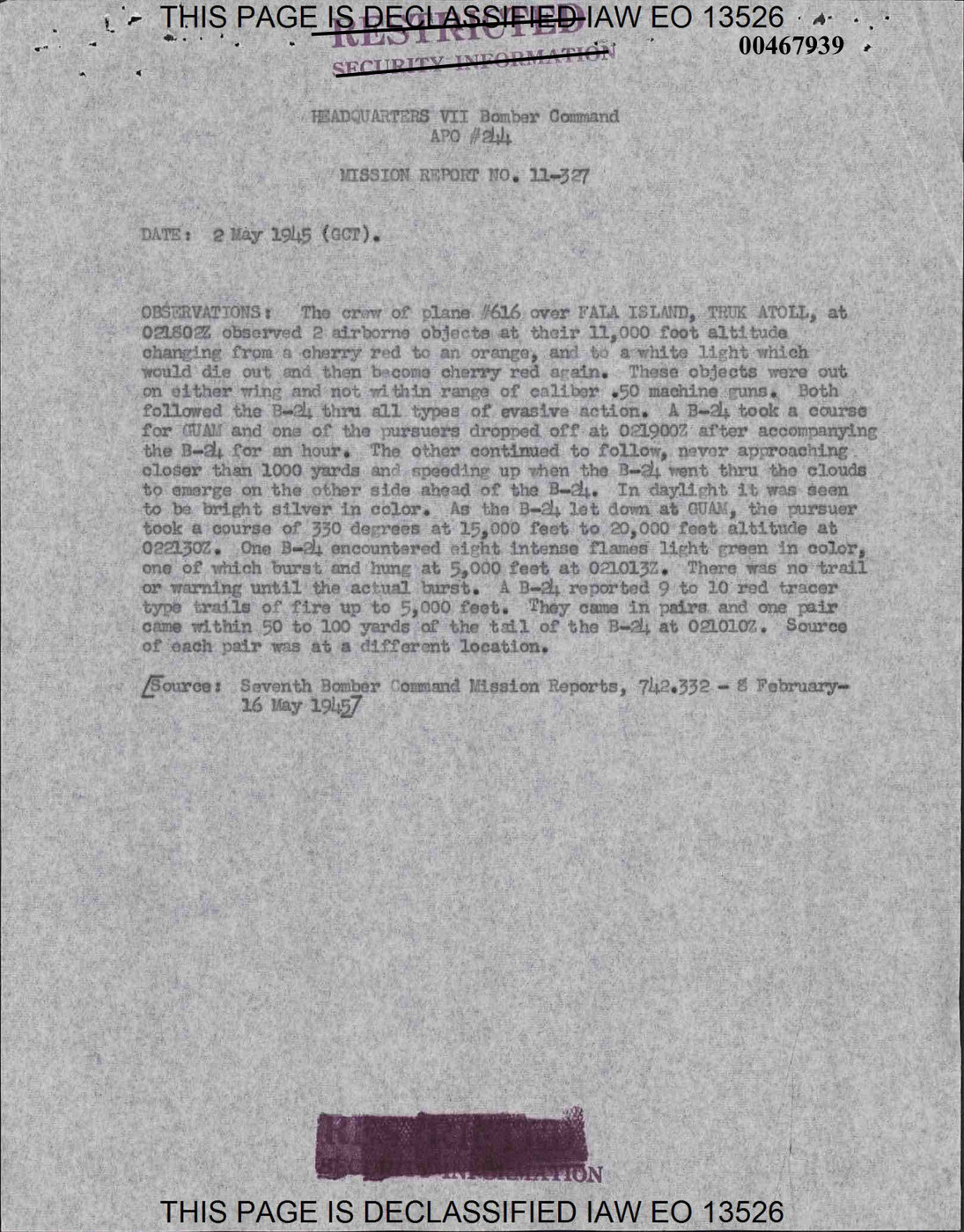
A newly published Air Force record carries the primary document behind a paragraph of a widely cited contemporary magazine account of the wartime foo fighters. Headquarters VII Bomber Command Mission Report 11-327 describes two objects holding station off both wings of a lone B-24 over Truk Atoll at eleven thousand feet, one breaking away after an hour and the other following the bomber 634 miles to Guam, resolving in daylight as a bright silver body before climbing away.
What did witnesses see at Fala Island?
Two luminous objects paced an American bomber for more than three hours on 2 May 1945. The primary record of what they did is a wartime Air Force mission report that the National Archives published in August 2026.
The night belonged to the Seventh Air Force. Its B-24 Liberators flew from Guam against the bypassed Japanese garrison at Truk Atoll in the Caroline Islands, a target the Americans had cut off rather than invaded and then kept under continuous attack. The United States Army Air Forces combat chronology for that date records twelve B-24s from Guam hitting the airfield on Param Island inside Truk lagoon, and, during the night of 2 and 3 May, nine more B-24s flying individual harassment bombings against Param, Moen and Tol. Individual is the operative word. These were single aircraft, alone over the atoll, which is why the account that follows describes one bomber and not a formation.
One of those aircraft was plane number 616. The primary record of what its crew saw is Headquarters VII Bomber Command, APO 244, Mission Report No. 11-327, dated 2 May 1945 in Greenwich Civil Time. Its observations paragraph opens: "The crew of plane #616 over FALA ISLAND, TRUK ATOLL, at 021802Z observed 2 airborne objects at their 11,000 foot altitude changing from a cherry red to an orange, and to a white light which would die out and then become cherry red again. These objects were out on either wing and not within range of caliber .50 machine guns. Both followed the B-24 thru all types of evasive action."
What happened next is the part that makes the report unusual. "A B-24 took a course for GUAM and one of the pursuers dropped off at 021900Z after accompanying the B-24 for an hour. The other continued to follow, never approaching closer than 1000 yards and speeding up when the B-24 went thru the clouds to emerge on the other side ahead of the B-24. In daylight it was seen to be bright silver in color. As the B-24 let down at GUAM, the pursuer took a course of 350 degrees at 15,000 feet to 20,000 feet altitude at 022130Z."
Put the clock against the sun and the account becomes measurable rather than merely strange. The report times everything in Greenwich Civil Time, so the comparison can be made without assuming anything about which local zone the crews were keeping. The United States Naval Observatory puts sunrise at Truk on the morning of 3 May at 05:38 in the zone ten hours ahead of Greenwich, which is 19:38 Greenwich, and the start of civil twilight at 19:16 Greenwich. First contact at 021802Z therefore falls an hour and thirty six minutes before sunrise, in full darkness, and the object that turned back at 021900Z did so sixteen minutes before the sky had even begun to lighten. Sunrise at Guam was 05:59 local, or 19:59 Greenwich, so the final observation at 022130Z falls an hour and a half after the sun came up. That is broad daylight, which is exactly when the report says the object "was seen to be bright silver in color." The two ends of the encounter are internally consistent, and so is the geography: Truk to Guam is 1,020 kilometres, or 634 statute miles, and the three hours and twenty eight minutes between the first and last timings works out to about 183 miles per hour, an ordinary cruise for a loaded Liberator going home.
The same report carries two other things that are often quoted alongside the pacing objects and should not be. "One B-24 encountered eight intense flames light green in color, one of which burst and hung at 5,000 feet at 021013Z. There was no trail or warning until the actual burst. A B-24 reported 9 to 10 red tracer type trails of fire up to 5,000 feet. They came in pairs and one pair came within 50 to 100 yards of the tail of the B-24 at 021010Z. Source of each pair was at a different location." Those events happened at about eight in the evening local, over the target, roughly eight hours before the pacing objects appeared, and they are described as rising from separate ground positions. They read as ordinary defensive fire from an alerted garrison, and treating them as part of the same phenomenon inflates the case.
More footage and images of this sighting
What is the official explanation?
There is no official explanation of this event, and that is not an oversight in the record. The mission report states the observation and stops. It carries no evaluation block, no candidate explanation and no follow up tasking, which is what a wartime unit intelligence summary normally looks like when the reporting officer has nothing to add.
The document's afterlife is better documented than the sighting. The observations were filed into Seventh Bomber Command Mission Reports, 742.332, covering 8 February to 16 May 1945, and the item's own source note says so. Nearly eight years later somebody at Air University pulled that page out and made a folder of it.
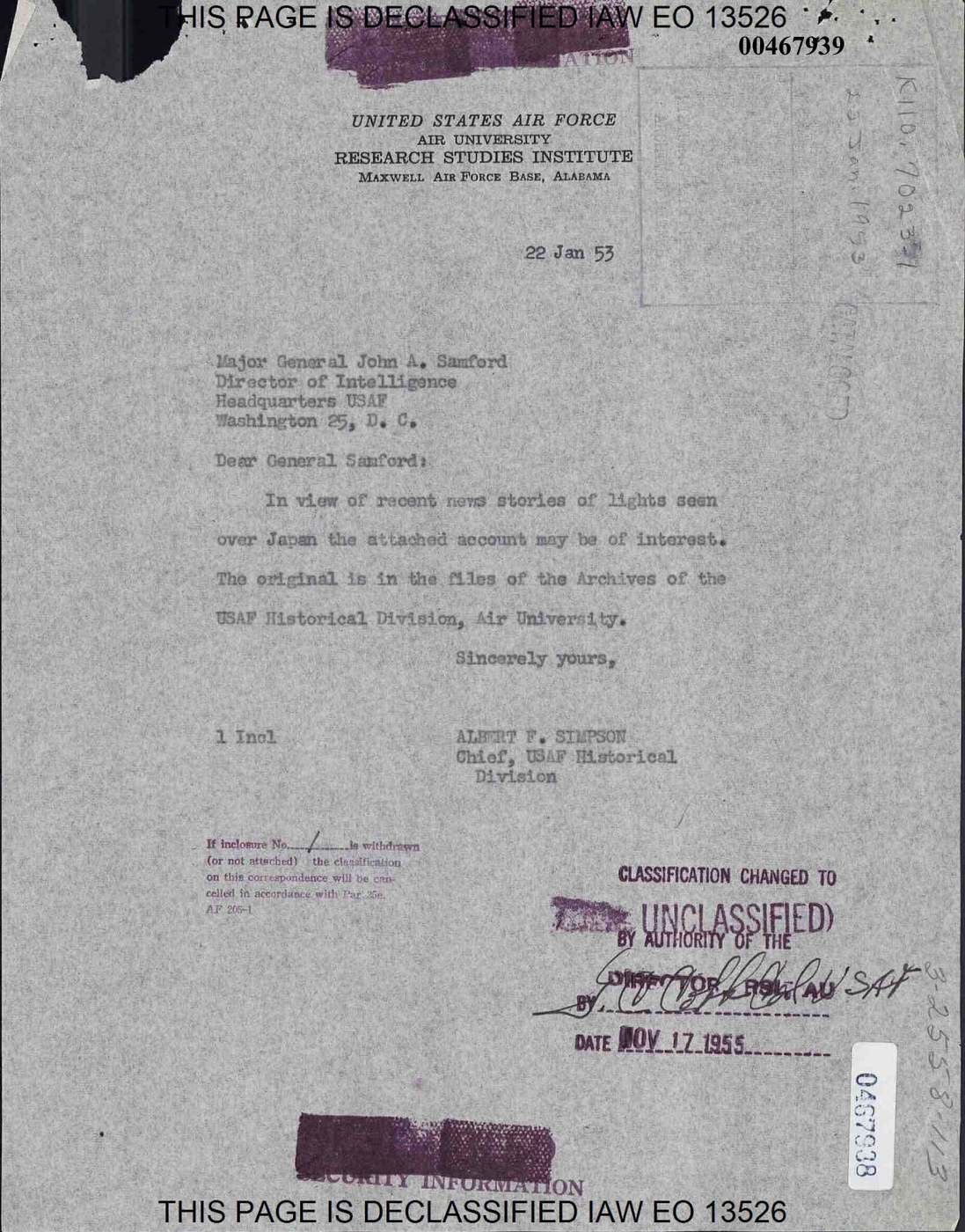
That folder is the file now in the National Archives, and its cover letter is the reason it exists. On 22 January 1953, on United States Air Force, Air University, Research Studies Institute letterhead at Maxwell Air Force Base, Alabama, Albert F. Simpson, Chief of the USAF Historical Division, wrote to Major General John A. Samford, Director of Intelligence, Headquarters USAF, Washington 25, D.C. The whole letter runs four lines: "In view of recent news stories of lights seen over Japan the attached account may be of interest. The original is in the files of the Archives of the USAF Historical Division, Air University." One inclosure. Simpson was the Air Force's first historian and held the post from 1946 until 1969; Samford was the officer who had fronted the Pentagon press conference on the Washington flap the previous July.
The news stories Simpson meant are datable to the week he wrote. On 21 January 1953 the Air Force disclosed that "rotating clusters of red, white and green lights" had been seen over northern Japan by American airmen on 29 December 1952, and that on 9 January two F-94 interceptors had tracked such a cluster on radar, with the radar locking on and steering the jets toward it. Wire coverage of both the December cluster reports and, a few days later, of Lt. David C. Brigham's close range disc sighting near the Siberian border ran heavily through late January 1953. Simpson's letter is dated the day after the first of those disclosures. So the transmittal is a historian noticing that the Air Force had seen this shape of report before, in the same theatre, eight years earlier, and quietly saying so to the man running Air Force intelligence.
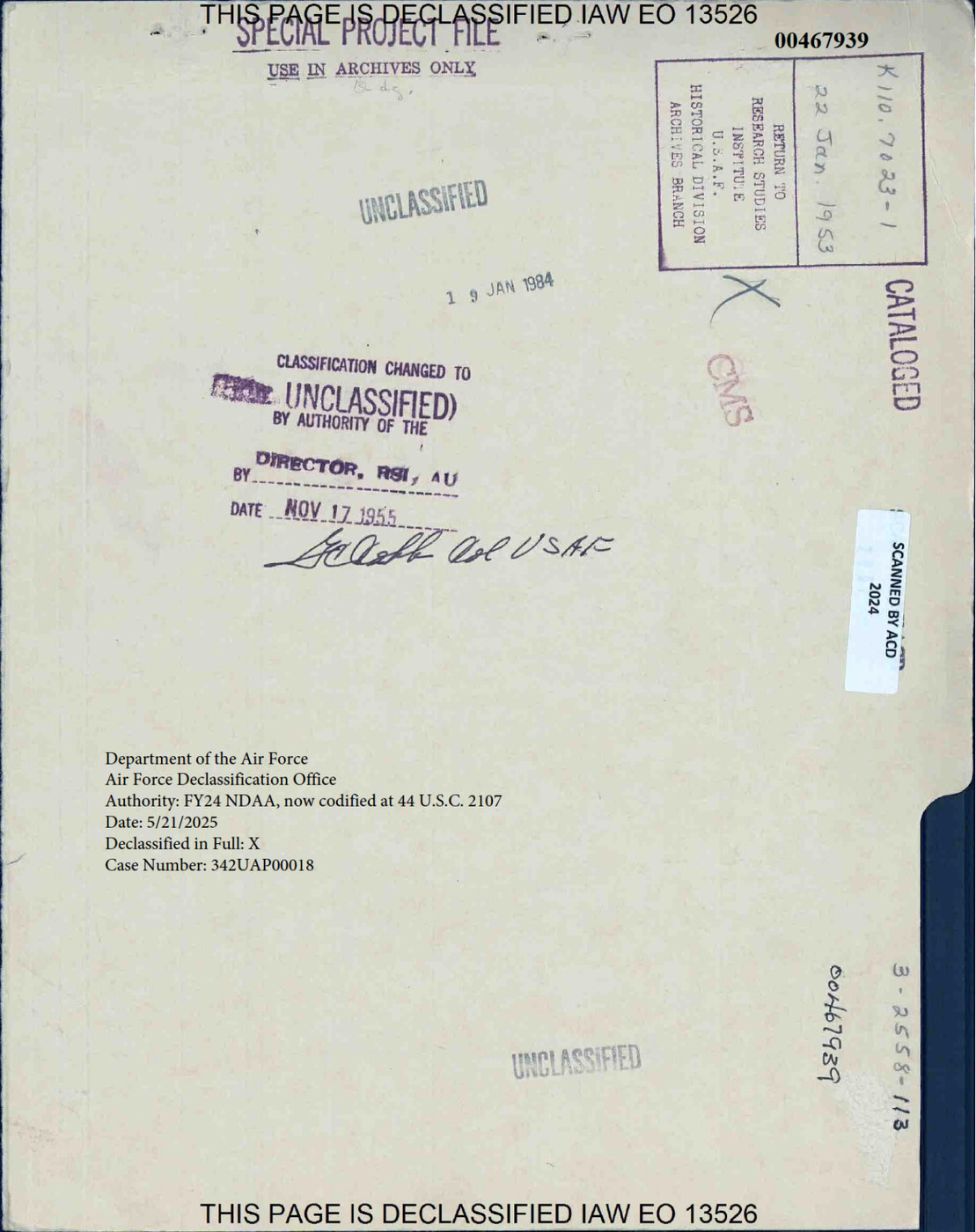
The declassification chain is stamped across the pages. The folder is marked RESTRICTED and SECURITY INFORMATION, both struck through, with "CLASSIFICATION CHANGED TO UNCLASSIFIED BY AUTHORITY OF THE DIRECTOR, RSI, AU" and the date NOV 17 1955. A later archival stamp reads 19 JAN 1984. The modern release block on the cover reads: Department of the Air Force, Air Force Declassification Office, Authority: FY24 NDAA, now codified at 44 U.S.C. 2107, Date: 5/21/2025, Declassified in Full: X, Case Number: 342UAP00018. The file reached the public catalog of the National Archives in August 2026 as part of the thirty item Air Force series in Record Group 615, and the folder's own back cover carries a handwritten tab in pencil reading "UFO lights."
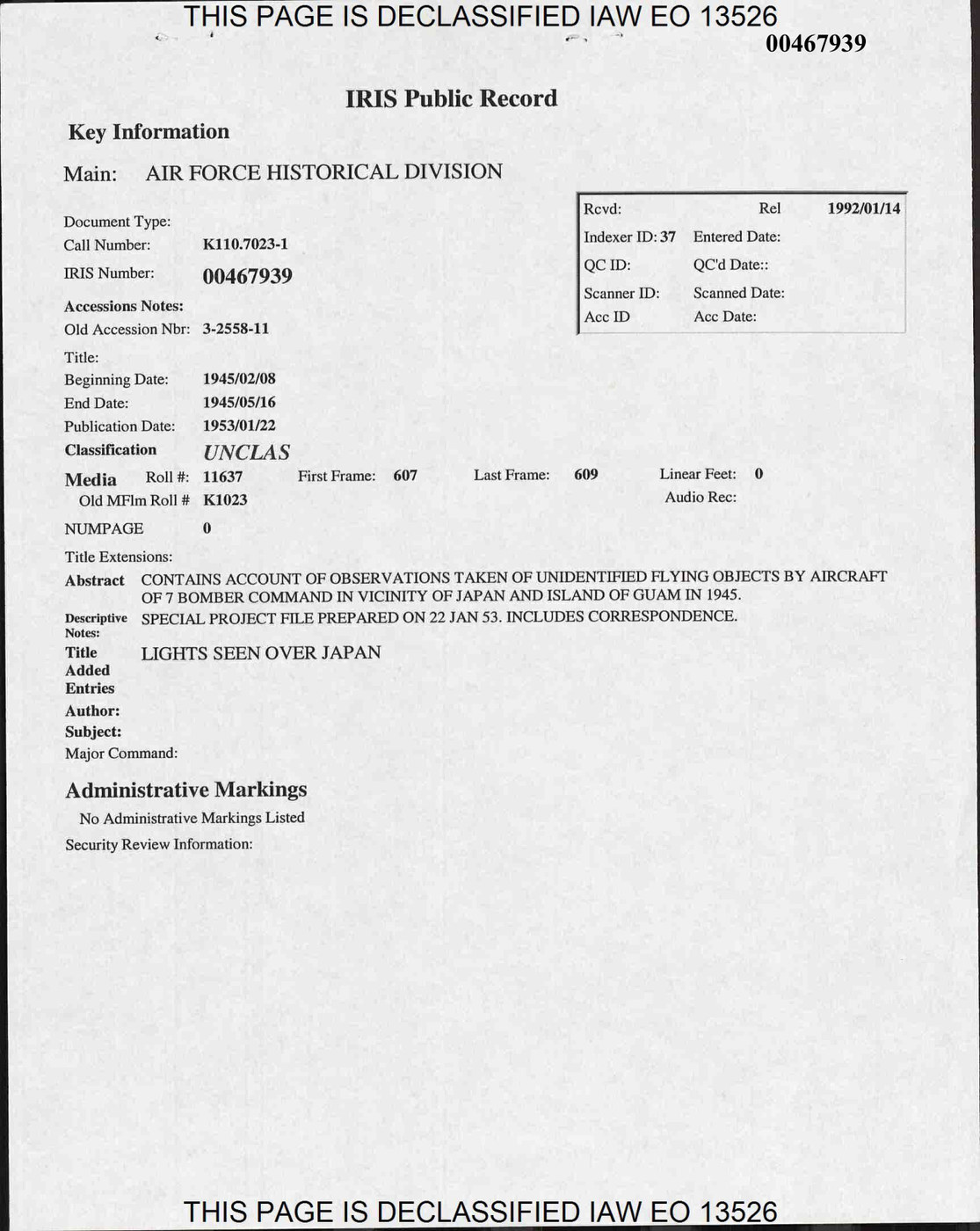
One warning about the catalogue entry, because it will mislead anyone searching. The record is titled "Lights Seen Over Japan, January, 1953" and its file is named accordingly. The sighting is not in January 1953 and it is not over Japan. January 1953 is when the folder was assembled, and the record's own IRIS abstract states the content plainly: "CONTAINS ACCOUNT OF OBSERVATIONS TAKEN OF UNIDENTIFIED FLYING OBJECTS BY AIRCRAFT OF 7 BOMBER COMMAND IN VICINITY OF JAPAN AND ISLAND OF GUAM IN 1945," with a beginning date of 8 February 1945 and an end date of 16 May 1945. Even that is loose, since Truk lies about 2,000 kilometres southeast of Japan and is not in its vicinity in any ordinary sense. The parent title names the folder, not the event inside it.
What did the witnesses think it was?
No witness is named. The report describes "the crew of plane #616" and nothing further, which is normal for a VII Bomber Command mission summary of this kind, where the reporting unit rather than the individual is the unit of account. The crew of a Liberator on a night harassment run numbered around ten men, so this is a multiple witness observation without a single identified observer, and the archive should say that rather than manufacture a name.
The event did reach the public, and quickly. In December 1945, seven months after the flight and four months after the Japanese surrender, Jo Chamberlin published "The Foo Fighter Mystery" in The American Legion Magazine, a widely cited contemporary account of the wartime balls of fire. Most of the article is about B-29 crews over Japan. One paragraph is about this flight: "Far to the south, a B-24 Liberator was at 11,000 feet over Truk lagoon, when two red lights rose rapidly from below, and followed the B-24. After an hour, one light turned back. The other kept on, sometimes behind, sometimes alongside, sometimes ahead about 1,000 yards, until daybreak when it climbed to 15,000 feet and stayed in the sun, like a Jap fighter seeking game, but never came down. During the flight, the light changed from red to orange, then white, and back to orange, and appeared to be the size of a basketball. No wing or fuselage was observed. The B-24 radioed island radar stations to see if there were any enemy planes in the sky. The answer was: 'None.'"
So the case has been in print for eighty years. What was missing was the document underneath it, and comparing the two is worth doing carefully, because they do not match at every point.
Chamberlin has three substantial details the mission report does not contain: that the objects rose rapidly from below, that the surviving object appeared to be the size of a basketball with no wing or fuselage visible, and that the B-24 queried island radar stations and was told there were no enemy aircraft airborne. The radar query is the most consequential of the three, since a negative radar check is close to the strongest corroboration a night air encounter can have, and it is not in the report we can now read. Either Chamberlin worked from a fuller version of the same reporting, or he drew those lines from the wider body of foo fighter material he was collecting and attached them here. Both are possible and neither can be settled from this file alone.
The mission report likewise has details Chamberlin omits: the exact timings, the eleven thousand foot altitude match, the objects sitting out on either wing beyond effective range of the aircraft's fifty calibre guns, the evasive action, the thousand yard standoff, the acceleration through cloud to emerge ahead, the silver colour in daylight, and the departure heading of 350 degrees. Chamberlin also attaches the passing through cloud and emerging in the same relative position to a B-29 over Japan rather than to this B-24, which the mission report gives to the Truk aircraft. Where the two disagree, the mission report is the earlier and more direct record and should be preferred.
Is the Truk Atoll Foo Fighters: Two Objects Paced a B-24 from Truk to Guam, 2 May 1945 real? The two-pass assessment
Pass one, how could this be mundane. The candidates are real and several of them are strong, so they are worth taking one at a time with numbers rather than dismissed.
The brightest object in that sky was Venus, and its geometry is uncomfortably good. Run for Truk at the moment of first contact, 021802Z, the Jet Propulsion Laboratory Horizons ephemeris puts Venus at azimuth 80 degrees and elevation minus 1.6 degrees at magnitude minus 4.6, climbing to plus 5.7 degrees by 1830Z and plus 13.1 degrees by 1900Z. From 11,000 feet the horizon is depressed by roughly 1.8 degrees, so Venus was rising into view in the east at the exact minute the crew reported the objects, at a brightness nothing else in the sky approached. An object a few degrees above the horizon is also in the geometry that produces violent colour scintillation, which is a direct match for a light that changed "from a cherry red to an orange, and to a white light which would die out and then become cherry red again." Venus stays visible into daylight as a small silver white point, matching "bright silver in color," and it cannot be shaken by evasive action, matching a pursuer that would not leave. This is the most serious prosaic explanation on the table and no honest reading of the case can skip it.
Two things sit against it. The report describes the object crossing through cloud and emerging ahead of the aircraft, which a body 41 million kilometres away cannot do. And there were two objects, of which one departed after an hour while the other stayed; Venus can account for the second but not for the first, and a crew misled by Venus should not have watched its twin turn back.
The Moon was up and bright, at azimuth 179 degrees and elevation 59 degrees at 021802Z, a 72 per cent waning gibbous at magnitude minus 11.1. That is far too high in the sky to be described as sitting out on a wing at the aircraft's own altitude, so the Moon can be set aside as the object itself, though it means the crew were not working in a dark sky and had good natural illumination. Jupiter was below the horizon and setting and can be discarded.
Japanese aircraft deserve serious weight, and the file itself shows the Air Force thought so. The same folder that carries this mission report also contains a second Air University record on Japanese and Russian ramming techniques, including combat examples of ramming attacks by Japanese Army fighters against B-29s. Whoever assembled the folder was holding the two subjects side by side. A night fighter shadowing a lone bomber out of range, climbing away at first light, is a recognisable tactic, and Chamberlin's own phrasing, "like a Jap fighter seeking game," concedes the resemblance. What the aircraft reading does not explain is a light that changes colour through red, orange and white and extinguishes and returns, that keeps station through all types of evasive action while never closing, or that accelerates through cloud to reappear ahead. It also does not fit the operational picture well: Truk in May 1945 was a starved, bypassed garrison, and sending an interceptor 634 miles to Guam and back is not what a fuel constrained unit does.
The green flames and the paired tracer trails belong to a different explanation and probably a mundane one. They occurred over the target around 021010Z and 021013Z, some eight hours before the pacing objects, at 5,000 feet, and the report notes the source of each pair was at a different location. Anti aircraft fire and aerial phosphorus bursts from separate ground positions cover that comfortably. Keeping them separate from the pacing objects is the honest way to read the document.
Saint Elmo's fire and ball lightning are the other standing candidates for wartime balls of fire. Neither survives a three and a half hour duration, a station keeping distance judged at a thousand yards, or persistence into full daylight.
Pass two, if the observation is accurate, what is it. What is left after Venus, the Moon, an interceptor and the atmosphere have all had their turn is a specific set of behaviours: two objects at the bomber's exact altitude, positioned symmetrically off both wings, holding through deliberate evasive manoeuvres, one breaking off cleanly after an hour, the other maintaining a fixed standoff for three and a half hours across 634 miles of open ocean, accelerating past the aircraft during a cloud passage, resolving in daylight as a silver body rather than a light, and finally climbing away on a measured heading into a higher altitude band. That is not the profile of a celestial object or an atmospheric one, and if it was an aircraft it was one operating at a range and endurance the defenders at Truk did not have.
Tier is Unknown, because there is no official narrative to weigh. The Air Force filed this observation, kept it classified for a decade, unclassified it in 1955, pulled it out again in 1953 to hand to its own Director of Intelligence, and at no point wrote down what it thought the objects were. Eighty one years later the document says the same thing it said in 1945, which is what the crew saw and nothing about what it meant.
Sources
- catalog.archives.gov/id/659965402
- catalog.archives.gov/medialz/electronic-records/rg-615/656595571/00467939_Lights_Seen_Over_Japan.pdf
- project1947.com/articles/amlfoo.htm
- www.project1947.com/fig/1945a.htm
- www.project1947.com/fig/1953a.htm
- aircrewremembered.com/USAAFCombatOperations/May.45.html
More cases from this region: UFO sightings in Federated States of Micronesia