The Walesville Jet Crash: An F-94C, an Unidentified Target and Four Deaths in Oneida County, New York (2 July 1954)
For forty five years this was the case in which a flying saucer killed a family: an interceptor scrambled after a disc, a cockpit filled with impossible heat, a crew driven out, a pilotless jet falling on a crossroads. The Air Force accident report stayed classified until a researcher pried it loose, and it says the fire detector circuit failed for a reason nobody could establish. The disc was a partially deflated forty foot balloon that drifted over Utica that evening, hours after the crash.
What did witnesses see at The Walesville intersection?
A jet interceptor fell on a crossroads hamlet in upstate New York and killed four people on the ground. It had been diverted, minutes earlier, to chase an unidentified target it never managed to find.
That single sentence is why the Walesville crash of 2 July 1954 became one of the most cited aircraft cases in the UFO literature, and why it is worth rebuilding here from the documents rather than from the books. For four decades the case circulated as the clearest example of a flying saucer killing civilians: an interceptor scrambled after a disc, a cockpit filled with impossible heat as the pilot closed in, a crew driven out of their own aeroplane, and a pilotless jet falling on a family. The Air Force accident report that settles most of it stayed classified until a researcher pried it loose, and by the time it appeared the dramatic version had been in print for forty five years.
The aircraft was a Lockheed F-94C Starfire, serial 51-13559, of the 27th Fighter Interceptor Squadron at Griffiss Air Force Base in Rome, New York. It took off at 11:05 in the morning, Eastern Standard Time, on what the official summary calls an operational training mission. It was only a few miles out when the Griffiss control tower called the pilot to tell him he was being diverted to an active air defense mission, and gave him a vector of 60 degrees and an altitude of 10,000 feet to intercept an unidentified aircraft.
He could not find it. The controller then told him about a second unidentified aircraft in the area, and that one he did find and identify, by tail number, as an Air Force C-47 transport, tail number 6099. The official summary records that at this point there were no indications of any malfunction in the F-94C, as stated by both its own pilot and the pilot of the C-47.
The ground controller then turned him back toward the first unknown on a heading of 240 degrees. The Starfire was at 8,000 feet, flying above the tops of broken cloud. The unidentified aircraft was not above the cloud, so the pilot began to descend through it, and as he did so the summary records that it had become evident the unknown was simply going in to land at Griffiss.
It was during that descent that the aeroplane went wrong. The summary of circumstances filed with the accident report puts it plainly: during the descent there was intense heat in the cockpit and the engine plenum chamber fire warning light came on. The pilot shut the engine down and the light stayed lit. With a fire warning that would not clear and what the report calls a critical low altitude, the pilot ordered his radar observer out and followed him. Both men were recovered without injury.
The abandoned Starfire flew on. It travelled about four miles from the point of ejection, on a heading of 199 degrees, and struck the ground at the Walesville intersection at 11:27 in the morning, Eastern Standard Time, which the newspapers reported in daylight saving terms as about half past twelve. It hit a dwelling, then hit a car at the crossroads. The aeroplane was carrying forty eight high powered rockets. None of them exploded. The fuel did.
What is the official explanation?
The contemporary official account and the final official account are not the same account, and the gap between them is part of this case.
On the day itself a spokesman at Griffiss gave the wire services a short narrative that was printed across the country the following morning. As The Key West Citizen carried it on 3 July 1954, the two aircraft were ordered by radio to check on an unidentified plane that had entered the area guarded by the air defense operation; the pilots were satisfied the aircraft was friendly and were heading back to base when fire broke out in the cockpit of the pilot's aeroplane; both men stuck with the craft as long as they could, and then the pilot ordered his observer out and followed him over the side from about 7,000 feet. That version has an actual fire in it.
The accident investigation, completed on 17 August 1954, found there had been no fire at all. Its central finding survives in the summary statement quoted by Kevin Randle, who worked from the declassified document: investigation revealed the primary cause of the accident to be a malfunction of the aircraft fire detector circuit, the cause for that malfunction could not be determined, and the pilot's decision to abandon the aircraft was consistent with the emergency instructions contained in the F-94C Flight Handbook. A thorough examination of the aeroplane's air conditioning and pressurisation system found no evidence of smoke, fuel or oil, which a real fire would have produced.
The report also supplied a mundane and rather sad reconstruction of the heat. The pilot had flown this same aircraft earlier the same day and had found it necessary to adjust the cockpit temperature manually several times. The vents were set so that pressurised air was being directed into the cockpit, with the larger vents forward of the pilot's seat. Because the pilot acknowledged changing engine power settings and altitude during his attempted second interception, the report concluded that he had interpreted a normal, non automatically controlled temperature rise as an overheat condition, and that since there was no evidence of in flight fire, the warning indication was probably a malfunction of the fire warning circuit. A separate conclusion of the same report was that Air Force inspection requirements for the F-94C fire and overheat warning circuits were inadequate.
The Condon Report reviewed the case in 1968 and filed it in its optical and radar analysis chapter as case 19-B, Walesville to Westmoreland, New York, classified as Class II-B, primarily radar, returns mostly single sharp aircraft like blips. Its summary reproduces the Air Force account of the cockpit temperature, the fire warning light and the ejection, and then states flatly that there is no Blue Book file because no UFO was involved. Its conclusion has two lines: the first object was probably a balloon, and there was no UFO in the aircraft accident case.
That last claim needs a caveat the Condon Report does not give it. The Project Blue Book master index does carry an entry for Walesville, New York on 2 July 1954. Randle, who checked it, notes that the index lists the accident as information only and gives the witnesses as Stringfield and others, a reference to the civilian researcher Leonard Stringfield rather than to any military observer. So there is an index entry without an evaluation, which is a weaker thing than a case file but not the nothing that Condon implies.
What did the witnesses think it was?
The people who died were not connected to any of this, and the archive should name them.
Killed in a car at the crossroads were Stanley Phillips, aged 38, his wife Florence, aged 32, and their son Gary, aged 11, all of nearby Hecla. Killed in one of the houses was Mrs Doris Monroe, aged 28. Her daughter Betty Lou Monroe, aged one, was injured, apparently by flying debris, and was the survivor of that house. A neighbour named Orson Buck pulled the Monroe child clear and carried her to the Walesville general store, from where she was taken to a hospital in Utica. The crew both walked away: the pilot was Lieutenant William E. Atkins, aged 24, of Dutton, Virginia, and the radar observer was Lieutenant Henry F. Coudon, aged 26, of Perryville, Maryland.
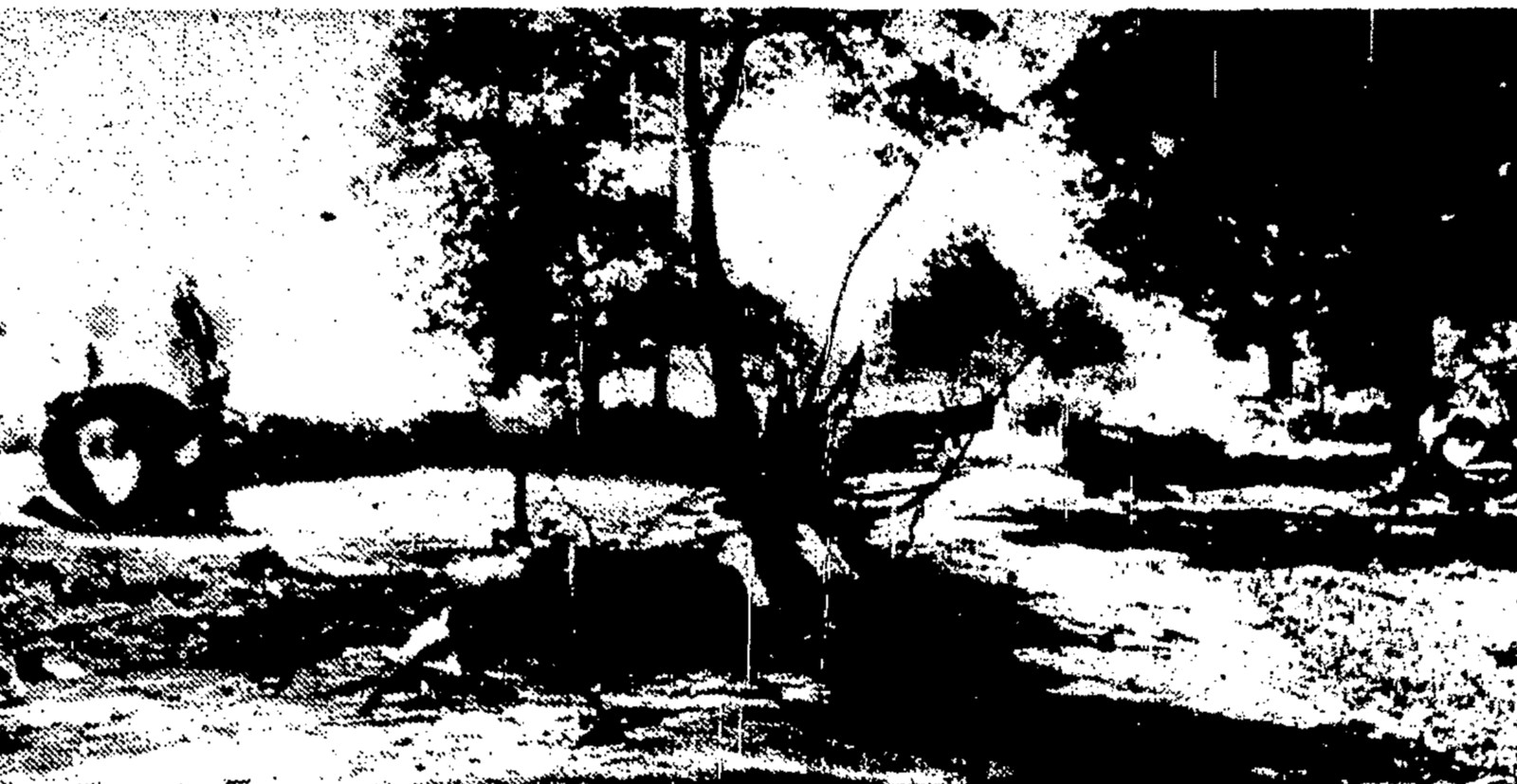
The Post-Standard of Syracuse, which sent its own staff photographer, recorded the scene the next morning. A 157 year old farmhouse belonging to Mrs Mary Peck burned after being struck by a piece of the aircraft. Debris was scattered over a 500 yard area. Looking east from the junction of the Halsey and Whitesboro roads, the paper's caption places the centre section of the aeroplane on the left, the engine lying on the highway, and the tail still smouldering on the right about 400 feet from the intersection where the falling aircraft had struck the passing car. Heat from the burning wreck was intense enough that the macadam of the road melted.
There was a second and entirely separate event in the same district on the same day, and confusing the two is the single largest source of error in this case. That evening, hours after the crash, something silvery drifted over the Utica area and set off a public flap. The New York Times reported on 3 July that the Utica Press estimated more than a thousand calls about the object jammed its switchboard between six and ten in the evening, and that it was reported by residents across a twenty five mile radius running from Rome in the west to Frankfort east of Utica. Colonel Milton F. Summerfelt, commandant of the Air Force Depot at Rome, said the object appeared to be a plastic balloon about forty feet long and partially deflated, theorised that it was making a gradual descent, and said that if it were still in the area the next morning a plane would be sent up to investigate it. A Mohawk Airlines pilot put its altitude at about 20,000 feet and said he saw a light apparently shining from it.
A partially deflated forty foot plastic balloon, seen by a thousand callers in the evening, is where the disc in the daytime crash story comes from.
Is the Walesville Jet Crash: An F-94C, an Unidentified Target and Four Deaths in Oneida County, New York (2 July 1954) real? The two-pass assessment
PASS ONE. Could this be entirely ordinary?
It could, and here it very largely is, and the honest thing for this archive to do is say so plainly about one of its own genre's most repeated stories.
The mundane reconstruction is not a hand wave. It is named, it shows its method, and it rests on the primary document. Kevin Randle set it out in the International UFO Reporter in autumn 2000, working from the Air Force accident report that Jan Aldrich had succeeded in getting declassified, and from the Summary of Circumstances filed with Project Blue Book. Three separate legs hold it up.
The first leg is that neither unknown was unknown for long. The F-94C was not scrambled after a saucer; it was already airborne on a training flight and was diverted to a real air defense intercept. The second target it was given was identified by its own pilot, by tail number, as an Air Force C-47. The first target, the one it never caught above the cloud, was resolved by the tower rather than by the pilot: the summary records that it had become evident the aircraft was going in to land at Griffiss. Two aeroplanes, both accounted for.
The second leg is that there was no fire and no external heat source. The physical examination of the air conditioning and pressurisation system found no smoke, no fuel and no oil. The finding was a malfunctioning fire detector circuit of undetermined cause, arriving at the precise moment that a manually controlled cockpit was warming up in a descent with the vents blowing forward of the pilot's seat, after a morning in which that same pilot had already been fiddling with the temperature by hand in that same aeroplane. It is a bleak coincidence rather than a mystery.
The third leg is chronological, and it is the one that explains where the saucer came from. The dramatic version has a disc in the sky at the moment of the crash. There was no disc at midday. There was a partially deflated forty foot plastic balloon over Utica that evening, generating a thousand phone calls, described as a balloon by the base commandant on the record at the time. Donald Keyhoe and several writers after him dated the balloon reports to 1 July, and sometimes dated the crash to 1 July as well, and the two events were welded into one.
The embellishments are traceable and they grew. Keyhoe, writing in The Flying Saucer Conspiracy in 1955, gave the crew unbearable heat and a radar officer's face blurred in waves of heat. In Aliens from Space in 1973 he added an unnamed Air Force headquarters source claiming the pilot's mind had blacked out so completely that he could not remember bailing out. Otto Binder in 1967 asserted that the radar officer spotted the UFO first and that the only possible source of the heat was the object. Jacques Vallee, in The Edge of Reality in 1975, described a dense cloud cover, two jets, and the UFO coming head on at the pilot when he broke through; the report says broken cloud, which is not the same thing. And the melting plastic detail that appears in later retellings is, as Jan Aldrich points out, in none of the original reports, not in Keyhoe and not in the newspapers. It was added long afterwards.
Randle's conclusion is that Walesville belongs with the death of Thomas Mantell in 1948 chasing a balloon, and should be removed from the UFO files.
PASS TWO. If the anomalous reading is right, what is left of it?
Very little, and this file will not pretend otherwise. But two things do survive, and neither is the heat ray.
The first is Jan Aldrich's dissent, which matters precisely because it comes from the man who got the document released and who is scrupulous enough to debunk the melting plastic in the same message. Aldrich states that he obtained the Walesville report and that it is, in his words, obfuscated. His specific objection is narrow and checkable: the report says the aircraft was on a training mission when it was diverted to an active Air Defense mission, and there are no documents to indicate what that active mission actually was. An air defense scramble against an unknown track is a documented event in the air defense system, and the accident file for a crash that killed four civilians does not contain that documentation. Aldrich also finds it strange that the crew ejected over a populated area on a warning light alone, when pilots commonly try to steer clear of houses first, though he notes the pilot was not faulted and had followed the procedure then in force.
The second is the Condon Report's own conduct, which Vallee raised at the time and which reads poorly in hindsight. Vallee says he obtained the pilot's and the radar observer's names and telephone numbers and handed them to Edward Condon in 1966 as the first thing he gave him, telling him he had the authority to pick up the phone. Condon never called. The Colorado project instead disposed of the case in a short paragraph, asked the Air Force accident agency for material and received one paragraph summaries, and then wrote that there was no Blue Book file because no UFO was involved, a statement that is not quite true given the master index entry. A conclusion that happens to be correct can still be reached lazily, and this one was.
So the verdict is Strongly Disputed rather than Unknown, and the dispute is not really about what happened in the cockpit. The mechanical account is documented and it holds. What remains genuinely open is a records question: what the active air defense mission was, and why an accident file that killed four people on the ground never says. That is worth a Freedom of Information request rather than a heat ray.
The reason this page exists at all is that a case which is substantially explained can still be worth an entry, if the explained version is the one nobody has heard. Four people died at a crossroads in Oneida County because a fire detector circuit failed for a reason the Air Force could never establish. They did not die because something in the sky attacked an aeroplane, and forty five years of books saying otherwise did their families no favours.
Sources
- files.ncas.org/condon/text/s3chap05.htm
- www.nicap.org/reports/Walesville_IUR_2000_v25No03.pdf
- www.nicap.org/reports/540702walesville_aldrich.htm
- www.nicap.org/reports/540702walesville_condon.htm
- www.nicap.org/reports/540702walesville_report.htm
- www.nicap.org/540702walesville_dir.htm
- www.nicap.org/docs/22415727.pdf
- www.nicap.org/docs/22415729.pdf
- www.loc.gov/resource/sn83045462/1954-07-03/ed-1/?sp=2
- www.loc.gov/resource/sn83016244/1954-07-03/ed-1/?sp=2
More cases from this region: UFO sightings in United States