A Policeman Burned by a UFO: The Kerman Incident (Amparano, 1978)
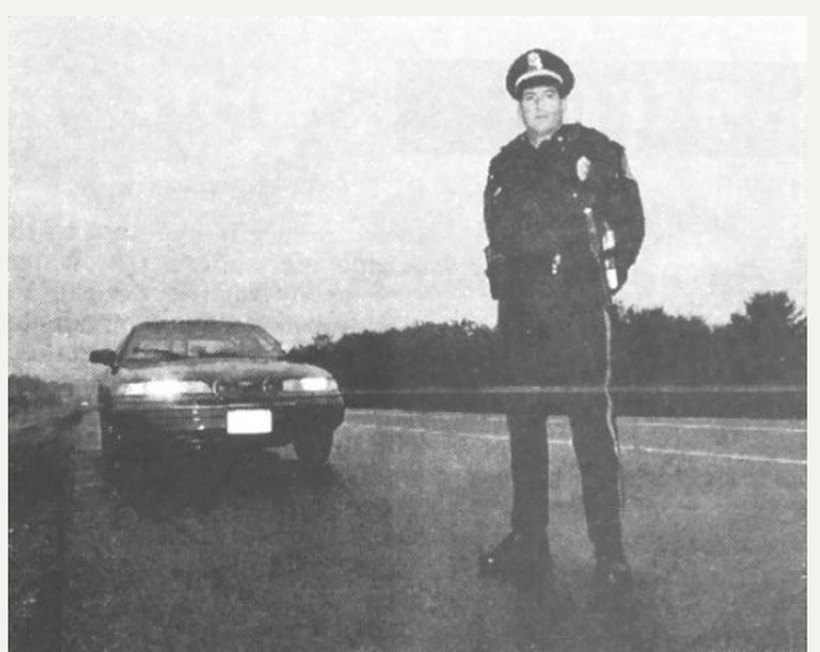
At about 3:32 a.m. on 13 May 1978, Kerman senior police officer Manuel Amparano, then 33 years old, was on routine patrol on the edge of the small farming town of Kerman in Fresno County, California, driving along Del Norte Avenue near California Avenue and Kerman High School. This case file covers what witnesses reported, the official narrative, and a two-pass assessment with its evidence tier.
What did witnesses see at Kerman?
At about 3:32 a.m. on 13 May 1978, Kerman senior police officer Manuel Amparano, then 33 years old, was on routine patrol on the edge of the small farming town of Kerman in Fresno County, California, driving along Del Norte Avenue near California Avenue and Kerman High School. Ahead of him, roughly half a mile out, he saw a reddish glow that he first took for a fire, the kind of thing local teenagers might set in a field or among the trees. As he closed the distance he realized the light was not a fire on the ground at all. It was a circular object, which he later compared to a round fireball or a setting sun, hanging about 100 to 150 feet off the ground. He estimated its size at roughly 25 by 50 feet. The crimson-to-orange glow seemed at first to be sitting inside a tree line, an oak or maple rather than the palms he had assumed, which is part of what told him something was wrong with his first read of the scene.
Amparano stopped his patrol car and reached for his spotlight to get a better look at the thing. Before he could train the light on it, the object reacted. A brilliant bluish-white beam, which Amparano described as being like the flash of a camera, came from the object at an angle apparently toward his car. The glowing sphere then made a sharp turn and shot away to the southwest at high speed and in complete silence. Through the whole encounter Amparano stayed inside his vehicle with the windows rolled up, and he reported hearing nothing at all except the idle of his own car engine. There was no sound of engines, rotors, or rushing air, which is one of the details that has kept the case from being filed neatly as a misidentified aircraft.
The strange part was not over when the object left. Back at the police station roughly fifty minutes later, fellow officers noticed Amparano looked badly sunburned. His face and neck were reddened, and he would later realize his chest was burned too, in the areas that had been facing the light. He described himself as being "as red as a lobster," and said it was "like a sunburn when you fall asleep at the pool." White blisters formed on the parts of his body that had faced the object, and his eyes were sensitive to light for about a week afterward. He had been wearing his uniform the entire time, yet the burning ran underneath the clothing on the side that had faced the glow.
What is the official explanation?
There was no Project Blue Book to receive this report; the Air Force had shut Blue Book down in 1969, so the 1978 Kerman case fell to local police and to civilian UFO research organizations. The immediate official response came from Amparano's own department. Then Kerman Police Chief James Van Cleaf opened an inquiry and, according to the contemporary reporting, eventually logged a total of fourteen witnesses who said they had seen an unusual object or light in the same time frame, drawn from civilians and from law enforcement across multiple jurisdictions in the central San Joaquin Valley. Amparano and the department also checked the obvious conventional sources. The Air National Guard, the weather bureau, and the Fresno Air Terminal were all contacted, and each reported that nothing unusual had shown up on radar that night.
The medical record became the most fought-over piece of official paper in the case, because the burns were documented in several places at different severities. Amparano did not go to the hospital right away; he delayed his visit to Fresno Community Hospital by many hours. When the injury was finally written up, the emergency room record described a "mild first degree burn," and the attending doctor's first report likewise recorded first-degree burns. A separate sheriff's workers' compensation form, however, referred to third-degree burns, and the treating physicians reportedly told Amparano the pattern looked like it had been caused by microwaves, prescribing codeine for the pain and following him for roughly a month. The doctors said they were unfamiliar with the exact presentation. A physician's speculation that microwave radiation could burn skin through clothing without scorching the fabric is the seed of the whole "microwave burn" framing that has followed the case ever since.
On the documentary side, the case was investigated and published by serious civilian researchers rather than by any government body. The Fresno Bee covered it on 19 May 1978 and again on 23 February 1979. The Center for UFO Studies (CUFOS), founded by astronomer J. Allen Hynek, holds a file on it, and its journal the International UFO Reporter ran the case in vol. 3, September 1978, pp. 10-11, under the title "California Policeman Burned By UFO," the issue being from the era when Allan Hendry was doing the magazine's case write-ups. The Aerial Phenomena Research Organization (APRO) also carried it. NICAP later catalogued the event in its 1978 chronology, citing the CUFOS files, the IUR article, and both Fresno Bee pieces. Decades on, the investigator and author Kevin Randle re-examined the case using those records, and central California local news (CBS47 / KSEE24 YourCentralValley) revisited it as a regional mystery.
What did the witnesses think it was?
Amparano himself was the close-range witness, and his standing is part of why the case has held up as long as it has. He was a United States Marine veteran with about five years of police experience, described by investigators as a steady, credible man who actively avoided publicity rather than chasing it. He never claimed to know what the object was. His own summary of his uncertainty was careful: he said what he was not certain about was "whether it was some kind of government project or something from out there." He did not embellish the encounter into a flying saucer with portholes or occupants. He reported a glowing sphere, a blue flash, a silent high-speed departure, and burns he could not explain, and he stuck to that account across decades of retellings.
He was far from the only witness. The investigation by Chief Van Cleaf gathered roughly fourteen people who reported seeing the object or a related light that night. Researchers reviewing the files have named officer A. J. Byington and officer Robert Mueller, who along with officer Ed Singh saw Amparano's burned condition when he returned to the station, and who years later described a circular dead spot in the field where the object had hovered. Other names attached to the broader wave of reports include police chaplain trainee Pastor Tom Johnson, farmer Thomas Addis, housewife Lisa Harrison, Ken Westbrook Jr., retired special US Marshal Phil Maher, Fresno air terminal meteorologist Carl Smith, and deputy Paul Baker. Amparano's wife corroborated the physical injury directly, noting blisters on his ears that she saw at home.
The physical aftermath in the field became its own piece of witness testimony. The cotton field over which the sphere had hovered was searched immediately and yielded no debris, no scorch marks, and no landing impressions. But witnesses reported that for years afterward nothing would grow in a roughly circular patch at that spot, an apparent sterilized ring in otherwise productive farmland; that ground was eventually folded into an almond orchard. Researchers also logged similar phenomena in the region in the following months, including red orbs reported in January 1979 and sightings handled by the Madera County Sheriff's Department, which placed the Amparano encounter inside a small local wave rather than leaving it as a single isolated anecdote.
The dispute
The dispute has two prongs, neither of which closes the case. The first is the Vandenberg launch hypothesis, pushed by skeptical commenters (notably one identified as "Lance" in the discussion around Kevin Randle's re-examination) who argued that a missile or rocket launch in the southern sky at the right time and bearing would explain a bright fast-moving light fleeing to the south-southwest. The archival Vandenberg launch record does show a real event on the same date, an Atlas F carrying the NDS-2 satellite from Space Launch Complex 3E on 13 May 1978, which is more than the skeptics usually have. The problem is that the proponents never matched it to the encounter: the logged launch time is "unknown," so nothing puts it at 3:32 a.m. local; an Atlas F orbital launch tracks out over the Pacific to the south and west rather than hovering low over a specific Kerman field; and a launch tens or hundreds of miles away cannot account for a silent sphere sitting at 100 to 150 feet in a tree line, a directed blue flash, or, above all, burns to a man's skin. Amparano himself noted that with fourteen agencies and many people awake and outdoors that night, not one independent rocket-sighting report came in.
The second prong is the medical-severity discrepancy, which is the case's genuine soft spot. The emergency room record and the doctor's first report classify the injury only as a "mild first degree burn," while the more striking second and third degree characterizations come from a sheriff's workers' compensation form and from witness descriptions of blistering and lobster-red skin rather than from a clinician's formal diagnosis. Skeptics fairly point out that the most clinically conservative document describes a minor burn, and that the "microwave" attribution is a physician's speculation, not a measured finding. A related hoax suggestion, that Amparano used a sunlamp to fake an injury for a compensation claim, also surfaced in later debate.
Neither prong amounts to a method-shown discrediting of the event. The hoax-by-sunlamp idea collides with the roughly fifty-minute gap between the 3:32 a.m. sighting and Amparano arriving at the station already visibly burned, and with the fact that the injury was independently seen by fellow officers, by his wife, and by hospital staff who treated and followed him for about a month. The burns are documented as real even at the conservative first-degree reading. So the dispute lowers confidence in the most dramatic claims, microwave causation, third-degree severity, a sterilized ring in the soil, without overturning the basic facts that a credible officer reported a low silent glowing sphere with a directed flash and that he sustained a genuine, witnessed burn the same morning. That is why the case lands at Barely Disputed and not Strongly Disputed or discredited.
Is the A Policeman Burned by a UFO: The Kerman Incident (Amparano, 1978) real? The two-pass assessment
Pass one, the ordinary explanations. The leading prosaic candidate is a rocket or missile launch from Vandenberg Air Force Base, about 150 miles to the south-southwest, which skeptics have argued would put a bright, climbing, fast-moving light in the southern sky in roughly the direction Amparano said the object fled. The Vandenberg launch log does in fact show an Atlas F lifting an NDS-2 satellite from Space Launch Complex 3E on 13 May 1978, so a real same-date launch existed. That is the strongest single fact the skeptics have. But it is incomplete on its own terms. The launch time in the archival record is listed as unknown, so no source actually places it at 3:32 a.m. local; an Atlas F orbital shot heads out over the Pacific to the south and west rather than hanging at 100 to 150 feet over a Kerman cotton field; a distant rocket does not make a low silent sphere sit in a tree line and then dart off at a sharp angle; and crucially a rocket plume miles away does not sunburn a man through his uniform. Other ordinary candidates fare worse. A hoax-by-sunlamp theory, floated in later online debate, runs into the roughly fifty-minute window between the sighting and his arrival at the station already visibly burned, and into the fact that fellow officers, his wife, and hospital staff all saw a real injury. Ball lightning, a meteor or reentry, an aircraft landing light, and a misjudged planet all fail to combine the low hover, the directed blue flash, the silence, the patterned burns, and the multiple independent witnesses.
Pass two, if the core report is accurate. Then this is a close encounter of the second kind, an object that produced measurable physiological and possibly environmental effects. The signature detail is the burn pattern: reddening and blistering only on the surfaces of the body that faced the light, present under clothing, with delayed onset and about a week of photophobia, plus a treating physician reaching for microwave radiation as the closest analogue. That, combined with a low silent hovering sphere, a directed energy-like blue flash, fourteen witnesses, and a reported long-lived sterile ring in the soil, is the profile of a genuine unexplained aerial object interacting with its surroundings, exactly the kind of physical-trace case that researchers from Hynek to Randle have argued deserved hard science rather than a filed-and-forgotten fate.
The honest verdict is Barely Disputed. A real counter-explanation exists, a documented Vandenberg launch on the same calendar date, and a genuine weakness sits in the file, namely that the medical paperwork formally records only a "mild first degree burn" while the more dramatic second and third degree language traces to a workers' compensation form and to witness description rather than to a clinician's signed diagnosis. Those are real dents. But neither is a method-shown debunk of this event. No one has matched the launch to the time and bearing, and no rocket explanation touches the burns at all; the burns themselves are documented as real even at the conservative first-degree reading, witnessed by multiple officers, the man's wife, and hospital staff. The counter-case is partial and unproven, the core encounter and a real injury stand, so the case sits in Barely Disputed rather than anything stronger, and well short of discredited.
Sources
- www.nicap.org/chronos/1978fullrep.htm
- kevinrandle.blogspot.com/2015/06/kerman-california-ufo-case-update.html
- www.thinkaboutitdocs.com/1978-police-officer-suffers-burns-from-a-ufo/
- www.weirdfresno.com/2009/12/kerman-police-officer-wittnessed-ufo-in.html
- www.tall-white-aliens.com/police-officer-suffers-burns-from-a-ufo/
More cases from this region: UFO sightings in United States