The Gulf Breeze Sightings
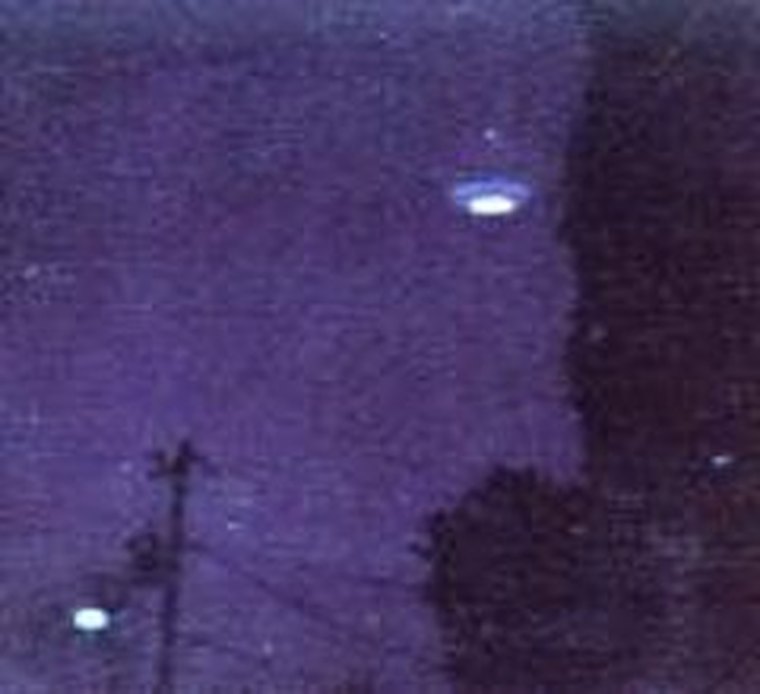
On the evening of Wednesday 11 November 1987, Ed Walters, a building contractor in Gulf Breeze, Florida, said he was working in the home office of his house on Silverthorn Road when he noticed a glow behind a roughly thirty foot pine in his front yard. This case file covers what witnesses reported, the official narrative, and a two-pass assessment with its evidence tier.
What did witnesses see at Gulf Breeze?
On the evening of Wednesday 11 November 1987, Ed Walters, a building contractor in Gulf Breeze, Florida, said he was working in the home office of his house on Silverthorn Road when he noticed a glow behind a roughly thirty foot pine in his front yard. He stepped outside and reported a top-shaped craft with a row of dark squares and smaller openings running across its midsection, lit so brightly he compared it to something "right out of a Spielberg movie." He grabbed an old Polaroid Sun 600 from his work gear and, by his account, took five instant photographs as the object drifted clear of the tree.
Walters said the object then fired a narrow blue beam that pinned him in place, lifted him off the ground by his shirt collar, filled his head with a hum, and carried a sharp smell of ammonia mixed with cinnamon at the back of his throat. He reported a voice in his head, calm and instructive, telling him "We will not harm you" and "Calm down," and across later encounters he said the beings communicated in both English and Spanish and gave him a name that sounded like "Zehaas." He described seeing a four foot tall gray figure with large black eyes inside or just outside his home on a later night, which he said he failed to photograph.
The first night was only the opening of what Walters logged as a long series of return visits. Over roughly the next six months he claimed repeated encounters and produced dozens of further images, the most famous being a January 1988 "road shot" he said he grabbed one-handed from the cab of his truck, which shows the hood, part of the road, and the craft together. He photographed a 7 February 1988 episode in which he said his wife Frances tried to outrun the beam, and on 1 May 1988 he reported the presence at Shoreline Park after midnight, where he said he photographed the object and then lost consciousness for about an hour. The widely reproduced totals run from his earliest five Polaroids to somewhere above thirty still images plus videotape, taken across the original Polaroid, a newer self-ejecting Polaroid, a stereo rig of two Polaroids on a board, and a four-lens Nimslo 3D camera.
Walters was not the only person reporting strange lights over Gulf Breeze. After the Sentinel ran his pictures the town drew nightly skywatchers and a run of other reports, including images credited to an anonymous local the press called "Believer Bill," and the broader flap of 1987 and 1988 produced witnesses among residents, officials, and tourists. That multi-witness backdrop is part of why the case grew so large so fast.
What is the official explanation?
There was no federal investigation that treated this as a state matter; the official apparatus here is the civilian UFO research community and, later, the local government and courts. Walters first took his photographs to Gulf Breeze Sentinel editor Duane Cook on 17 November 1987, presenting them as the work of an anonymous "Mr. X" who wanted no publicity. Two of the five ran on the Sentinel front page on 19 November 1987 alongside a note from "Mr. X." Walters used the aliases "Mr. X," "Mr. Ed," and "Jim" before going public as himself.
The Mutual UFO Network (MUFON) took the case on and, unusually, supplied Walters with sealed cameras to document further sightings, including the four-lens Nimslo and the stereo two-Polaroid board. MUFON International Director Walter Andrus championed the case publicly and later described it as either one of the best the organization ever worked or the best-orchestrated hoax it had seen. Navy optical physicist Bruce Maccabee investigated the sites, the cameras, and the prints over more than a year and wrote a long analysis, around ninety pages, used in Walters' book. Maccabee's stated conclusion, in the St. Petersburg Times of 25 February 1990, was unambiguous: "Having studied these sightings every which way for more than a year, I have concluded that they are proof of the existence of UFOs." He estimated the "classic" object at roughly nine to thirteen feet in size and conceded the early snapshots came from an old Polaroid that could be double exposed, arguing later cameras closed that door.
The official narrative split hard against Walters over 1988 to 1990. The National Enquirer commissioned NASA Jet Propulsion Laboratory image analyst Robert Nathan, who found "many of these images are double exposure photographs" and sensed "some kind of a cut and paste on some surface," and the Enquirer declined to certify them. J. Allen Hynek judged the photos fake, citing unevenly spaced windows on the craft and a waviness suggesting reflection off water. Inside MUFON, field investigators Rex and Carol Salisberry concluded "several, if not all of the photos are probable hoaxes" and left the organization over it. Gulf Breeze Mayor Ed Gray analyzed the photographs himself and also concluded they were fake. The decisive official moment came on 10 June 1990, when Pensacola News Journal reporter Craig Myers published that a UFO model built from plastic foam plates and drafting paper had been found in the attic of Walters' former home, and the newspaper used it to reproduce his pictures.
What did the witnesses think it was?
Ed Walters held to his account for the rest of his life. He insisted the encounters were real, that the beings were physical visitors, and that the model recovered from his old attic had been planted to frame him after he and his family moved out. He and his wife Frances co-authored "The Gulf Breeze Sightings" (William Morrow, 1990), written in diary form, in which they describe months of close encounters and frame the photographs as evidence rather than artistry. Walters cooperated with MUFON, submitted to their sealed-camera protocol, and pointed to that cooperation as proof he had nothing to hide. He sued the Pensacola News Journal over its coverage.
His believers were not fringe figures. Bruce Maccabee, a working Navy physicist, put his name to the claim that the photographs prove UFOs exist, and Walt Andrus committed MUFON's institutional weight behind the case. Editor Duane Cook, who first published the pictures, said he was troubled that the only sharp craft photos came from Walters or the anonymous "Believer Bill," but felt too many other credible eyewitnesses had come forward to dismiss it all. That is the heart of the pro-case argument from the witness side: even if every Walters photograph were thrown out, Gulf Breeze hosted a genuine flap, with independent residents and skywatchers reporting lights over the same months.
The corroborating witness who mattered most to the case, though, turned. Tommy Smith, a young Gulf Breeze man and a onetime friend of Walters' son, had been cited as independent support. In June 1990 Smith told investigators that he had helped Walters fake UFO pictures by double-exposing Polaroid film using models, a flashlight, and colored paper, and that no real craft was involved. His father, attorney Tom Smith, backed the account. Walters' answer to all of it, the recantation and the attic model alike, was that he was being set up, and he never wavered from that position before his death in 2013.
The dispute
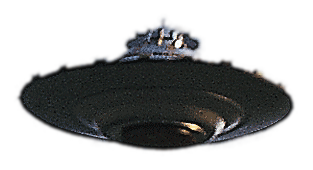
The dispute is concrete and physical, not a matter of opinion about credibility. In June 1990 the new residents of Walters' former house on Silverthorn Road discovered a model UFO hidden in the attic, roughly nine inches by five to six inches, assembled from four plastic foam plates, cardboard, paper, and blue-tinted plastic. Pensacola News Journal reporter Craig Myers obtained the model and, on 10 June 1990, published that the paper had reproduced Walters' photographs with it. The reproduction matched the domed top-shape, the orange window band, and the blue under-glow seen in the originals. This is a positive identification of the specific object behind the imagery plus a shown method of fabrication, which is what separates a strong dispute from a weak one.
The model was not the only blow. JPL image analyst Robert Nathan, hired by the National Enquirer, found "many of these images are double exposure photographs" and the Enquirer declined to certify them. Inside MUFON, field investigators Rex and Carol Salisberry concluded "several, if not all of the photos are probable hoaxes" and left the organization over the finding. Days after the attic model surfaced, a young local named Tommy Smith told Gulf Breeze Mayor Ed Gray, Police Chief Jerry Brown, reporter Craig Myers, TV reporter Mark Curtis, and a court reporter that he had helped Walters fake the pictures by double-exposing Polaroid film with models, a flashlight, and colored paper. Walters' earliest camera was an old Polaroid that, as even his defender Bruce Maccabee conceded, physically permitted double exposure. The case also carries Walters' undisclosed 1960s convictions for forgery and auto theft and a roughly 200,000 dollar book advance, both relevant to motive.
The case does not collapse entirely, which is why this is Strongly Disputed rather than a finished verdict. Walters insisted the model was planted to frame him after he moved out, and MUFON's Gary Watson defended him, arguing the model and its drafting paper postdated his residence and were placed by persons unknown. Bruce Maccabee, a Navy optical physicist, never recanted his conclusion that the photographs are genuine, and Gulf Breeze did host a wider flap in which other residents reported lights, so a real local wave can coexist with faked photos. The pivot is the date of the drafting paper found with the model. Skeptic Philip Klass tied that paper to plans for a house Walters had built in early 1987, before the first sighting, which would make the planting story impossible; Watson placed the paper in 1989. That unresolved dating dispute is the only thing keeping the authenticity claim alive, and it is the precise point on which honest sources still disagree.
Is the Gulf Breeze Sightings real? The two-pass assessment
Pass one, the entirely ordinary reading. This case has an unusually complete mundane explanation, which is rare for a famous sighting. The mechanism is a tabletop model photographed with double-exposure technique on an instant camera. Walters' first camera was an old Polaroid Sun 600 that physically allowed two exposures on one frame, a point even his strongest defender Bruce Maccabee conceded. A small craft built from four plastic foam plates, cardboard, paper, and blue plastic, about nine inches across, was found in the attic of Walters' former home in June 1990, and the Pensacola News Journal reproduced his photographs with it. A young local, Tommy Smith, said in June 1990 that he had watched Walters fake the pictures with models, a flashlight, and colored paper. JPL analyst Robert Nathan found double exposures, MUFON's own Rex and Carol Salisberry called the photos probable hoaxes, J. Allen Hynek flagged uneven windows and a water-reflection waviness, and even Mayor Ed Gray concluded they were fake. Walters had a roughly 200,000 dollar book advance and undisclosed prior convictions for forgery and auto theft. That is method, motive, recovered prop, and a confession, the full set.
Pass two, if real. If the photographs genuinely captured a craft, it was a domed top-shaped object with a glowing window band that could project a paralyzing beam, repeatedly returning to one family across half a year, with associated four foot gray occupants who spoke English and Spanish. The strongest pro-case points are that Maccabee, a credentialed Navy optical physicist, studied the cameras and sites for over a year and never recanted his conclusion that the photographs prove UFOs exist; that MUFON's sealed-camera protocol produced some of the later images under at least nominal control; and that Gulf Breeze did host a wider flap, so an authentic local wave could in principle sit underneath even faked photos. Walters' planting defense, backed by MUFON's Gary Watson, keeps a thin door open.
The verdict is Strongly Disputed. This sits above a barely-disputed case because the counter-explanation is not a soft psychological argument or an unproven reconstruction; it is a recovered physical prop, a shown reproduction method, named independent analysts demonstrating double exposure, and a witness concession. It stops short of a settled discredit only because the planting claim turns on one unresolved fact, the date of the drafting paper found with the model, where Philip Klass placed it in early 1987 before the sightings and Watson placed it in 1989. Until that single point is closed, the case is honestly described as strongly disputed and is flagged for human review of a possible discredit.
Sources
- web.archive.org/web/20250905214042/http://www.ufocasebook.com/gulfbreeze.html
- mysterydelver.com/high-hoax/
- rr0.org/time/1/9/9/3/01/EdWaltersTheModelAndTommySmith_MufonUfoJournal/index.html
- www.gpposner.com/Gulf_Breeze.html
- www.ufospensacolabeach.com/the-ufo-incident/
- anomalyresponse.com/case/GulfBreeze1987
- www.tampabay.com/archive/1990/02/25/proof-of-ufos-photographs-have-been-authenticated-but-seeing-isn-t-necessarily-believing/
- www.thinkaboutitdocs.com/gulf-breeze-sightings/
More cases from this region: UFO sightings in United States