The Ilkley Moor Alien (1987)
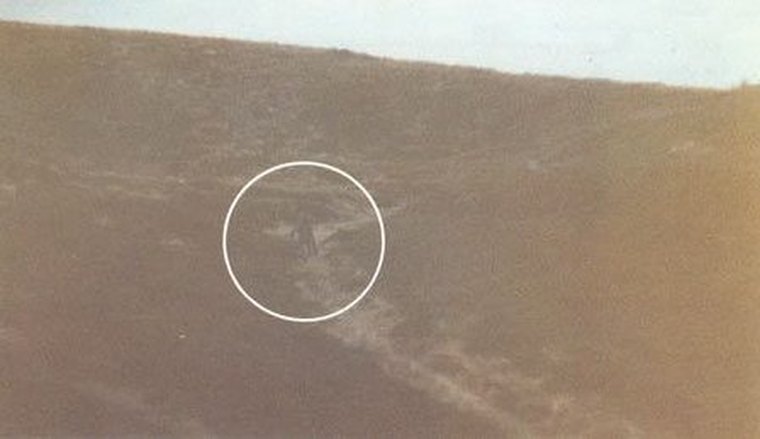
On the morning of 1 December 1987 a man using the pseudonym Philip Spencer, an off-duty police officer, set out on foot across Ilkley Moor in West Yorkshire to walk to his father-in-law's house in a neighbouring village. This case file covers what witnesses reported, the official narrative, and a two-pass assessment with its evidence tier.
What did witnesses see at Ilkley Moor?
On the morning of 1 December 1987 a man using the pseudonym Philip Spencer, an off-duty police officer, set out on foot across Ilkley Moor in West Yorkshire to walk to his father-in-law's house in a neighbouring village. The moor was misty. He carried a camera, hoping to photograph atmospheric light effects and any of the strange aerial lights that had recently been reported over the area, and a small pocket compass for navigation in the fog. He walked up past the White Wells bath house and toward a stand of trees on the higher moor.
Spencer reported hearing a low humming sound. Ahead of him, roughly thirty feet away near some boulders, he saw a small creature. He described it as about four to four and a half feet tall, with greenish or blue-green tinted skin, a large head with big pointed ears, large dark eyes, no visible nose and a small mouth. Its hands were oversized with long thick fingers he likened to sausages, and its feet were splayed into a rough V shape, as if it had only two large toes. It moved with a shuffling gait yet covered ground quickly. When Spencer called out to it, the being raised an arm and waved at him, a gesture he read as telling him to keep away or to stop.
In that instant Spencer lifted his camera and took a single photograph of the figure. The creature then turned and moved off behind a rocky outcrop. Spencer ran after it. As he came over the rise he said he saw a large object lifting from a hollow in the moor: two silver saucer shapes joined at the rim with a domed top, and on the dome a whitish square box-like appendage pierced with a pattern of holes. The humming grew louder. The craft climbed and vanished into the low cloud.
Two physical details anchored the account. When Spencer checked his compass it was now pointing south instead of north, its polarity apparently reversed. And when he reached the village he found, by the church or town hall clock, that far more time had passed than he believed: his own watch and his sense of the morning were running roughly an hour to nearly two hours behind the real time. He had set out believing it was early and arrived to find it was around ten o'clock, with a stretch of the morning he could not account for.
What is the official explanation?
There was never a government or military investigation of the Ilkley Moor encounter; it produced no Ministry of Defence file or police report of record, since the witness reported it privately rather than officially. The serious investigation was civilian, conducted by two of Britain's most experienced UFO researchers, and the documentary record is theirs.
Spencer first wrote to Jenny Randles, who passed the case to Peter Hough. Hough became the lead investigator, assisted by veteran Manchester researcher Arthur Tomlinson. Hough was openly wary at the start, describing it as a potentially too-good-to-be-true case, but after meeting Spencer concluded he was a man of integrity who was not chasing money or publicity, which is why the pseudonym was used. Randles examined the rest of the film and found only five frames had been exposed, consistent with Spencer's story of a brief outing rather than a staged photo session.
The negative was sent to the Kodak laboratory at Hemel Hempstead, where analyst Peter Sutherst examined it. His conclusion, as quoted by the investigators, was that it was a genuine first-generation exposure that had not been interfered with: the figure was part of the original photograph and had not been superimposed or added in a darkroom. The image was too grainy, from the slow film used in poor morning light, to be enhanced into clarity. Geoffrey Crawley of the British Journal of Photography, the analyst who had years earlier exposed the Cottingley fairy photographs as fakes, also looked at it without being able to resolve the figure further. The investigators then sent material to Dr Bruce Maccabee, the United States Navy optical physicist who has analysed many UFO photographs. Maccabee's verdict was that the grain defeated proper photogrammetric testing. He is quoted saying, "I had great hopes that this case would prove definitive. Sadly circumstances prevent it from being so." None of these analysts identified the figure as a cutout, a model or a known object; their finding was that the negative was authentic and the small figure simply could not be resolved well enough to classify.
The compass was tested too. Hough pursued the polarity reversal with an academic specialist in electrical engineering, who confirmed that reversing a compass needle's polarity is physically possible but requires a very large pulsed or rapidly applied magnetic field, on the order of thousands of times the strength of the earth's own field. Hough also had the site and the witness's effects checked for radiation, with negative results. On 16 March 1988, at Arthur Tomlinson's home, the clinical psychologist Dr Jim Singleton conducted a regression hypnosis session with Spencer, with Hough present and a journalist running tape recorders. Singleton, who had also assessed Spencer psychologically, judged that Spencer was telling the truth as he understood it.
What did the witnesses think it was?
Spencer was consistent throughout that he had photographed a real creature and a real craft, and that something had happened to him on the moor that cost him a chunk of the morning. He did not present himself as a contactee or campaigner. He asked for anonymity, declined to profit from the photograph, and submitted to expert scrutiny of his film, his compass and eventually his own mind under hypnosis, behaviour the investigators read as that of a puzzled witness rather than a hoaxer.
Under regression with Dr Singleton on 16 March 1988, Spencer's account expanded into a full abduction narrative. He recalled being unable to move, lifted off the ground, and taken aboard the domed craft through a door. He described a medical-style examination conducted with a beam of light, and said he was shown two films by the beings. The first depicted scenes of environmental devastation, pollution, starvation and natural disaster, which he understood as a warning about the future of the planet. The second he said he had been instructed not to describe to anyone. A striking detail emerged in the regression: the sequence implied he had taken the photograph after the encounter aboard the craft rather than before it, which the investigators noted helped reconcile the lighting and the missing time, since the conscious memory and the hypnotic memory did not line up cleanly.
Spencer's believed interpretation, then, was straightforward: he had stumbled onto a landed craft and one of its occupants, photographed the being, watched the craft leave, and lost time because he had in fact been taken aboard. The corroboration is internal rather than from independent eyewitnesses, since he was alone on the moor. What supports him is the convergence of separate strands: an authenticated, untampered negative; a genuinely reversed compass; a documented time discrepancy; a psychologist's assessment that he believed what he was saying; and the judgement of two seasoned investigators, including Randles, who had debunked many cases, that this witness was not running a con.
The dispute
The case is disputed, but the dispute is weak and rests on assertion rather than any demonstrated solution, which is why it lands at Barely Disputed rather than anywhere harsher. The best-known counter-claim came from the Daily Star, which around 1989 ran a piece ridiculing the photograph and suggesting the "alien" was something mundane, with the figure variously described as a man, a cardboard cut-out, or in the most-repeated version an insurance salesman in a blue anorak crossing the moor on a bicycle. This was tabloid mockery. No source has ever produced the salesman, the bicycle, the anorak or the cut-out, no investigator confirmed the identification, and the line survives in UFO literature as a joke retold as fact rather than as a finding. It identifies no specific real-world object and shows no method.
The general skeptical position is that the photograph is too blurry to prove anything, that a small dark figure on a misty hillside could be a person, a cardboard prop or a piece of moorland clutter, that compasses are trivially easy to damage or tamper with, and that a regression-hypnosis abduction story is exactly the kind of confabulated narrative that hypnosis is known to manufacture. Skeptics also ask why Spencer photographed the creature and not the far more impressive craft. These are reasonable doubts, but every one of them is a plausibility argument, not a demonstration. As of the published record, no skeptic has reconstructed this specific photograph using a known prop, produced a side-by-side match to a named object with measurements, or obtained any confession from Spencer or an accomplice.
The points that cut against the debunk are concrete. The Kodak laboratory found the negative was a genuine first exposure that had not been interfered with, so the figure is not a darkroom paste-up; it was physically present on the moor in front of the lens, whatever it was. The compass reversal is real and, per the engineering consultation Hough obtained, requires a very large magnetic field to produce, which is not the same as casually breaking a compass. Bruce Maccabee, an experienced and cautious photo analyst, did not call it a fake; he said only that the grain prevented a definitive test. The strongest honest statement against the case is that the image quality is too poor to confirm what the figure is, which is a long way from showing it to be a hoax. Because the counter-explanations remain unproven and the one authenticated piece of physical evidence, the untampered negative, stands, the case is only barely disputed and largely still stands.
Is the Ilkley Moor Alien (1987) real? The two-pass assessment
Pass one, the entirely ordinary readings. The most economical explanation is a hoax: Spencer was alone, the only witness, and produced a single grainy frame of a small figure plus a story that grew more elaborate under hypnosis. A cardboard cut-out, a doll, a distant person, or a deliberately staged prop on a misty hillside could all read as a four-foot grey-green humanoid in a soft, underexposed photograph, and a compass can be reversed or simply broken by anyone determined to salt the evidence. The abduction content arrived only through regression hypnosis, a technique with a well-documented capacity to generate vivid false memories, so the medical examination and the two films carry little independent weight. The missing time can be a misread watch or clock. On this reading the case is one man, one blurry picture, and a narrative. The problem for the hoax theory is that nobody has ever shown the method or the object. The Daily Star's insurance-salesman-on-a-bicycle was never produced, no prop was recovered, no accomplice confessed, and the Kodak laboratory specifically found the negative was a genuine untampered first exposure, which rules out a darkroom composite and means whatever the figure is, it was really there on the moor.
Pass two, if the encounter is real. Then a small humanoid entity was present on Ilkley Moor on the morning of 1 December 1987, was photographed at close range, and departed in a domed disc-shaped craft, and the witness lost roughly an hour to two hours of time and came away with a compass whose polarity had been reversed by a strong magnetic field. That would place the event among the better-documented close-entity and abduction cases of the late twentieth century, with an unusual triple of supporting strands: an authenticated photograph, a physically altered instrument, and a time anomaly, all attached to a witness whom a clinical psychologist judged to be sincere and whom two veteran investigators, including a noted debunker, declined to dismiss.
Weighing the two, the authenticated negative and the reversed compass are real physical residue, and the proposed mundane solutions are all assertions that have never been demonstrated. No analyst called the photo fake; the strongest skeptical statement is that it is too grainy to confirm what the figure is. That is genuine doubt, but it is not a debunk. A case with an untampered negative of an unidentified figure, a magnetically reversed compass, and only unproven counter-explanations is not discredited and is not strongly disputed. It is Barely Disputed and largely stands, which is the tier assigned here.
Sources
- ufologie.patrickgross.org/htm/ilkleymoor.htm
- www.ghosttheory.com/2015/03/13/the-1987-ilkley-moor-alien-photograph
- www.thinkaboutitdocs.com/1987-the-ilkley-moor-alien/
- web.archive.org/web/20260622131636/https://www.ufocasebook.com/ilkleymoor.html
- www.realyorkshireblog.com/post/the-ilkley-moor-alien
- forums.forteana.org/index.php?threads/ilkley-moor-alien-photo-yorkshire-december-1987.64415/page-10
- archive.org/details/paranormalsource0000rand
More cases from this region: UFO sightings in United Kingdom