The Phobos 2 Incident
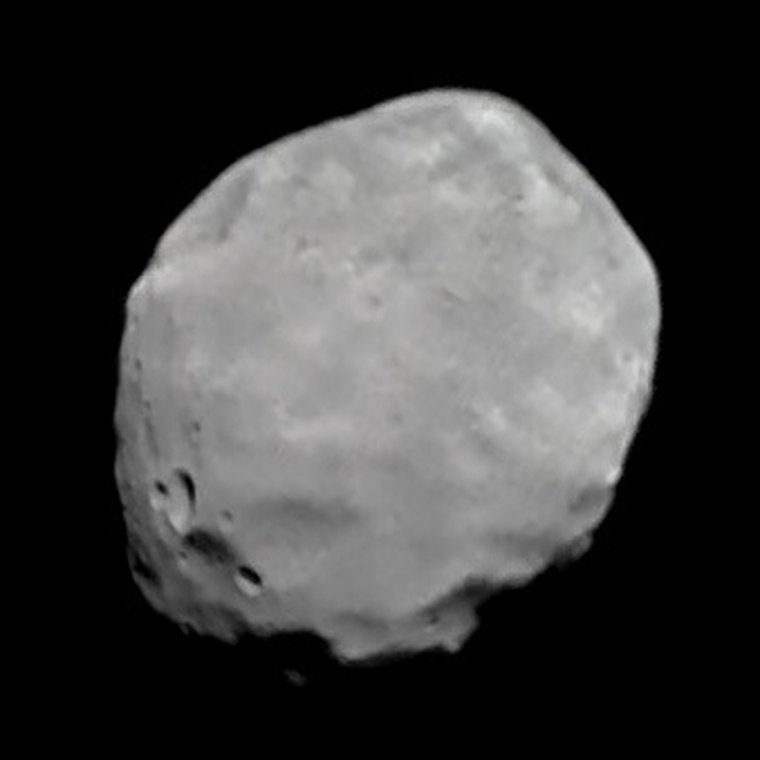
On 27 March 1989 the Soviet Union lost contact with Phobos 2, the surviving half of its twin-spacecraft Phobos '88 mission to Mars. This case file covers what witnesses reported, the official narrative, and a two-pass assessment with its evidence tier.
What did witnesses see at Mars orbit?
On 27 March 1989 the Soviet Union lost contact with Phobos 2, the surviving half of its twin-spacecraft Phobos '88 mission to Mars. The probe had launched on 12 July 1988 from Baykonur, reached Mars orbit at the end of January 1989, and spent February and March closing on the tiny inner moon Phobos. It was meant to creep to within tens of meters of the moon and drop two landers, a stationary platform called DAS and a spring-legged "hopper" called PROP-F. That final approach never happened. The signal weakened and then was gone.
The ufology story attaches to a handful of frames returned in the spacecraft's last days. According to Boris Bolitsky, science correspondent for Radio Moscow, the probe radioed back "quite remarkable features" shortly before it fell silent. A report in New Scientist on 8 April 1989 described markings, either on the Martian surface or in the lower atmosphere, between 20 and 25 kilometers across, "spindle-shaped" and unlike any known geological formation. Dr John Becklake of the London Science Museum told reporters the pattern was puzzling in part because it had been caught not by the optical camera but by the infrared instrument.
From there the claim grew. Popular retellings say that "seconds before" contact was lost, the probe imaged a dark elliptical object roughly 20 kilometers long moving near the spacecraft, and that the very last transmission was a photograph of a cylindrical "mother ship," a cigar about 20 kilometers long and 1.5 kilometers wide. The same accounts describe a separate frame of a huge elongated shadow lying across Mars that, they say, no surface feature could explain. The two recurring exhibits are therefore a long dark object near the probe and a long dark shadow on the planet, both arriving in the same window in which the spacecraft died.
What is the official explanation?
The official record of the failure is mundane and consistent across independent space agency sources. NASA's HEASARC mission page states that contact was lost on 27 March 1989 while the spacecraft was maneuvering to encounter Phobos, and that "the loss was traced to either a failure of the on-board computer or of the radio transmitter (which was already operating on the backup power system)." Gunter's Space Page and the JPL-hosted Solar Views summary both record the same date and conclude the failure resulted from "a malfunction of the on-board computer." The pattern echoes the loss of the sister craft Phobos 1 the previous September, which was killed by a bad command upload that swung its solar panels off the Sun and drained the batteries. In both cases the spacecraft simply stopped pointing its antenna at Earth.
The two images at the heart of the UFO story are not lost, suppressed, or unexplained. They are archived and published. The "last image" was a full-globe view of the moon Phobos itself, about 25 kilometers across, taken by the VSK television camera on 25 March 1989. The Planetary Society holds it with a plain caption: "This view of Mars' moon Phobos (which is about 25 kilometers in diameter) was captured by the Phobos 2 mission on March 25, 1989. This was the last image that Phobos 2 acquired before contact was lost on March 27, 1989." Phobos is an irregular, elongated body, and a low-resolution frame of it is precisely the dark elongated shape that the cigar-ship claim describes.
The "shadow" frame was explained by the people who built the instrument. The elongated dark feature came from Termoskan, a two-channel scanning radiometer that imaged Mars in visible and thermal infrared. NASA's Planetary Data System holds the Termoskan thermal/visible dataset and notes that in February and March 1989 it captured very high resolution panoramas of Mars's equatorial region from roughly 30 degrees south to 6 degrees north. The Phobos '88 orbit let Termoskan record the visible shadow of the moon Phobos sweeping across Mars and measure the surface cooling in that shadow. The peer-reviewed Termoskan results were published as Murray and colleagues, "Thermal imaging of the surface of Mars," Nature volume 341, page 593 (1989), and "Preliminary assessment of Termoskan observations of Mars," Planetary and Space Science volume 39, page 237 (1991). Most directly, A.S. Selivanov and Yu.M. Gektin of the Institute of Space Device Engineering in Moscow, the instrument's own designers, addressed the "mystery object" in The Planetary Report (January/February 1993): it was the shadow of one of Mars's moons, about 21 kilometers long, and its odd distortion came from the spacecraft's own instability, with the spin axis drifting about 40 arcminutes during the imaging. That same drift is the visible early symptom of the attitude loss that killed the probe.
What did the witnesses think it was?
The contemporary witnesses were Soviet mission scientists and Western science reporters, and what they actually said in March and April 1989 was that the images were "puzzling," not that they showed a spaceship. Boris Bolitsky of Radio Moscow flagged "remarkable features," and John Becklake of the London Science Museum stressed the genuinely interesting point that the markings showed in the infrared channel rather than the optical one, which is exactly what a thermal shadow does. Neither man claimed an artificial object. The leap from "puzzling thermal feature" to "20 kilometer mother ship" was made later, by UFO writers building on the coincidence that a probe died days after returning strange-looking pictures and an unrelated computer or transmitter fault.
The Soviet space establishment said the opposite. Mission officials attributed the loss to onboard systems, the same family of fault that had already destroyed Phobos 1, and the agency's verdict was blunt and undramatic, with the craft described as effectively lost for good once the signal could not be reacquired. No Soviet scientist on the record claimed the probe was attacked, and the engineers closest to the hardware, Selivanov and Gektin, went out of their way years later to identify the so-called object as the moon's shadow.
The genuinely corroborating witnesses, then, point away from the anomaly. The instrument designers explained the shadow. The Planetary Society and Ted Stryk, who reprocessed the surviving VSK data from Russian Academy of Sciences originals, published the elongated dark frame and labeled it as what it is, the moon Phobos. The peer-reviewed Mars thermal imaging community treated the same Termoskan data as a scientific milestone, the highest resolution thermal maps of Mars obtained to that date, not as evidence of a craft. The believers in a downed-probe scenario are largely later authors working from secondhand captions rather than the mission imagery itself.
The dispute
The dispute is whether the famous "final images" from Phobos 2 show an artificial 20 kilometer object and an inexplicable shadow, or two ordinary, correctly identified things in genuine spacecraft data. The anomalous claim was seeded by contemporary remarks from Boris Bolitsky of Radio Moscow and Dr John Becklake of the London Science Museum, reported in New Scientist on 8 April 1989, describing "spindle-shaped" features 20 to 25 kilometers across seen in the infrared channel and called puzzling. Later UFO authors hardened these into the now-standard story of a cigar-shaped "mother ship" imaged just before the probe was knocked out.
The counter-explanation is specific, method-shown, and comes from primary sources rather than an unsupported official assertion. The "object" is a real VSK camera frame of the moon Phobos itself, an irregular body roughly 25 kilometers across, archived and captioned by The Planetary Society as the last image acquired before contact was lost on 27 March 1989, reprocessed by Ted Stryk from Russian Academy of Sciences data. The "shadow" is the genuine shadow of Phobos sweeping across Mars, recorded by the Termoskan thermal imager during the February to March 1989 equatorial panoramas held in NASA's Planetary Data System and published in the peer-reviewed literature, Murray and colleagues in Nature volume 341 page 593 (1989) and in Planetary and Space Science volume 39 page 237 (1991). Decisively, the instrument's own designers, A.S. Selivanov and Yu.M. Gektin of the Institute of Space Device Engineering in Moscow, identified the feature in The Planetary Report (January/February 1993) as the moon's shadow, about 21 kilometers long, distorted by the spacecraft's spin axis drifting around 40 arcminutes during the scan.
Why it does not fully close the case as a hoax, and why this is Barely Disputed rather than Strongly. There is no fabricated image, no recovered prop, and no confession, because there is no hoax to confess to. The images are authentic mission products. What was wrong was the interpretation, not the data, and the correction comes from named engineers showing their method. That makes the anomaly very weak, but it also means the case is not a debunked fake, it is a real mission event whose photographs were misread. The failure itself, attributed by NASA HEASARC and others to an onboard computer or backup transmitter fault, mirrors the loss of Phobos 1 and needs no exotic cause. The case remains in the disputed column mainly because the dramatic version was first advanced by credentialed contemporary figures and still circulates, not because any evidence of a craft survives scrutiny.
Is the Phobos 2 Incident real? The two-pass assessment
Pass one, how this is entirely ordinary. Both signature images have specific, documented, primary-source explanations. The "cigar-shaped object" is a low-resolution VSK frame of the moon Phobos, an irregular body about 25 kilometers across, taken on 25 March 1989 and published by The Planetary Society as the probe's last image. The "shadow on Mars" is the real shadow of Phobos crossing the Martian surface, recorded by the Termoskan thermal imager, about 21 kilometers long, with its distortion traced by the instrument's own builders to the spacecraft's spin axis drifting roughly 40 arcminutes during the scan. The loss of contact on 27 March 1989 is independently attributed by NASA HEASARC, Gunter's Space Page and JPL's summary to an onboard computer or backup transmitter fault, the same failure mode that had already killed Phobos 1. Nothing in the surviving data requires a craft, and the elongated shapes are exactly what the moon and its shadow produce.
Pass two, if real, what would it be. The anomalous reading holds that a 20 kilometer object closed on the probe and that the spacecraft was destroyed in the act of photographing it. For that to stand you would need the published "object" frame to be something other than Phobos and the "shadow" frame to be something other than the moon's shadow, and you would need the timing of an unrelated computer or transmitter fault to be evidence of attack rather than coincidence. None of those holds up against the archived imagery and the instrument designers' own account.
This is the upper edge of Barely Disputed. The material is authentic and officially documented and the failure has a clean engineering explanation, which argues for treating the anomaly as resolved. It does not sit in the strongly disputed tier because there is no hoax, no fabricated image, and no single confession, the dispute is instead settled by correctly identifying the real objects in genuine frames, the moon Phobos and its shadow. The case stays disputed rather than closed only because the spectacular interpretation was first floated by named contemporary figures, was contested in the press in April 1989 before the Selivanov and Gektin clarification, and still circulates widely. Weighed honestly, the case largely stands as a real, authenticated mission anomaly with a known cause, so Barely Disputed.
Sources
- heasarc.gsfc.nasa.gov/docs/heasarc/missions/phobos2.html
- www.planetary.org/space-images/phobos_mars_vsk_19890325_1040
- ui.adsabs.harvard.edu/abs/1991P&SS...39..237M/abstract
- www.nature.com/articles/341593a0
- space.skyrocket.de/doc_sdat/fobos-1.htm
- solarviews.com/eng/phobos12.htm
- imagine.gsfc.nasa.gov/observatories/history/missions/phobos.html
- ufology.patrickgross.org/htm/phobrep.htm
- ufologie.patrickgross.org/htm/phob12.htm
More cases from this region: UFO sightings in Mars orbit (USSR mission)