The Val Johnson Squad Car Collision
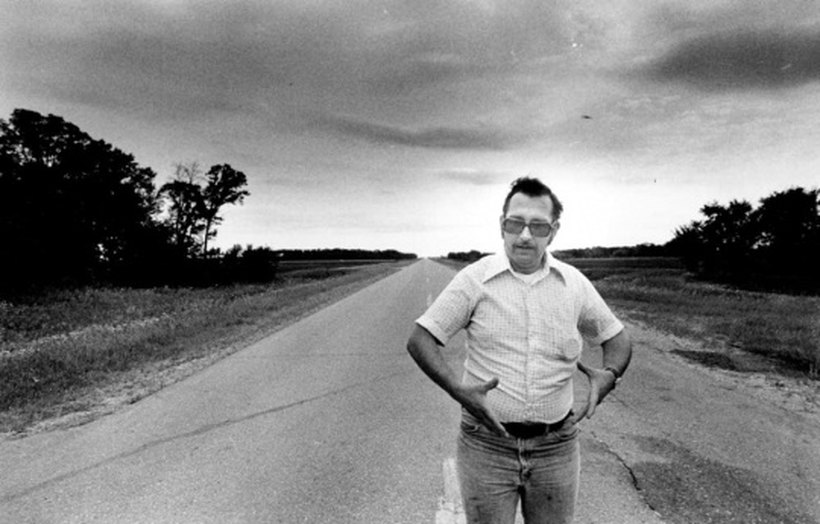
At roughly 1:40 a.m. on 27 August 1979, Marshall County deputy sheriff Val Johnson was on solo night patrol in his 1977 Ford LTD squad car, driving west on County Road 5 about ten miles west of Stephen, Minnesota, near the North Dakota border. This case file covers what witnesses reported, the official narrative, and a two-pass assessment with its evidence tier.
What did witnesses see at County Road 5 near State Highway 220?
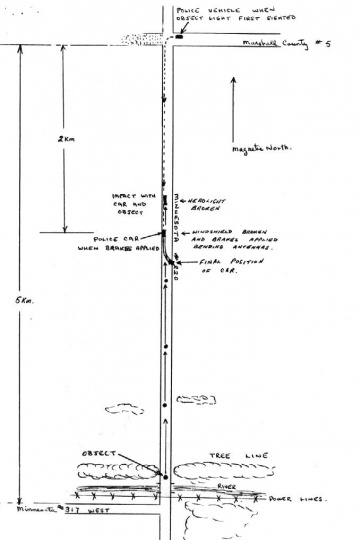
At roughly 1:40 a.m. on 27 August 1979, Marshall County deputy sheriff Val Johnson was on solo night patrol in his 1977 Ford LTD squad car, driving west on County Road 5 about ten miles west of Stephen, Minnesota, near the North Dakota border. He noticed a very bright light off to the side, low over the fields. In his own recorded statement he described it as "a very bright, brilliant light, 8 to 12 inches in diameter, 3 to 4 feet off the ground. The edges were very defined." His first thought was an aircraft in trouble: "I thought perhaps at first that it could be an aircraft in trouble, as it appeared to be a landing light from an aircraft." He turned south onto State Highway 220 to investigate and close the distance.
As he approached, the light did not behave like a landing aircraft. By his account it suddenly rushed at the car. "The light intercepted my vehicle causing damage to a headlight, putting a dent in the hood, breaking the windshield and bending antennas on top of the vehicle." He heard glass breaking, was blinded by the brilliance, and then lost consciousness. In his statement he said he "was rendered either unconscious, neutralized or unknowing for a period of approximately 39 minutes." During that gap the car kept moving. Hendry's reconstruction from the skid evidence had the vehicle travel south in a straight line for 854 feet before the brakes engaged, "by forces unknown to myself," leaving it stopped at a sharp angle across the road shoulder.
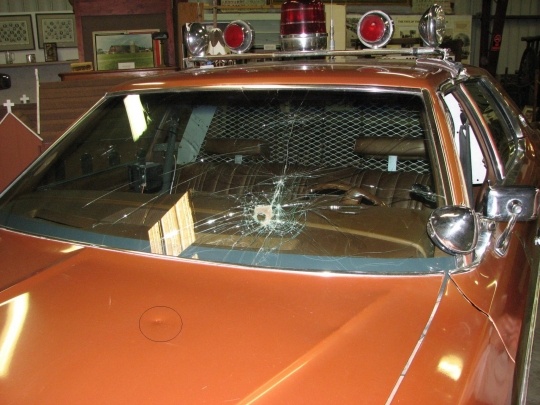
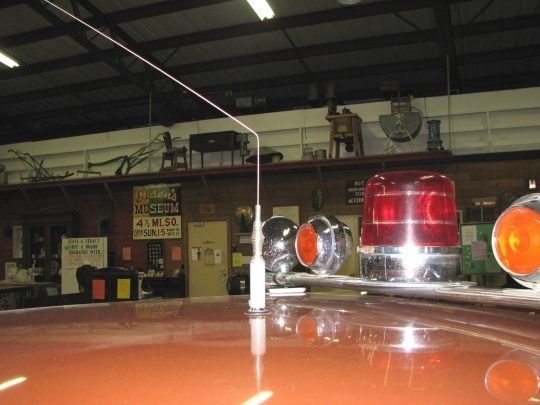
When Johnson came to, the squad car was askew, the windshield cracked, a headlight smashed, the red roof light damaged, the hood dented and two antennas bent. His eyes were burning and he could not stand bright light. He reached for the radio. At 2:19 a.m. he called a 10-88, officer needs assistance, to his dispatcher. The transcribed transmission preserved in the case file has him reporting that something had hit the car and that it was not a vehicle and he did not know what it was. He then noticed something stranger than the damage: "my timepiece in the Police vehicle and my mechanical wrist watch were both lacking 14 minutes of time to the minute." Both clocks, an electric dashboard clock and a wind-up mechanical watch he said he had set earlier that evening, had lost exactly fourteen minutes and otherwise kept running normally. Responding deputies found him shaken, found the car as described, and took him to the hospital in Warren.
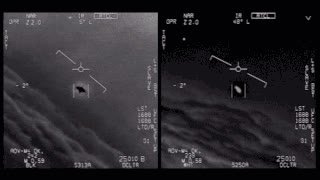
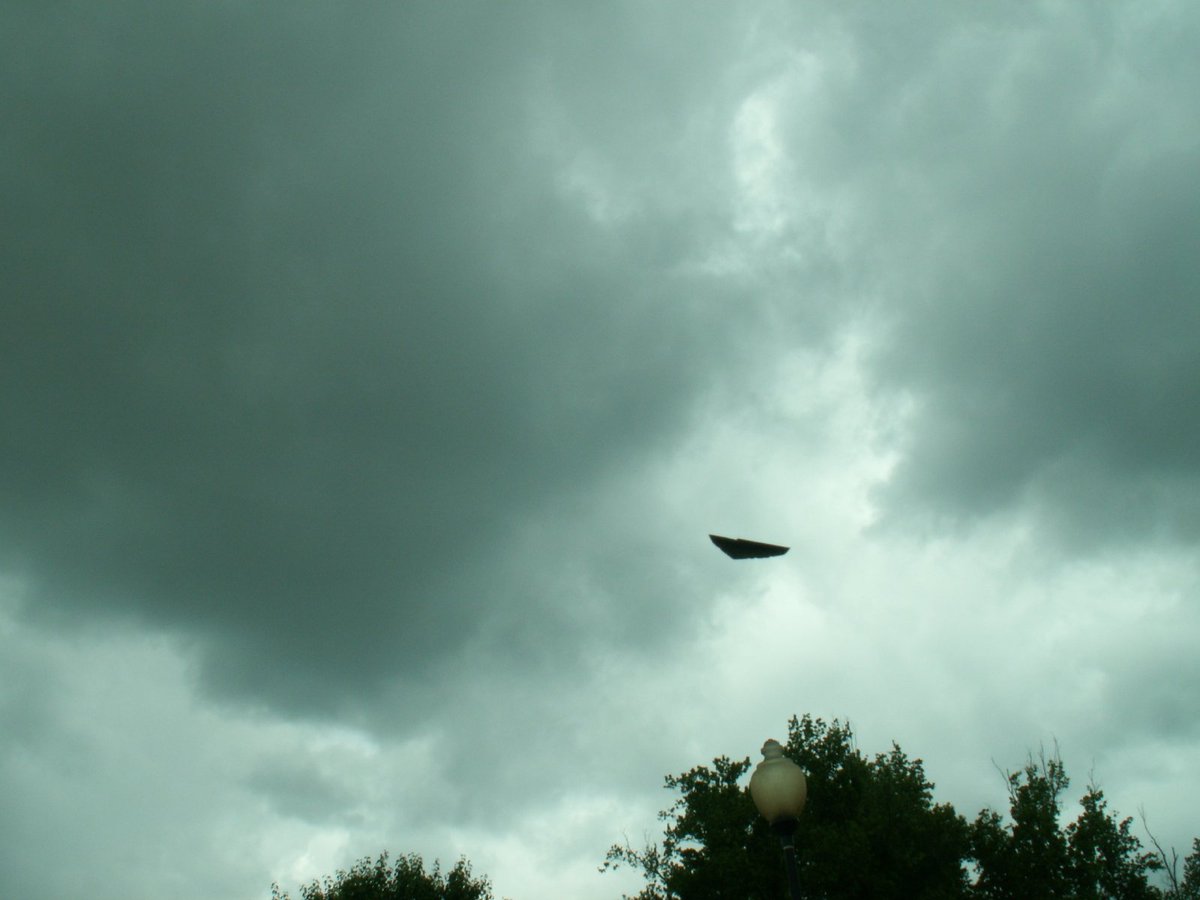
More footage and images of this sighting
What is the official explanation?
There was no federal cover-story apparatus on this one, but there was an unusually thorough multi-party technical investigation, which is what gives the case its weight. The Marshall County Sheriff's Office, under Sheriff Dennis Brekke, documented the scene and the damage and then did something most agencies never do: it invited outside experts to examine the car. The United States Air Force and the FAA were asked whether any aircraft had been in the area at that hour and both reported none. No radar track, no flight plan, no near-miss report from any pilot.
The Center for UFO Studies (CUFOS) in Evanston, Illinois, the organization founded by astronomer J. Allen Hynek, sent its chief investigator Allan Hendry to the scene. Hendry was no enthusiast. He had personally worked through more than a thousand UFO reports and found ordinary causes for almost all of them, to the point that believers called him a closet skeptic. He treated the squad car as a forensic problem and published his findings as a two-part technical report, "Minnesota CEII: The Val Johnson Story," in the International UFO Reporter, Vol. 4 Nos. 3-4 (September-October 1979) and No. 5 (November 1979). He catalogued every damaged component, reconstructed the timeline, and farmed the physical evidence out to corporate laboratories.
The windshield went to Ford Motor Company, where a windshield specialist named Meridan French studied it. The crack ran top to bottom on the driver's side with four apparent impact points, and the fracture pattern showed signs of force from both directions at once. French's reported conclusion was blunt: "Even after several days of reflection on the crack patterns and apparent sequence of fractures, I still have no explanation for what seem to be inward and outward forces acting almost simultaneously." Honeywell engineers examined the bent antennas and the car's electrical system. The roof antenna was bent at roughly a 60-degree angle starting about six inches above its base, the trunk antenna bent near 90 degrees near the top, while the regular front fender antenna was untouched. Magnetic scans of the body for evidence of a strong electromagnetic field came back, in the investigators' words, essentially negative. At the hospital a doctor in Warren diagnosed Johnson's eyes as a "mild case of welder's burns," and an ophthalmologist in Grand Forks found "some irritation to the inner portions of the eye which could have been caused by seeing a bright light after dark," the condition known medically as actinic conjunctivitis. None of the investigating bodies, sheriff, Air Force, FAA, Ford, Honeywell or CUFOS, produced a conventional cause. As the ufoskeptic.org summary of Hendry's work puts it, "no cause could be found for the event, including collision with another vehicle or a low-flying plane, a hoax on the part of Johnson, or anything else." The car was never repaired. It sits today at the Marshall County Historical Society museum in Warren, windshield, hood, lights and antennas left exactly as they were that night, and it is the museum's single most visited artifact.
What did the witnesses think it was?
Val Johnson never claimed to have seen a spaceship and never claimed to know what hit him. That restraint is part of why the case held up. He said only that an intense light collided with his car, that he lost consciousness, and that he woke to find the vehicle and his own eyes damaged. He did not embellish it over the years and did not build a career on it. His own statement is careful and hedged, describing himself as "unconscious, neutralized or unknowing" rather than asserting abduction or missing time of the dramatic kind.
His credibility was vouched for by the people who worked with him. Sheriff Dennis Brekke stood behind his deputy, with the often-quoted line that he knew Val and if Val said it happened, it happened. Johnson was described in the contemporary coverage and in CUFOS's report as a man of professional integrity who was not given to inventing stories. The corroborating evidence was physical rather than testimonial: there were no second eyewitnesses to the light itself, since Johnson was alone, but the responding deputies, the hospital staff, the Ford and Honeywell technicians and the museum that has preserved the car all attest to the damage and the injuries being real and documented in the hours after the event, not assembled later.
Hendry, the man who investigated it hardest, came away convinced it was not a hoax. He considered fabrication seriously, as he always did, and rejected it. His reasoning leaned on the eye injuries above all. A person can dent a hood and crack a windshield with tools, but it is hard to imagine a deputy deliberately scorching his own eyes badly enough that a doctor diagnoses welder's burns, then feigning shock for the ambulance crew, all to stage a prank that put his career under a magnifying glass. Hendry also pointed to the difficulty of reproducing the exact, oddly selective damage pattern, on a rural road at night, without leaving tool marks or being seen, in the few minutes available. Johnson took no money, sought no fame and gave no interviews claiming alien contact. Decades later he was still reported as standing by the simple account he gave that morning.
The dispute
The principal dispute is the hoax allegation made by aviation journalist and professional UFO skeptic Philip J. Klass at the 1980 Smithsonian Institution UFO symposium. Klass framed the case as a binary, either an alien spaceship hit the car or Deputy Johnson staged it, and he came down on the prank side. His grounds were that Johnson had a reputation as a practical joker and had previously talked about running a "UFO patrol," which Klass read as a motive and a hint of fabricated interest. He suggested Johnson damaged the car himself and, in a sarcastic flourish, that he deliberately injured his own eyes and faked a state of shock for the ambulance crew. Klass also accused Allan Hendry of withholding data that would have pointed to a mundane explanation, and he challenged Hendry to have Johnson take a polygraph.
The dispute is real but it is weak as a closing argument, which is why the case stays at Barely Disputed rather than higher. Klass produced no method that reproduces the actual evidence. He showed no tool, no marks, no reconstruction that yields the windshield cracking from both sides at once, the selectively smashed inner headlight, the two bent antennas and one untouched, the punctured roof light, the fourteen-minute loss on both an electric clock and a mechanical watch, and medically diagnosed welder's burns, all at the same time. His case is character inference plus an unmet polygraph dare. Hendry responded that this was "character assassination," that digging up unrelated episodes to discredit a witness was not evidence, and he cited the conflicting polygraph results in the Travis Walton case as the reason he did not treat lie-detector tests as decisive. The one technical foothold the skeptics have is a remark by Ford windshield specialist Meridan French that the crack pattern could be roughly approximated in a laboratory using a rubber mallet. That was a comment about how one might mimic the fractures, not a finding that a mallet was used, and French's own bottom line was that he had "no explanation" for the inward-and-outward forces and attributed them to "mechanical forces of unknown origin."
There is also a partial naturalistic argument, associated with Guy Westcott, that abrupt braking whipped the whip antennas forward into the dome light, bending them and puncturing it without any exotic force, and a recurring suggestion that the luminous object was ball lightning. The Westcott deceleration model can plausibly cover the antennas and the roof light, but it does not touch the windshield fractures, the broken inner headlight, the eye burns or the clock anomaly, and ball lightning is not known to leave this kind of specific selective mechanical damage. Jerome Clark's verdict on the whole Klass-versus-Hendry confrontation was that "as an effort to settle the UFO controversy, the Smithsonian debate was a good public spectacle, settling nothing and changing nobody's mind." That remains the honest position. A hoax cannot be ruled out absolutely, no single case ever can, but no one has demonstrated how this one was faked, the physical evidence is preserved and still unexplained, and the witness was never discredited. The counter-explanation is an unproven assertion, not a shown method, so the case largely stands.
Is the Val Johnson Squad Car Collision real? The two-pass assessment
Pass one, the ordinary explanations. The leading skeptical case is a hoax by Johnson himself, advanced most forcefully by veteran debunker Philip J. Klass at the 1980 Smithsonian Institution UFO symposium. Klass argued there were only two options, a spaceship or a prank, and he favored the prank. He had learned that Johnson liked practical jokes and had talked about organizing a "UFO patrol," and he suggested Johnson damaged the car himself, even sarcastically proposing that Johnson injured his own eyes and faked shock. Klass accused Hendry of withholding data and challenged him to put Johnson on a polygraph. The naturalistic alternatives are thinner. The Air Force and FAA ruled out aircraft in the area, which kills the near-miss-with-a-plane idea, and the lack of engine noise and the eye burns cut against it too. A windshield expert at Ford did note that the crack pattern could in principle be approximated in a lab by tapping with a rubber mallet, which is the hook later skeptics hang the hoax theory on. Guy Westcott offered a partly mechanical reconstruction in which sudden braking whipped the antennas forward into the dome light, removing the need for any exotic force on those parts. Ball lightning has been floated for the luminous object and the eye irritation.
Pass two, if the event is what the evidence shows. Then a small, intensely bright, sharply defined luminous object closed on a moving police car at high speed, struck it with forces strong enough to crack a windshield from both directions at once, bend two of three antennas while sparing the third, smash an inner headlight while leaving the outer one whole, dent the hood, puncture the roof light, stop two independent clocks for the same fourteen minutes, and burn the driver's eyes, all without leaving any identifiable physical residue, radar track, sound or conventional impact mark. Hendry classified it as an unexplained close encounter of the second kind and never wavered from that, calling it one of the most evidential cases he ever worked.
The dispute exists and is real, but it does not close the case. The rubber-mallet remark was a lab thought about how one might mimic the cracks, not a finding that a mallet was used, and Ford's own expert ended at "mechanical forces of unknown origin." Klass's hoax theory rests on character inference and an unproven polygraph dare, not on a demonstrated method that reproduces this specific pattern, the injuries and the clock loss together. Westcott's deceleration model addresses the antennas but not the windshield, the headlight, the burns or the time anomaly. No one has ever shown how to fake the whole constellation. Because there is a named counter-explanation (the Klass hoax claim) but it is unproven and contested, while the physical evidence remains genuinely unexplained and the witness was never discredited, this case sits at Barely Disputed. The damage is authentic and preserved, the official and corporate investigations all came up empty, and the object remains unidentified.
Sources
- www.mnhs.org/mnopedia/search/index/event/val-johnson-incident-1979
- web.archive.org/web/20250130103119/https://www.ufocasebook.com/minnesotasheriff1979.html
- www.ufoskeptic.org/marshall/
- ufologie.patrickgross.org/htm/marshallcounty79.htm
- cufos.org/PDFs/IUR%20issues/IUR%20Vol.%204%20No.%203-4%20Sept.-Oct.%201979.pdf
- cufos.org/PDFs/IUR%20issues/IUR%20Vol.%204%20No.%205%20Nov.%201979.pdf
- ufos-scientificresearch.blogspot.com/2014/09/more-on-little-known-1980-smithsonian.html
- www.mprnews.org/story/2015/08/26/minnesota-deputy-squad-car-ufo-mystery
More cases from this region: UFO sightings in United States