A Soviet Cosmonaut Sees a UFO (1979)
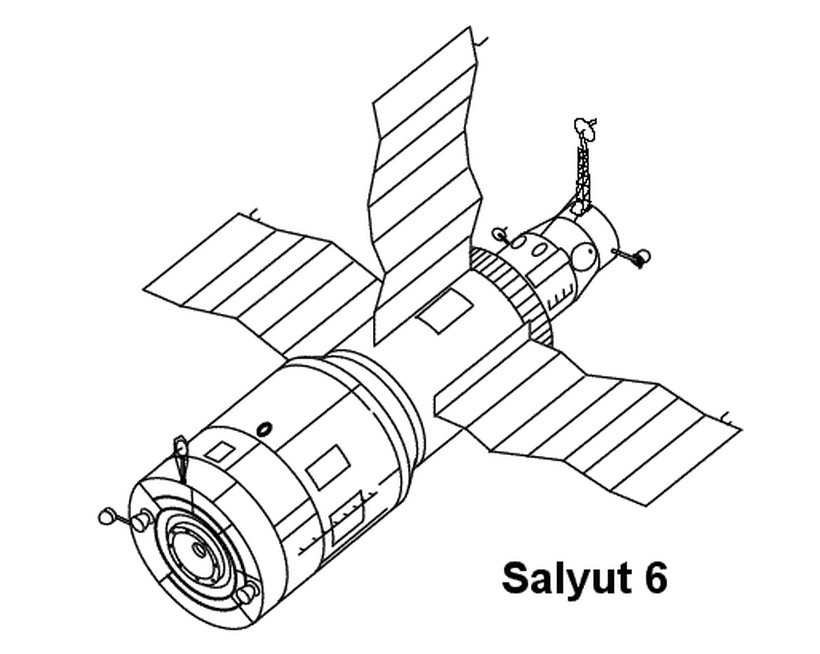
The account, as it circulates in the UFO literature, runs like this. This case file covers what witnesses reported, the official narrative, and a two-pass assessment with its evidence tier.
What did witnesses see at Earth orbit?
The account, as it circulates in the UFO literature, runs like this. In April 1979 cosmonaut Viktor Afanasyev is said to have lifted off to dock with the Soviet orbital station Salyut 6. While still en route, the story goes, he saw an object turn toward his spacecraft, fall into formation with it, and pace it through orbit.
The words attributed to him are consistent across every retelling. "It followed us during half of our orbit. We observed it on the light side, and when we entered the shadow side, it disappeared completely." He is quoted describing the thing in surprisingly engineered terms: "It was an engineering structure, made from some type of metal, approximately 40 meters long with inner hulls. The object was narrow here and wider here, and inside there were openings. Some places had projections like small wings." On the distance, the quote reads: "We photographed it, and our photos showed it to be 23 to 28 meters away."
So the reported object is not a light or a blur. It is a roughly 40-meter metal structure with a varying cross-section, internal compartments, openings or portholes, and small wing-like protrusions, holding station 23 to 28 meters off the spacecraft for about half an orbit, then vanishing the instant the craft crossed into Earth's shadow. Afanasyev is said to have radioed its size, shape and position back to mission control throughout the encounter and to have photographed it repeatedly.
The second half of the story is the suppression. On return to Earth, the account says, he was debriefed, his cameras and film were confiscated, and he was ordered never to speak of it. The photographs and the voice transmissions from orbit have never been released. The framing is that only after the collapse of the Soviet Union did he feel safe enough to tell it at all. That is the seen-and-told shape of the case: a structured craft, a formation flight, photographs taken, and then an official silence that conveniently explains why none of the imagery can be produced.
What is the official explanation?
There is no Soviet or Russian official narrative for this event, because in the documented record the event has no place to sit. No 1979 mission report, cosmonaut debrief, TASS bulletin, or space-program log records a cosmonaut named Afanasyev observing a 40-meter object near Salyut 6, for a simple reason: Viktor Afanasyev was not in space in 1979 and was not yet a cosmonaut.
The verifiable spaceflight record is unambiguous. The standard cosmonaut biography at spacefacts.de gives Viktor Mikhailovich Afanasyev's cosmonaut selection date as 2 September 1985 and lists his first spaceflight as Soyuz TM-11 to Mir, launching 2 December 1990 and landing 26 May 1991, followed by Soyuz TM-18 in 1994 and Soyuz TM-29 in 1999. The astronautix.com biography and the Wikipedia chronology agree on the same dates: 1985 group, first flight December 1990. In April 1979 Afanasyev was a serving military test pilot who had not been selected for cosmonaut training and would not be for another six years.
What actually flew to Salyut 6 in that window is also documented. The crewed mission that lifted off in April 1979 was Soyuz 33, launched 10 April 1979 with commander Nikolai Rukavishnikov and Bulgarian Intercosmos cosmonaut Georgi Ivanov. Soyuz 33 suffered a main-engine failure during the rendezvous, the engine shutting down after about three seconds of a planned burn at roughly 1,000 meters to several kilometers from the station, and the crew never docked. They made a steep ballistic re-entry and were recovered safely, which is why the unmanned Soyuz 34 was sent up that June to give the resident Soyuz 32 crew a trusted ride home. Those facts come from the Soyuz 33 mission record and globalsecurity.org's Soyuz mission summaries. There is no Afanasyev on that flight, no second April 1979 crewed launch, and no documented anomaly logged against Soyuz 33.
The nearest thing to an "official" element in this case is therefore the suppression claim itself, the confiscated film and the gag order, which is asserted inside the story rather than evidenced from outside it. No archive, no FOIA-style Russian release, and no mission transcript has ever been produced to support it. The account is also conspicuously absent from the serious primary literature on Soviet UFO reports: Jacques Vallee's 1992 "UFO Chronicles of the Soviet Union," which catalogues Soviet sightings in detail, contains no Afanasyev case and no 1979 Salyut 6 object.
What did the witnesses think it was?
The single named witness is Viktor Afanasyev himself, and the weight of the case rests entirely on his authority as a cosmonaut. That authority is real for his actual career: he is a genuine three-mission Mir veteran with hundreds of days in orbit and multiple spacewalks. The problem is that the authority is being borrowed for a flight he never made.
There are no corroborating witnesses. The story names no second crew member who saw the object, no ground-control operator who logged the radioed descriptions, and no fellow cosmonaut who confirms the encounter. This matters because the wider catalogue of Soviet and Russian cosmonaut UFO claims does have named, dated, multi-witness entries, and Afanasyev's 1979 sighting is not among them. The compilation at openminds.tv of cosmonaut UFO statements lists Vladimir Kovalenok and Aleksandr Ivanchenkov describing a "tennis ball" object on Salyut 6 in 1978, Kovalenok describing a melon-shaped object with a cone-like extension on Salyut 6 on 5 May 1981, Valery Ryumin and Leonid Popov reporting white spots in June 1980, Gennadiy Manakov and Gennadiy Strekalov reporting a silvery sphere from Mir in September 1990, and Musa Manarov filming a cigar-shaped object from Mir in March 1991. Afanasyev's alleged April 1979 encounter appears in none of these serious catalogues. It surfaces only in the chain that runs through Michael Hesemann.
What Afanasyev himself actually said, in his own language and in full context, is the missing piece. The quotes that circulate reach English readers only after passing through an interview, a translation, and a ufologist's framing. Cosmonauts do report seeing "unidentified" objects in orbit, meaning objects they could not immediately name, and such objects routinely turn out to be insulation fragments, drifting debris, ice crystals, or distant booster stages. If Afanasyev described an unidentified object from one of his real 1990s Mir flights, and that account was later relabelled as a structured craft, redated to 1979, and relocated to Salyut 6, the canonical story would be the predictable result. As a motivated-testimony note, the suppression element is unfalsifiable by design: it explains the total absence of the photographs that would otherwise settle the matter.
The dispute
The dispute is fundamental: the case names a witness who could not have been present. The widely repeated story holds that cosmonaut Viktor Afanasyev observed and photographed a 40-meter metallic object while en route to Salyut 6 in April 1979. But Afanasyev's documented spaceflight career makes April 1979 impossible. The standard cosmonaut biography at spacefacts.de lists his selection date as 2 September 1985 and his first spaceflight as Soyuz TM-11, launched 2 December 1990. The astronautix.com biography and the published mission chronology agree. In April 1979 he was a military pilot who had not yet been selected for cosmonaut training. He had no spaceflight in the 1970s at all, and his only flights were to Mir in 1990 to 1991, 1994, and 1999.
The actual April 1979 mission to Salyut 6 is on record and contains no Afanasyev. It was Soyuz 33, launched 10 April 1979 with commander Nikolai Rukavishnikov and Bulgarian cosmonaut Georgi Ivanov. Its main engine failed during the approach, shutting down early, the crew never docked, and they returned to Earth on a steep ballistic descent. This is documented in the Soyuz 33 mission record and globalsecurity.org's Soyuz summaries, and it is why the unmanned Soyuz 34 was launched that June. There was no second crewed launch in April 1979 and no logged anomaly against Soyuz 33. So the canonical claim places a cosmonaut who was not yet a cosmonaut on a flight that did not include him, in a month whose one real crewed mission failed to reach the station.
The trail of the story points to its construction rather than to an event. It is absent from Jacques Vallee's 1992 primary compilation "UFO Chronicles of the Soviet Union" and from the careful catalogues of genuine cosmonaut UFO statements, which do list Kovalenok, Ryumin, Popov, Manakov, Strekalov, and Manarov by name and date but not Afanasyev in 1979. The account instead surfaces through German ufologist Michael Hesemann, whose filmed interviews with Soviet cosmonauts and generals were presented at the International UFO Congress in Laughlin, Nevada on 6 March 2002, and from there propagated across UFO websites with the "April 1979 Salyut 6" wording fixed in place. Space historian James Oberg, a former NASA engineer who specialises in Soviet space anomalies, has long argued that famous cosmonaut UFO stories trace to classified launches and orbital debris, and has identified the Afanasyev 1979 date as flatly inconsistent with the flight record.
What keeps this from being a settled discredit rather than a strong dispute is only the missing primary layer: the original, unedited Russian-language interview in which Afanasyev allegedly spoke. It is possible he described an unidentified but mundane object from one of his real 1990s Mir flights and that the account was later redated and relocated. Either way, the specific claim as it stands, Afanasyev, April 1979, Salyut 6, is positively contradicted by named, dated, cross-verified records, which is why this case is filed as Strongly Disputed and flagged for discredit review.
Is the A Soviet Cosmonaut Sees a UFO (1979) real? The two-pass assessment
Pass one, how could this be entirely ordinary. The most ordinary explanation is the strongest one here, and it does not even require an optical illusion: the encounter as described could not have happened to this witness on this date. Afanasyev was selected as a cosmonaut on 2 September 1985 and first flew on 2 December 1990, per spacefacts.de and astronautix. In April 1979 he had never been to space. The crewed mission that did launch toward Salyut 6 that month was Soyuz 33 on 10 April 1979, crewed by Rukavishnikov and Ivanov, which suffered an engine failure and never docked. There is no slot for Afanasyev and no second April 1979 launch. So even before asking what the object was, the case fails on identity and date. If a real perception sits underneath the legend at all, it most plausibly belongs to one of Afanasyev's genuine Mir flights in the 1990s and describes a mundane orbital object, a piece of debris, an insulation fragment, or a distant rocket plume, later inflated into a 40-meter structured craft. Space historian James Oberg, a former NASA engineer who has spent decades tracing Soviet space UFO stories, has shown that many of the famous ones resolve into classified launches, missile tests, and decaying hardware, and he has specifically flagged the Afanasyev 1979 date as impossible given the cosmonaut's flight record.
Pass two, if real, what is it. Take the account at face value and you have a 40-meter metallic craft with internal compartments, openings, and wing-like protrusions, deliberately station-keeping 23 to 28 meters off a Soyuz for half an orbit, photographed in detail, then officially confiscated and buried. That is an extraordinary claim of an engineered, controlled object in Earth orbit. But the only evidence for it is the testimony, and the testimony is anchored to a flight that did not occur. The confiscated-film element removes the one thing that could verify it. The story is also absent from Vallee's primary Soviet UFO compilation and from the serious cosmonaut-sighting catalogues, and surfaces only through Michael Hesemann's interviews, presented at the Laughlin congress on 6 March 2002 and reproduced from there across the UFO web.
This is why the case lands at Strongly Disputed rather than merely barely. The bar for "strongly" is a positive identification of the specific real-world cause, and here the cause is the documentary record itself: a named witness whose verified career and the verified April 1979 crew manifest both rule him out of the claimed event. That is not a contested psychological reconstruction or an unproven natural-explanation guess; it is a hard chronological impossibility tied to named, dated, cross-checked spaceflight records. The two photographs that would test it have, by the story's own logic, never existed in public. The verdict is Strongly Disputed, and because the evidence is method-shown and misattribution-grade, it is flagged for discredit review rather than asserted as a discredit here.
Sources
- www.spacefacts.de/bios/cosmonauts/english/afanasyev_viktor.htm
- www.astronautix.com/s/soyuz33.html
- www.globalsecurity.org/space/world/russia/soyuz_33_series.htm
- archive.org/stream/B-001-002-573/B-001-002-573_djvu.txt
- www.ufoevidence.org/cases/case392.htm
- web.archive.org/web/20260113033810/https://timefordisclosure.com/sightings-russian-cosmonaut-ufo-sightings/
More cases from this region: UFO sightings in Soviet Union