The BAASS Underground Vault Designed for Recovered Hardware and Biological Samples, June 2009
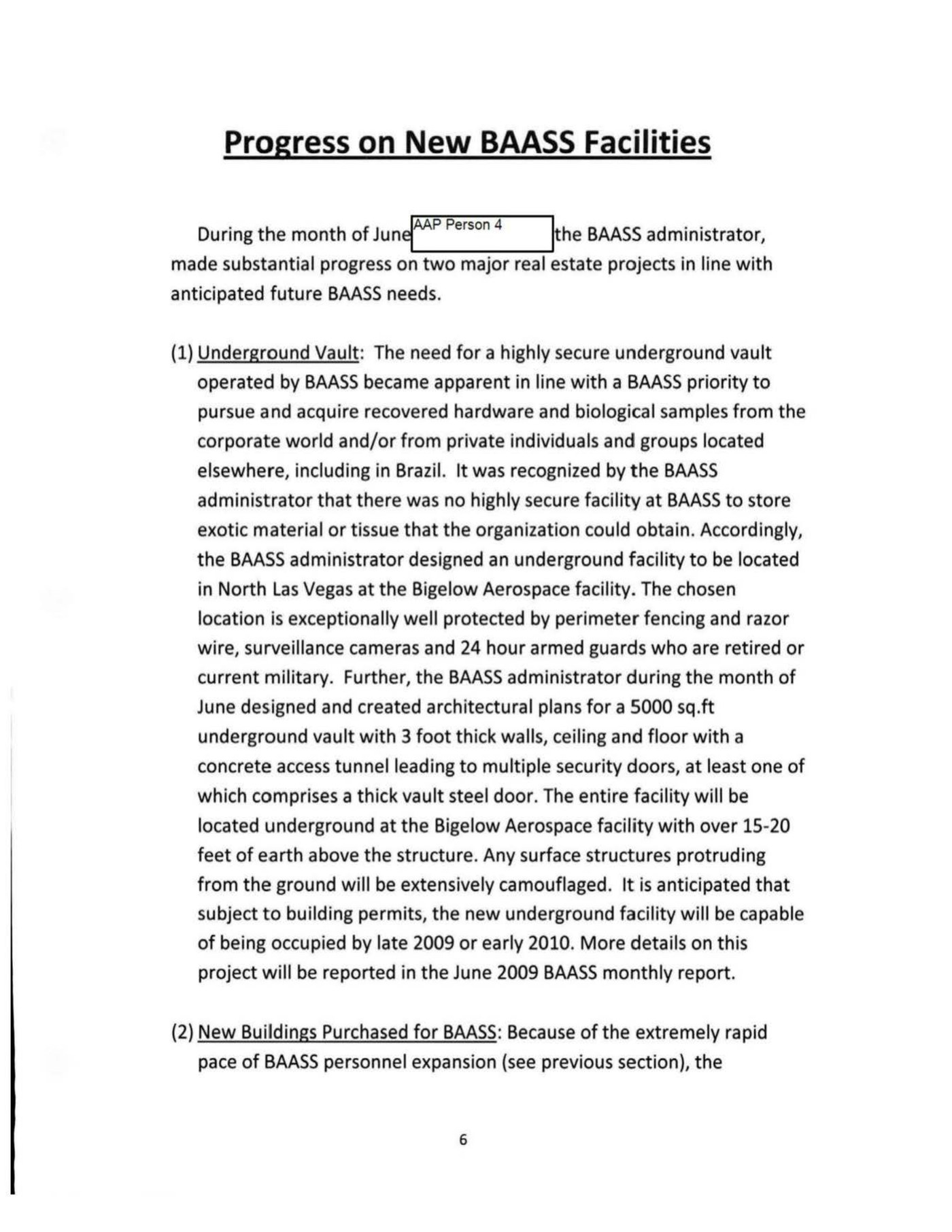
A contractor working under a Defense Intelligence Agency programme designed a 5,000 square foot underground vault with three foot thick walls, to store what its own monthly report called exotic material or tissue.
What did witnesses see at Bigelow Aerospace?
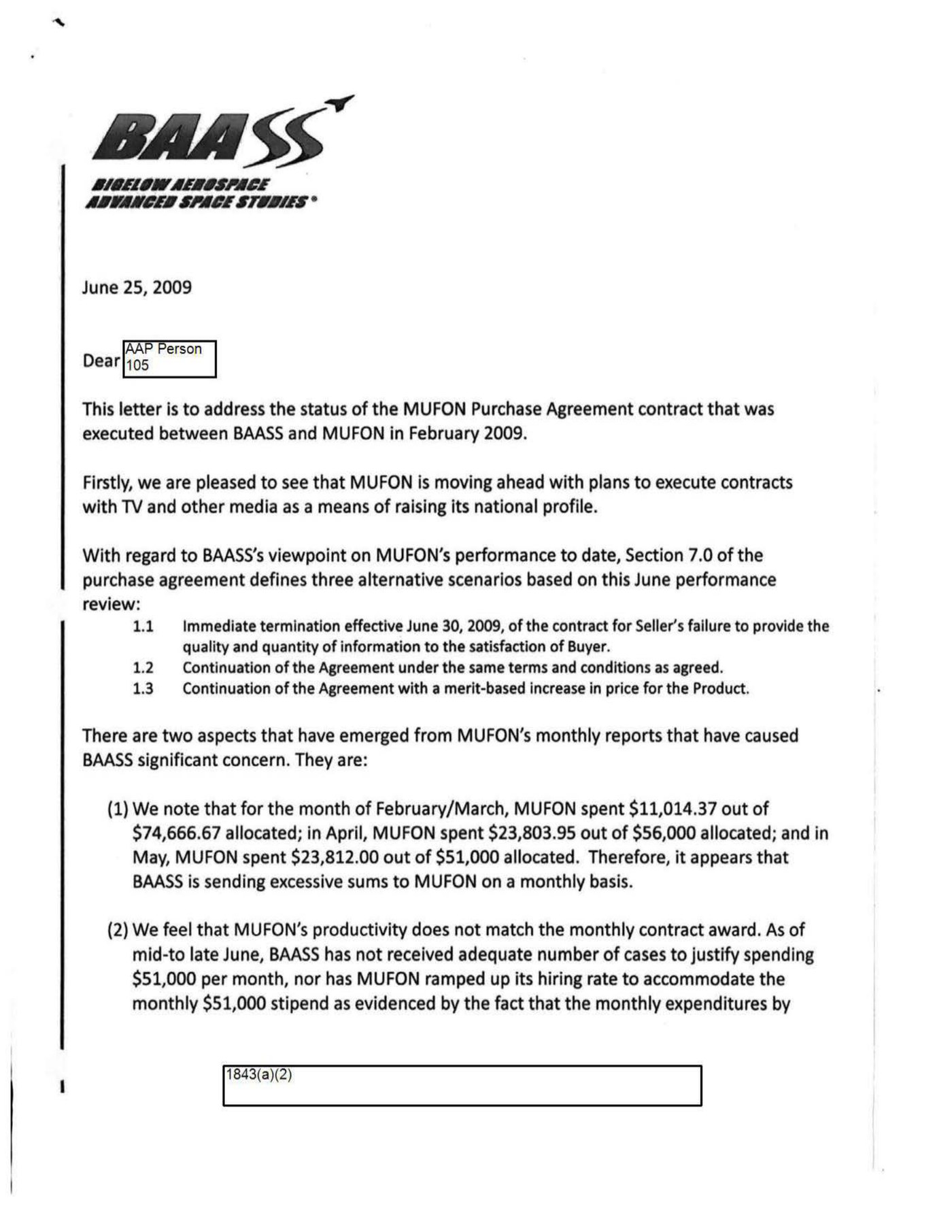
A monthly report filed by a Defense Intelligence Agency contractor describes the design of a concealed underground vault. The document is the June 2009 monthly report of Bigelow Aerospace Advanced Space Studies, released on 23 October 2026, and the relevant passage sits under the heading Progress on New BAASS Facilities.
The report states the reason for the project in its own words. The need for a highly secure underground vault operated by BAASS became apparent in line with a BAASS priority to pursue and acquire recovered hardware and biological samples from the corporate world and or from private individuals and groups located elsewhere, including in Brazil. It continues that it was recognized by the BAASS administrator that there was no highly secure facility at BAASS to store exotic material or tissue that the organization could obtain.
The specifications are given in the same paragraph. During June 2009 the BAASS administrator designed and created architectural plans for a 5,000 square foot underground vault with three foot thick walls, ceiling and floor, reached by a concrete access tunnel leading to multiple security doors, at least one of which comprises a thick vault steel door. The facility was to be located underground at the Bigelow Aerospace facility in North Las Vegas, with over 15 to 20 feet of earth above the structure, and any surface structures protruding from the ground were to be extensively camouflaged. The report notes that the chosen location is already protected by perimeter fencing and razor wire, surveillance cameras and 24 hour armed guards who are retired or current military. Subject to building permits, occupancy was anticipated by late 2009 or early 2010.
A second real estate project is described in the same section. Faced with rapid personnel expansion, the administrator personally inspected close to fifty buildings across the Las Vegas Valley and purchased five office buildings, in escrow as of the end of June 2009. These were to include a 5,000 square foot laboratory and secure physical evidence storage facility, and a second building containing a secure conference room, identified in the document as a SCIF, with adjacent office space.
What is the official explanation?
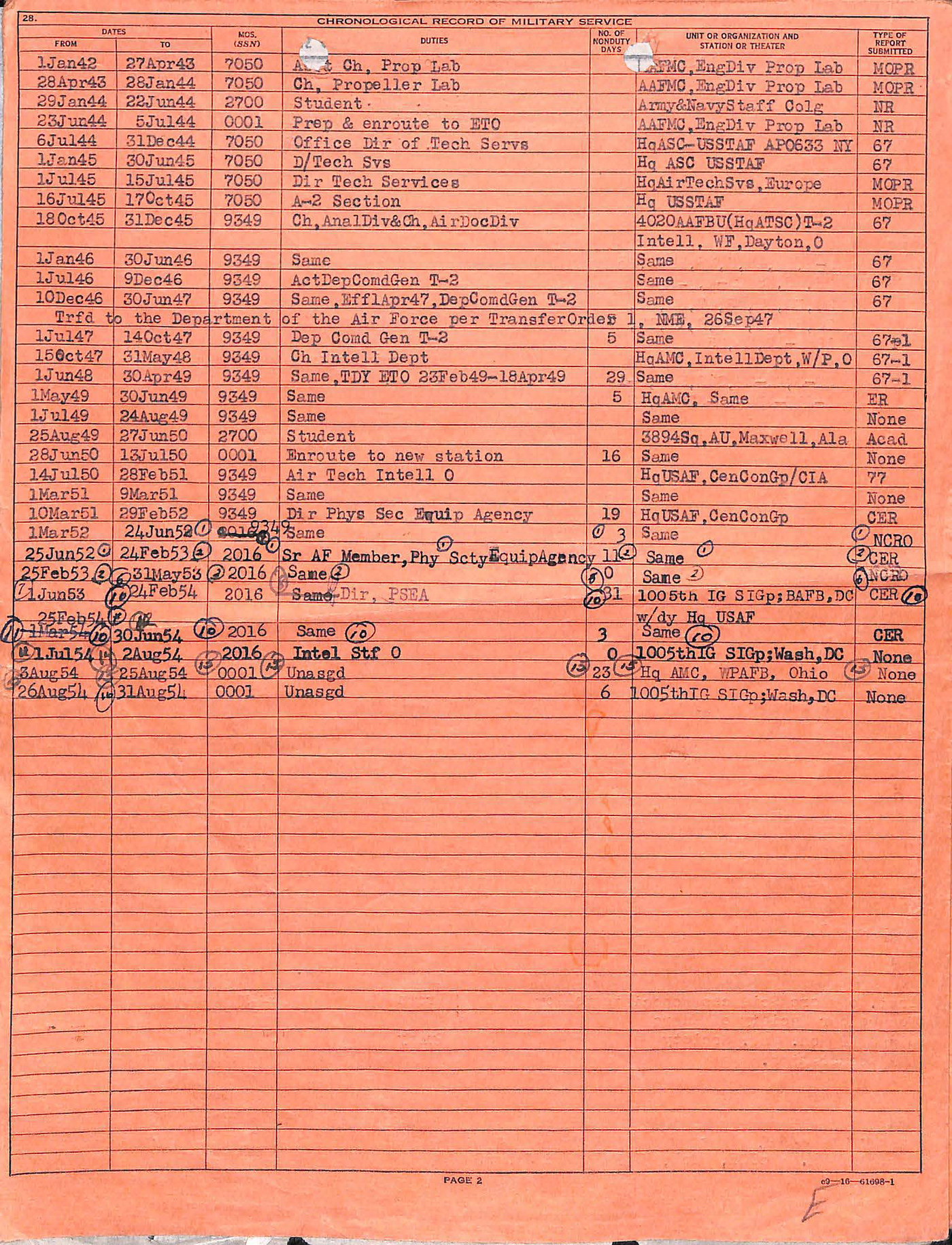
The source is DOW-UAP-D171, BAASS Monthly Report, March 2009 by the manifest's title, carrying a manifest incident date of 9 July 2009 and a location of Las Vegas, Nevada. The document itself is 134 pages and its content is the June 2009 reporting period. It was published by the Department of War on 23 October 2026 in PURSUE Release 07 and is marked as redacted in the manifest.
BAASS was the contractor to the Advanced Aerospace Weapon System Applications Program, a Defense Intelligence Agency administered programme active from 2008 to 2012. The Department's own blurb for every document in this group describes AAWSAP as having an official scope of work identifying twelve technical research areas relating to potential aerospace threats over a time horizon of more than forty years.
No official comment on the vault exists. The released document is a contractor's progress report to its sponsor, not an agency statement, and the Department has published it without annotation. There is no record in the release of whether the vault was built, whether building permits were sought or granted, or what if anything was ever stored in it.
The redaction convention in this file is worth noting because it shapes what can be said. Individuals are replaced with tokens of the form AAP Person followed by a number, and the withholding is marked with the code 1843(a)(2). Section 1843 of the UAP Disclosure Act subtitle, which is set out as a note to title 44 of the United States Code, provides the statutory grounds for postponing public disclosure of unidentified anomalous phenomena records, and subsection (a)(2) concerns personal privacy. The administrator who designed the vault is therefore referred to throughout only as AAP Person 4, and this archive does not name him, because the document does not.
What did the witnesses think it was?
The passage is a single contractor's self-report, so the first question is what it actually establishes and what it only asserts.
It establishes, as a documented fact, that a federally contracted organisation wrote down in a report to its government sponsor that it intended to acquire recovered hardware and biological samples, that it had no secure place to put exotic material or tissue, and that it responded by designing a concealed hardened structure. That is the contractor's own stated intent, recorded contemporaneously, and it is now in the public record.
It does not establish that any such material existed, was ever acquired, or was ever stored. The report describes a need, a design and a timeline. It reports no acquisition. The word recovered appears as a description of the category of thing BAASS hoped to obtain from the corporate world or from private individuals, not as a description of anything in hand.
The Brazil reference is the detail no coverage has picked up, and it deserves to be stated carefully. The document names Brazil as one of the places where the private individuals and groups holding such material were located. It does not say what material, from what event, or from whom. Brazil has a substantial documented UFO record and a national archive of military reports, and this archive holds cases drawn from it, but nothing in this document connects the vault plan to any specific Brazilian case, and no such connection should be inferred from the sentence alone.
One internal error is worth logging for anyone who works from the text. The report dates the escrow on the five office buildings as of June 31, 2009. June has thirty days. This is the contractor's own slip, not a transcription artifact, and it is a small reminder that these are working documents rather than polished products.
Is the BAASS Underground Vault Designed for Recovered Hardware and Biological Samples, June 2009 real? The two-pass assessment
Pass one, how this could be mundane, and a good deal of it is. Bigelow Aerospace was a private aerospace company with genuine government contracts and genuine proprietary hardware, operating on a secured industrial campus. Companies in that position build secure storage. A hardened underground facility with controlled access is an unremarkable thing for a contractor handling classified material to want, and the same report describes an ordinary commercial expansion of five office buildings alongside it. The SCIF is a standard requirement for any contractor reading classified product. Camouflaging surface structures is consistent with site security practice rather than with concealment of contents.
The deflating reading of the striking phrase is also available. Exotic material is a term of art that can cover advanced alloys, metamaterials and engineered samples of entirely terrestrial origin, and the same monthly report lists consultants working on metamaterials and signature reduction, pulse power weaponry and advanced nuclear space propulsion. Tissue and biological samples are exactly what a programme that was simultaneously collecting soil, plant, animal and hair specimens from field investigations would need to store. The vault need not imply anything recovered from anywhere unusual.
Pass two, what does not deflate. The sentence structure is the part that resists the mundane reading, because the document gives the vault a specific purpose rather than a general one. It does not say BAASS needed secure storage and therefore built a vault. It says the need became apparent in line with a BAASS priority to pursue and acquire recovered hardware and biological samples, from the corporate world and from private individuals, including in Brazil. The stated driver is an acquisition programme aimed at material held by third parties. Whatever one concludes about whether such material exists, a federally funded contractor writing to its Defense Intelligence Agency sponsor that acquiring it was a priority, and that it had designed a buried vault to hold it, is a documented fact about the programme.
The archive tiers this Unknown. No official explanation has been offered and none is contradicted. Nothing is claimed to have been recovered, and this archive does not claim it. What is on the record is intent, a design, a set of dimensions and a deadline, written by the contractor and released by the government seventeen years later.
Sources
- www.war.gov/medialink/ufo/release-07/documents/DOW-UAP-D171-BAASS_Monthly_Report_June_2009.pdf
- www.war.gov/UFO/
- www.abovethenormnews.com/2026/10/24/pentagon-ufo-underground-vault/
More cases from this region: UFO sightings in United States