Colonel Howard M. McCoy's Air Force Personnel File, Closed 31 August 1954
The Department of War released the complete 298 page personnel file of the officer who ran Air Force technical intelligence through the founding years of the official UFO investigation. The file never once mentions flying saucers, and what it does contain has not been reported.
What did witnesses see at Headquarters Air Materiel Command?
The largest single document in the seventh PURSUE tranche is a personnel file. It runs to 298 pages and belongs to Colonel Howard Monroe McCoy, the officer who directed Air Force technical intelligence at Wright Field during the years in which the service created its first formal investigation of unidentified flying objects.
The most important fact about the file is a negative one, and it is measured rather than argued. Across all 298 pages the extracted text contains zero occurrences of flying saucer, zero of saucer, zero of unidentified, zero of Project Sign, zero of Grudge and zero of estimate of the situation. The word Sign appears 193 times and every sampled occurrence is Signed, Signature or Signal on a routine form. This is the same false-positive trap that this archive has logged before, and it is worth stating plainly: the file is a career administrative record, and the headline framing that the Department released the dossier of the man who ran America's first UFO programme describes the man accurately and the document not at all.
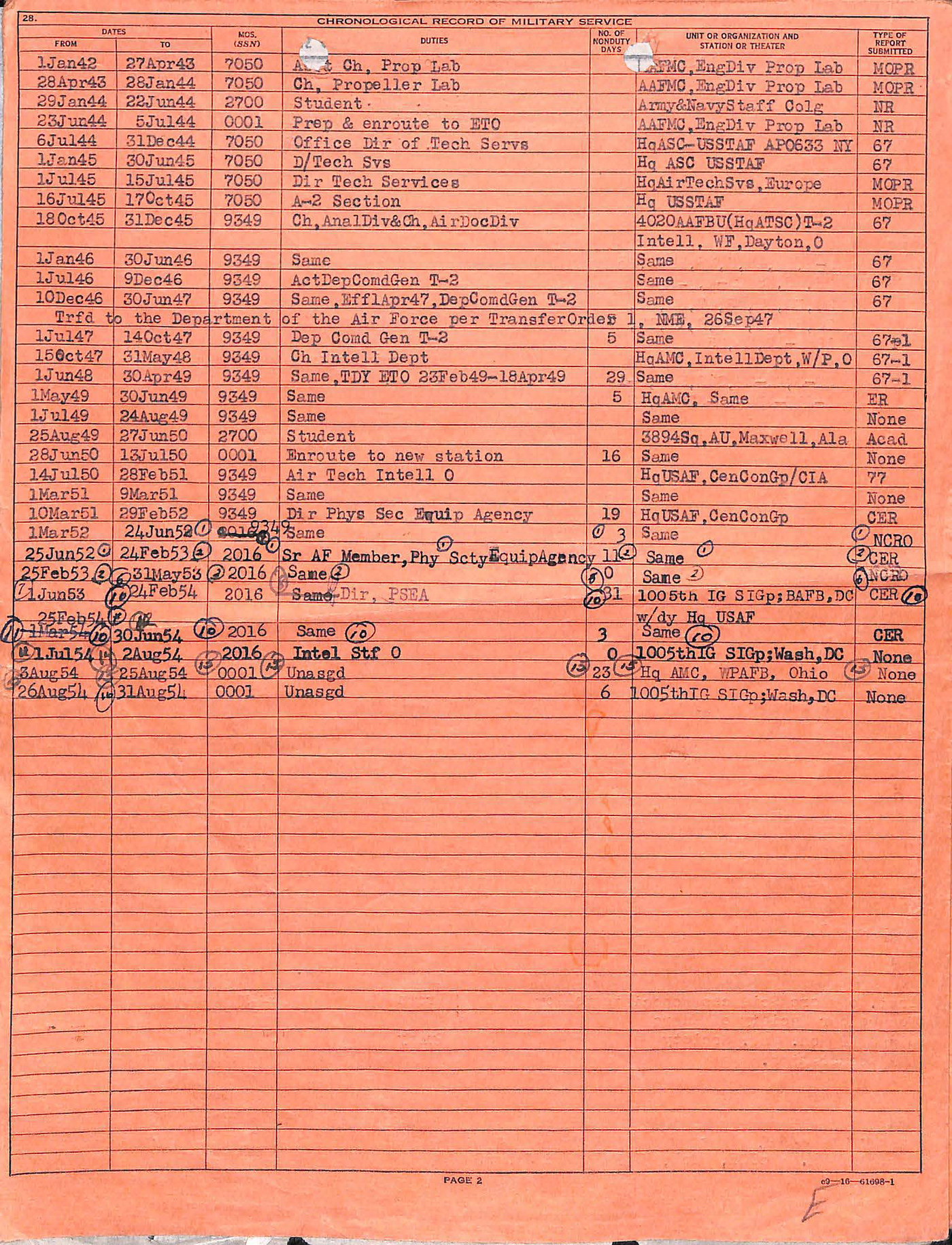
What the file does contain is the official, dated, signed record of exactly where McCoy sat during the relevant years. The Chronological Record of Military Service, reproduced here as the hero image, is legible in full. It records him as Chief of the Analysis Division and Chief of the Air Documents Division at T-2 Intelligence, Wright Field, Dayton, from 18 October 1945. He became Acting Deputy Commanding General, T-2, on 1 July 1946, and Deputy Commanding General, T-2, effective 1 April 1947. He held that post through 14 October 1947. From 15 October 1947 to 30 April 1949 he was Chief of the Intelligence Department at Headquarters Air Materiel Command, with a temporary duty tour to the European Theatre from 23 February to 18 April 1949.
Those dates bracket the founding period precisely. He was Deputy Commanding General for intelligence at Wright Field in June 1947, when civilian sightings began, and in September 1947, when Air Materiel Command produced its assessment of the phenomenon. He was Chief of the Intelligence Department for the whole life of Project Sign and into the period when it was redesignated.
More footage and images of this sighting
What is the official explanation?
The file is published as DOW-UAP-D180, Final Personnel Record for McCoy, Howard M., U.S. Air Force, 1954, in the Department of War PURSUE Release 07 of 23 October 2026. The manifest gives the incident date as 31 August 1954 and the location as not applicable. The Department's own summary describes him as leaving service as a Colonel, and records that from December 1946 to August 1949 he served as Deputy Commanding General for Intelligence (T-2) and later as Chief of the Intelligence Department, Headquarters, Air Materiel Command.
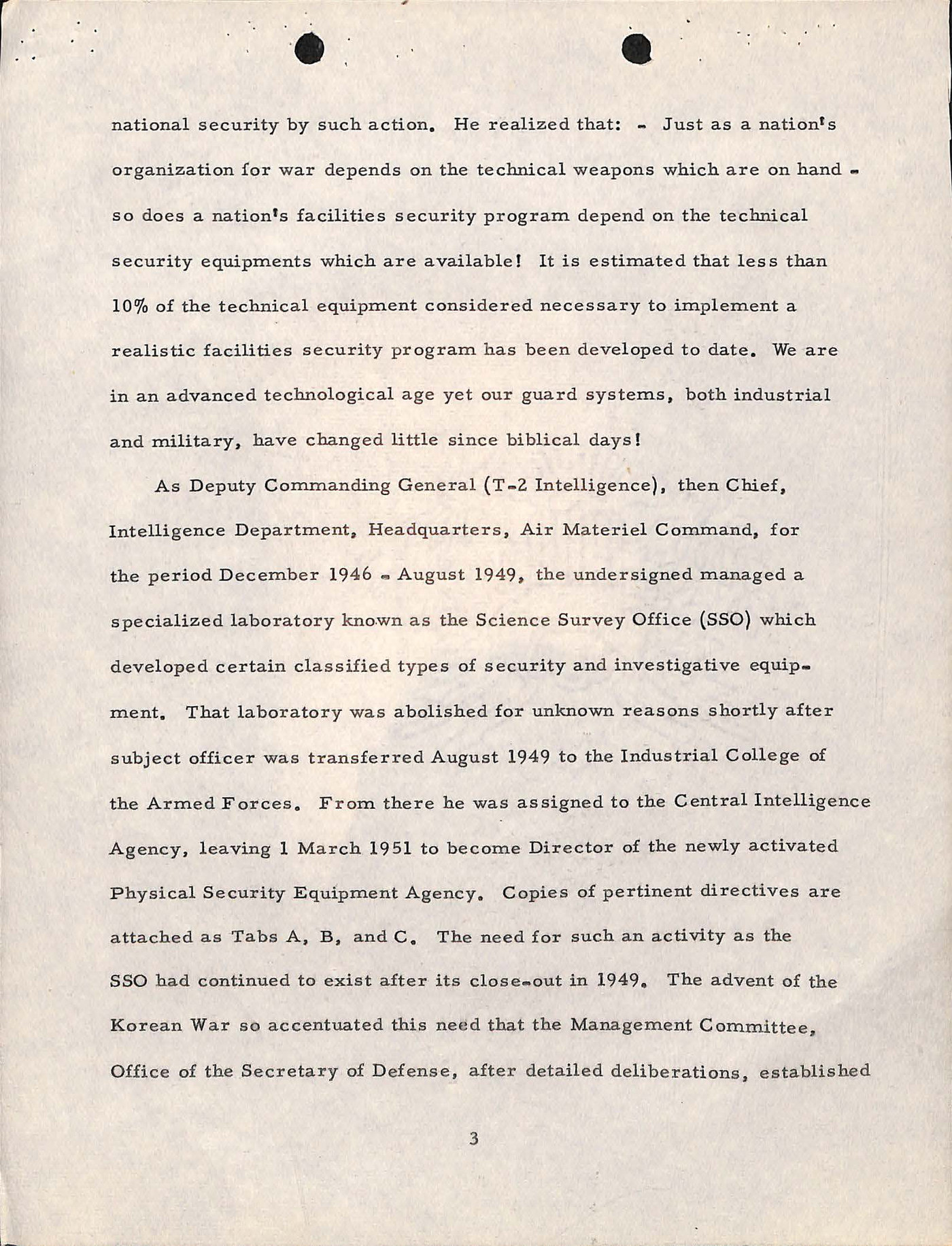
Two findings inside the file have not appeared in the coverage of the release, and both come from a single page of McCoy's own narrative, written in the third person as the undersigned.
The first is an organisation. McCoy states that as Deputy Commanding General (T-2 Intelligence), then Chief, Intelligence Department, Headquarters, Air Materiel Command, for the period December 1946 to August 1949, he managed a specialized laboratory known as the Science Survey Office, which developed certain classified types of security and investigative equipment. He then records that the laboratory was abolished for unknown reasons shortly after he transferred in August 1949 to the Industrial College of the Armed Forces. The phrase for unknown reasons is his.
The second is an assignment. McCoy writes that from the Industrial College he was assigned to the Central Intelligence Agency, leaving on 1 March 1951 to become Director of the newly activated Physical Security Equipment Agency. The Chronological Record corroborates this independently in its own column: from 14 July 1950 to 28 February 1951 his duty is recorded as Air Technical Intelligence Officer, Headquarters United States Air Force, Central Control Group slash CIA.
The file also establishes who rated him. Nathan F. Twining, as Lieutenant General commanding Air Materiel Command, personally concurred in McCoy's efficiency reports, signing the endorsement I concur in the above report. Twining is the officer who signed the letter of 23 September 1947 that is the single most quoted Air Force document of the early period.
What did the witnesses think it was?
A personnel file has no witnesses, so the question is what the record supports and what it does not.
It supports the chain of command with documentary precision. McCoy's efficiency reports were endorsed by Twining at Air Materiel Command, which means the man who wrote that the reported phenomena were something real and not visionary or fictitious was the rating officer of the man running the intelligence department that assessed them. That relationship is normally cited from secondary histories. Here it sits in the primary paperwork of both officers' careers.
It also fixes the Science Survey Office as a real, named, classified laboratory under McCoy's management during the exact window of December 1946 to August 1949. The archive has not found this entity named in the mainstream literature of the period.
It does not support any UFO connection for that laboratory. McCoy describes its output as certain classified types of security and investigative equipment, which is consistent with the rest of his career: he went on to direct the Physical Security Equipment Agency and to serve as Senior Air Force Member of that agency into 1954. The same page complains that less than 10 percent of the technical equipment considered necessary to implement a realistic facilities security program has been developed to date, and delivers the line that dates the man as much as the document: we are in an advanced technological age yet our guard systems, both industrial and military, have changed little since biblical days.
The file's later pages record the end of the career it documents. From 1 June 1953 he was Director of the Physical Security Equipment Agency with the 1005th Inspector General Special Investigations Group at Bolling Air Force Base, Washington, with duty at Headquarters United States Air Force. From 1 to 2 August 1954 he was an Intelligence Staff Officer with the same group in Washington. He was unassigned from 3 August 1954, briefly back at Headquarters Air Materiel Command at Wright-Patterson, and the record closes on 31 August 1954.
Is the Colonel Howard M. McCoy's Air Force Personnel File, Closed 31 August 1954 real? The two-pass assessment
Pass one, the deflating reading. This is an ordinary officer's personnel jacket. Most of its 298 pages are efficiency reports, orders, medical and pay paperwork, travel vouchers and school records, and its text layer is degraded microfilm optical character recognition that renders his own name variously as McCOY, HOWARD U. and RlcCoy. It contains no UFO material whatsoever, and anyone approaching it expecting disclosure will find none. The Science Survey Office is described by McCoy himself as a security equipment laboratory, which fits his documented later career in physical security exactly and requires no exotic reading. His CIA assignment in 1950 and 1951 is recorded in the open on a standard service form, which is not how a secret is kept. Nothing here is hidden; it simply had not been published.
Pass two, what the record is nonetheless worth. The value of this file is evidentiary rather than revelatory, and it runs in two directions. It independently confirms, from federal personnel paperwork rather than from memoir or secondary history, the dates and titles that place McCoy at the centre of Air Force technical intelligence from October 1945 to April 1949. It documents the Twining rating relationship in both men's official records. And it names a classified laboratory under his direction during that window that was abolished, in his own words, for unknown reasons, immediately after he left.
That last item is the one worth flagging for future work, and it is worth flagging honestly. The archive is not claiming the Science Survey Office had anything to do with unidentified objects, because the document does not say so and no other source has been found that does. What can be said is that a named classified laboratory existed under the Air Force's senior technical intelligence officer during the founding years of the UFO investigation, that its stated purpose was security and investigative equipment, and that its closure is unexplained in the only document the public has. That is a research lead, not a finding.
The case is tiered Unknown because there is nothing here to adjudicate. No sighting is reported, no claim is made, and no official narrative is contradicted. The honest summary is that the Department released a large and genuinely useful biographical record, that the coverage has described it as something it is not, and that the two facts inside it that deserve attention are a laboratory and a letter of assignment that nobody has written about.
Sources
- www.war.gov/medialink/ufo/release-07/documents/DOW-UAP-D180_Final-Personnel-Record-for-McCoy-Howard-M-US-Air-Force-1954.pdf
- www.war.gov/UFO/
- www.reddit.com/r/UFOs/comments/1xe33wl/pentagons_7th_ufo_file_dump_includes_298page/
More cases from this region: UFO sightings in United States