Radar Contact with an Unidentified Aircraft over Saudi Arabia during Operation Power Flite, 18 January 1957
A Strategic Air Command B-52 held an unidentified radar return for five to seven minutes over Saudi Arabia while flying the first nonstop jet circumnavigation of the Earth. The report was classified Secret and stayed unpublished for sixty-nine years.
What did witnesses see at Over Saudi Arabia?
A B-52 bomber crew tracked an unidentified aircraft on gunnery radar over Saudi Arabia on 18 January 1957. The contact lasted five to seven minutes and the reporting officer concluded that the return had appeared where no aircraft were expected.
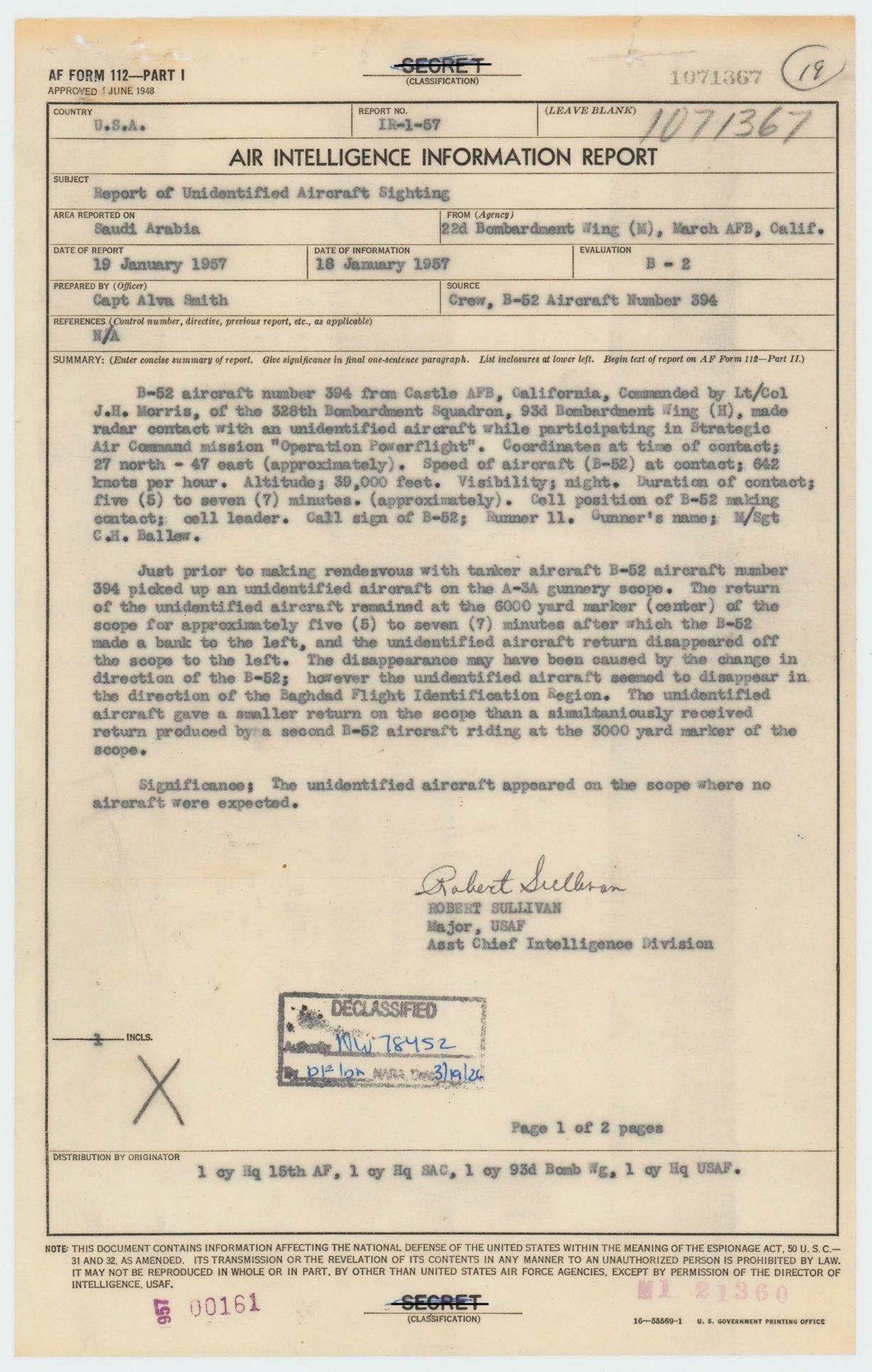
The aircraft was B-52 number 394, flying from Castle Air Force Base in California and commanded by Lieutenant Colonel J. H. Morris of the 328th Bombardment Squadron, 93d Bombardment Wing (Heavy). At the moment of contact the bomber was at 39,000 feet and 642 knots true airspeed, in night conditions, flying as cell leader under the call sign Runner 11. The gunner was Master Sergeant C. H. Ballew. The position was recorded as approximately 27 degrees north, 47 degrees east, which places the encounter over north-eastern Saudi Arabia.
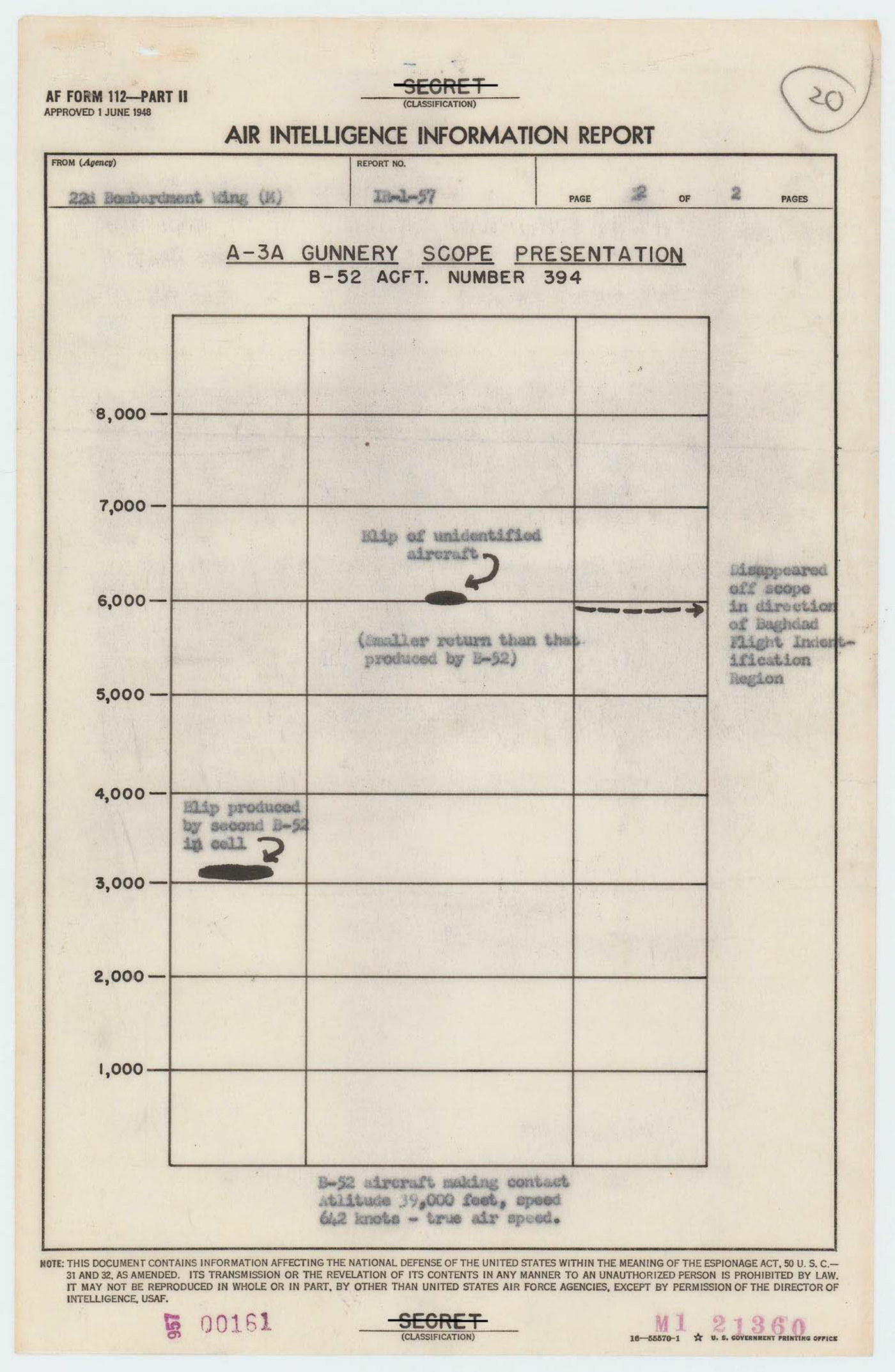
The report states that just before a scheduled rendezvous with tanker aircraft, B-52 number 394 picked up an unidentified aircraft on its A-3A gunnery scope. The return held steady at the 6,000 yard marker at the centre of the scope for approximately five to seven minutes. The B-52 then banked to the left and the unidentified return moved off the scope to the left. The reporting officer recorded both readings of that disappearance in the same sentence rather than choosing between them: the loss of contact may have been caused by the change in direction of the B-52, however the unidentified aircraft seemed to disappear in the direction of the Baghdad Flight Identification Region.
The document carries a hand-drawn scope diagram as its second page, and that drawing is the strongest piece of evidence in the file because it records a simultaneous comparison. A second B-52 in the same cell was riding at the 3,000 yard marker and produced its own return at the same time. The unidentified aircraft gave a smaller return than the known bomber. The crew therefore had a calibrated reference in frame: a four-engine heavy bomber of known size at a known range, against which the unknown contact read smaller.
More footage and images of this sighting
What is the official explanation?
The record is an Air Intelligence Information Report on AF Form 112, report number IR-1-57, submitted by the 22d Bombardment Wing (Medium) at March Air Force Base, California. It is dated 19 January 1957 and carries a date of information of 18 January 1957. It was prepared by Captain Alva Smith and signed by Major Robert Sullivan, Assistant Chief of the Intelligence Division. The source is recorded simply as the crew of B-52 aircraft number 394.
The report carries the source and information reliability rating B-2, which on the standard Air Force admiralty scale means a usually reliable source and information judged probably true. That is a comparatively high rating and it was assigned to an aircrew report by the intelligence officer who took it.
The form's own Significance block contains a single sentence, and it is the closest thing to an official conclusion anywhere in the file: the unidentified aircraft appeared on the scope where no aircraft were expected. No identification was offered, no explanation was proposed, and no follow-up is recorded in the released document.
Distribution was to Headquarters 15th Air Force, Headquarters Strategic Air Command, the 93d Bomb Wing and Headquarters United States Air Force. The page is stamped Secret, struck through, with a declassification stamp reading NW 78452 and a National Archives date of 19 March 2026. It was published on 23 October 2026 as DOW-UAP-D155 in the seventh PURSUE tranche, where the Department listed it as a Featured record.
What did the witnesses think it was?
The mission context is what makes this report unusual, and it is independently documented. The report names the Strategic Air Command mission as Operation Powerflight. The Air Force Historical Foundation records the operation, under the official spelling Power Flite, as the flight in which Major General Archie J. Old Jr. led three B-52s of the 93rd Bombardment Wing from Castle Air Force Base on a 24,325 mile nonstop circumnavigation of the globe, landing at March Air Force Base on 18 January 1957 after 45 hours and 19 minutes, averaging 532 miles per hour and relying on air refuelling. The crews received the Distinguished Flying Cross and the 93rd earned the Mackay Trophy.
Every detail in the intelligence report fits that mission independently. The aircraft came from Castle Air Force Base and the 93d Bombardment Wing, which is the unit that flew the operation. The report was filed by a wing at March Air Force Base, which is where the bombers landed. The date of information is 18 January 1957, the day of the landing. The route crossed the Middle East, which is where 27 north 47 east sits. The contact occurred just before a tanker rendezvous, and the operation depended on a sequence of air refuellings. The sighting therefore took place during one of the most closely documented flights in Air Force history, by a crew that was being tracked, timed and refuelled on a schedule.
One small discrepancy is worth recording rather than smoothing over. The intelligence report spells the mission Powerflight as one word, while the Air Force Historical Foundation and the operation's own records use Power Flite. This is a reporting officer writing the name phonetically, not evidence of a different mission.
No witness statement beyond the crew report is present in the released file, no names appear other than the aircraft commander, the gunner and the two intelligence officers, and no photographs exist. The only imagery is the scope diagram drawn by the reporting officer.
Is the Radar Contact with an Unidentified Aircraft over Saudi Arabia during Operation Power Flite, 18 January 1957 real? The two-pass assessment
Pass one, how this could be mundane. The obvious candidate is another aircraft. The encounter happened in a busy corridor near the Baghdad Flight Identification Region, and the report itself names that region as the direction in which the contact seemed to go. Civil and military traffic existed across the Persian Gulf and Iraq in 1957, and a B-52 cell transiting at 39,000 feet at night would not necessarily have been briefed on every aircraft in the area. The crew's own equipment is also a candidate. The A-3A was a gunnery radar built to track a target aircraft, not a search set, and it was being operated in a cell where a second bomber was generating a strong return at 3,000 yards. Sidelobe returns, a reflection from the tanker force assembling ahead, or a spurious lock are all live possibilities, and the loss of contact coinciding exactly with the B-52's own left bank is the single most deflating fact in the file. The reporting officer said so himself in the document.
A second prosaic candidate is the refuelling operation. The report states the contact occurred just prior to rendezvous with tanker aircraft, and Power Flite used a large tanker force staged along the route. A KC-97 manoeuvring into position is the most ordinary possible explanation for an unexpected radar return a few minutes before a scheduled join-up, and the released file gives no indication that this was checked.
Pass two, if the contact was real. What survives the deflation is narrow but specific. The return was held for five to seven minutes, which is long for a transient artifact. It sat at a fixed 6,000 yard marker, which means it was holding station relative to a bomber travelling at 642 knots. It gave a smaller return than a B-52 observed at the same moment on the same scope, so the crew had an internal calibration rather than an impression. And the intelligence officer who took the report, who was in a position to dismiss it, rated it B-2 and wrote that it appeared where no aircraft were expected.
The archive tiers this Unknown. There is no official explanation in the released record, nothing was identified, and the file closes without a conclusion. The case is not strong evidence of anything exotic, because a tanker, a cell-mate reflection or ordinary regional traffic each remain fully available and untested. What it is, is a well-documented radar observation by a professional crew on a historic mission, preserved in a contemporary intelligence report with a rating, a drawing and a signature, and released to the public for the first time sixty-nine years after it was written.
Sources
- www.war.gov/medialink/ufo/release-07/documents/DOW-UAP-D155-Air_Intelligence_Information_Report_Saudi_Arabia-1957.pdf
- www.war.gov/UFO/
- afhistory.org/january-18-1957-2/
More cases from this region: UFO sightings in Saudi Arabia