Guidelines for Interagency Handling of Space Vehicle Fragments: The White House Fragment Files, 1962 to 1964
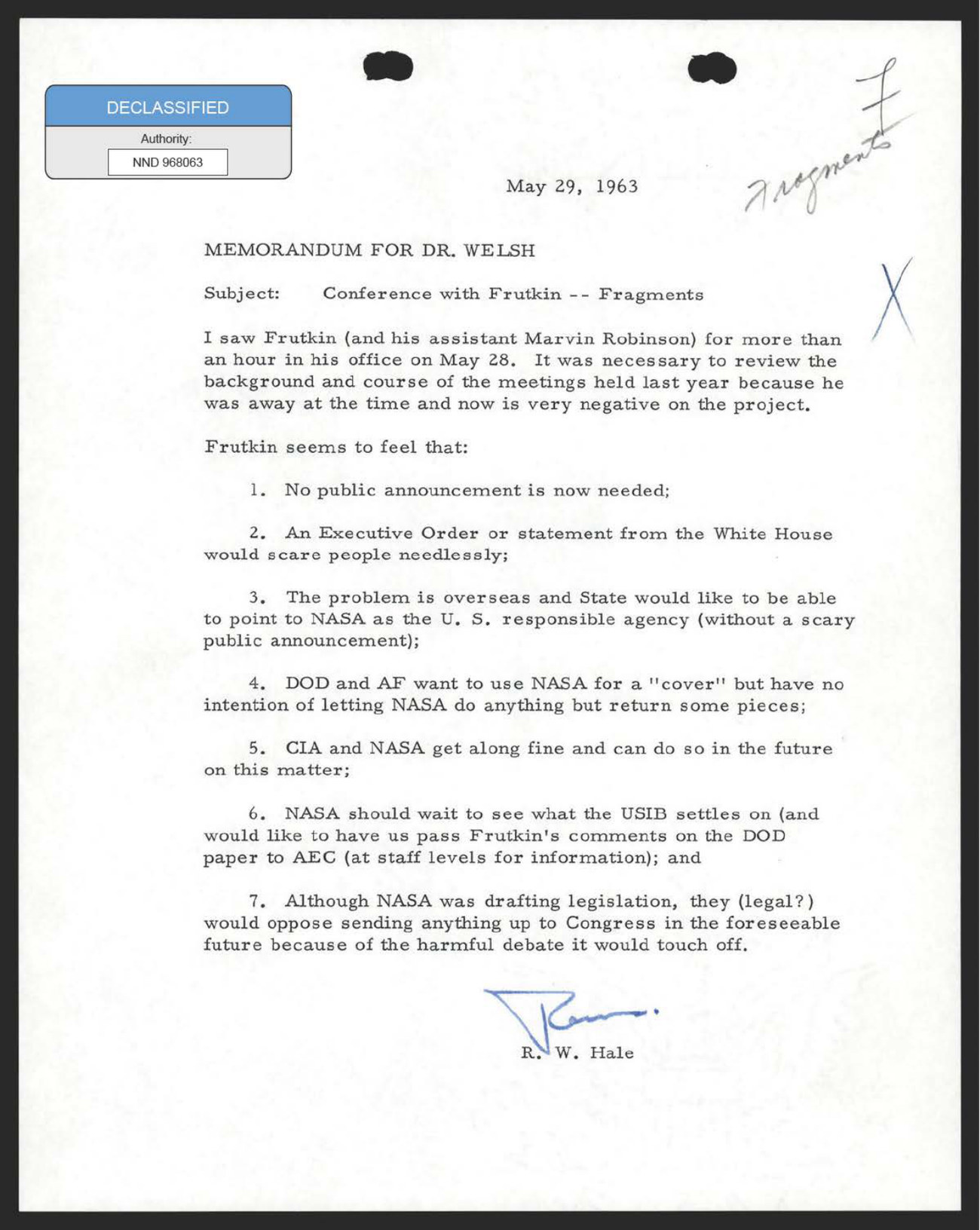
A 1963 White House memorandum says the Pentagon wanted to use NASA as a cover for recovering fallen fragments. The seventy-three pages behind it never once say unidentified, and name what the fragments were.
What happened
Two paired records in PURSUE Release 07 document a Cold War interagency argument about fallen fragments. The effort ran from 1962 to 1964 and settled who recovers objects that fall from the sky, and what the public is told about them. They come from the Executive Office of the President.
The first (EOP-UAP-D002) is a single page dated 29 May 1963, a memorandum for Dr. Welsh from R. W. Hale, subject Conference with Frutkin, Fragments. Edward C. Welsh was Executive Secretary of the National Aeronautics and Space Council, which sat in the Executive Office of the President. Arnold W. Frutkin was NASA's Director of International Programs. Hale reports that he spent more than an hour with Frutkin and his assistant Marvin Robinson on 28 May, that it was necessary to review the background because Frutkin had been away during the previous year's meetings, and that Frutkin was now very negative on the project.
The memorandum then lists seven things Frutkin seemed to feel. That no public announcement was needed. That an Executive Order or statement from the White House would scare people needlessly. That the problem was overseas and the State Department would like to point to NASA as the responsible United States agency without a scary public announcement. That the Department of Defense and the Air Force wanted to use NASA for a cover but had no intention of letting NASA do anything but return some pieces. That the CIA and NASA got along fine. That NASA should wait to see what the United States Intelligence Board settled on. And that although NASA was drafting legislation, its lawyers would oppose sending anything to Congress in the foreseeable future because of the harmful debate it would touch off.
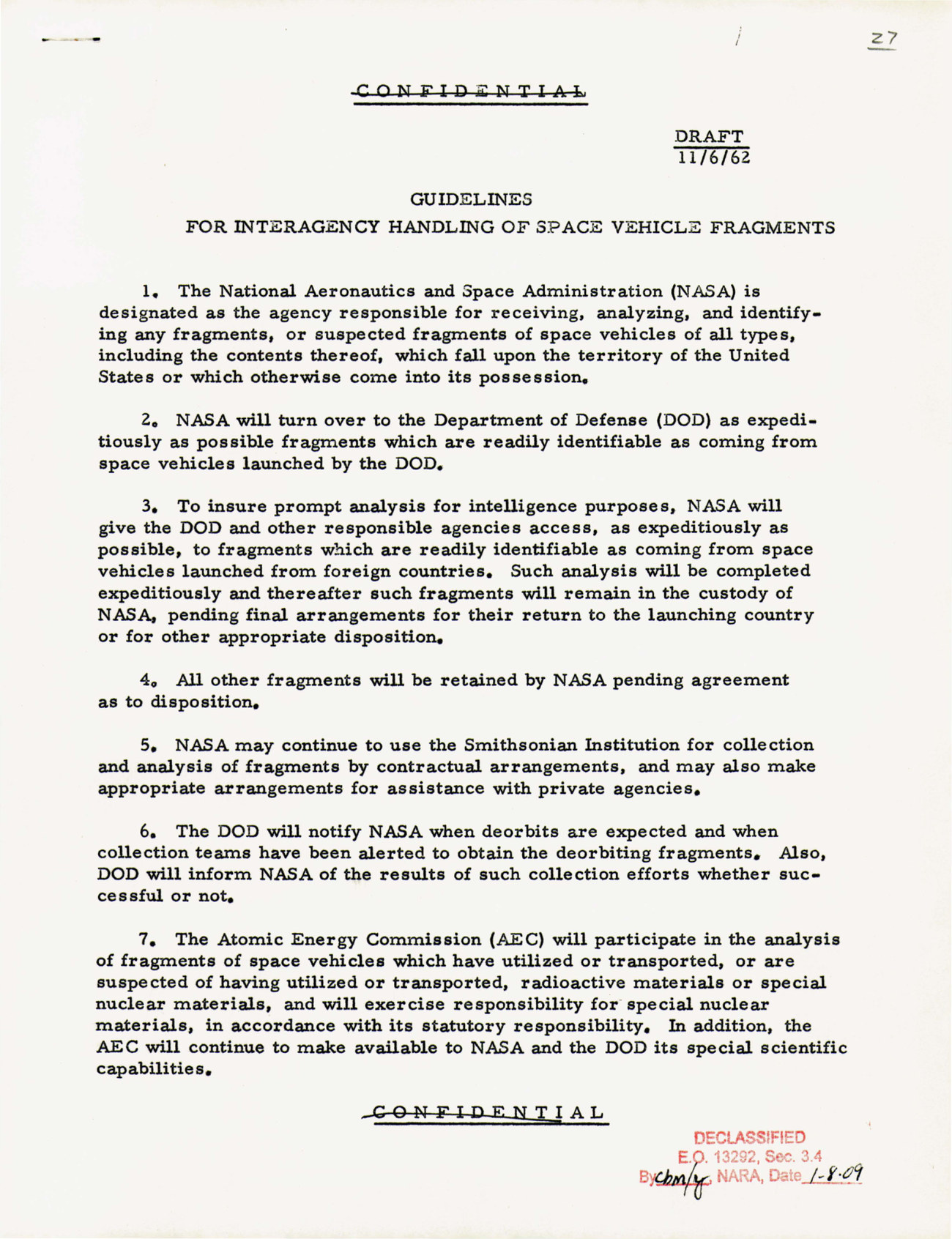
The second record (USG-UAP-D002) is seventy-two pages of the correspondence behind that meeting, drawn from the Lyndon B. Johnson Library and opening with the library's own document withdrawal sheet. It contains successive drafts of a paper titled Guidelines For Interagency Handling Of Space Vehicle Fragments, the earliest marked Confidential and dated 6 November 1962.
Documents and images
What is the official position?
The Guidelines set out a division of labour in seven numbered paragraphs. NASA is designated the agency responsible for receiving, analyzing and identifying any fragments, or suspected fragments, of space vehicles of all types, including the contents thereof, which fall upon the territory of the United States or otherwise come into its possession. NASA is to turn over to the Department of Defense as expeditiously as possible any fragments readily identifiable as coming from vehicles the Department launched.
Paragraph three is the intelligence provision. To ensure prompt analysis for intelligence purposes, NASA is to give the Department of Defense and other responsible agencies access, as expeditiously as possible, to fragments readily identifiable as coming from space vehicles launched from foreign countries. Such fragments then remain in NASA custody pending final arrangements for their return to the launching country or other appropriate disposition. All other fragments are retained by NASA pending agreement as to disposition.
Paragraph five records that NASA may continue to use the Smithsonian Institution for collection and analysis of fragments by contractual arrangement, and may make arrangements with private agencies. Paragraph six requires the Department of Defense to notify NASA when deorbits are expected and when collection teams have been alerted, and to report the results of collection efforts whether successful or not. Paragraph seven gives the Atomic Energy Commission a role in analysing fragments that carried, or are suspected of having carried, radioactive or special nuclear materials.
A later draft in the same file revises paragraph one so that the Department of Defense becomes solely responsible for receiving and identifying fragments from vehicles it launched, with NASA to deliver any such fragments to the Department if they come into NASA hands.
The Johnson Library withdrawal sheet lists the related items and their dates, including drafts of 15 November and November 1963, a Welsh to McCone item of 31 May 1963, and National Aeronautics and Space Council meeting memoranda of November 1963. John A. McCone was Director of Central Intelligence.
What the people involved say
There are no witnesses in this file. It is a policy record, and the only people in it are officials: Welsh and Hale at the Space Council, Frutkin and Robinson at NASA, McCone at the Central Intelligence Agency, with the State Department, the Atomic Energy Commission and the Smithsonian Institution appearing as institutions with assigned roles.
What the file does carry, and what makes it worth publishing, is an unusually frank internal description of how an announcement decision was being made. The 29 May 1963 memorandum is one official reporting another official's private view, and it records three distinct motives for keeping the arrangement quiet: that a White House statement would frighten the public, that the State Department wanted a civilian agency to point to because the problem was overseas, and that the Department of Defense and the Air Force wanted NASA's name on the programme without giving NASA any real part in it.
Is the Guidelines for Interagency Handling of Space Vehicle Fragments: The White House Fragment Files, 1962 to 1964 real? The two-pass assessment
Pass one, and in this case pass one is most of the answer. The obvious reading of a 1963 White House file about recovering fallen fragments, released in a UAP tranche, is that it concerns the recovery of crashed unidentified craft. The documents do not support that reading and they are unusually explicit about what they do concern. Across all seventy-three released pages the phrase space vehicle appears thirty-five times and the word fragment appears about one hundred and forty-seven times, while the word unidentified appears zero times, the acronym UFO appears zero times, and the word flying appears once. The title of the governing paper is Guidelines For Interagency Handling Of Space Vehicle Fragments. Paragraph three settles the subject matter beyond argument by providing for fragments from vehicles launched by foreign countries to be examined for intelligence and then returned to the launching country, which is a description of fallen satellite and launch-vehicle hardware and of nobody's idea of a recovered alien craft.
The historical context fits exactly. By 1962 both superpowers were losing hardware back into the atmosphere routinely, debris was coming down abroad as well as at home, and foreign-launched material on the ground was a genuine intelligence prize. An arrangement in which NASA publicly receives and catalogues fragments, the Department of Defense quietly gets first look at anything foreign, the Atomic Energy Commission handles anything radioactive, and the Smithsonian does the laboratory work under contract, is a sensible and entirely terrestrial answer to that problem.
Pass two, what is genuinely notable. Two things survive the deflation and both are about government behaviour rather than about anomalous objects. The first is the word cover, written down by a White House staffer as a description of what the Department of Defense and the Air Force wanted from NASA. That a civilian space agency was to be the public face of a recovery programme it would not actually run is a documented instance of exactly the institutional arrangement that later UFO secrecy arguments assert, set out in a contemporaneous internal memorandum and not in a recollection. The second is the stated reason for silence. The objection to a White House announcement recorded here is not that the subject was classified but that it would scare people needlessly and touch off a harmful debate, which is a presentational judgement about public reaction being used to decide what the public is told.
The case stands at Unknown in this archive's sense only because it is a government file rather than a sighting, and it is worth saying plainly what it is not. This is not evidence of crash retrieval of anomalous craft, and anyone citing it that way is citing a document that contradicts them in its own title. What it does show is that in 1962 and 1963 the United States built an interagency machine for picking fallen objects out of the ground, gave the intelligence agencies first access to the foreign ones, and decided against telling the public about it for reasons of public reaction. That is a smaller claim than the one the file will be used to support, and it has the advantage of being true.
Sources
- www.war.gov/UFO/
- www.war.gov/medialink/ufo/release-07/documents/EOP-UAP-D002-Memo_on_Interagency_Coordination_for_the_Recovery_of_Foreign_Materiel-May_1963.pdf
- www.war.gov/medialink/ufo/release-07/documents/USG-UAP-D002-Interagency_Correspondence_Concerning_Space_Fragments-1962_1964.pdf
- www.war.gov/Portals/1/Interactive/2026/UFO/uap-data.csv
More cases from this region: UFO sightings in United States