The Catalina Island File: Four Air Force UFO Reports from One California Island, 1949 to 1955
The Pentagon's seventh declassification tranche released four Air Force UFO reports from a single twenty-two mile island off Los Angeles, spanning six years. Two were explained at the time and two never were.
What did witnesses see at Santa Catalina Island and the San Pedro Channel?
PURSUE Release 07 contains four separate Air Force records of unidentified objects reported at or near Santa Catalina Island, California. They span 1949 to 1955 and were released together on 23 October 2026.
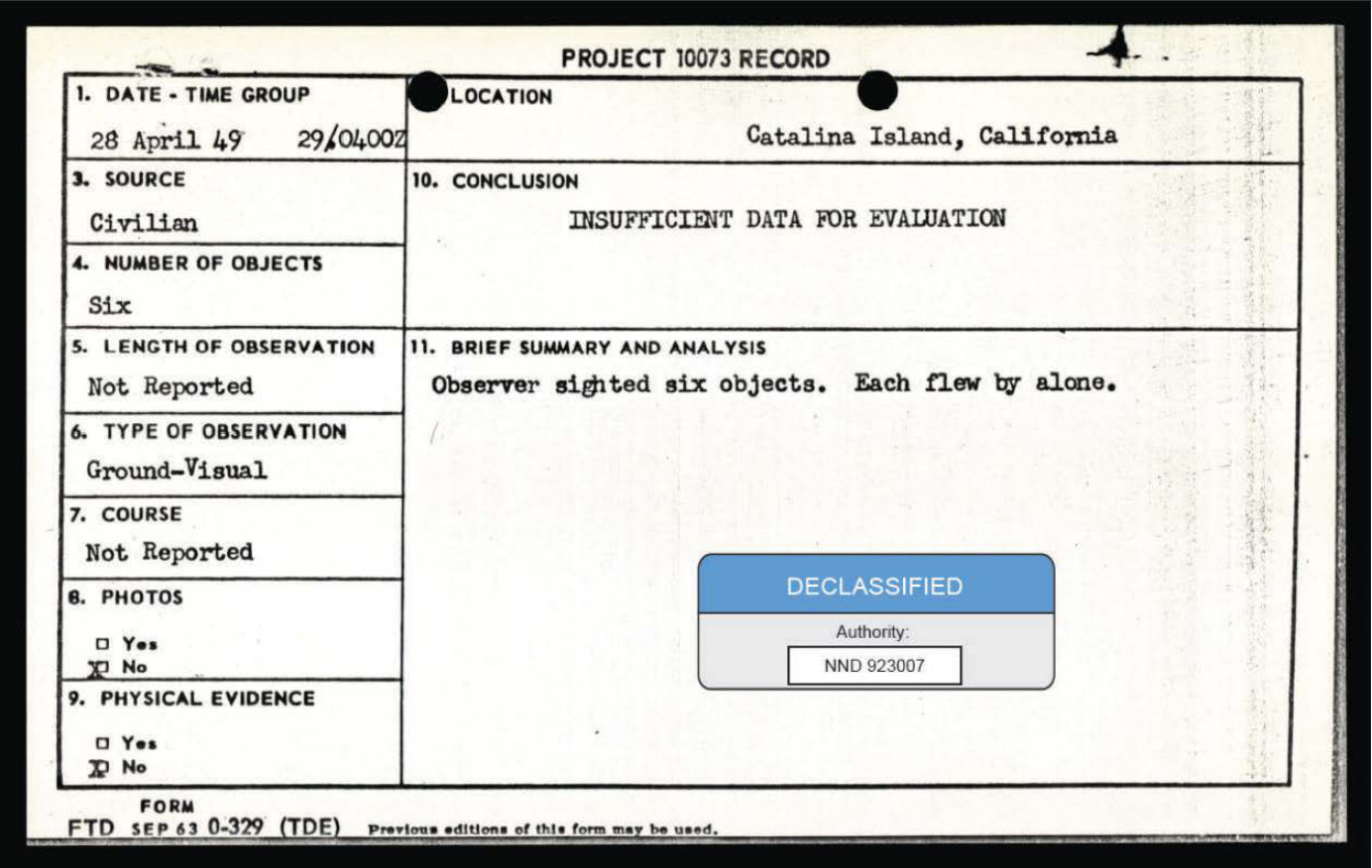
The earliest is a Project 10073 Record (DOW-UAP-D181) for 28 April 1949, date-time group 29/0400Z, with a civilian source. It records six objects, length of observation not reported, course not reported, type of observation ground-visual, no photographs and no physical evidence. Its entire summary and analysis reads that the observer sighted six objects and each flew by alone. The Air Force conclusion is Insufficient Data For Evaluation.
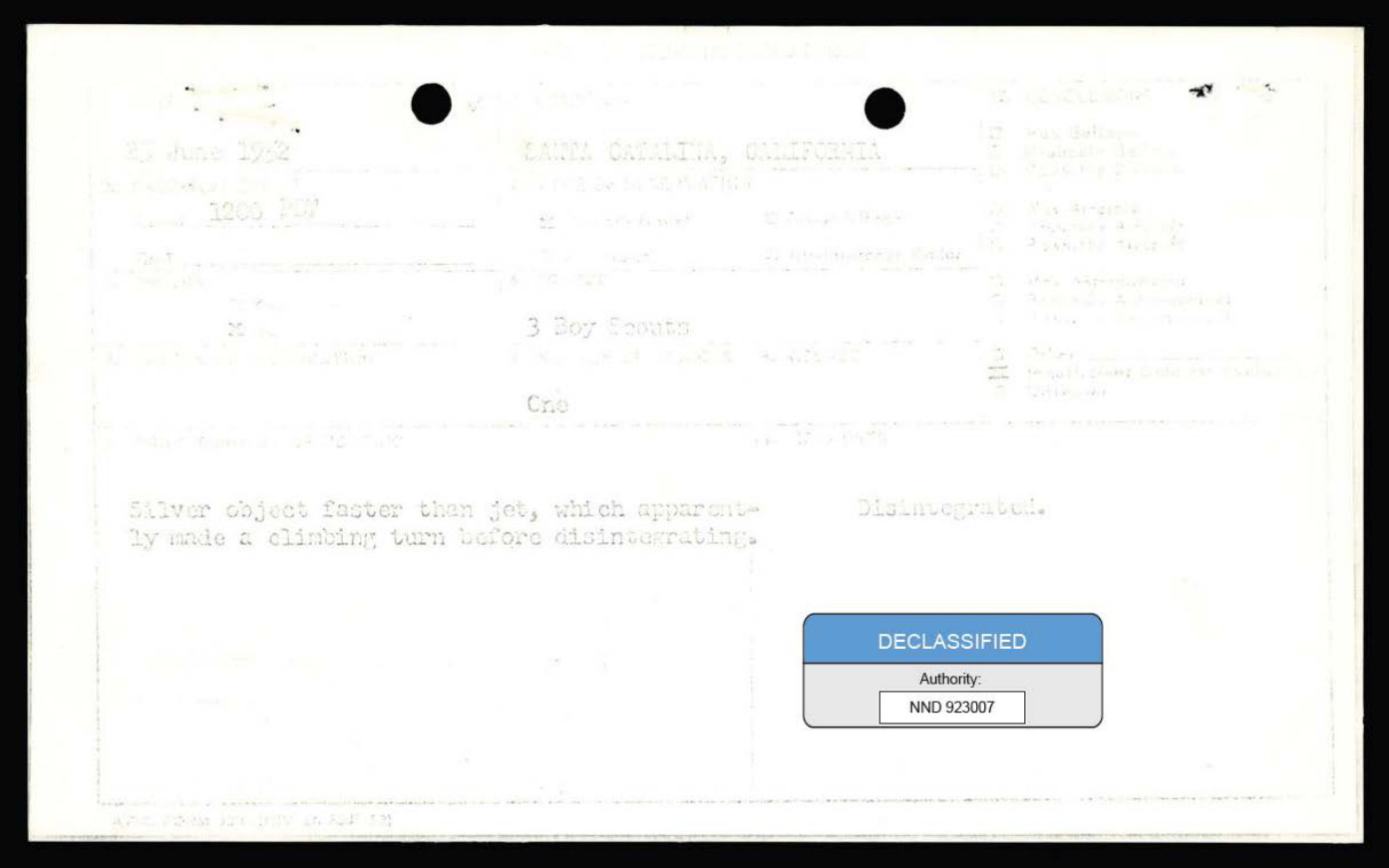
The second is an Air Intelligence Information Report (DOW-UAP-D179) on AF Form 112, submitted by the 807th Air Base Group at March Air Force Base and dated 28 August 1952 for an event of 25 June 1952. Three Boy Scouts in summer camp at Camp Fox reported an object while hiking up one of the island's mountains at about 1200 hours Pacific Standard Daylight Time. The report describes the object as silver in colour, of uncertain altitude, estimated to be faster than a conventional jet, with no sound observed, and records one manoeuvre, apparently a climbing turn, immediately before it disappeared by what the report calls disintegration. Sky conditions were clear and unlimited, no observing instruments of any sort were available, and a rough sketch was enclosed. The report lists four enclosures, letters from Clyde Vrooman, Howard Howell, Sam Gites and Forrest E. Spriggs. The reporting officer noted that no estimate of reliability could be attempted and that the experience of the observers was probably meagre at best.
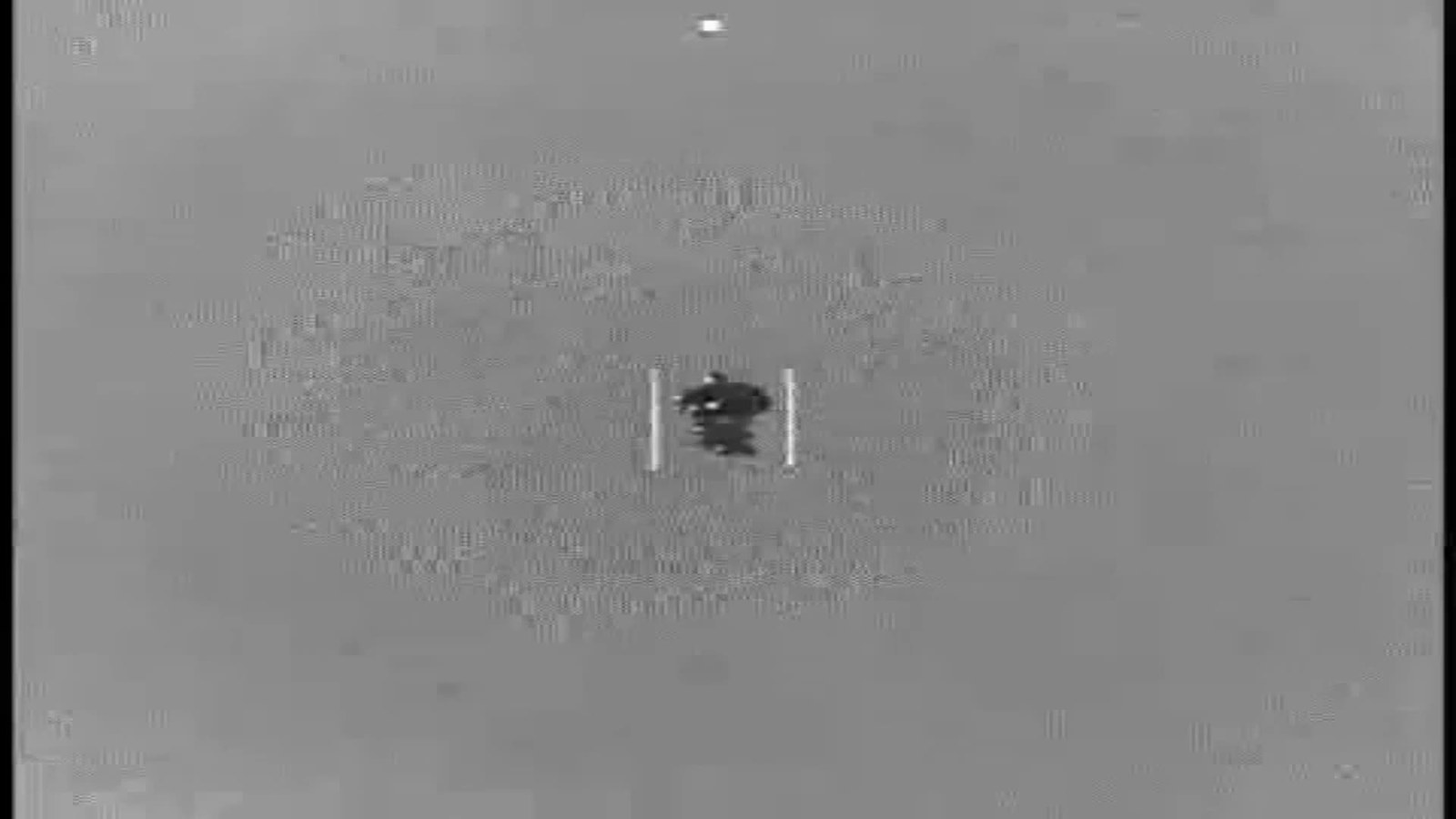
The third (DOW-UAP-D178) covers 16 November 1953 and is a teletype from the 67th Air Division routed to Air Defense Command, ATIC at Wright-Patterson, the Director of Intelligence at Headquarters USAF and Continental Air Command. The observer was not on the island but at Tenth and Gaffey in San Pedro on the mainland, looking across the channel. He reported a round saucer shape the apparent size of a pea, purplish white on first sighting and fading to a whiter colour, at 45 degrees elevation, apparently stationary over Catalina before moving north-west toward Los Angeles where it faded from view. Duration ten minutes, night clear, flight path straight and level.
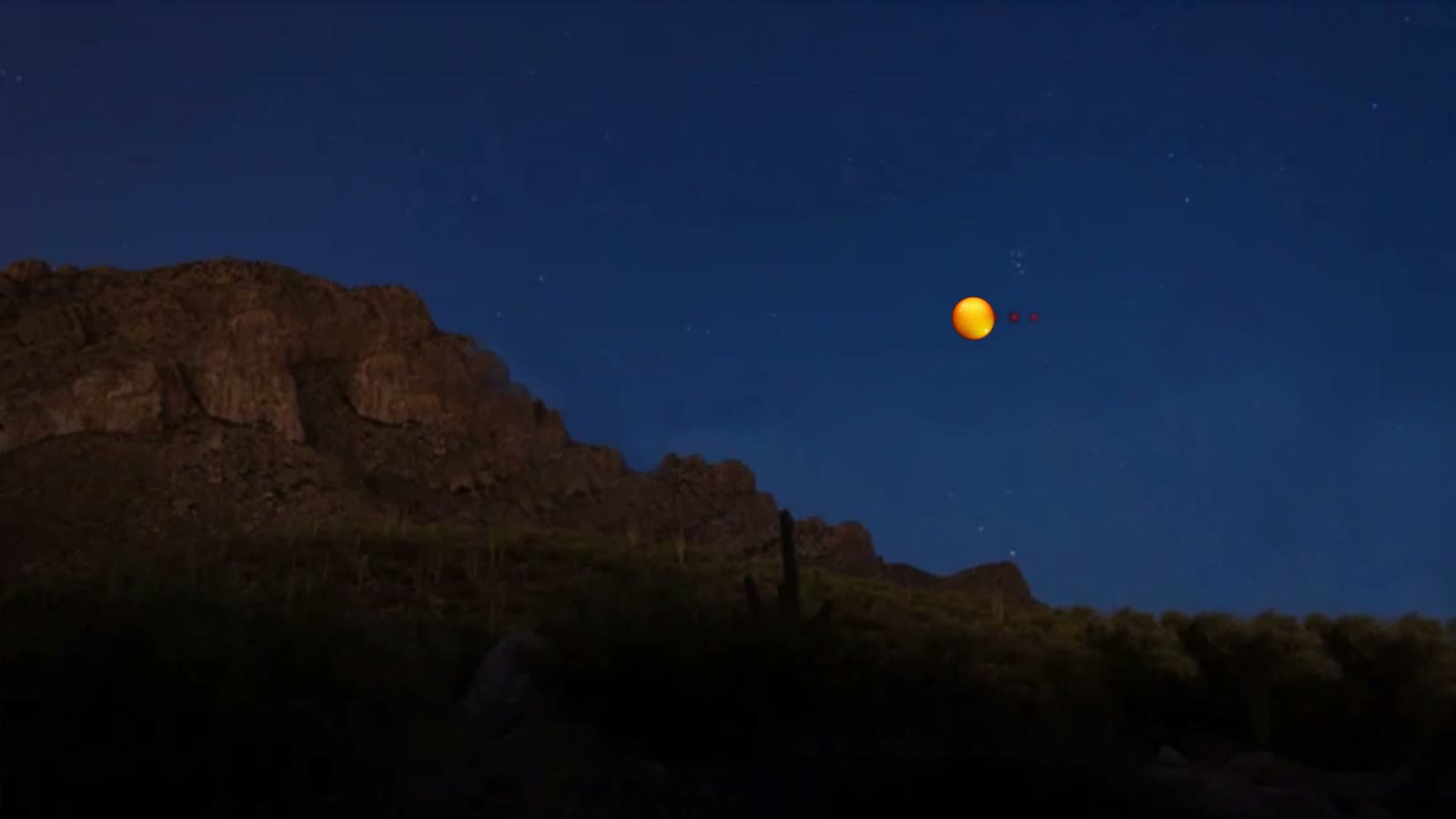
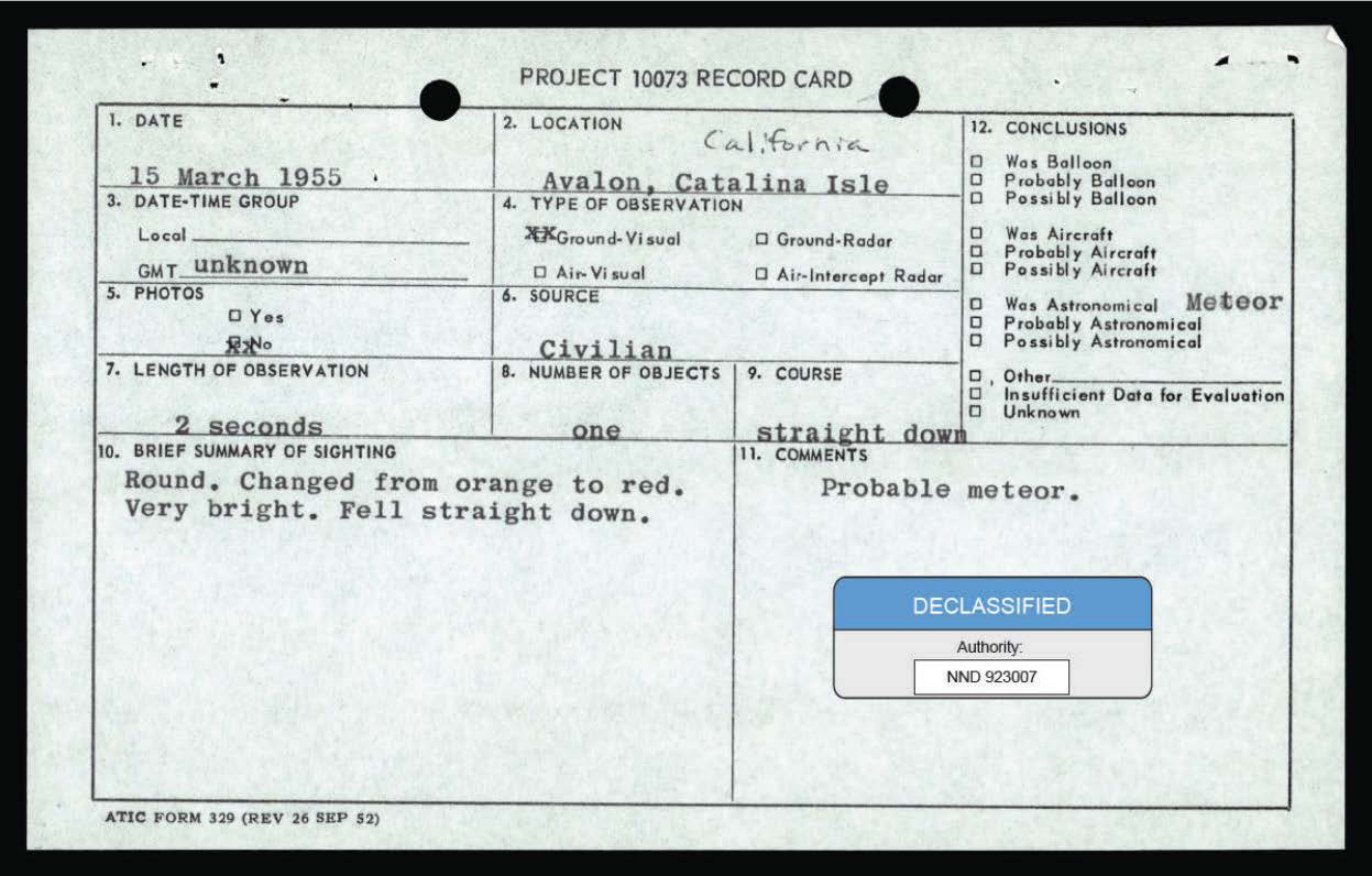
The fourth (DOW-UAP-D177) is a Project 10073 Record Card for 15 March 1955 at Avalon on the island itself. A civilian reported one object for approximately two seconds, round, changing from orange to red, very bright, the apparent size of a nickel held at arm's length, falling straight down in the vicinity of Catalina Isle.
More footage and images of this sighting
What is the official explanation?
The four records carry different official dispositions, and the range is the point of the file.
The 1949 report was closed as Insufficient Data For Evaluation, which in Project Blue Book practice means the Air Force declined to assign an explanation rather than that it endorsed one.
The 1952 Boy Scout report was forwarded without a conclusion to the Chief of the Air Technical Intelligence Center at Wright-Patterson and to the 12th Air Division. The covering report noted that no report had been made by electrical means because of the time lag in receipt of the information at the installation, which is why a June sighting was reported in August.
The 1953 teletype records a prosaic candidate offered at the time by named third parties rather than by the Air Force: astronomers at Griffith Park Observatory advised that objects such as these are possibly planets which appear more clearly after rainfall. The filing officer assessed the witness as fairly reliable because of his association with jet aircraft activity while stationed at Long Beach Air Force Base, and recorded that the astronomers' observation may account for the appearance of the subject.
The 1955 card is the only one of the four with a definite Air Force explanation. The conclusion block is marked Was Astronomical with the word Meteor written beside it, and the comments block reads Probable meteor. The supporting teletype records the intelligence officer's reasoning in one sentence, that the flight path and length of time in sight suggest the object was probably a meteor.
All four carry the declassification authority NND 923007.
What did the witnesses think it was?
Three of the four files identify their observers only by category, as civilian, which is standard for Blue Book record cards. The 1952 file is the exception and is unusually well witnessed for its period: three Boy Scouts from Camp Fox, all in the same group at the time, with four letters enclosed as separate written accounts and a sketch of what they saw. The named correspondents are Clyde Vrooman, Howard Howell, Sam Gites and Forrest E. Spriggs, whose letter is dated 1 July 1952, six days after the sighting.
That is a better evidentiary package than the file's own assessment suggests. The reporting officer wrote that the experience of the observers was probably meagre at best, which is a judgement about their competence as aerial observers rather than about their honesty, and it was made by an officer who had not interviewed them. Four contemporaneous written accounts and a sketch produced within a week, by witnesses who were together and could be cross-checked, is more than most 1952 reports carry.
The 1953 observer is described in the teletype as locally stationed and associated with jet aircraft activity at Long Beach Air Force Base, which is why the filing officer rated him fairly reliable. This archive does not reproduce his name, which appears in the released teletype along with his home address.
Is the Catalina Island File: Four Air Force UFO Reports from One California Island, 1949 to 1955 real? The two-pass assessment
Pass one, how these could be mundane, taken one at a time. The 1955 Avalon report is almost certainly what the Air Force said it was. A very bright round object that changes from orange to red, is the apparent size of a nickel at arm's length, falls straight down and is gone in two seconds is a textbook fireball, and the intelligence officer's one sentence of reasoning is sound. The 1953 San Pedro report is the weakest of the four as an anomaly. A pea-sized point of light at 45 degrees elevation, watched for ten minutes on a clear night, apparently stationary and then drifting out of view, is the classic signature of a bright planet or star observed casually, and the Griffith Park astronomers said so at the time. Ten minutes of apparent stationarity is a strong argument for an astronomical object rather than against one. The 1952 Camp Fox report has a natural candidate too: a high, fast, silver object seen in clear midday sky that makes one turn and then disappears is consistent with a high-altitude aircraft catching sunlight, and the word disintegration in the report is the reporter's paraphrase of boys describing something that simply vanished, not a physical finding. The 1949 report cannot be assessed at all, because it carries no duration, no course and no description beyond six objects passing one at a time, which is precisely why the Air Force closed it as insufficient data.
The geography also deserves deflating. Santa Catalina Island sits off one of the busiest coastlines in the United States, roughly twenty-two miles from the Los Angeles basin, under heavy military and civil air traffic, with Long Beach, March and later Los Alamitos air bases nearby and a naval presence throughout the period. A cluster of reports there across six years is what you would expect from a well-populated, well-watched, heavily flown stretch of coast rather than from anything peculiar to the island.
Pass two, what survives. Two of the four were never explained, and they are the two with the least mundane content. The 1949 report is unresolved only because it is thin. The 1952 report is the one that resists its own prosaic reading, because the single detail that does not fit a sunlit aircraft is the one the reporting officer recorded without comment: no sound, at midday, from an object the witnesses judged faster than a conventional jet. In 1952 a jet fast enough to look like that over coastal California would generally have been audible. Against that, the witnesses were boys on a hike with no instruments, altitude was explicitly uncertain, and a high enough aircraft is silent at the ground, so the detail is suggestive rather than decisive.
The file stands at Unknown as a whole, because two of its four records were closed without an explanation and no later Air Force review reopened them. The two that were explained are recorded here as explained, and nothing is gained by pretending otherwise. The honest reading of this group is that the Department released a small geographic cluster that shows the full range of Blue Book outcomes in miniature: one meteor, one probable astronomical misidentification, one report too thin to evaluate, and one that remains genuinely open.
Sources
- www.war.gov/UFO/
- www.war.gov/medialink/ufo/release-07/documents/DOW-UAP-D181_Unresolved_UAP_Report_Catalina_Island-1949.pdf
- www.war.gov/medialink/ufo/release-07/documents/DOW-UAP-D179_Unresolved_UAP_Report_Catalina_Island-1952.pdf
- www.war.gov/medialink/ufo/release-07/documents/DOW-UAP-D178_Unresolved_UAP_Report_Catalina_Island-1953.pdf
- www.war.gov/medialink/ufo/release-07/documents/DOW-UAP-D177_Unresolved_UAP_Report_Catalina_Island-1955.pdf
- www.war.gov/Portals/1/Interactive/2026/UFO/uap-data.csv
More cases from this region: UFO sightings in United States