The BAASS Operational Records: Bigelow Aerospace's Working Papers for the Defense Intelligence Agency, 2008 to 2010
The Pentagon has published the internal working papers of the contractor that ran its 2008 UFO programme, including monthly reports, a data warehouse design, and a field investigation that collected hair samples at a Utah ranch.
What did witnesses see at Bigelow Aerospace Advanced Space Studies?
On 23 October 2026 the Department of War released ten documents produced by Bigelow Aerospace Advanced Space Studies. They are the contractor's own internal working papers for the Defense Intelligence Agency programme widely known as AAWSAP.
The set runs to roughly 700 pages and covers the period from November 2008 to November 2010. It contains a Project Management Plan for contract HHM402-08-C-0072 (DOW-UAP-D168), monthly reports for March, April, June and November 2009 (DOW-UAP-D169, D170, D171 and D173), a package of reports prepared for BAASS by the Mutual UFO Network's Advanced Technology Establishment (DOW-UAP-D166), a data warehouse design study called Project Capella (DOW-UAP-D167), a sixty page Utah Ranch Investigation report covering two field deployments in 2010 (DOW-UAP-D174), and a 141 page BAASS Self-Assessment of UAP Analysis Capabilities dated 23 November 2010 (DOW-UAP-D175).
This is the first time the contractor's operational record, as opposed to the contract paperwork, has been published by the government. Until now the programme was documented mainly through the contract file, the thirty-seven Defense Intelligence Reference Documents, and the public accounts of former participants.
One detail of vocabulary is worth recording because it is checkable and surprising. The acronym AAWSAP appears zero times across all ten documents. The contractor refers to itself as BAASS throughout and identifies the work by its contract number.
More footage and images of this sighting
What is the official explanation?
The documents were published at war.gov/UFO as part of PURSUE Release 07, the seventh tranche under the Presidential Unsealing and Reporting System for UAP Encounters. All ten carry the manifest pairing tag AAWSAP and all ten are marked as redacted.
Redactions throughout are applied under Section 1843 of the UAP Disclosure Act, the postponement provision codified in the notes to 44 U.S.C. 2107, principally the privacy ground at 1843(a)(2). Personnel are anonymised with a consistent scheme, appearing as AAP Person followed by a number rather than by name.
The Department has released no assessment of the contractor's findings and no statement about whether the work it describes produced results. The documents are presented as records, not as conclusions.
What did the witnesses think it was?
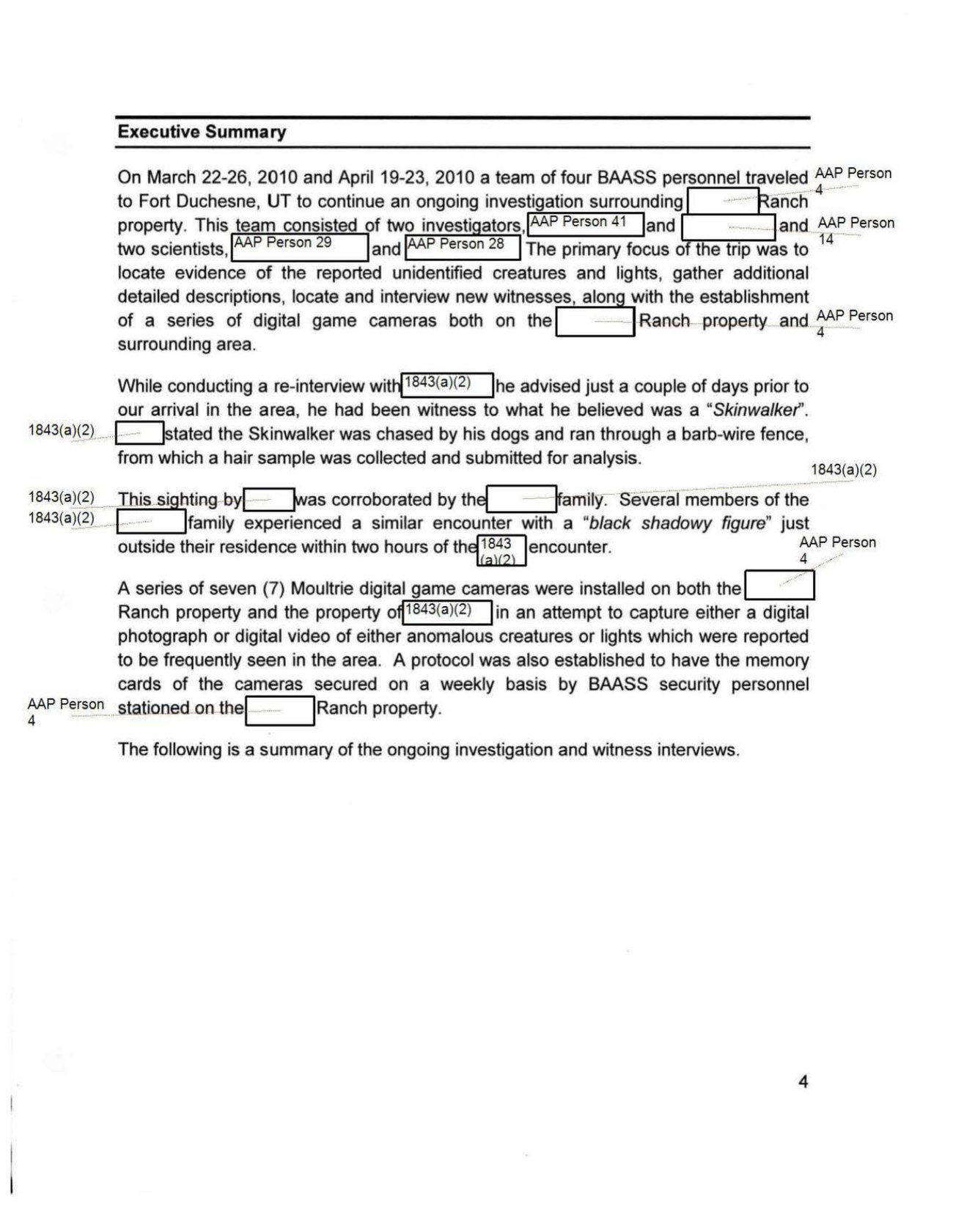
The Utah Ranch Investigation report (DOW-UAP-D174) is the most striking single document in the set, and it is a government contractor's field record of the property generally known as Skinwalker Ranch. It covers two deployments, 22 to 26 March and 19 to 23 April 2010, by a four person BAASS team consisting of a task force director, two investigators and two scientists.
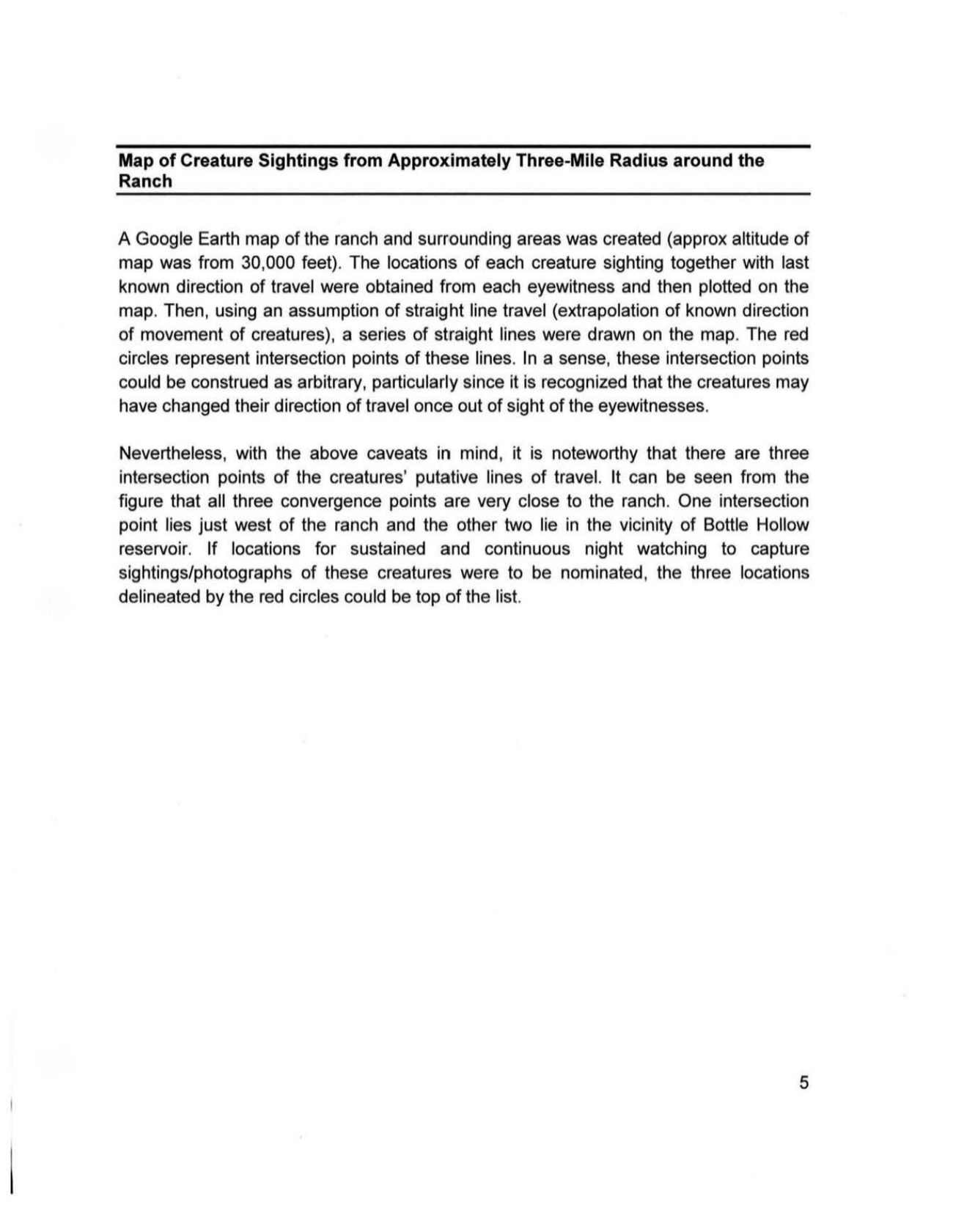
The report states that the primary focus of the trip was to locate evidence of the reported unidentified creatures and lights, gather additional detailed descriptions, locate and interview new witnesses, and establish a series of digital game cameras on the ranch property and the surrounding area. Seven Moultrie digital game cameras were installed, with a protocol for BAASS security personnel stationed on the ranch to collect the memory cards weekly. A Google Earth map was produced plotting creature sightings and their last known direction of travel within an approximately three mile radius of the ranch.
During a re-interview a witness reported that a couple of days before the team arrived he had seen what he believed was a Skinwalker, that his dogs chased it, and that it ran through a barbed wire fence leaving a hair sample, which was collected and submitted for analysis. The report records that members of another family experienced a similar encounter with a black shadowy figure outside their residence within two hours of that sighting. The document's list of figures includes five hair samples from reported Skinwalker sightings, photographs of reported creatures, and microscope imagery captioned as being for DNA species identification.
The same report describes a parallel biology programme at the site using standard laboratory mutagenicity organisms: Sul+ tobacco plants described as exhibiting mutations in both alleles, spiderwort stamens and stamen hairs, and a seed experiment. Spiderwort stamen-hair assays and sulfur-locus tobacco assays are long-established bioassays for mutagens and ionising radiation, so the choice of organism indicates the team was testing the ground for a mutagenic agent.
Project Capella (DOW-UAP-D167) is a different kind of document, a design study for a sighting database. It is Report no. 001 to BAASS from Documatica Research, LLC of San Francisco, dated 10 December 2008, and it proposes a data warehouse for research on unusual aerial phenomena and related anomalies, with appendices on classification methodology, reliability measures, and modelling of what it calls high-strangeness data elements. Its historical survey is unusually well informed, covering the 1953 Battelle Memorial Institute punched-card analysis for Project Blue Book, the French GEPAN and GEIPAN database under CNES, UFOCAT, UNICAT and the NARCAP files.
Is the BAASS Operational Records: Bigelow Aerospace's Working Papers for the Defense Intelligence Agency, 2008 to 2010 real? The two-pass assessment
Pass one, what is mundane here. Most of this corpus is ordinary contractor output. Monthly reports, a project management plan, staffing and deliverable schedules and a self-assessment are what a company produces against a government contract, and their existence proves only that the contract was administered. The MUFON material is a tasking relationship with a civilian reporting network, which is a sensible way to acquire case volume cheaply and is not evidence about the cases themselves. Project Capella is a database design document, and a good one, but a plan for a data warehouse is not a finding. Nothing in the set is an instrument record of an anomalous object.
The Utah Ranch Investigation needs the same discipline. It documents what a team did and what witnesses told them, not what was established. Hair samples collected from a barbed wire fence and submitted for analysis are a procedure, and the document in its released form does not carry a result that identifies anything anomalous. Game cameras were installed; no photograph of an anomalous creature is presented. A plant bioassay programme indicates what the team was looking for, not what it found. Read conservatively, the report records an intelligence contractor taking local folklore seriously enough to sample it, which is interesting as institutional history and is not evidence of the folklore.
Pass two, what is genuinely new. The significance of this release is institutional rather than evidential, and it is large. These papers show what a Defense Intelligence Agency contractor actually did with public money: it ran field investigations into reported shapeshifting creatures on a Utah ranch, installed game camera arrays, collected biological samples for species identification, ran mutagenicity bioassays on the soil's effect on plants, commissioned a professional data warehouse for anomaly reports, and built a tasking pipeline into a civilian UFO reporting organisation. That is a far broader and stranger programme than the aerospace-threat framing under which the contract was publicly defended, and the documents are the government's own.
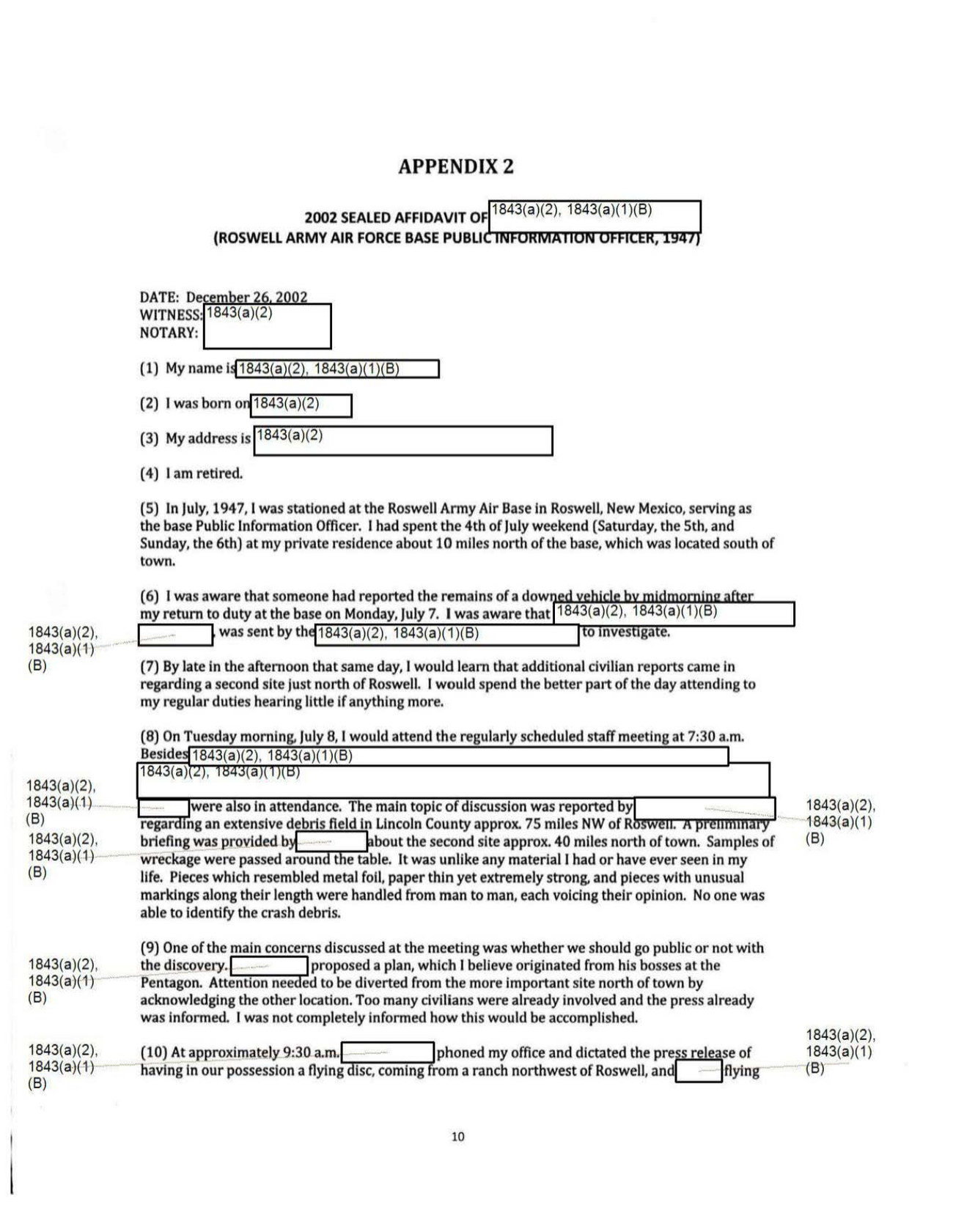
One further finding runs across the whole set and is worth stating because it is checkable. The privacy redactions are applied so mechanically that in several places the surrounding released text identifies the redacted person beyond reasonable doubt. The self-assessment (DOW-UAP-D175) redacts the name of the pilot in its account of the 24 June 1947 Mount Rainier sighting while leaving in place the date, the state, the chain of nine objects, the words he used to newsmen in Pendleton, Oregon and the resulting coinage of flying saucer, all of which have been in print since 1947. The Project Management Plan redacts the affiant of a 2002 sealed affidavit while stating that he was the Public Information Officer at Roswell Army Air Base in July 1947, which is a single documented individual. Project Capella redacts its author while recording that he compiled and published the Magonia catalogue of over 700 close encounter cases in 1968 and that his Blue Book database was turned over to the Condon study in 1968, achievements that are matters of public record, and the report is issued under the unredacted name of his company. A redaction that leaves the biography intact protects nobody and costs the reader accuracy.
The case stands at Unknown. These are authenticated federal records whose contents are now public, the Department offers no assessment of them, and the documents describe activity rather than resolving any sighting.
Sources
- www.war.gov/UFO/
- www.war.gov/medialink/ufo/release-07/documents/DOW-UAP-D168-BAASS_Project_Management_Plan-December_2008.pdf
- www.war.gov/medialink/ufo/release-07/documents/DOW-UAP-D174-Utah_Ranch_Investigation_Report_April_2010.pdf
- www.war.gov/medialink/ufo/release-07/documents/DOW-UAP-D167-Project_Capella-December-2008.pdf
- www.war.gov/medialink/ufo/release-07/documents/DOW-UAP-D175-BAASS_Self-Assessment_of_UAP_Analysis_Capabilities_November_2010.pdf
- www.war.gov/medialink/ufo/release-07/documents/DOW-UAP-D166-MUFON-Reports_Prepared_for_BAASS-November_2008.pdf
- www.war.gov/Portals/1/Interactive/2026/UFO/uap-data.csv
More cases from this region: UFO sightings in United States