A Matte Black Triangle Reported by Federal Agents in the Western United States, June 2026
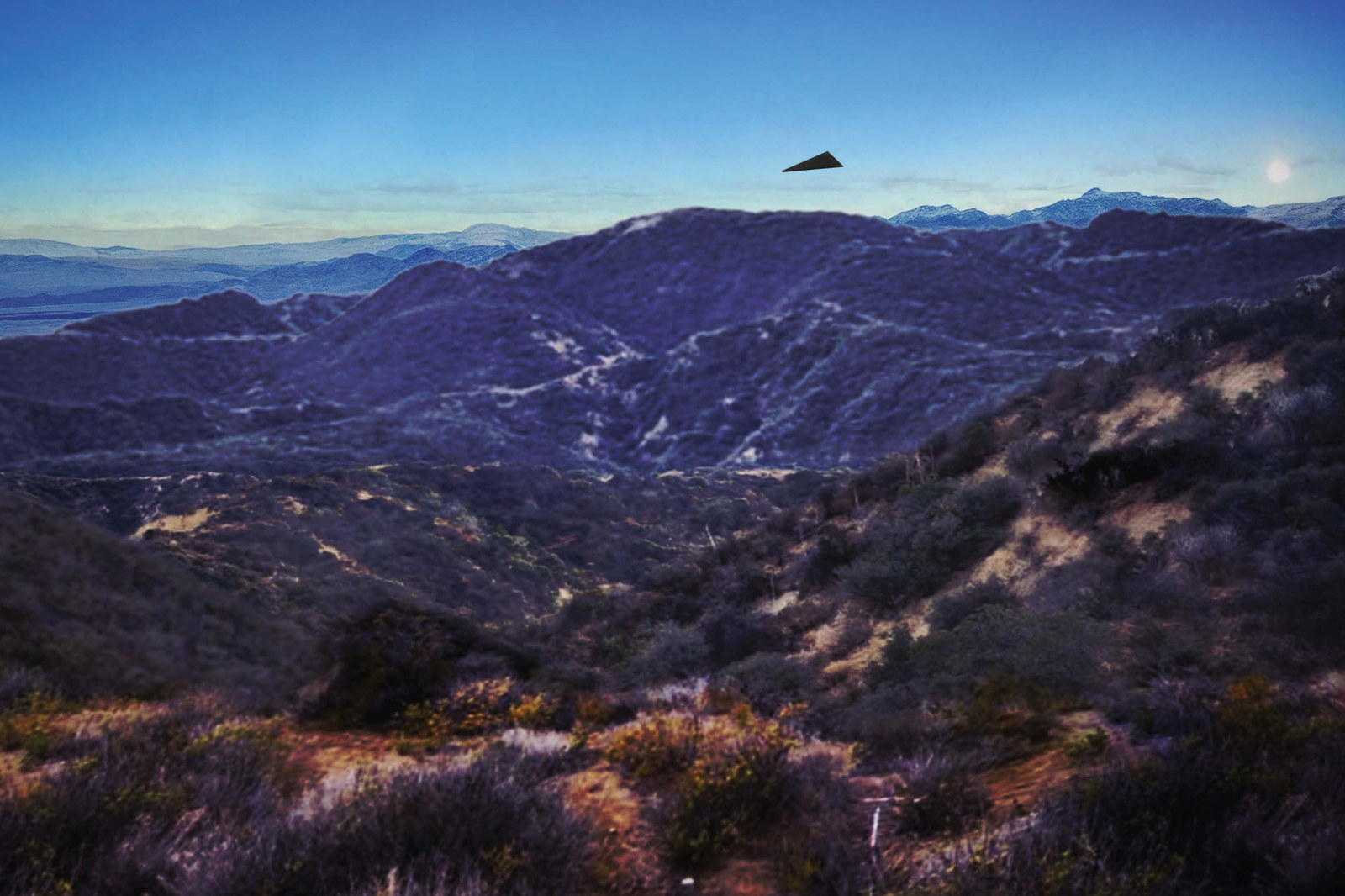
Two federal special agents reported a silent matte black triangle that rose over a ridge, hovered, and left at the speed of a fighter jet. Two official documents describe the same minutes and disagree about how long it lasted.
What did witnesses see at A sensitive national security site?
On an evening in June 2026 two federal special agents at an observation post in the western United States reported a matte black triangular craft. It rose vertically over a ridge line, hovered, and then departed in seconds.
A third official at a separate observation post several miles west detected the object first on long-range thermal equipment and called out the contact by radio. The All-domain Anomaly Resolution Office recorded the encounter in a Memorandum for Record (DOW-UAP-D176) describing three phases: a controlled vertical ascent of roughly ten seconds to an estimated 200 to 300 feet above the ridge line, a station-keeping hover of roughly twenty seconds with no observable drift or oscillation, and a terminal manoeuvre of two to three seconds in which the craft went from a standstill into high-speed horizontal flight, banked, and descended into a canyon drainage. AARO recorded the object as presenting an estimated thirteen to fifteen foot wingspan, a six to nine foot fuselage length, and a maximum vertical thickness of one to two feet, with a continuous featureless surface showing no propulsive apertures, intakes, control surfaces or cockpit features.
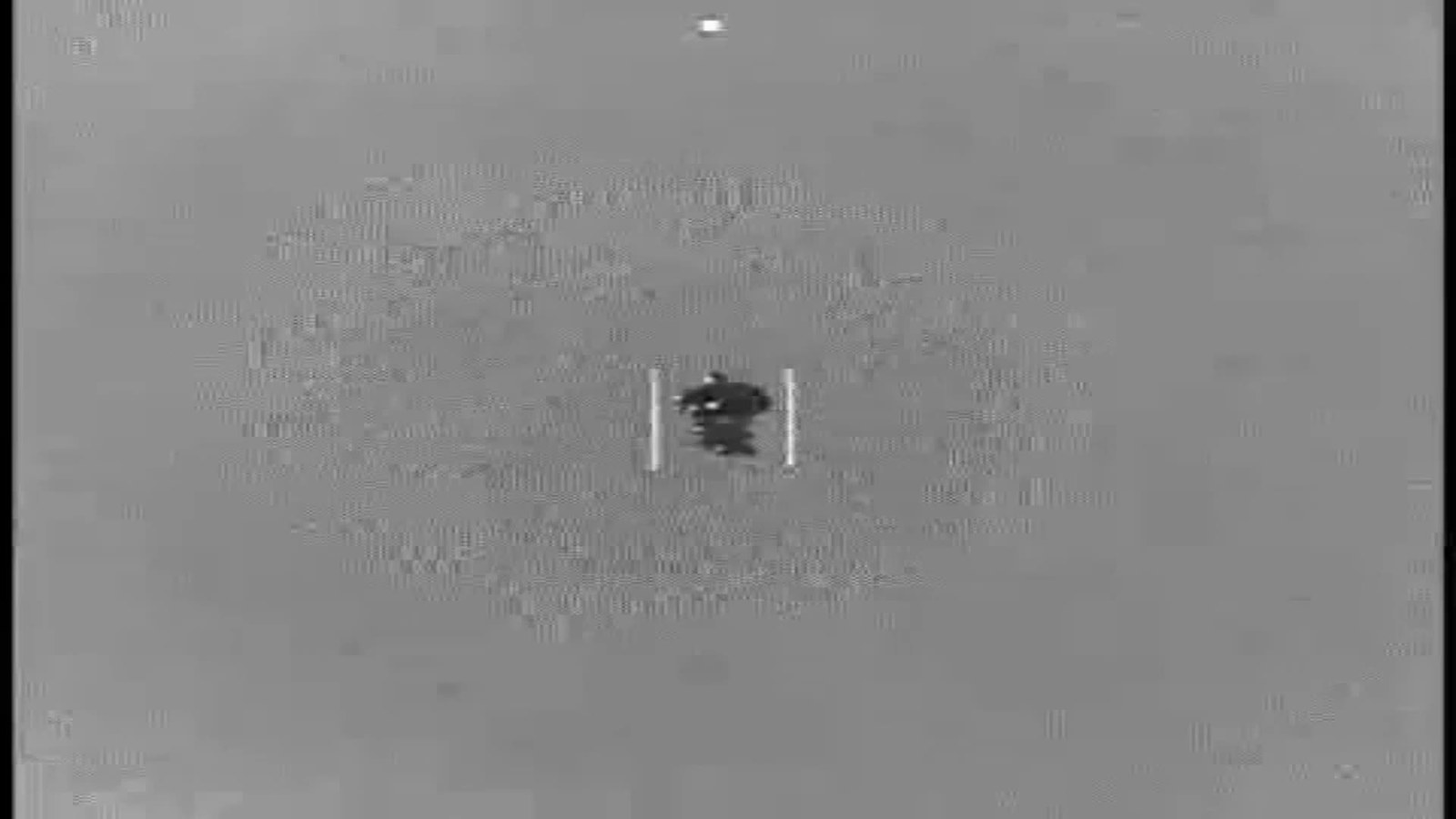
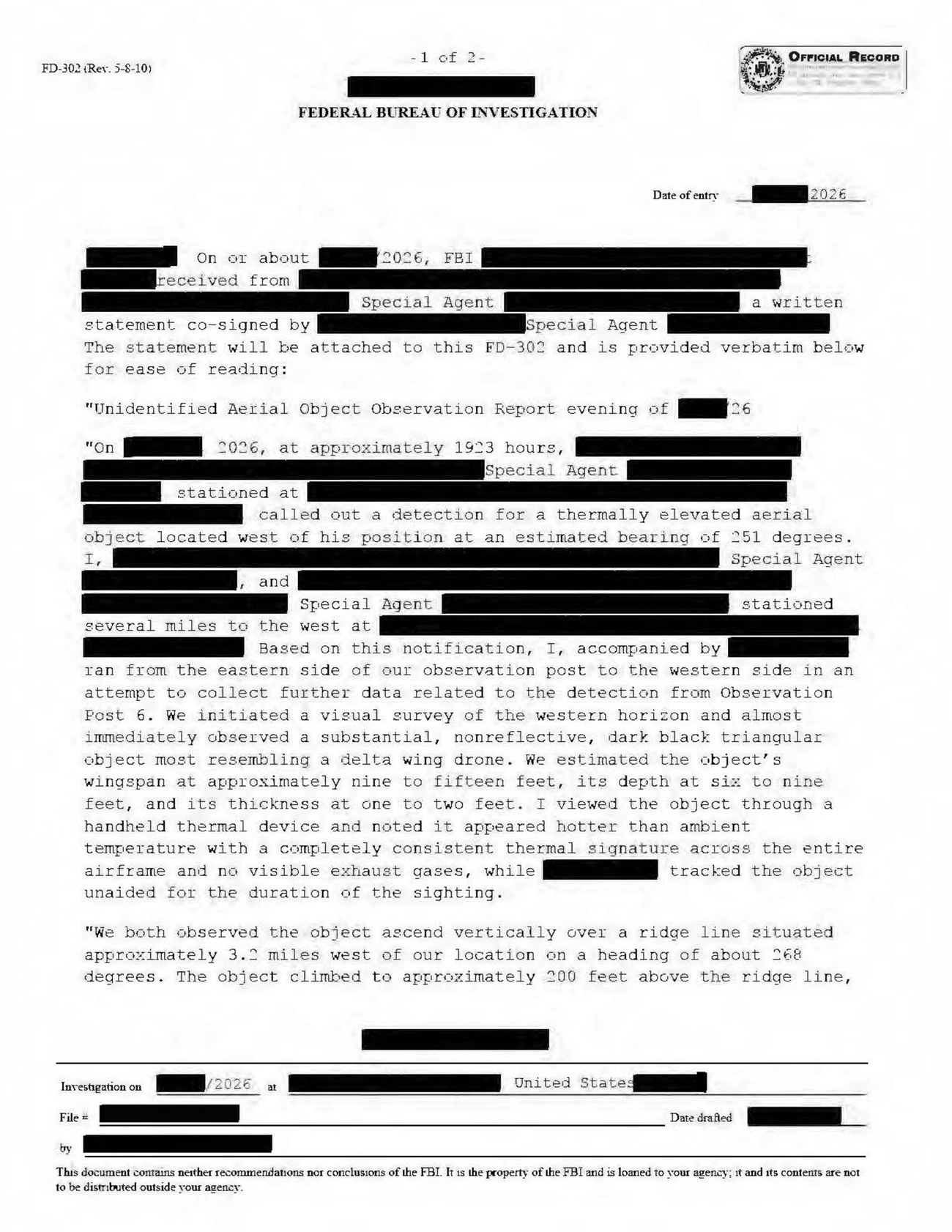
The agents' own co-signed statement, reproduced verbatim inside FBI form FD-302 (FBI-UAP-D043), is shorter and differs in several particulars. It records the initial call-out at approximately 1923 hours at an estimated bearing of 251 degrees, a ridge line approximately 3.2 miles west on a heading of about 268 degrees, a climb to approximately 200 feet above that ridge, and loss of visual contact at an estimated range of about 1.5 miles. The agents estimated the wingspan at nine to fifteen feet. One agent viewed the object through a handheld thermal device and recorded that it appeared hotter than ambient temperature with a completely consistent thermal signature across the entire airframe and no visible exhaust gases.
Both documents agree on the two points the witnesses considered decisive: the object made no sound at all, and it showed no localised heat source anywhere on its airframe.
More footage and images of this sighting
What is the official explanation?
The two records were released together on 23 October 2026 in PURSUE Release 07, the seventh tranche of declassified UAP material published by the U.S. Department of War at war.gov/UFO. The Department's manifest cross-pairs them to each other and to nothing else, which is the Department's own way of stating that it treats them as one incident rather than two.
AARO's memorandum does not reach a conclusion. The Department's published description states that AARO considers the incident to warrant further investigation because of what it calls the close alignment of the reported morphological features and kinematic profiles with other reported incidents in the western United States region, and that the file does not present a conclusive finding regarding the nature or origin of the reported object. The memorandum carries AARO's standard caution that the descriptions reflect the reporters' subjective interpretations at the time of the event.
The memorandum records that a ground survey of the canyon drainage conducted the following morning located no wreckage, no ground scarring and no vegetation damage, that the agents reported no physiological effects, and that no electromagnetic interference or anomalous readings were recorded on personal or agency equipment.
The date and the location are withheld. The redaction marks printed on the pages cite the postponement grounds of Section 1843 of the UAP Disclosure Act: the date and location are withheld under 1843(a)(1)(C), personal identities under 1843(a)(2) and 1843(a)(3), and one passage about the witnesses' professional background additionally under 1843(a)(1)(B). The Department's own summary of the memorandum also describes a secondary observation on the following evening and observations spanning two days. No such passage appears in the released text of the memorandum, so either it sits inside a withheld portion or the summary describes more than the released pages carry.
One figure now attached to this event in news coverage is not in either document. Several outlets reported the object as travelling at 1,800 miles per hour. Neither the AARO memorandum nor the FBI form contains the string mph, miles per hour, knots or Mach, or any numeric speed at all. The memorandum says the opposite in plain words, that no instrumented speed measurement was obtained, and its only statement about speed is that the sources estimated it by the distance the object covered along the ridge before they lost sight of it and compared it to a military fighter jet. The 1,800 figure is an inference made downstream of the release and this archive does not adopt it.
What did the witnesses think it was?
The AARO memorandum records the collector's assessment of the witnesses: both primary sources have extensive operational experience, regularly observe conventional aircraft operating around the observation site, and work alongside government agencies and academic studies using unmanned aerial systems. That last detail cuts both ways and the memorandum says so plainly. These are people who see drones routinely, which strengthens their judgement that this was not one, and also means a drone was the first thing they would have thought of.
They did think of it. The agents' own statement calls the object a substantial, nonreflective, dark black triangular object most resembling a delta wing drone, and the closing sentence of their statement records that neither of them detected any auditory output from what they themselves call the unmanned aerial system. The witnesses filed the sighting in the language of a drone report.
The collector note records the agents' reason for rejecting that reading. On that hilltop, they said, even a conventional Group 1 drone, a high-torque quadcopter motor or a rotary-wing aircraft operating at a distance of 1.4 miles would have been clearly audible. They established the object's size by comparing its outline against trees on the ridge line behind it, and bounded its range by terrain cross-reference.
The two accounts disagree about duration, and the disagreement is not small. AARO describes roughly ten seconds of ascent, roughly twenty seconds of hover and two to three seconds of departure, which is about half a minute. The agents' co-signed statement ends with the sentence that the total duration of the sighting was approximately three seconds. The most natural reading is that the agents were timing only the final high-speed transit, which AARO also puts at two to three seconds, but that is an inference and the statement does not say it. The two documents also differ by an hour on the time, 1923 hours in the FBI statement against 2023 local in the AARO memorandum, and differ on the reported wingspan, nine to fifteen feet against thirteen to fifteen feet.
Is the A Matte Black Triangle Reported by Federal Agents in the Western United States, June 2026 real? The two-pass assessment
Pass one, how this could be mundane. The witnesses' own first description is the strongest prosaic candidate on the table: a delta wing drone. A matte black fixed-wing drone of roughly the stated size exists in quantity, and a vertical ascent followed by a hover and a fast departure is within reach of a modern tailsitter or a hybrid vertical-takeoff airframe. The two arguments offered against it are silence and the uniform thermal signature, and both are weaker than they look at this range. Sound at 1.4 to 3.2 miles across canyon terrain in moving evening air is not reliably audible, and a small electric airframe is quiet to begin with. A uniform thermal signature is what a cold-soaked composite airframe with an electric motor looks like on a handheld monocular with a narrow field of view, which is also the instrument that lost the object the moment it accelerated. Against that, the FBI statement records the object as hotter than ambient, which is not what AARO's memorandum emphasises, and an object that is warm all over is not obviously a cold airframe either.
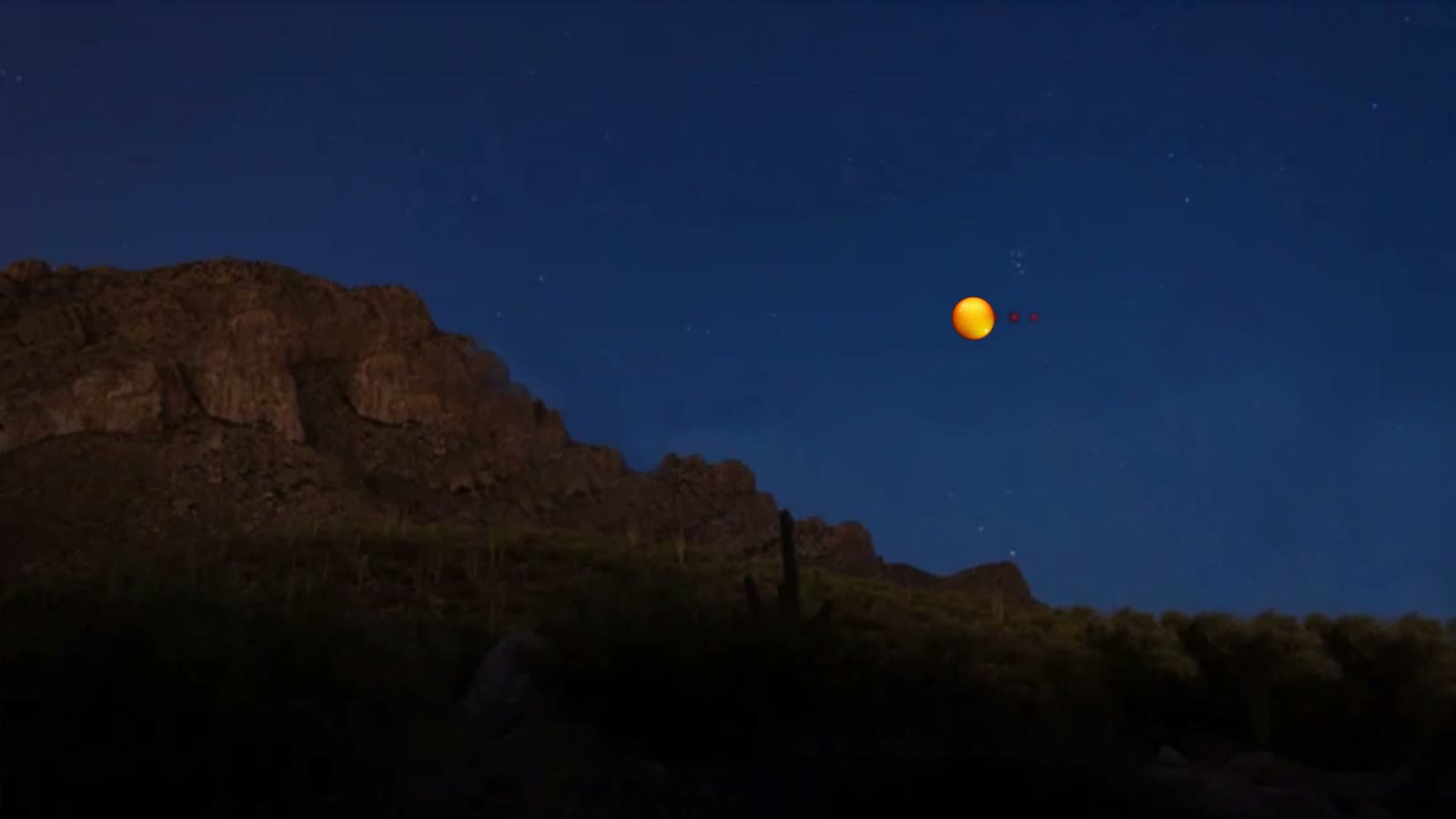
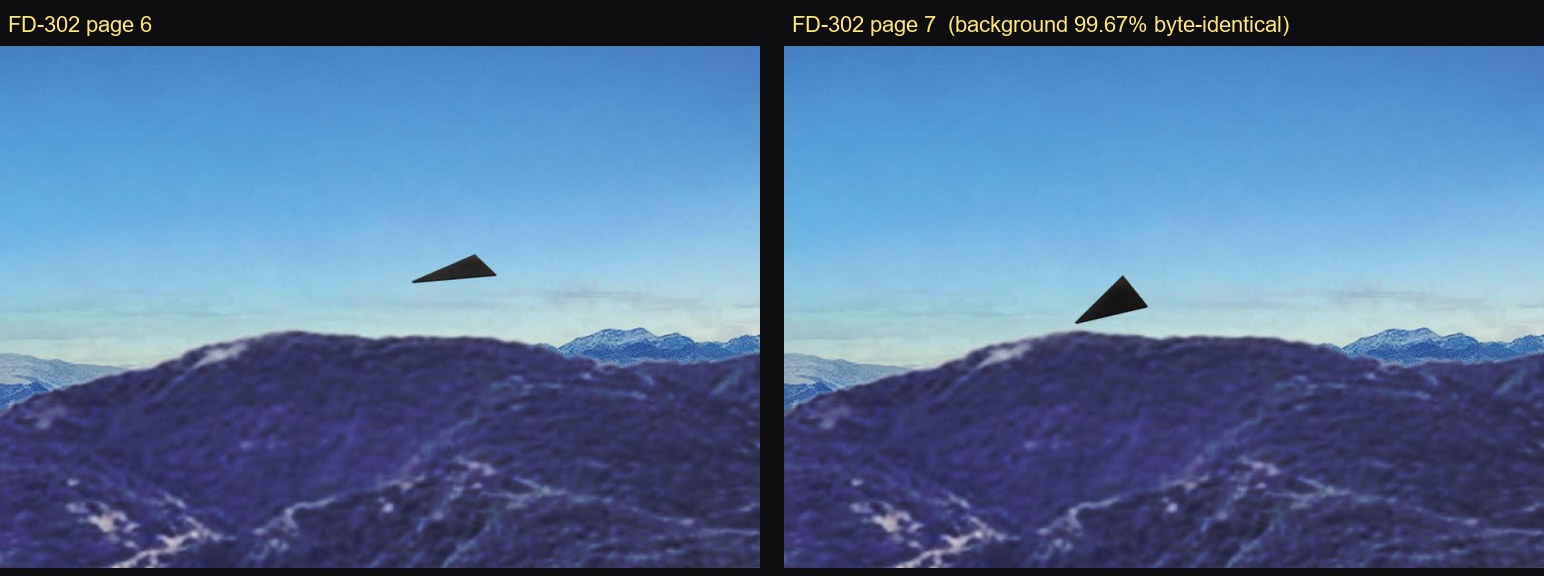
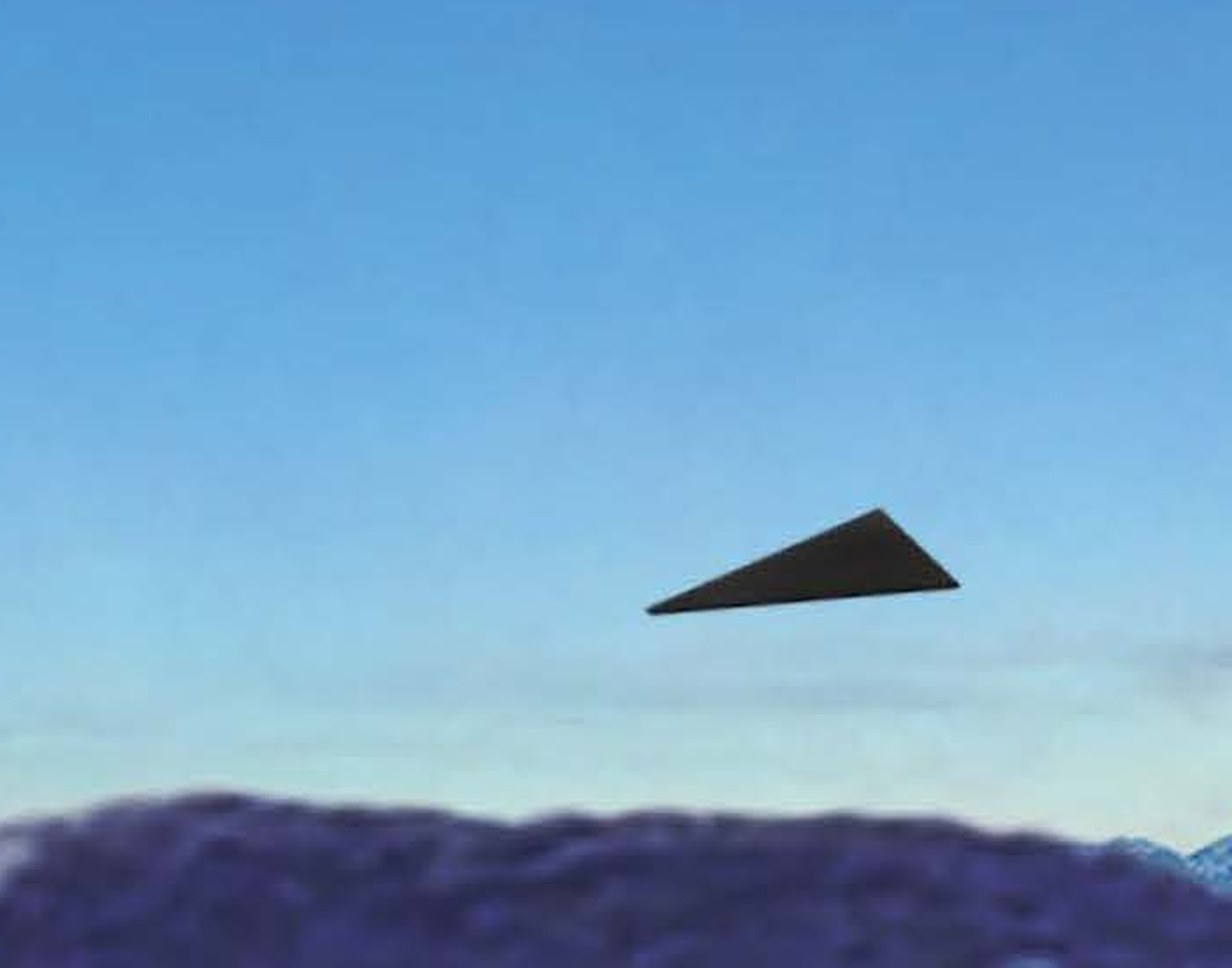
The imagery deserves its own paragraph, because it is the part of this release most likely to be misread. Nine large colour images are bound into the FBI file after the two pages of statement. They show a dusk ridge and canyon scene with the object low and horizontal in some frames and resolved into a banked triangle in others, and they track AARO's three phases closely. They are not photographs of the object. Pages 6 and 7 carry backgrounds that are 99.67 percent byte-identical at native resolution and differ only inside a single 536 by 480 pixel box, which is where the object sits. Pages 8 and 10 are identical on the same test, differing only inside one 1032 by 784 pixel box, and page 11 is 99.4 percent identical to both. Independent photographs of a moving object cannot do that. Sensor noise, exposure and micro camera shake differ between real exposures, and identical pixels away from a changed region is the signature of one base image edited locally and re-saved. A second check points the same way: measured against the Moon in the same frame, the drawn object subtends several times the angle a nine to fifteen foot craft would subtend at the 1.4 to 3.2 miles the documents state, so it is drawn for legibility rather than to scale. A third check is the simplest of all. The AARO memorandum names the instruments at the scene, and they are binoculars, a handheld thermal monocular and a tripod-mounted thermal system that terrain prevented the agents from moving in time. The memorandum contains no occurrence of the words camera, photo, image, imagery, video or still. The honest description of these nine images is that they are depictions of a reported event, composited onto photographs of the observation site, and this archive treats them the way it treats any witness drawing: as a record of a memory, not of an object.
Pass two, if the account is accurate. What the witnesses describe is not a shape, it is a performance envelope. A ten second controlled vertical climb with a completely fixed horizontal attitude, no tilt, sway or wobble, is already difficult, because rotorcraft and multirotors hold altitude by vectoring thrust and bleed attitude while doing it. A twenty second hover with no observable drift in moving evening air on a ridge is harder. Going from a dead stop into fighter-speed horizontal flight with no acceleration ramp and no pitching, in absolute silence, with no exhaust plume, no heat shimmer and no particulate discharge, is the part no known airframe does. The two agents were in a position to judge that last point specifically, and their judgement is the evidence this case rests on.
The case stands at Unknown. There is no official resolution, AARO says so itself, and the documentary record is unusually good: two agencies, two independently written accounts of the same minutes, released together, disagreeing in exactly the way genuine independent accounts of a fast event disagree. The disagreements are a reason to take the pair seriously rather than a reason to dismiss it, because a fabricated pair would agree. What the file does not contain is an instrument record. No photograph, no video, no radar track and no thermal recording was released, the handheld monocular lost the object on acceleration, and the only tripod-mounted sensor on the hill was pointing the wrong way and could not be moved. The nine images are drawings. Everything in this case comes down to what two experienced observers say they saw for somewhere between three and thirty-two seconds.
Sources
- www.war.gov/UFO/
- www.war.gov/medialink/ufo/release-07/documents/DOW-UAP-D176-Triangular_UAP_AARO_MFR_2026.pdf
- www.war.gov/medialink/ufo/release-07/documents/FBI-UAP-D043-FD_302_Unidentified_Aerial_Object_Observation_Report-2026.pdf
- www.war.gov/Portals/1/Interactive/2026/UFO/uap-data.csv
More cases from this region: UFO sightings in United States