The BAASS Purchase Agreement with MUFON and Its Funding Review of June 2009
Released correspondence shows a Defense Intelligence Agency contractor paying the largest civilian UFO organisation in the United States a monthly stipend for its case reports, and then cutting that stipend in half because it judged the output too thin.
What did witnesses see at Las Vegas?
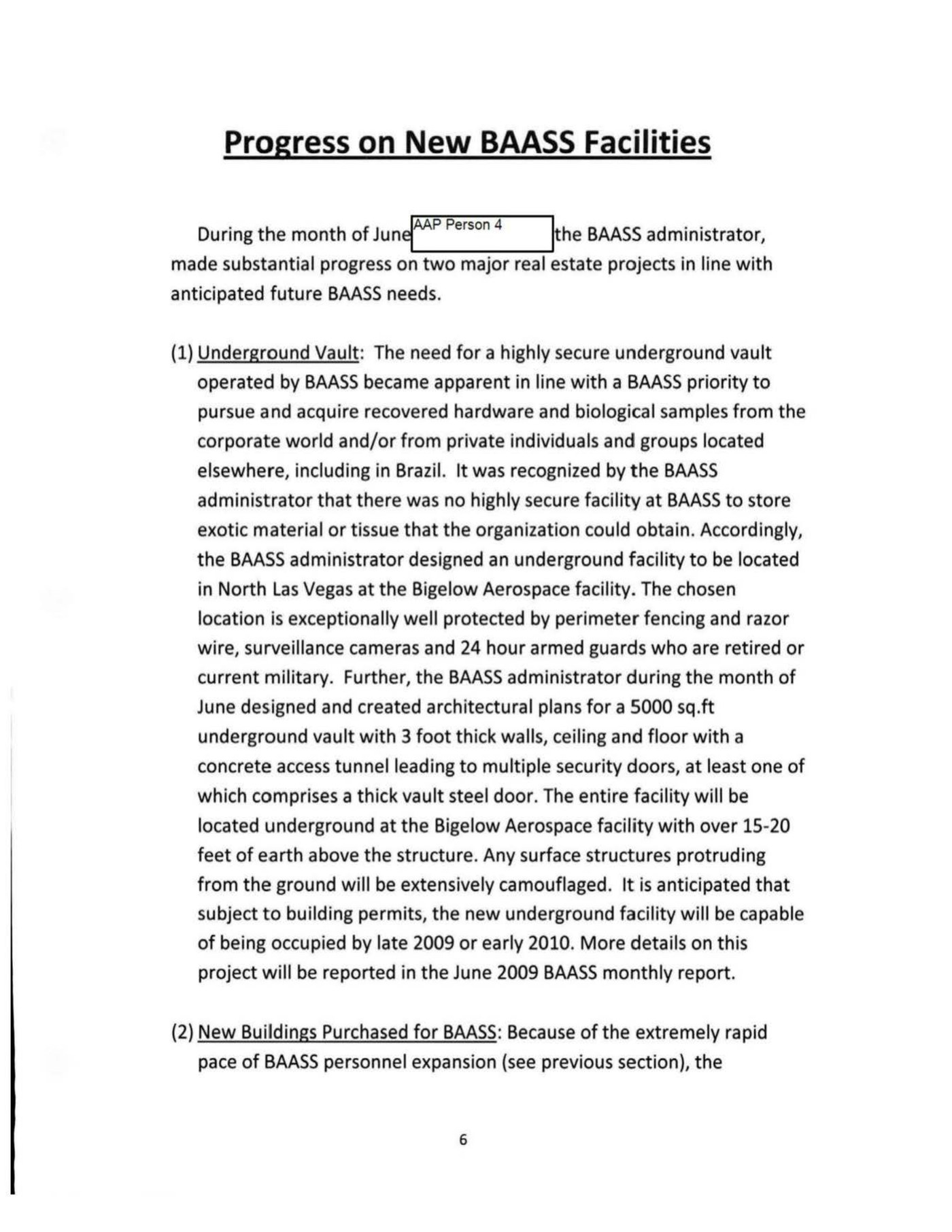
Two letters released on 23 October 2026 document a cash arrangement with exact figures. A contractor to a Defense Intelligence Agency programme paid the Mutual UFO Network a monthly stipend for access to civilian UFO reports, and then halved it. The letters sit inside the June 2009 monthly report of Bigelow Aerospace Advanced Space Studies, the contractor to the programme known as AAWSAP.
The report describes the agreement in plain terms. In February 2009, BAASS executed a purchase order with MUFON entitling BAASS to receive notification of significant reports on UAP sightings from anywhere in the United States within hours, to receive timely reports from MUFON investigators regarding investigations of these incidents, and to receive physical evidence, including photographs, digital recordings, samples of soil, insects, plants and animals, for scientific analysis. The report adds that BAASS has multiple laboratories ready to conduct forensic, photographic, metallurgic, chemical, isotope and biological analysis of any specimens received, and that it had hired a team of investigators with intelligence and law enforcement backgrounds, trained to deploy as rapid reaction investigative teams anywhere in the United States.
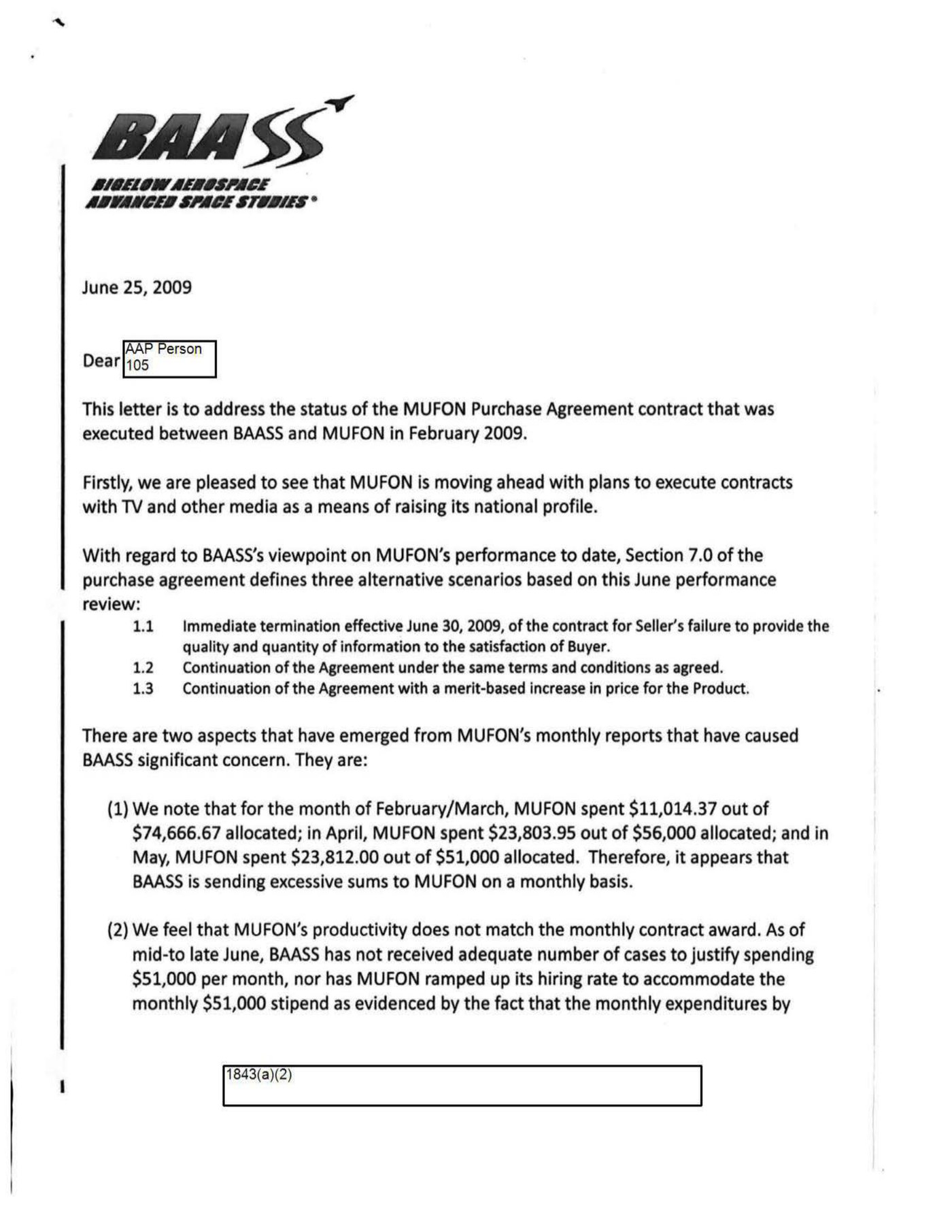
The first letter is from the BAASS administrator to MUFON, dated 25 June 2009. It cites Section 7.0 of the purchase agreement, which defined three alternatives at the June performance review: immediate termination effective 30 June 2009 for failure to provide the quality and quantity of information to the satisfaction of the buyer, continuation under the same terms, or continuation with a merit based increase in price.
The letter then sets out the numbers. For February and March, MUFON spent 11,014 dollars and 37 cents out of 74,666 dollars and 67 cents allocated. In April it spent 23,803 dollars and 95 cents out of 56,000 dollars. In May it spent 23,812 dollars out of 51,000 dollars. BAASS concluded that it was sending excessive sums on a monthly basis, that MUFON's productivity did not match the monthly contract award, and that expenditure had reached a plateau. It proposed a Phase II funding level of 25,500 dollars per month between 1 July and 31 October 2009, noting that combined with roughly 120,000 dollars in unspent allocations this would leave about 55,000 dollars a month available. It stated that the accumulation of large sums of unspent money was not in the spirit of the agreement, and set the next review for 27 October 2009.
More footage and images of this sighting
What is the official explanation?
The documents are pages of DOW-UAP-D171, published by the Department of War in PURSUE Release 07 on 23 October 2026 and marked redacted in the release manifest. The manifest records the agency as Department of War and the location as Las Vegas, Nevada.
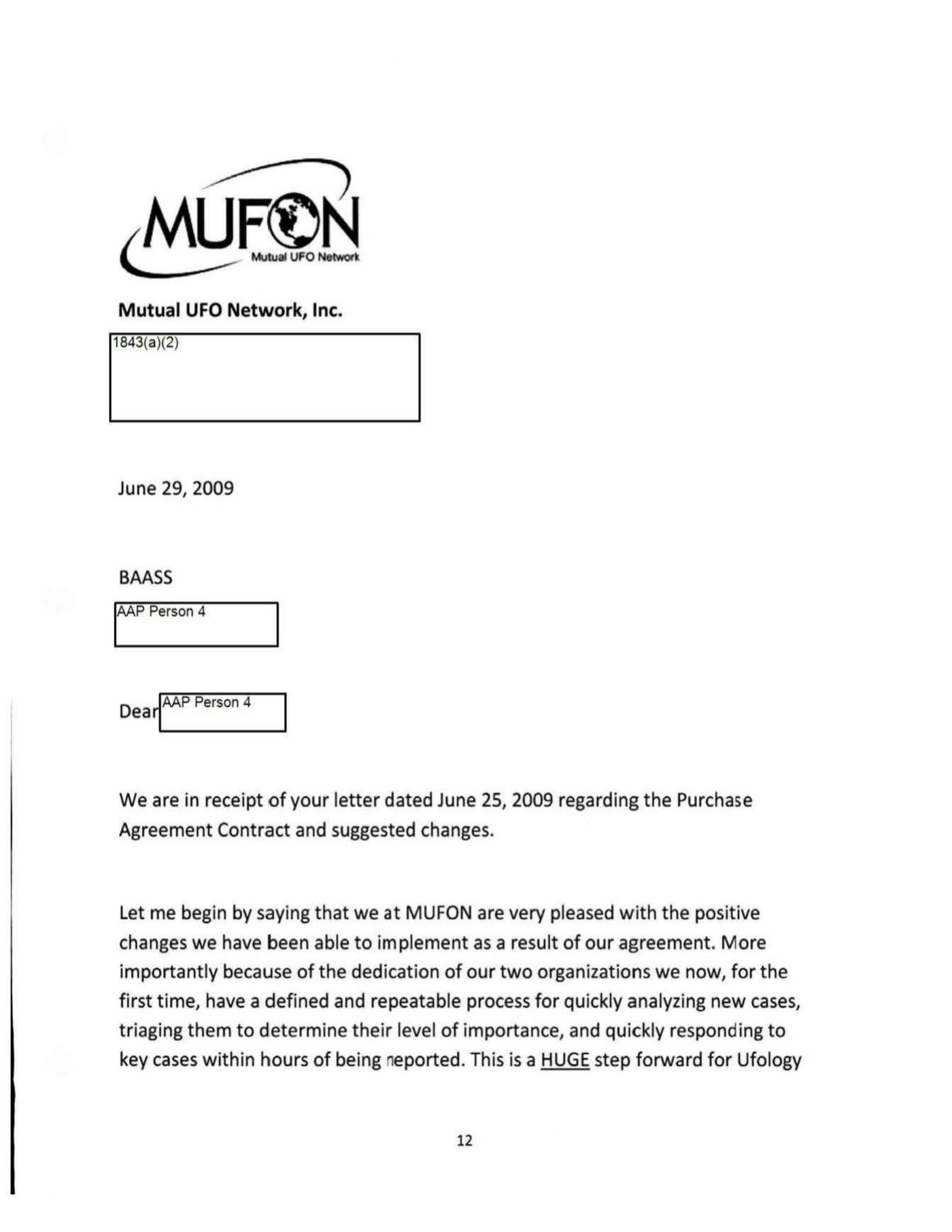
The reply is dated 29 June 2009, four days after the BAASS letter, and is written on Mutual UFO Network letterhead. It accepts the cut. MUFON accepts the reduction in payments for the next four months with supplemental monies to come from the initial funds allocated from February to June 2009, and asks that BAASS reevaluate the monthly allocation in October 2009 based on expected increases in expenses.
The reply also contains MUFON's own assessment of what the arrangement had achieved, and it is the most quotable passage in the exchange. The writer states that because of the dedication of our two organizations we now, for the first time, have a defined and repeatable process for quickly analyzing new cases, triaging them to determine their level of importance, and quickly responding to key cases within hours of being reported, and calls this a HUGE step forward for Ufology, capitalisation in the original.
Both signatories are withheld. The BAASS letter is signed by AAP Person 4, identified in the document only as Administrator, BAASS. The MUFON reply is signed by AAP Person 105. The withholding code printed on the pages is 1843(a)(2), the personal privacy ground under the UAP Disclosure Act subtitle. This archive therefore names neither correspondent, and readers should be aware that identifying either from outside knowledge is inference rather than record.
One further detail appears in the BAASS letter without comment. The administrator writes that BAASS is pleased to see that MUFON is moving ahead with plans to execute contracts with TV and other media as a means of raising its national profile.
What did the witnesses think it was?
There are no witnesses to a contract, so the question is what the correspondence proves and what it does not.
It proves the existence, the mechanism and the price of the arrangement. Until this release, the BAASS and MUFON relationship was known mainly through participant accounts and journalism, and the sums were not public. The letters put the February 2009 start date, the deliverables, the review clause, four months of actual expenditure figures, the proposed Phase II rate and the October review date into the documentary record, in the words of both parties.
It proves that the government side was dissatisfied on volume, and that the dissatisfaction was about throughput rather than about the nature of the material. The complaint is that too few cases arrived and that money went unspent, not that the cases were worthless.
It also proves something about the direction of the money that is easy to state loosely and should be stated precisely. MUFON was not paid by the Defense Intelligence Agency. MUFON was paid by BAASS, a private company holding a Defense Intelligence Agency contract. The distinction matters because it is the same structure that lets a government programme acquire civilian material without a government body appearing in the transaction, and because the documents themselves never show a federal officer in the correspondence.
What the release does not contain is the purchase agreement itself. Section 7.0 is quoted but the contract is not among the twenty-eight published records, so its full terms, including what rights BAASS obtained over the material and what MUFON's investigators were told about the ultimate customer, remain unpublished. The archive notes this as an open question rather than filling it.
Is the BAASS Purchase Agreement with MUFON and Its Funding Review of June 2009 real? The two-pass assessment
Pass one, the ordinary reading. This is a procurement dispute. A buyer contracted for a volume of product, received less than it expected, observed that the seller was not spending its budget, and exercised a review clause that the contract had written in advance for exactly that purpose. The seller accepted. Both letters are courteous and both parties express satisfaction with the working relationship. Nothing in the exchange is irregular, and a contracting officer in any industry would recognise every move in it. The figures are modest by federal standards: the entire disputed sum is a reduction from 51,000 dollars to 25,500 dollars a month.
It is also worth resisting the temptation to read sinister intent into the media sentence. BAASS expressing approval that MUFON was pursuing television contracts to raise its national profile is most simply read as what it says, which is that a higher public profile would bring MUFON more reports, and more reports were the product BAASS was buying.
Pass two, why the document matters anyway. The significance is structural rather than scandalous. For roughly a year, the pipeline by which ordinary Americans reported strange objects to a volunteer civilian organisation was connected, by a purchase order with a performance clause, to a Defense Intelligence Agency programme with laboratories standing by for metallurgic and isotope analysis and investigators trained to deploy within hours. Members of the public filing a MUFON report in 2009 were, through two intermediaries, filing into a federal research programme, and the released correspondence gives no indication that they were told so.
The second durable point is MUFON's own claim about what the money bought. The reply says that the rapid triage and response process existed for the first time because of the arrangement. If that is accurate, then federal contract money materially changed the operating capability of the largest civilian UFO organisation in the United States, and the capability outlived the funding.
The archive tiers this Unknown. No sighting is at issue, no official explanation is in dispute, and the documents are what they appear to be. The case exists because the arrangement is now documented at the level of dates and dollars rather than recollection, and because the agreement that governed it has still not been released.
Sources
- www.war.gov/medialink/ufo/release-07/documents/DOW-UAP-D171-BAASS_Monthly_Report_June_2009.pdf
- www.war.gov/UFO/
- www.war.gov/medialink/ufo/release-07/documents/DOW-UAP-D166-MUFON-Reports_Prepared_for_BAASS-November_2008.pdf
More cases from this region: UFO sightings in United States