The Lakenheath-Bentwaters Radar Incident
On the night of 13 to 14 August 1956, ground-controlled approach radar at RAF Bentwaters in Suffolk, then operated by the United States Air Force, began catching a string of fast-moving returns that made no sense for any aircraft of the period. This case file covers what witnesses reported, the official narrative, and a two-pass assessment with its evidence tier.
What did witnesses see at RAF Bentwaters and RAF Lakenheath?
On the night of 13 to 14 August 1956, ground-controlled approach radar at RAF Bentwaters in Suffolk, then operated by the United States Air Force, began catching a string of fast-moving returns that made no sense for any aircraft of the period. The chronology, preserved in the Project Blue Book teletype and reconstructed by the Condon Report's radar consultant Gordon David Thayer, runs roughly like this. At about 2130Z the Bentwaters GCA set picked up a single target 25 to 30 miles to the east-southeast, crossing the scope at a speed the operator first estimated near 4,000 mph; when Thayer recomputed it from the plotted positions he got a figure on the order of 9,000 to 10,800 mph. The target faded as it crossed the field.
Minutes later a group of 12 to 15 returns appeared about 8 miles southwest, drifting northeast at a far more ordinary 80 to 125 mph. Over a 6 to 7 mile span these echoes merged into a single very strong return, described as several times larger than the radar signature of a B-36 bomber. Around 2200Z another single target ran from 30 miles east to 25 miles west of the station in roughly 16 seconds, which works out to something in the order of 12,000 mph. Then at about 2255Z came the return that tied radar to human eyes. A target tracked from the east toward the west at an estimated 2,000 to 4,000 mph, and as it did so the Bentwaters control tower saw a bright light cross the field from east to west at terrific speed at about 4,000 feet, while at the same moment the pilot of a C-47 transport flying over the base reported a bright light streaking westward beneath his aircraft. Ground radar, a tower observer, and an airborne witness all caught the same pass.
Bentwaters telephoned RAF Lakenheath, about 40 miles to the northwest, and asked whether their radar showed anything moving at 4,000 mph. Lakenheath's radar air traffic control center went to full moving-target indication, which strips out stationary ground clutter, and soon picked up the night's strangest object. A controller spotted a stationary echo 20 to 25 miles southwest of the base. With no warm-up at all it suddenly tracked north-northeast at a speed later calculated at 400 to 600 mph. As Technical Sergeant Forrest Perkins, the Lakenheath watch supervisor, put it in his account, there was no build-up to this speed, it was constant from the second it started to move until it stopped. The object made several abrupt changes of direction, always in straight lines, always near 600 mph, with no visible acceleration or deceleration, and it repeatedly went stationary again, all of this while the MTI filter was running.
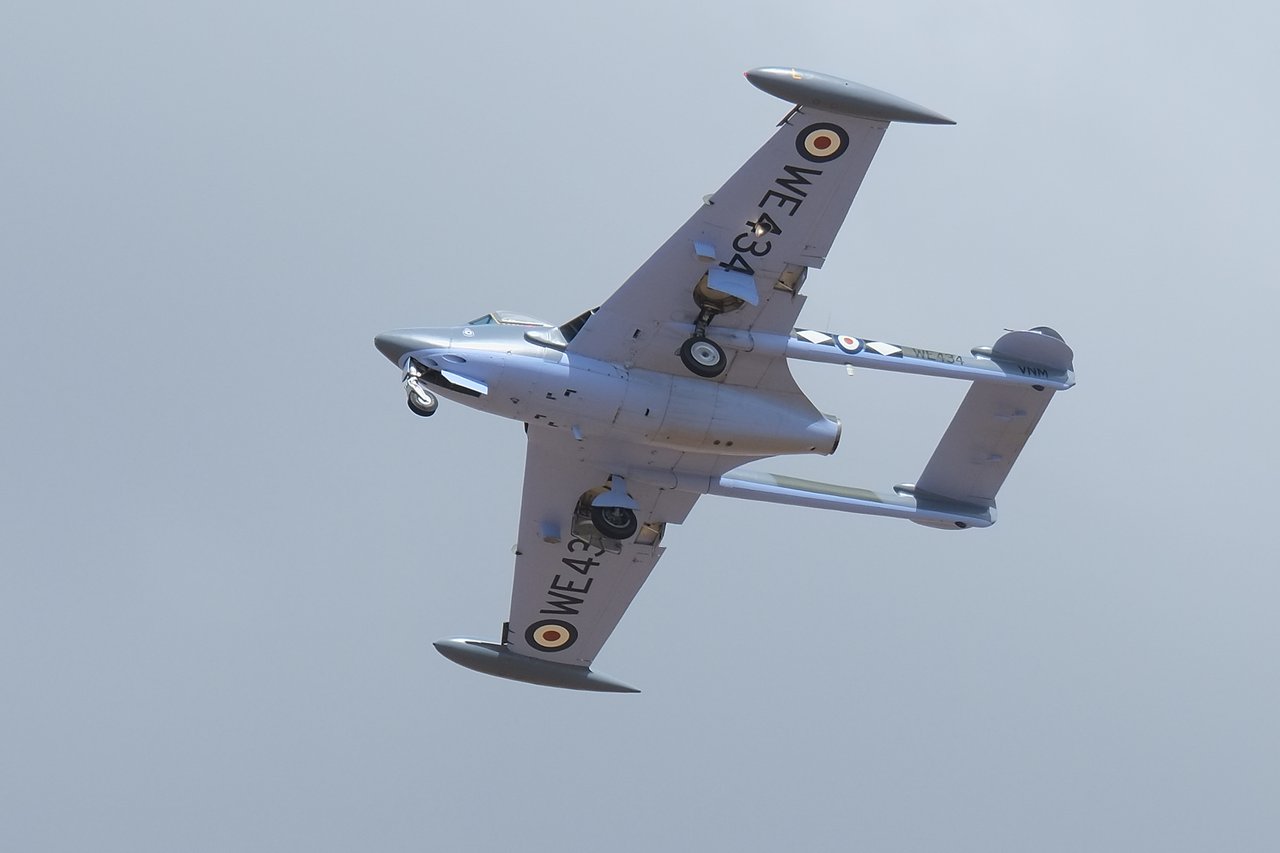
The RAF then scrambled a de Havilland Venom NF.3 night fighter from RAF Waterbeach. Vectored onto the target southwest of Lakenheath, the pilot achieved an airborne radar lock and radioed words to the effect of "Roger, I've got my guns locked on him," calling it the clearest target he had ever seen on radar. Seconds later the object swung around behind the Venom. The pilot's next transmission was "Where did he go? Do you still have him?" Lakenheath confirmed the return was now on his tail. He flew evasive maneuvers and could not shake it; the echo stayed locked behind his aircraft as a distinct return for several minutes until, low on fuel, he broke off for base. A second Venom was scrambled but turned back with engine trouble before reaching the area. The first object eventually made a couple of short moves and left radar coverage to the north at about 600 mph.
What is the official explanation?
The case is unusually well documented for a 1956 sighting because two layers of official apparatus examined it. The first is the United States Air Force itself. A contemporary Air Intelligence Information Report was filed by Captain Edward L. Holt on 31 August 1956, and the events were carried in a Project Blue Book teletype message that the Condon Report later reproduced in full on its pages 252 to 254, with only the names and exact localities deleted. Despite the radar, tower, airborne and interceptor elements all lining up, Blue Book did not enter the case in its official "unidentified" column, a classification gap that later investigators treated as an administrative convenience rather than a genuine resolution.
The second and weightier layer is the Condon Report, formally the Scientific Study of Unidentified Flying Objects conducted at the University of Colorado under Edward U. Condon and published in 1968. The Air Force funded the Condon project specifically to evaluate whether UFO reports held any scientific substance, and the project's overall public conclusion was negative. That makes its treatment of Lakenheath-Bentwaters, handled as Case 2, all the more striking. The radar analysis was written by Gordon David Thayer, an atmospheric and radio-propagation specialist. Thayer worked through the most obvious mundane explanation for radar UFOs, anomalous propagation, in which temperature inversions bend radar beams and paint false ground echoes. He rejected it for the central events. The high-speed 2255Z target moved almost opposite to the prevailing winds, whereas anomalous-propagation false targets drift with the wind, and the Lakenheath object's complicated stop-and-go maneuvering appeared on two different radars working at different frequencies and scan rates, which a single propagation anomaly cannot produce. Thayer noted that ghost echoes do not stop following an aircraft and become stationary, as this return did.
The Condon Report's written conclusion on Case 2 is quoted here in full: "In summary, this is the most puzzling and unusual case in the radar-visual files. The apparently rational, intelligent behavior of the UFO suggests a mechanical device of unknown origin as the most probable explanation of this sighting. However, in view of the inevitable fallibility of witnesses, more conventional explanations of this report cannot be entirely ruled out." That a study commissioned to dampen UFO claims conceded its single most puzzling radar-visual case pointed to "a mechanical device of unknown origin" is the heart of why this case endures. The closing hedge about witness fallibility is an honest caveat, not a counter-explanation, and the report offered no specific ordinary object, aircraft, or weather mechanism that fits the full sequence.
What did the witnesses think it was?
The strongest witness voice belongs to Technical Sergeant Forrest Perkins, the United States Air Force watch supervisor in the Lakenheath radar air traffic control center on the night in question. Perkins wrote directly to the Colorado project in 1968, twelve years after the event, and it was largely his letter that brought the case to the Condon Committee's attention and gave investigators the coherent Lakenheath narrative that the Blue Book file alone did not contain. Perkins described the target appearing as a stationary echo, then moving off with no build-up in speed, holding straight-line tracks at about 600 mph, and repeatedly stopping dead. He recounted the interceptor episode plainly, including the moment the object slipped behind the Venom, and he characterized the pilot during the chase as getting worried, excited and pretty scared, a detail that survives in his own words rather than in any official summary. His account, written from memory long after, agreed closely with the independently filed teletype, which is part of why both Thayer and the atmospheric physicist James E. McDonald treated it as reliable corroboration rather than embellishment.
The corroborating witnesses are layered. At Bentwaters the radar operators tracked the high-speed returns; the control tower crew saw a bright light cross the field; and the C-47 pilot overhead saw a light streak beneath him at the same moment as the radar pass, an airborne human confirmation of a ground radar track. At Lakenheath the radar crew tracked the maneuvering object on MTI. The two RAF Venom night-fighter crews scrambled from Waterbeach provided the airborne radar element, with the first pilot getting a gun-radar lock he called the clearest target he had ever seen, then finding himself tailed by the very thing he had locked onto and unable to lose it.
James E. McDonald, a senior atmospheric physicist at the University of Arizona, independently investigated the case in the late 1960s. Working from Blue Book copies in which all the military names had been cut out before release, he could not interview the radar operators by name, but he cross-examined the documentary record and Perkins's account in detail and judged the events scientifically inexplicable by ordinary means. He framed the stakes bluntly, asking in his paper whether a UFO case like Lakenheath did not warrant more than a mere shrug of the shoulders from science. None of these witnesses recanted, and no participant later confessed to error or fabrication.
Is the Lakenheath-Bentwaters Radar Incident real? The two-pass assessment
Pass one, the search for an entirely ordinary explanation. The obvious candidate for radar UFOs is anomalous propagation: a temperature inversion bending the radar beam and painting false returns from the ground or from distant clutter. This was the explanation the official apparatus would have preferred, and the Condon Report's own radar man, Gordon Thayer, tested it carefully precisely because it is the mundane default. It does not fit. The fast Bentwaters target moved against the prevailing wind, while propagation ghosts drift with the wind. The maneuvering Lakenheath object appeared on two separate radars running different frequencies and scan rates, which a single atmospheric anomaly cannot reproduce. Most damning, propagation echoes do not lock onto an aircraft, tail it, and then go stationary, which is exactly what witnesses and radar reported. Other ordinary candidates fare no better. Meteors were in the sky that night, but observers explicitly distinguished the object from the meteors, and meteors do not stop, hover, reverse, or chase a fighter for several minutes. A balloon cannot make 600 mph straight runs or sit motionless then accelerate instantly. No 1956 aircraft, friendly or hostile, could go from a dead stop to several hundred miles per hour with no acceleration phase, sit stationary on MTI, and out-turn a Venom night fighter. There is no confession, no recovered prop, no identified ship or rocket, and no demonstrated fabrication anywhere in the record.
Pass two, if it was a real object, what was it. The behavior reported is the behavior of a controlled craft: it held station, accelerated without a visible build-up, ran dead-straight legs at constant speed, changed heading sharply, and, most tellingly, reacted to the interceptor by maneuvering behind it and staying there. Thayer called it the most puzzling and unusual case in the radar-visual files. The Condon Report concluded the most probable explanation was a mechanical device of unknown origin. James E. McDonald, examining it independently, found it scientifically inexplicable by conventional means. The convergence is what gives this case its weight: an Air Force-funded study set up to deflate UFO claims still conceded that its hardest radar-visual case pointed to an unknown mechanical device, and an independent senior physicist reached the same dead end from the same documents.
This case is not disputed in the strong sense the tier system reserves for confessions, recantations, recovered hoax props, or a positively identified real-world object. None of those exist here. The only counter-explanation ever seriously advanced, anomalous propagation, was tested and rejected by the very official radar analyst tasked with the case, and no specific aircraft, balloon, launch, or weather event has ever been matched to the full sequence. The material is authenticated, the witnesses are named and never recanted, and the object remains unexplained after examination by both the Air Force's own commissioned study and an independent scientist. That is the definition of Verified Unexplained, and that is the tier.
Sources
- ufologie.patrickgross.org/htm/bentwaters56condon.htm
- ufology.patrickgross.org/htm/bentwaters56thayer.htm
- ufologie.patrickgross.org/htm/bentwaters56mcd.htm
- ufologie.patrickgross.org/htm/bentwaters56.htm
- www.fold3.com/publication/461/us-project-blue-book-ufo-investigations-1947-1969
More cases from this region: UFO sightings in United Kingdom