The Milton Torres RAF Manston Scramble
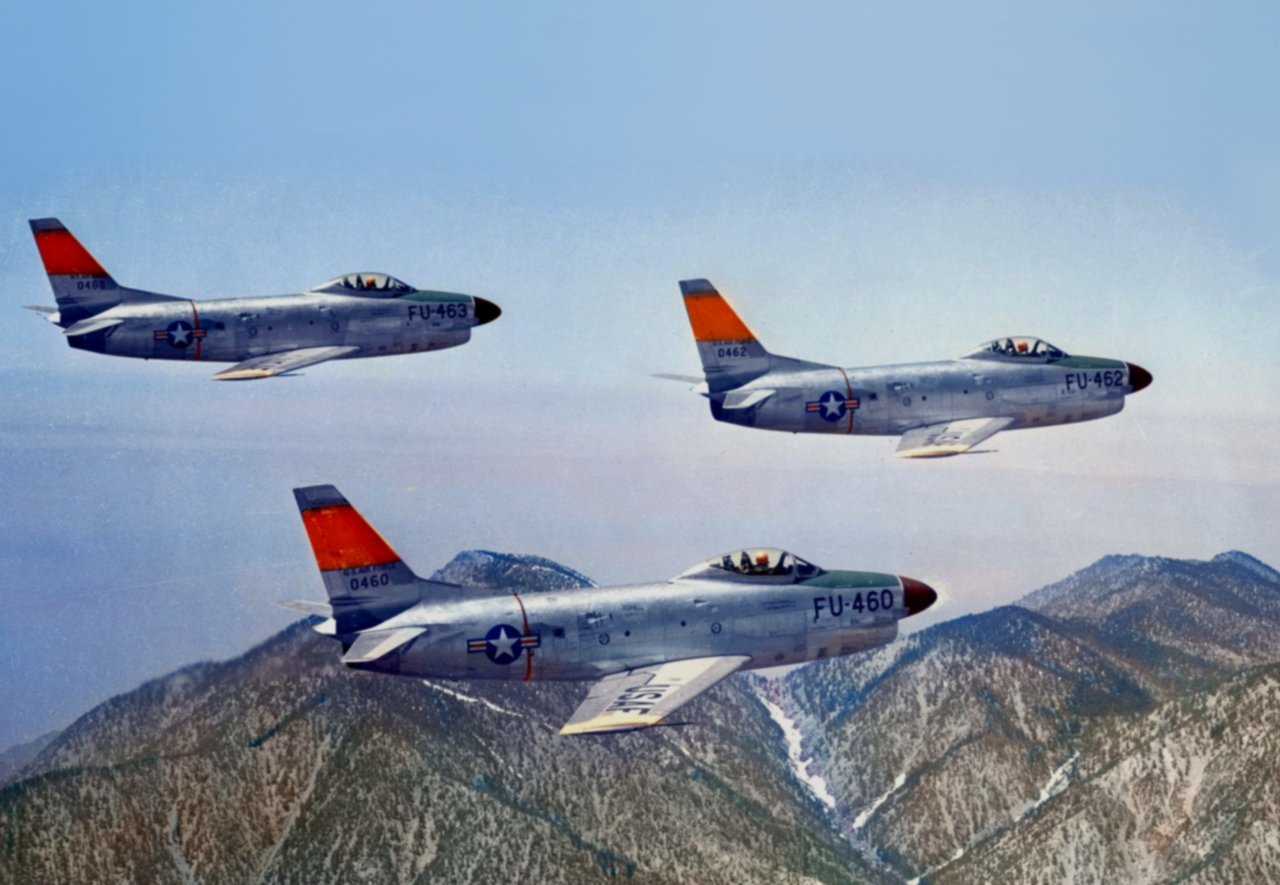
Just before midnight on 20 May 1957, First Lieutenant Milton John Torres was sitting five-minute alert at the end of the runway at RAF Manston in Kent. This case file covers what witnesses reported, the official narrative, and a two-pass assessment with its evidence tier.
What did witnesses see at RAF Manston?
Just before midnight on 20 May 1957, First Lieutenant Milton John Torres was sitting five-minute alert at the end of the runway at RAF Manston in Kent. Torres, then twenty-five, flew with the United States Air Force 514th Fighter Interceptor Squadron, 406th Fighter Interceptor Wing, in a North American F-86D Sabre, a single-seat all-weather interceptor armed with twenty-four 2.75-inch Mighty Mouse folding-fin rockets fired in a salvo from a retractable belly tray. It was, in his words, a typical English night in Kent, pitch black under a thick layer of cloud. He and his wingman, Dave Roberson, scrambled inside the allotted five minutes.
Torres set down what happened next in a long written statement that now sits in the Ministry of Defence files. As soon as his wheels were in the well, the ground-controlled interception station at the RAF Metropolitan Sector called him and told him this would be a fire mission. He was vectored up to around 32,000 feet and steered toward a contact the ground had been watching for some time. In his statement, the briefing said the ground had been observing for a considerable time a blip that was orbiting the East Anglia area. He was flying fast, about .92 Mach, closing on the target through solid instrument-flight cloud, never seeing anything with his own eyes.
When his airborne radar picked it up the return was enormous. Torres wrote, "The blip was burning a hole in the radar with its incredible intensity. It was similar to a blip I had received from B-52s and seemed to be a magnet of light. It had the proportions of a flying aircraft carrier." He achieved lock-on almost at once. "I had locked on in just a few seconds, and I locked on exactly 15 miles, which was the maximum range for lock on." The order he had been given was to fire the full salvo of twenty-four rockets the instant he had a valid solution. He selected the rockets to salvo and asked for authentication of the order, conscious, as he put it, that he was only a lieutenant and very much aware of the gravity of the situation. The authentication came back valid.
Then, in the seconds before he could fire, the object simply left. The overtake reading on his scope ran off the scale and the contact accelerated away from him. "By this time, the UFO had broke lock, and I saw him leaving my 30 mile range," he wrote. It outran his radar and was gone, off both his airborne set and the ground scopes, within seconds. Torres never got a visual on it. The whole event, from scramble to landing, took about an hour. He flew back to Manston with twenty-four live rockets he had very nearly let go at something he could not see and could not explain.
What is the official explanation?
There is no contemporary 1957 operational record of this scramble in the public domain. What exists officially is Torres's own statement, which the Ministry of Defence UFO desk filed away in the DEFE 24 series and which the National Archives published in October 2008 as part of a release of around 1,500 pages drawn from the MoD UFO files. The academic consultant to that release, Dr David Clarke, singled the Torres account out as one of the most striking cases in the batch. The documents carry no official explanation for the incident, and neither the MoD nor the USAF, when pressed by journalists after the 2008 release, produced a corroborating radar log, an operations record, or a mission report that confirmed the engagement. The MoD held Torres's later written account but found nothing in its own archives to set against it.
That absence of paperwork cuts two ways, and Torres himself supplied the reason it might be missing. In his statement he describes what happened the day after the flight. A well-dressed American civilian in a dark trench coat, whom he likened to an IBM salesman, came to see him, jumped straight into questions about the previous night's mission, and then told him the matter was highly classified. In Torres's words, the man "threatened me with a national security breach if I breathed a word about it to anyone," and warned that his flying privileges could be pulled. Torres took the warning seriously and said nothing for roughly three decades. His squadron was rotated on shortly afterward and he never saw any mission paperwork from the night.
The official channel through which the case finally surfaced was therefore not an investigation but a disclosure decision. The MoD chose, decades later, to retain and then release Torres's account rather than to debunk it, and the file as released contains the testimony without any attached finding of cause. In Cold War terms this is an air-defence interception of an unidentified target over British airspace that was treated as real enough at the time to authorise a live weapons release, and the only surviving official trace is the pilot's word and the government's later decision to publish it.
What did the witnesses think it was?
Torres has never wavered on the substance. By the time the story became public he was Dr Milton Torres, a retired pilot living in Florida and a professor of engineering, and he repeated the account in interviews tied to the 2008 release the same way he had written it: a colossal radar return, an order to fire the full salvo, authentication confirmed, and then an object that broke lock and left a thirty-mile scope in seconds. He was emphatic that he never saw the thing, only its radar signature, and equally emphatic that a return that large behaving that way was unlike anything he had tracked, including the B-52s he used as his point of comparison. He did not claim it was a spacecraft. He described what his instruments showed and what he was ordered to do.
The case did not surface as a lone man's story. It came out because Torres and his former wingman, Dave Roberson, both flying with the 514th, met again at a Manston veterans reunion in 1988 and found they each remembered the night. Roberson's recollection is not a carbon copy of Torres's, which is itself a mark of independent memory rather than a rehearsed tale. Roberson recalled the activity involving more than one unknown across several radar sites, with tracking reaching up toward Scotland, and remembered detail about aircraft being armed for the response. The two men differ on some particulars, as honest witnesses to a thirty-year-old night naturally do, but they agree on the core: an unusual target, an unusually serious air-defence reaction, and orders that went beyond a routine training intercept.
Torres believed something genuinely anomalous had been on those scopes. He was not a UFO campaigner trading on the story; he sat on it under a security warning until a reunion loosened it, and he framed it throughout in the cautious, technical language of a man describing his radar and his weapons panel. The corroboration of a named second pilot from the same unit, recovered independently at the reunion, is what lifts this above an uncheckable single account.
The dispute
The dispute has two strands, both real and both unproven. The first is the official record itself. When the National Archives released Torres's statement in October 2008, the Ministry of Defence file contained no corroborating 1957 operations log, no radar plot, and no official explanation, and neither the MoD nor the USAF could produce a contemporaneous record of the scramble when journalists asked. Skeptics read that silence as grounds for doubt that the engagement happened as described, or at all. But this is an official non-finding, not a shown debunk. The MoD asserted nothing about cause and offered no method by which the report could be dismissed. An absence of paperwork from a Cold War alert squadron that rotated out shortly afterward, in an era when such intercepts were not always logged for posterity, is weak evidence of non-occurrence, and Torres himself gave a specific reason the trail might be cold, namely an intelligence officer who warned him to keep it classified.
The second and stronger strand is the phantom-radar hypothesis. Dr David Clarke, the academic who consulted on the National Archives release and knows the file better than anyone, has noted that the United States ran Cold War electronic-countermeasures programmes, including the CIA Palladium project, capable of injecting false targets onto radar that could appear very large, very fast, and highly manoeuvrable. A spoofed echo would neatly account for the central anomalies: a return of impossible size, an impossible acceleration, the total lack of any visual object, and the absence of physical traces. It would also fit an air-defence response that treated the contact as urgent. This is the most credible ordinary explanation on offer.
What it is not, yet, is proof. No researcher has surfaced a Palladium operation run against RAF Metropolitan Sector on the night of 20 May 1957, nor any traced exercise, document, or unit tasking that places phantom-echo equipment in this event. Anomalous propagation and ducting are likewise possible in principle but undemonstrated for this particular lock-on at fifteen miles with a measured overtake. Against the skeptical case stands named multi-witness corroboration: Torres and his wingman Dave Roberson, both of the 514th, independently recalled the night at a 1988 reunion, with overlapping but not identical detail, which reads as honest memory rather than a single rehearsed tale. Because every counter-explanation here is plausible but unmethodised, with no confession, no recovered prop, and no positively identified real-world cause for this specific contact, the case is disputed only weakly and largely stands. That places it at Barely Disputed rather than Strongly Disputed.
Is the Milton Torres RAF Manston Scramble real? The two-pass assessment
Pass one, the ordinary readings. The most economical explanation that needs no exotic object is a radar artifact. A return that "burns a hole in the radar" with the proportions of a flying aircraft carrier, that locks at a clean fifteen miles, then runs the overtake off the scale and vanishes off a thirty-mile scope in seconds, is consistent with anomalous propagation, a ducting return, or a deliberately injected false echo. Dr David Clarke, the National Archives consultant who knows the file best, has pointed directly at this possibility, noting Cold War electronic-countermeasures work such as the CIA Palladium programme, which could generate phantom radar targets that appeared large, fast, and impossibly agile. An ECM ghost would also explain why the target had no visual component and why it left no wreckage, no transponder, and no second-radar corroboration of a physical craft. A second ordinary reading is simple absence of corroboration: with no 1957 operations log surviving, the entire case rests on one pilot's memory plus a second pilot's partly differing memory recovered thirty-one years later, and human recall of a single night that long ago is fallible.
Pass two, if the target was real. Then this is one of the cleaner military-radar UAP cases on record. It was tracked by ground radar for a considerable time before the scramble, it was acquired and locked by an airborne intercept radar, it was judged threatening enough that a live weapons release was authorised and authenticated over British airspace in peacetime, and it then displayed an acceleration that outran an interceptor doing .92 Mach. Two named pilots from the same squadron independently recall the night. The government preserved the testimony for decades and released it without offering any cause.
The dispute here is genuine but unproven, which is exactly the threshold for Barely Disputed. The official side is an absence of records and a statement of no explanation, not a shown method that closes the case. The strongest skeptical lead, the Palladium phantom-radar hypothesis, is a plausible mechanism advanced by a serious researcher, but no one has produced a Palladium operation, a specific traced exercise, or any document tying that programme to this scramble. There is no confession, no recovered hoax prop, and no positively identified real-world object. A radar artifact is possible but not demonstrated for this specific contact. With named multi-witness corroboration on one side and only weak, unmethodised counter-explanations on the other, the case largely stands. Tier: Barely Disputed.
Sources
- www.manstonhistory.org.uk/usaf-f-86d-manston-ordered-fire-ufo-may-20th-1957/
- www.thelivingmoon.com/49ufo_files/03files2/1957_May_20_Milton_Torres.html
- www.seattletimes.com/nation-world/retired-pilot-explains-1957-ufo-incident/
- www.nbcnews.com/id/wbna27279684
- www.newscientist.com/article/dn14991-newly-released-files-contain-ufo-mysteries/
More cases from this region: UFO sightings in United Kingdom