The Carl Higdon Abduction
Everett Carl Higdon Jr., a 41 year old oil-rig foreman from Rawlins, Wyoming with about fifteen years in the oilfields and a stint in the Air Force during the Korean War, drove south on the afternoon of Friday 25 October 1974 to hunt elk in the northern Medicine Bow National Forest, in country known as McCarty Canyon roughly forty miles south of town. This case file covers what witnesses reported, the official narrative, and a two-pass assessment with its evidence tier.
What did witnesses see at McCarty Canyon?
Everett Carl Higdon Jr., a 41 year old oil-rig foreman from Rawlins, Wyoming with about fifteen years in the oilfields and a stint in the Air Force during the Korean War, drove south on the afternoon of Friday 25 October 1974 to hunt elk in the northern Medicine Bow National Forest, in country known as McCarty Canyon roughly forty miles south of town. At about four in the afternoon he topped a rise and saw five elk standing in a clearing. He raised his brand-new 7mm magnum rifle, sighted on a bull, and squeezed the trigger. What happened next is the hinge of the whole case: he reported no recoil and no report. He said the bullet left the muzzle in slow motion, drifted out about fifty to sixty feet, and dropped into the snow. In his own blunt phrase it went "splat" and fell to the ground.
When he lowered the rifle a figure was standing off to his right where none had been. It stood a little over six feet, an estimated 180 pounds, in a tight black suit like a wetsuit or diving suit with crossed straps over the chest and a wide belt carrying a six-pointed star and a yellow emblem below it. The being was bow-legged, with a head that seemed to merge into the shoulders without much of a neck, straw-like hair or bristles standing straight up, small deep-set eyes, no real ears, a thin slit of a mouth showing a few large blocky teeth, and two short antenna-like projections on the brow. Higdon said it had no proper hands; one arm ended in a rod or cone like a drill or a spike. It spoke without moving its mouth and asked, more or less, "How are you?" Higdon answered "Pretty good." It asked, "Are you hungry?" A small packet or box floated to him holding four pills; he was told that if he took one he would not need to eat for four days. He swallowed one.
The entity, which Higdon came to call Ausso (also rendered Auzzo), asked whether he wanted to go along. Higdon said something like "I might as well." He next found himself inside a cube-shaped, transparent enclosure that looked far too small from outside yet held him, the being, one or two more figures, and the five elk, all of them apparently floating and motionless. Then came a near-instant transit that Higdon put at an enormous distance, a figure repeated in the literature as on the order of 163,000 of some unit, to a place with a tall conical tower like the Seattle Space Needle, perhaps a hundred feet high, throwing off a brilliant flashing, buzzing light. Inside he was put under a kind of helmet or screen wired to a device and examined. He also saw several other ordinary-looking people there who seemed to belong. After the scan he was told, in effect, "You are not what we need," or "You are not the kind we are looking for," and that he would be taken back.
Higdon's next clear memory was sitting in his pickup, dazed, eyes streaming, in rough country. The truck was not where he had left it. Friends and a search party located him before midnight, around 11:30 to 11:40 p.m., his vehicle stuck three miles away in a deep mud hole in terrain so broken that it should not have been driveable, with no tire tracks leading in. Members of the search reported a strange reddish light in the sky as they worked.
What is the official explanation?
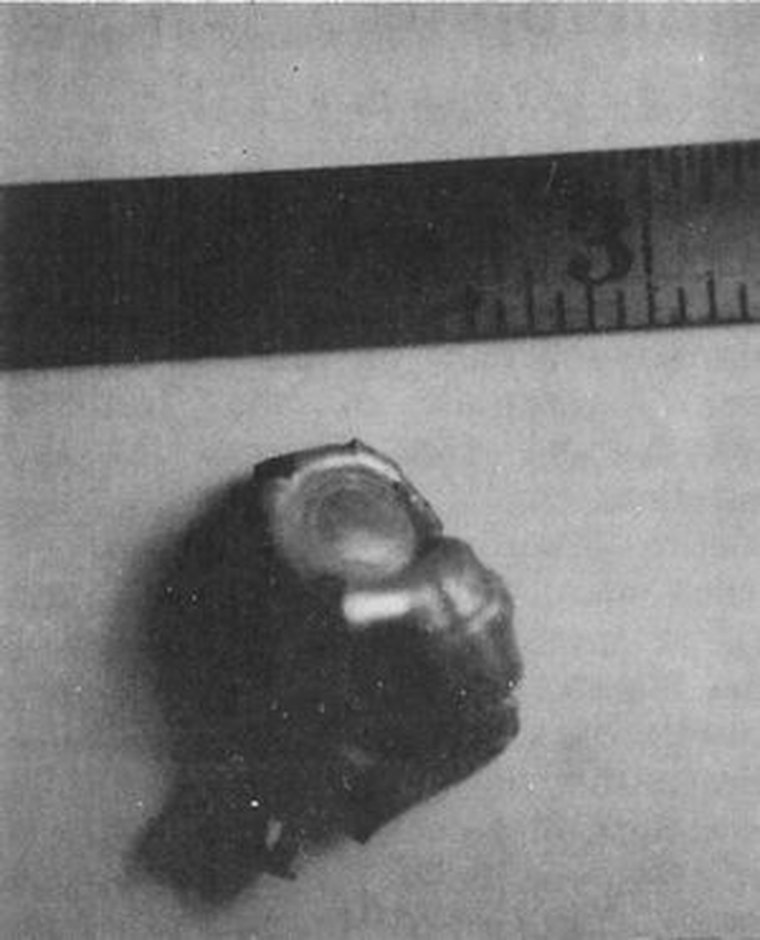
There was no military or federal investigation of the Higdon case; it sits outside Project Blue Book, which had closed in December 1969. The "official" record here is the civilian investigation conducted under the Aerial Phenomena Research Organization (APRO) and reported in mainstream form. The lead investigator was Dr. R. Leo Sprinkle, a counseling psychologist at the University of Wyoming in Laramie and a longtime APRO consultant. Sprinkle interviewed Higdon at length and conducted two regressive-hypnosis sessions, on 2 and 17 November 1974, using a pendulum technique and standard hypnotic procedure. He was joined in the early work by Rick Kenyon, an art teacher in the Rawlins public schools who sketched the entity and the craft from Higdon's descriptions and who photographed the recovered bullet, and by Robert Nantkes, a vocational rehabilitation counselor from Riverton, Wyoming. Frank Bourke is also credited in the APRO write-up.
Sprinkle's findings were published as a preliminary report in Flying Saucer Review vol. 21 no. 3 (November 1975), with an appendix by Gordon Creighton, and the case was carried in the APRO Bulletin vol. 23 no. 5 (March 1975), which printed Kenyon's photograph of the bullet and the artist's conception of the entity. Sprinkle's repeatedly quoted conclusion was cautious but firm: he found "no evidence of hoax" and "no evidence of psychotic reaction," and judged that Higdon was "reporting sincerely the events which he experienced." Higdon was also reported to have passed polygraph testing and never to have sold or commercialized the account.
The physical and medical record was handled by local professionals rather than any agency. After Higdon was brought in he was examined at Carbon County Memorial Hospital in Rawlins. His eyes were red and watering, he was sensitive to light and disoriented, but no bruises, fractures, or drugs were found. X-rays taken by Dr. R. C. Tongco were compared against earlier films: scar tissue on the lungs from an old tuberculosis case was reported as no longer visible, and the kidney stones that had troubled him before the event were said to be gone afterward. Blood work was described as showing an unusually high level of vitamins. The recovered bullet, a 7mm jacket, was passed to APRO's metallurgy consultant Dr. Walter Walker and also examined by a metallurgist at the University of Wyoming. Walker's reported conclusion was that the round had struck something extremely hard with great force, the jacket effectively turned inside out, yet the lead core was missing. The artifact later vanished from a safe at the university, which is why no modern re-analysis exists.
What did the witnesses think it was?
Higdon never wavered and never softened the story to make it easier to believe. His own summary, quoted for years afterward, was blunt: "It don't mean a hill of beans to me whether anybody believes it or not. I know what happened to me." He returned to oilfield work and, by the accounts of those who knew him, did not chase publicity, build a lecture career, or profit from the encounter. His wife, Margery Higdon, was a central corroborating figure on the physical side: it was she who, days later, found the strangely deformed bullet in the pocket of his hunting jacket, the same artifact Rick Kenyon then photographed for APRO. Margery stood by the account for the rest of his life and decades later set it down in book form, "Alien Abduction of The Wyoming Hunter: First person story of Carl Higdon, October 25, 1974" (2017), telling it as he had always told it.
One detail the witnesses themselves leaned on cuts against the idea of pure invention. Higdon had undergone a vasectomy some years before. In the recalled exchange, after the examination, the being concluded he did not meet the conditions for whatever they were gathering people for, and Higdon and his investigators tied that rejection to his sterility, that he was "not what they wanted" because he could no longer father children. It is an odd, specific, internally consistent hook that a hoaxer would have had little reason to plant.
Corroboration beyond Higdon is partial but real. He did not simply walk back into Rawlins on his own; friends and a search party found him, and they independently described his truck sitting in deep, broken country three miles from where he had parked, mired in a mud hole, with no tracks leading to it, a relocation no one could explain. Several searchers reported an unusual red or orange light in the sky during the recovery. Separately, Higdon's wife and two other people were reported to have seen a flashing red, green and white light in the area. Dr. Leo Sprinkle, who had no stake in deceiving the public and a professional reputation to protect, came away convinced the man was telling the truth as he understood it, and the local medical and metallurgical people who handled the X-rays and the bullet documented anomalies they could not tidily explain.
The dispute
The dispute is a natural-causes reconstruction rather than any proof of fabrication. The best-known skeptical reading is associated with Joe Nickell, the Committee for Skeptical Inquiry's longtime investigative columnist, writing in the Skeptical Inquirer. It proposes that Higdon's experience was a hallucination brought on by high-altitude hypoxia and by carbon monoxide from his truck's exhaust, combined with a fugue or dissociative state that would explain both the missing hours and how the truck ended up three miles away in terrain he could not consciously remember driving into. On this account the entity Ausso, the cube, the tower, and the journey are products of an oxygen-starved, possibly CO-poisoned brain, and the detail recovered later under Leo Sprinkle's hypnosis is partly confabulated, since hypnotic regression is well documented to manufacture confident false memories and a polygraph measures stress rather than truth.
The medical anomalies have ordinary candidate explanations too. The reported disappearance of old tuberculosis scarring and of kidney stones can be attributed to differences between X-ray films, readers, and dates rather than to anything paranormal, and "elevated vitamins" in blood work is not, by itself, evidence of an off-world event. The signature physical clue, the silent recoilless shot and the deformed bullet that fell after fifty feet, has a gun-room explanation: a squib or grossly under-charged cartridge can produce a weak report, little felt recoil, and a projectile that travels a short distance, and a jacket can be mangled while the soft lead core separates and is lost.
What keeps this at Barely Disputed and no higher is that none of the above was ever demonstrated on Higdon or on the actual artifact. No carbon-monoxide reading, no measured hypoxia, and no clinical fugue diagnosis was recorded at the time; the model is reasoning from circumstance, not a finding. The one piece of hard evidence, the bullet, was examined by APRO's metallurgist Dr. Walter Walker and a University of Wyoming metallurgist, called hard to explain, and then lost from a university safe before any independent re-test, so the squib hypothesis cannot be confirmed against it. There is no confession, no recovered prop, and no positively identified real-world craft, balloon, or aircraft. The case therefore leans on a witness who passed polygraphs, an investigator who found no hoax, and corroborating searchers, with a plausible but unproven counter-story sitting beside it.
Is the Carl Higdon Abduction real? The two-pass assessment
Pass one, the ordinary reading. The strongest mundane case treats this as a medical and psychological event, not a spacecraft. Higdon was alone at altitude in cold weather, sitting in or near a running truck. The skeptical reconstruction, associated with Joe Nickell writing in the Skeptical Inquirer, points to carbon monoxide from the truck exhaust and to high-altitude hypoxia as triggers for hallucination, and to a fugue or dissociative state to account for the lost hours and for driving the truck into impassable ground without later memory of doing so. Hypnosis is a known generator of confident false detail, so the vivid Ausso narrative recovered weeks later under Sprinkle could be partly confabulated. The "healed" tuberculosis scarring and vanished kidney stones can be read as differences between films and readers rather than miracles, the elevated vitamins as diet or supplements, and the slow-motion silent shot as a misfire, a squib load, or a faulty cartridge that under-charged and let the bullet dribble out, which would also explain a battered jacket with no core. On this reading nothing left the planet; a stressed man in a hypoxic, possibly carbon-monoxide-tainted state had a powerful hallucinatory episode and a genuine but terrestrial lost-time fugue.
Pass two, taking it at face value. If real, this is a close encounter of the abduction type: a non-human intelligence physically present in the Wyoming backcountry that paralyzed or "froze" the elk, neutralized a high-powered rifle round, moved Higdon some vast distance in a container that defied its own dimensions, examined him, found him useless for their purpose because he was sterile, and returned him with his truck inexplicably relocated. The reproduction angle and the food-pill economy echo other 1970s abduction reports without Higdon appearing to crib from them, and the case predates the wholesale templating of the abduction genre.
The verdict. The dispute here is genuine but it is a reconstruction, not a closure. No one has produced a confession, recovered hoax props, or a positively identified real-world object or vehicle, and the central hostile explanation, carbon monoxide plus hypoxia plus fugue, was never demonstrated against Higdon himself; it is an attractive after-the-fact model, not a measured finding. Against it stand a sincere witness who passed polygraphs and never cashed in, an independent professional investigator who found no hoax, an actual physical artifact that a metallurgist called inexplicable before it disappeared, and search-party corroboration of an impossibly relocated truck. That balance, a serious unexplained core with a plausible but unproven natural counter-story, places this case at Barely Disputed rather than anything stronger.
Sources
- ufologie.patrickgross.org/htm/higdon74.htm
- www.thinkaboutitdocs.com/carl-higdons-humanoid-ufo-encounter/
- www.thinkanomalous.com/carl-higdon.html
- thinkaboutitdocs.com/wp-content/uploads/2012/10/APRO23-5b1.jpg
- cowboystatedaily.com/2023/09/30/alien-abductions-of-2-wyoming-men-in-the-1970s-remain-unexplainable/
- www.pararational.com/the-1974-carl-higdon-abduction-wyoming-hunter-meets-ausso-one/
More cases from this region: UFO sightings in United States