The 1975 Overflights of the SAC Missile Bases
Over roughly two weeks in the autumn of 1975, security police, missile-site crews, radar operators, helicopter and tanker aircrews, and tower personnel at a string of nuclear-weapons bases across the northern United States reported the same thing: unidentified low-flying objects loitering over the most sensitive ground in the country, the weapons storage areas and the Minuteman ICBM fields. This case file covers what witnesses reported, the official narrative, and a two-pass assessment with its evidence tier.
What did witnesses see at Northern-tier Strategic Air Command bases: Loring AFB (Maine)?
Over roughly two weeks in the autumn of 1975, security police, missile-site crews, radar operators, helicopter and tanker aircrews, and tower personnel at a string of nuclear-weapons bases across the northern United States reported the same thing: unidentified low-flying objects loitering over the most sensitive ground in the country, the weapons storage areas and the Minuteman ICBM fields.
It opened at Loring AFB in northern Maine. Shortly before 8 p.m. on 27 October 1975, an airman patrolling the weapons-dump area saw an unidentified aircraft approaching the northern perimeter at about 300 feet, showing a red navigational light and a white strobe. It circled for roughly forty minutes, came within 300 yards of the nuclear-weapons area, then drifted toward Grand Falls, New Brunswick. A base teletype later stated flatly that "the A/C definitely penetrated the LAFB northern perimeter and on one occasion was within 300 yards of the munitions storage area perimeter." The next night, 28 October, Sergeants Clifton W. Blakeslee and William J. Long of the 42nd Security Police Squadron and Sergeant Danny Lewis watched running lights approach from the north at about 3,000 feet around 7:45 p.m., Lewis describing "a white flashing light and an amber or orange light." B-52 crew chief Sergeant Steven Eichner gave the most vivid account: an object "like a stretched-out football," about four car lengths long, reddish-orange, with the colors seeming to blend "as if you were looking at a desert scene" with heat waves rising, no doors, no windows, no propellers, no engines, and no sound.
On the night of 30 to 31 October the pattern jumped to Wurtsmith AFB in Michigan. Security police at the back gate reported an unlit "helicopter" coming in over the gate and hovering low over the weapons storage area. A returning KC-135 tanker, ordered by wing commander Colonel Boardman to identify the intruder, got involved instead: navigation instructor Captain Myron Taylor followed irregularly flashing lights north out over Lake Huron, and when the crew turned away the object followed them, then bolted when they turned back. Taylor estimated it pulled away at roughly 1,000 knots. The NORAD Command Director's log recorded the bones of it: "31 Oct 75 / 0445Z: Report from Wurtsmith AFB ... incident at 0355Z. Helicopter hovered over SAC weapons storage area then departed area. Tanker flying at 2700 feet made both visual sighting and radar skin paint. Tracked object 25NM SE over Lake Huron where contact was lost." Radar approach control tracked a return roughly 35 miles southeast of the base.
Then came Malmstrom AFB, Montana, home of the 341st Strategic Missile Wing and its Minuteman field. On 7 November the 24th NORAD Region Senior Director's Log recorded a call from the 341st SAC command post that missile locations M-1, L-3, LIMA and L-6 were reporting "a large red to orange to yellow object." A security camper team at site K-4 logged a UFO showing white lights with a single red light trailing fifty yards behind. The Sabotage Alert Team described a brightly glowing orange disc the size of a football field illuminating the missile site. Two F-106 interceptors were scrambled. Malmstrom search and height-finder radar carried an object between roughly 9,500 and 15,600 feet, at times nearly stationary at about seven knots. The log's most quoted line came in from the SAC command post at 0915Z on 8 November: "From four different points: Observed objects and fighters; when fighters arrived in area, the lights went out; when fighters departed, the lights came back on." Crews reported the object then climbed straight up, off the scope. Minot AFB in North Dakota added its own entry on 10 November: a bright object "about the size of a car" buzzing the base at 1,000 to 2,000 feet. North across the border, Canadian Forces Station Falconbridge in Ontario reported a sighting in the same window, folded into the NORAD totals.
What is the official explanation?
This is one of the rare UFO episodes where the official narrative is the primary source, because it was written in real time by the military's own command-and-control system and later pried loose under the Freedom of Information Act.
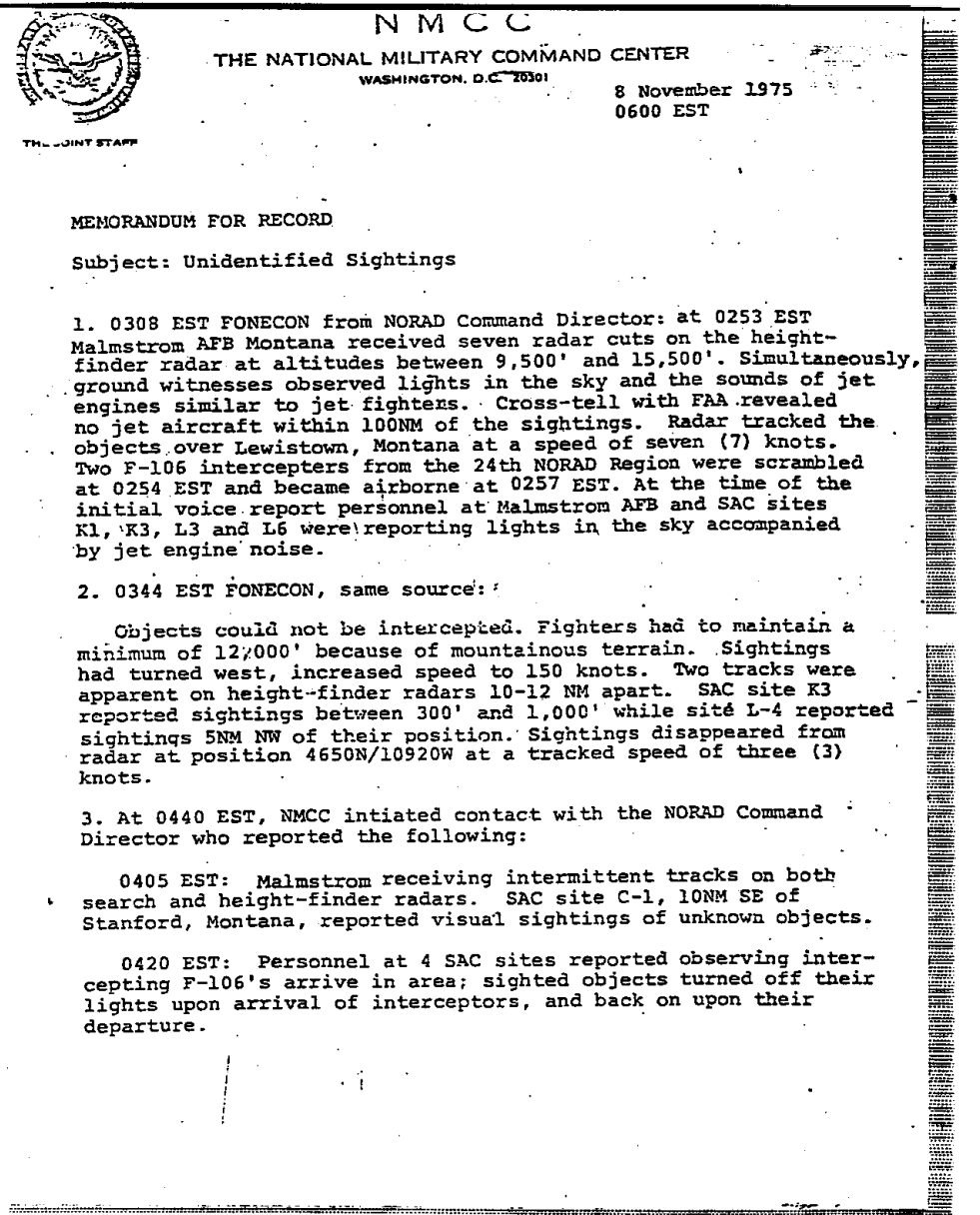
The capstone document is the NORAD Command Director's four-part message of 11 November 1975, sent to NORAD units to summarize the flap. It opens: "Since 28 Oct 75 numerous reports of suspicious objects have been received at the NORAD CU; reliable military personnel at Loring AFB, Maine, Wurtsmith AFB, Michigan, Malmstrom AFB, Mt, Minot AFB, ND, and Canadian Forces Station, Falconbridge, Ontario, Canada have visually sighted suspicious objects." The message recorded that radar at Malmstrom carried an object between 9,500 and 15,600 feet at about seven knots, that as interceptors approached "the lights went out" and came back on after the F-106s left, and that "efforts by Air Guard helicopters, SAC helicopters and F-106s failed to produce positive ID." A separate Commander-in-Chief Strategic Air Command (CINCSAC) message dated 10 November, framed under the subject "Defense Against Helicopter Assault," reported an unidentified helicopter hovering over a weapons storage area and stated that "all attempts to identify these aircraft have met with negative results." A National Military Command Center (NMCC) memorandum dated 8 November, surfaced as page 31 of an early Defense Department FOIA release, recorded that the objects "could not be intercepted" and that the fighters "had to maintain a minimum 12,000' because of mountainous terrain."
The intrusions were treated as a genuine security emergency, not a curiosity. Affected bases went to a high-priority alert posture (reported as Security Option 3), priority message traffic reached the NMCC in Washington, the Air Force Chief of Staff, and SAC Headquarters, and the Joint Chiefs of Staff were kept informed by daily updates while the events were in progress. A Loring operations report concluded that "the unknown helicopter has demonstrated a clear intent in the weapons storage area, is smart and a most capable aviator," language that gave the later book Clear Intent its title.
The Air Force never publicly identified the objects. As The New York Times noted in 1979, the service "did not reveal a cause for the sightings." The nearest thing to an explanation in the record is a command-center reference to possible temperature inversions in the area, raised against a backdrop in which "all attempts to identify these aircraft have met with negative results." When researchers Larry Fawcett and Barry Greenwood pressed for the underlying paperwork years later, the response they were given for one key base was that "all documentation at Malmstrom AFB has been destroyed." The bulk of what survives reached the public only because the Defense Department released it under FOIA, including the records grouped under FOIA Case 97-F-1677 processed by the Office of the Assistant Secretary of Defense in 1997.
What did the witnesses think it was?
The witnesses here were not lone observers in a field; they were vetted, on-duty Air Force personnel whose entire job was to know what was in their airspace, and many of them were certain they were watching something real and unidentified.
At Loring, base commander Colonel Richard Chapman of the 42nd Bomb Wing reportedly confronted the tower NCO during the events and pressed personnel to acknowledge what they were seeing, an unusual step that signals the commander himself took the intrusions seriously. Chief Warrant Officer Bernard Poulin, a Maine Army National Guard helicopter crewman who flew during the episode, later spoke to Fawcett and Greenwood about the difficulty of running down the object. The named security police, Blakeslee, Long, and Lewis, and B-52 crew chief Steven Eichner, gave detailed, consistent descriptions of a silent, structured craft that did not behave like any helicopter or aircraft they knew. At Wurtsmith, Captain Myron Taylor, a navigation instructor aboard the KC-135, reported that "each time we attempted to close on the object it would speed away from us," and that another officer aboard, Captain Higginbotham, was questioned afterward by the Office of Special Investigations and cautioned not to discuss the incident. That caution to stay quiet is itself part of the witness record, repeated by multiple personnel across multiple bases.
Crucially, the witnesses' belief that this was unexplained is corroborated by hardware, not just memory. Ground radar, airborne radar from the tanker, helicopter crews, missile-site security teams, and visual observers at four separate Malmstrom missile points all converged on the same phenomenon, including the signature behavior of lights extinguishing the moment F-106 interceptors arrived and reappearing once they left. That cross-confirmation across independent sensors and many trained observers is the heart of why the people involved believed, and many still believe, that something genuinely intruded on the most secure airspace in the country. The contemporary press carried it too: Bangor Daily News Presque Isle bureau chief Dean Rhodes chronicled the Loring intrusions as they happened, and the Lewiston Daily Sun reported two civilians encountering a curiously lit aircraft near Poland, Maine on the morning of 27 October, the same day the flap began.
The dispute
The dispute is not a confession or a recovered hoax; it is the gap between the official "negative results" posture and the absence of any positive identification. Two conventional explanations live inside the record itself. First, the helicopter framing: the CINCSAC message of 10 November 1975 was titled "Defense Against Helicopter Assault" and repeatedly called the intruders "unknown helicopters," and the late 1970s did see a documented wave of unexplained "phantom helicopter" reports, which gives a skeptic a real-world category to reach for. Second, a NORAD or command-center note raised the possibility of temperature inversions in the area, and inversions are a textbook cause of bent radar returns and refracted, dancing lights that observers can misread as a maneuvering craft. The bright "star-like" object reported at Minot on 10 November is the kind of sighting a planet or bright star plus an inversion can plausibly produce.
Who advanced these, and how strong are they. The helicopter and inversion lines come from the Air Force and NORAD command apparatus itself, not from independent investigators, which under UAP Globe's rules makes them an official posture rather than a method-shown debunk. Crucially, nobody, in 1975 or since, identified a specific helicopter unit, airframe, ship, balloon, or astronomical body and matched it to the sightings. The documents record attempts to identify the objects and then "negative results," and the nearest thing to a closing explanation researchers were ever offered for Malmstrom was that "all documentation at Malmstrom AFB has been destroyed." An assertion that something might have been a helicopter, with no helicopter ever produced, is not an identification.
Why it does not close the case. The conventional explanations each fail against specific, cross-confirmed details in the primary record. A helicopter of the period cannot be chased by a KC-135, pull away at an estimated 1,000 knots, hover nearly stationary on a height-finder, and then climb vertically off the scope; the Air Force's own helicopters and F-106 interceptors tried for positive ID and could not get one. A temperature inversion does not coordinate lights that go dark the moment fighters arrive and come back on when they leave, a behavior the NORAD Senior Director's Log records "from four different points." And neither explanation accounts for a structured, silent, football-shaped object seen at close range over the weapons-storage perimeter by named security police. Because the counter-explanation is an unproven official assertion rather than a demonstrated identification of the real object, this sits at Barely Disputed, and the case very largely stands.
Is the 1975 Overflights of the SAC Missile Bases real? The two-pass assessment
Pass one, the ordinary explanations. The official record itself floats two: helicopters and temperature inversions. The "unknown helicopter" framing is in the CINCSAC traffic, and a command center noted possible inversions in the area. A skeptic can build a real case here. The late 1970s saw a genuine wave of unexplained "phantom helicopter" sightings on both sides of the Atlantic, and a clandestine rotorcraft probing border bases from Canadian airspace is not physically impossible. Some reports describe navigation lights and strobes consistent with aircraft. Temperature inversions can bend radar and refract distant lights, and the bright "star-like" object at Minot on 10 November, and the climb of the Malmstrom object to extreme altitude, are exactly the kind of detail an astronomical body plus an over-read radar return can produce. Misidentification of stars and planets is the single most common source of sincere military UFO reports. None of this requires anything exotic.
But each ordinary explanation runs into the record. Helicopters of the era could not pace a KC-135 and then pull away at an estimated 1,000 knots, nor hold a near-stationary hover and then climb vertically off a height-finder scope; the Air Force's own helicopters and F-106s tried and failed to get a positive ID, which is hard to square with a conventional helicopter they should have been able to identify. A temperature inversion does not selectively switch its lights off the instant interceptors arrive and back on when they leave, a behavior independently reported "from four different points" in the NORAD log. And the inversion idea explains a refracted light, not a structured object seen at close range over a weapons-storage fence by security police standing under it. The official paperwork never actually adopted any of these explanations as a finding; it recorded "negative results" and left the objects unidentified.
Pass two, if it was real. What the documents describe is a coordinated, multi-base intrusion by objects that displayed controlled flight, apparent awareness of the interceptors sent against them, and a clear pattern of fixation on nuclear weapons. Whether that points to an advanced terrestrial adversary probing Cold War nuclear readiness, or to the non-human craft that researchers like Robert Hastings argue have repeatedly surveilled American and Soviet nuclear sites, the record does not resolve. What it does establish is that the United States military, in its own contemporaneous logs, could not identify what was over its bombs.
This case is dense with authenticated primary documentation and the objects were never identified, which on its face points to Verified Unexplained. It lands at Barely Disputed only because a partial official counter-explanation exists in the record, namely the helicopter framing and the temperature-inversion note, and that posture has to be acknowledged honestly. But that counter-explanation is exactly the weak, method-free kind the tier definition flags: an official assertion of "negative results" alongside a floated inversion, with no demonstrated identification of any specific aircraft, ship, balloon, or astronomical body that would account for the close-range structured sightings, the cross-sensor radar tracks, or the lights-out-on-intercept behavior. No independent, method-shown civilian analysis has identified the objects either. The case stands, and the dispute barely dents it.
Sources
- www.twz.com/35674/the-bizarre-mystery-of-unexplained-aerial-incursions-over-loring-air-force-base
- www.nicap.org/babylon/751030_wurtsmith.htm
- nicap.org/ncp/ncp-malmstrom751108.htm
- rr0.org/time/2/0/0/6/02/24/Hastings_UfosightingsAtIcbmSites/Malmstrom_1975/index.html
- www.bangordailynews.com/2009/10/02/opinion/the-loring-ufo-episode-revisited/
- www.theblackvault.com/documentarchive/unidentified-flying-objects-over-malmstrom-afb-november-1975/
- ufologie.patrickgross.org/htm/sac.htm
- www.bibliotecapleyades.net/ciencia/ufo_briefingdocument/1975.htm
More cases from this region: UFO sightings in United States